
Dynamic Markets Under the Procurement Act: Supplier Guide for 2026
Dynamic Markets are changing how suppliers find, join and win public sector opportunities. Learn how to prepare your central profile, target the right market parts and respond faster to call-offs in 2026.
mytender.io Research Team
Tender Writing & Bid Management Specialists
Dynamic Markets Under the Procurement Act: Supplier Guide for 2026
Dynamic Markets are not just a new label for old DPS lists.
This article is part of our Procurement Act series. For an overview of what changed and links to every guide in the series, see our Procurement Act 2023 supplier's guide.
They change when suppliers need to act, how public buyers can structure competitions and what bid teams need ready before the opportunity lands. For many SMEs, specialist contractors and growing public sector suppliers, they could become one of the most important routes to market under the Procurement Act 2023.
They also create a new trap. If you treat Dynamic Markets as something to think about once a call-off appears, you may already be late.
The strongest suppliers will use them differently. They will track markets early, join the right parts before live competitions, keep their central supplier information clean, prepare evidence packs in advance and build a faster way to respond when short call-off windows arrive.

Bid team mapping Dynamic Markets, Find a Tender notices and future call-off opportunities
This guide explains what Dynamic Markets mean for suppliers in 2026, how they differ from Dynamic Purchasing Systems, and how to turn them into a practical bidding advantage.
The short version: Dynamic Markets reward prepared suppliers, not reactive ones.
Why Dynamic Markets matter now
The Procurement Act 2023 came into force in February 2025. One of its biggest practical changes is the move towards simpler, more transparent and more flexible routes for public procurement.
Dynamic Markets sit right in the middle of that shift.
Under the old regime, many suppliers knew Dynamic Purchasing Systems, usually called DPS. These were open supplier lists for commonly used purchases. A supplier could apply to join during the life of the DPS, and buyers could then run further competitions among admitted suppliers.
Dynamic Markets keep the useful open-entry principle but broaden the model. They can cover goods, services and works. They can be split into parts. They can support more flexible call-off competitions. They are designed to work with the new notice regime, the Central Digital Platform and the wider move towards transparency.
That makes them especially relevant for suppliers in areas such as:
- facilities management
- construction and maintenance
- professional services
- technology and cyber security
- health and social care support
- waste and environmental services
- transport, logistics and fleet
- consultancy and specialist advisory work
For an SME, a Dynamic Market can be the difference between being locked out of a long framework for four years and being able to apply when capability, capacity or geography lines up.
For a larger supplier, it can become a pipeline management issue. If the organisation is not monitoring relevant markets, maintaining membership and preparing for call-offs, competitors may reach the buyer first.
Dynamic Markets vs DPS: what actually changes
The easiest mistake is to assume that a Dynamic Market is simply a DPS with a new badge. It is not.
The old DPS model was useful, but narrow. It was generally associated with standardised requirements and a relatively rigid two-stage process: qualify first, compete later. Many suppliers treated it as an admin hurdle.
Dynamic Markets are broader and more strategic.
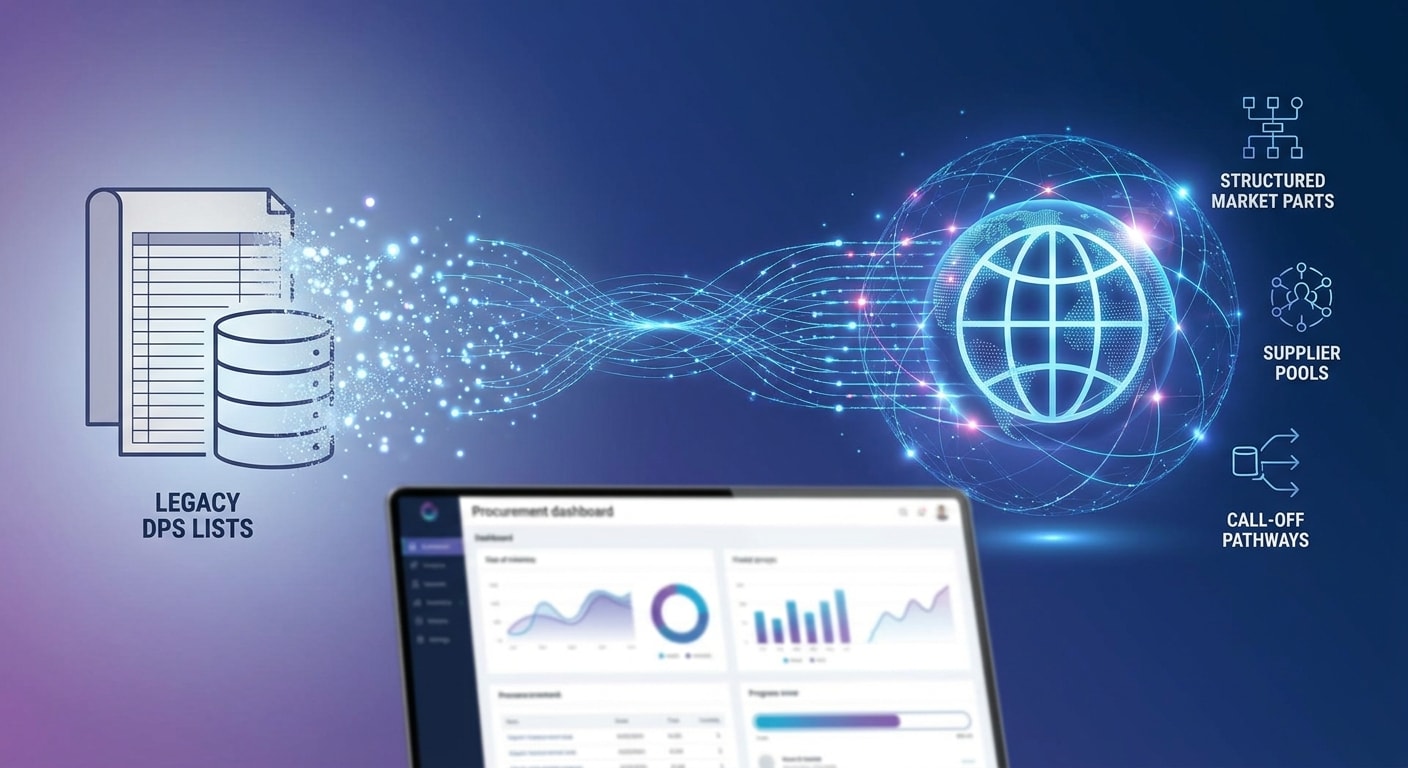
Comparison map showing legacy DPS lists moving into broader Dynamic Markets under the Procurement Act
There are five practical differences suppliers should understand.
First, the potential scope is wider. Dynamic Markets can be used for goods, services and works. That means the model is not limited to simple commodity-style purchasing. Buyers can use it for more complex categories where they want a live pool of qualified suppliers.
Second, the market can be divided into parts. A part might relate to geography, service type, value band, technical capability, sector, buyer group or contract size. This matters because suppliers do not need to chase everything. They can apply for the parts where they have the strongest evidence and the best chance of winning.
Third, call-offs may use more flexible procedures. A buyer can design a competition that includes written submissions, presentations, negotiation, demonstrations or staged evaluation, provided the rules are clear and fair. The written bid is still critical, but it may not be the only moment that decides the result.
Fourth, the Central Digital Platform changes the basic data burden. Core supplier information should increasingly be handled through a central profile. That does not remove the need for tailored answers, but it should reduce repeated form-filling and make the quality response more important.
Fifth, Dynamic Markets encourage earlier supplier positioning. Because markets stay open, there is less excuse to wait until a large framework window appears. If a relevant market exists, the supplier can apply, qualify and then watch for call-offs.
The opportunity is obvious. The operational challenge is also obvious. Someone has to track the markets, maintain the evidence, decide which parts are worth joining and keep bid capacity ready.
The supplier mindset shift
Most bid teams are built around deadlines. A tender arrives, the clock starts, the team scrambles, the answer is written, the review happens too late, and everyone promises to improve the process next time.
Dynamic Markets punish that rhythm.
The qualification step and the call-off step may happen at different times. A supplier might need to complete a membership application long before there is a specific contract to win. Then, once admitted, the supplier might receive several smaller competitions with short deadlines.
That means the work splits into three layers.
The first layer is market intelligence. Which Dynamic Markets exist in your sectors? Which notices are emerging? Which buyers are using them? Which parts match your capability? Which old DPS or framework routes are likely to be replaced?
The second layer is qualification readiness. Do you have the central information, policies, financial details, insurance, certificates, case studies and exclusion-ground declarations needed to apply quickly and cleanly?
The third layer is call-off execution. Can you produce a tailored, evidence-led response when a specific opportunity appears, without starting from scratch every time?
That is the real change. Dynamic Markets are not only a procurement route. They are a test of your bid operating model.
Step one: monitor Find a Tender before the obvious opportunity appears
Dynamic Markets will be visible through the public notice ecosystem. Suppliers should track Dynamic Market Notices, planned procurement notices, tender notices and award data through Find a Tender and any buyer portals relevant to their sector.
This is not just an admin task for the bid coordinator. It is commercial intelligence.
A Dynamic Market Notice can tell you which buyer or market operator is building a supplier pool, what the market covers, how it is divided, what conditions for membership apply and whether the opportunity is worth pursuing.
A planned procurement notice can show that a buyer is preparing a future requirement. An award notice can show which competitors are winning, what contract values look like and which categories are becoming active.
The best suppliers will turn this into a simple weekly routine:
- search for relevant CPV codes and buyer names
- track markets by sector, region and contract type
- log expiry dates for existing DPS or framework positions
- identify which markets are likely to produce recurring call-offs
- decide which parts should be joined now, later or not at all
The last point matters. Joining every possible market is not a strategy. It creates noise, admin and bid distraction. A good Dynamic Market plan is selective.
Ask three questions before applying:
- Do we have a credible chance of winning call-offs from this market?
- Do the parts match our geography, capacity and evidence base?
- Can we maintain the membership requirements without creating compliance risk?
If the answer is no, track it but do not rush in. Bid discipline still applies.
Step two: choose the right parts, not the biggest label
Dynamic Markets can be split into parts. For suppliers, those parts are where strategy lives.
A part might be a region, a service line, a project value band, a specialist capability, a type of buyer or a technical requirement. Applying for the wrong part can waste time and damage credibility. Applying for the right part can put you into competitions where your evidence feels built for the buyer.
An SME construction maintenance firm, for example, may be stronger in a regional lower-value works part than a national all-lots competition. A facilities management supplier may be stronger in hard FM for education estates than in a broad total FM category. A cyber security consultancy may be stronger in incident response and assurance than in managed service delivery.
That targeting should show up in the membership application.
Do not write as if you are trying to look bigger than you are. Write as if you know exactly where you are valuable.
A strong part-specific positioning statement should explain:
- the services you genuinely deliver
- the buyer environments where you have relevant experience
- the scale of contract you can support safely
- the accreditations or standards that support your capability
- the delivery geography you can cover without stretching
- the evidence you can provide for similar work
This is where many suppliers weaken their own bids. They see a broad opportunity and try to appear universal. Buyers do not need universal suppliers. They need reliable suppliers for defined needs.
Step three: build a Dynamic Market qualification pack
A membership application is not the same as a full tender response, but it still needs evidence.
The exact requirements will vary by market. But most suppliers should prepare a reusable qualification pack that can be tailored quickly.

Supplier evidence pack with compliance documents, policies, accreditations and case studies ready for Dynamic Market applications
The pack should include:
- company profile and registration details
- ownership and connected-person information where relevant
- insurance details and certificates
- audited accounts or financial information
- health and safety policy and performance data
- quality management evidence
- environmental policy and carbon reduction plan where required
- modern slavery statement where relevant
- information security and cyber credentials
- equality, diversity and inclusion policy
- social value commitments and delivery examples
- prompt payment and supply chain management evidence
- case studies matched to likely market parts
- references and contract performance metrics
- exclusion-ground self-declarations
- corrective action or self-cleaning evidence if needed
The goal is not to produce a giant folder no one reads. The goal is to make every common requirement easy to retrieve, verify and tailor.
This is exactly where a bid team benefits from a governed content library. If the latest insurance certificate sits in one person's inbox, the carbon plan sits in SharePoint under an old filename and the strongest case study is buried in last year's tender folder, the team will lose time before the real writing starts.
mytender.io helps teams avoid that by turning scattered bid material into usable, searchable knowledge. That matters for Dynamic Markets because speed only helps if the content is accurate.
Step four: treat membership as the start, not the win
Getting admitted to a Dynamic Market is useful. It is not the commercial result.
The real work starts after admission.
Once a supplier joins a market, it needs a live management process. Someone should know which parts the organisation has joined, what the conditions of membership are, whether documents need refreshing, what call-offs have appeared, what was bid, what was won, what feedback was received and what should change next time.
Without that discipline, the supplier ends up with a list of memberships and no revenue strategy.
A practical Dynamic Market tracker should record:
- market name and buyer or market operator
- relevant notice links
- parts joined and parts rejected
- membership conditions and renewal requirements
- key document expiry dates
- call-offs received
- bid or no-bid decisions
- submission deadlines
- outcome and feedback
- competitor intelligence from awards
- lessons for the next response
This is not bureaucracy for its own sake. It stops the same mistakes recurring.
If every call-off is treated as a surprise, the team never compounds learning. If every outcome is logged, the team starts to understand which buyers, parts, contract sizes and scoring models are worth pursuing.
Step five: prepare for faster call-off windows
Dynamic Market call-offs can move quickly. Once the buyer has an admitted pool of suppliers, the competition should be more focused than a full open procurement. That is good for efficient procurement, but it can be brutal for unprepared bid teams.
A supplier may have less time to assemble the team, clarify the requirement, tailor the case studies, price the solution, run reviews and submit.
That means the bid team needs pre-built components, not pre-written generic answers.
There is a difference.
A generic answer says the same thing to every buyer. It is usually bland, over-polished and low scoring.
A pre-built component is a verified piece of evidence, method, process, case study, mobilisation plan or compliance statement that can be adapted to a specific question.
The first saves time by removing thinking. The second saves time by removing searching.
Use the second.

Bid team responding to a Dynamic Market call-off with evidence, scoring criteria and pricing inputs aligned on one board
For Dynamic Market call-offs, prepare reusable components for:
- mobilisation approach
- contract governance
- risk management
- quality assurance
- social value delivery
- sustainability and carbon
- health and safety
- business continuity
- safeguarding where relevant
- data protection and information security
- supply chain management
- innovation and continuous improvement
- customer service and complaints handling
- performance reporting and KPIs
- exit and handover
Each component should have evidence attached. A mobilisation approach should link to a real mobilisation example. A social value promise should link to actual delivered outcomes. A KPI reporting method should link to dashboards, service reviews or contract performance examples.
That is how suppliers avoid the familiar trap of writing beautifully about processes that the evaluator cannot verify.
Step six: adapt to the Most Advantageous Tender mindset
The Procurement Act moves public procurement language towards the Most Advantageous Tender. That wording matters because it reflects a broader evaluation mindset.
Price still matters. Compliance still matters. But buyers have more room to evaluate quality, public value, resilience, innovation, delivery confidence and outcomes.
Dynamic Market call-offs will often reward suppliers who can explain why their offer is advantageous for that specific buyer, not just why they are competent generally.
That means bid teams should write from the buyer's objectives backwards.
If the buyer is a local authority, the advantage might be local delivery resilience, community benefit, transparent reporting and low mobilisation risk.
If the buyer is an NHS organisation, the advantage might be continuity, safety, patient experience, governance and rapid issue escalation.
If the buyer is a housing provider, the advantage might be resident communication, first-time fix, safeguarding awareness and evidence of working in occupied properties.
If the buyer is a construction framework operator, the advantage might be programme certainty, competence evidence, design coordination, supply chain resilience and carbon data.
The Dynamic Market route does not remove the need for win themes. It makes them sharper. The supplier pool is already qualified, so the question becomes: why are you the right admitted supplier for this call-off?
Step seven: expect more presentations, workshops and clarification pressure
Dynamic Markets can connect with the competitive flexible procedure. That means call-offs may involve supplier presentations, workshops, demonstrations, negotiation stages or structured clarification.
This is where many written bids get exposed.
A supplier may submit a strong answer on mobilisation, only for the buyer to ask the operations lead to explain the first 30 days in a workshop. If the written answer was created by the bid team without enough operational ownership, the gap becomes obvious.
The answer is to prepare live stages as part of the bid, not as an afterthought.
Before any presentation or workshop, the team should agree:
- the buyer's likely concerns
- the three or four messages that must land
- who owns each part of the story
- which claims need evidence on hand
- which assumptions are negotiable
- which commitments are red lines
- how questions will be handled
- what follow-up material may be needed
The most convincing supplier teams are consistent. The method statement, presentation, pricing explanation and operations commentary all sound like the same delivery model.
If the written bid says one thing and the live team says another, evaluators will trust the live team.
Step eight: do not ignore fees, terms and commercial rules
Some Dynamic Markets may include market terms, award fees or commercial mechanics that affect pricing. Suppliers should read these before joining, not after winning.
The commercial review should check:
- whether any supplier fees apply
- how call-off pricing will be evaluated
- whether price can be negotiated
- whether indexation is available
- what payment terms flow through the supply chain
- whether TUPE risk may arise
- whether insurance requirements are proportionate
- whether the market terms conflict with your standard delivery model
- whether participation creates reporting obligations
This is especially important for SMEs. A market may look attractive but produce low-margin call-offs if fees, reporting, mobilisation cost or geographic coverage are not priced properly.
Bid teams should bring finance and operations into the market decision early. Do not wait until a live competition to discover that the commercial model does not work.
Step nine: protect your performance record
Dynamic Markets are part of a more transparent procurement environment. Supplier performance, KPIs, payment behaviour and contract outcomes are becoming more visible.
That should change how suppliers bid.
Winning a call-off with unrealistic promises is not a win. It is a future problem with a notice attached.
If a contract includes published KPIs, the bid response should be honest about what can be delivered, how performance will be measured and how issues will be corrected. If the supplier overcommits to win a call-off and then misses targets, the damage may follow the business into future procurements.
A strong response should show:
- realistic service levels
- clear mobilisation assumptions
- named governance routines
- early warning processes
- credible recovery plans
- evidence of past performance
- a method for learning from complaints, failures and audit findings
This is not defensive writing. It is trust-building.
Buyers know contracts go wrong. They score suppliers who can spot issues early, tell the truth and recover quickly.
The role of AI in Dynamic Market bidding
AI can be extremely useful in Dynamic Market workflows, but only if it is grounded in verified supplier knowledge.
Useful AI tasks include:
- scanning long market documents for membership conditions
- extracting requirements into a compliance matrix
- summarising call-off instructions
- matching questions to previous evidence
- identifying missing attachments
- comparing draft answers against scoring criteria
- creating first drafts from approved source material
- helping reviewers spot vague claims
Risky AI tasks include:
- inventing experience the supplier does not have
- turning weak evidence into confident claims
- creating generic social value promises
- summarising legal or commercial terms without review
- reusing a method statement without checking the buyer context
The best use of AI is not to make a supplier sound bigger. It is to help the supplier prove what it can genuinely deliver, faster.
mytender.io is built around that principle. It helps bid teams break down tender packs, retrieve the right evidence, draft from real organisational knowledge and check responses against the requirement. For Dynamic Markets, that combination is especially valuable because the team needs both readiness and speed.
A practical Dynamic Market operating model
Suppliers do not need a huge transformation programme to get ready. They need a clear operating rhythm.

Operating loop for Dynamic Market success: monitor, join, bid, learn and improve
Start with a monthly market review. Look at new notices, active markets, upcoming call-offs, relevant awards and expiring legacy routes. Decide which markets need action.
Then maintain a qualification library. Keep core documents current. Assign owners for each policy, certificate, case study and declaration. Set reminders before expiry dates. Remove old versions so the bid team does not use the wrong evidence.
Next, create part-specific evidence packs. If you target three service categories, build three evidence packs. Each should include the best case studies, method components, accreditations, social value examples and technical proof for that part.
Then run a bid readiness review for admitted markets. For each market, ask: if a call-off came tomorrow, could we respond well? If not, what is missing?
Finally, review every outcome. Wins, losses and no-bids should all teach the team something. Dynamic Markets can produce repeated opportunities. That makes learning more valuable than in one-off tenders.
Common mistakes to avoid
The first mistake is joining too many markets. More memberships do not automatically mean more revenue. They can dilute focus and create administrative drag.
The second mistake is joining the wrong parts. If the part does not match your evidence, you will spend every call-off trying to stretch the truth.
The third mistake is treating admission as success. Admission creates access. Only disciplined call-off bidding creates revenue.
The fourth mistake is using stale documents. A central profile or qualification pack is only helpful if it is maintained. Expired insurance, old accounts or outdated policies can delay or damage applications.
The fifth mistake is writing generic call-off responses. The supplier pool is already qualified. Evaluators need to know why your solution is the best fit for this buyer, this requirement and this scoring model.
The sixth mistake is ignoring performance risk. Under a more transparent regime, poor delivery can damage future bidding. Do not promise what operations cannot deliver.
The seventh mistake is letting the bid team work alone. Dynamic Market success needs sales, operations, finance, legal, compliance and delivery leaders aligned before the deadline.
What to do this week
If Dynamic Markets are relevant to your business, do not wait for the perfect procurement notice. Start with five actions.
First, map your target sectors and CPV codes. Be specific. A broad search creates noise; a focused search creates opportunities.
Second, search Find a Tender for Dynamic Market Notices and planned procurements in those areas. Record the markets that look relevant and the parts that match your capability.
Third, audit your core supplier documents. Check whether your policies, certificates, accounts, case studies, insurance and declarations are current and easy to retrieve.
Fourth, choose one market or likely market type and build a part-specific evidence pack. Include only material that supports a realistic win.
Fifth, review your call-off response process. If a short-deadline competition arrived next week, where would time be lost? Fix that before the buyer asks.
The bottom line
Dynamic Markets create a more open route into public sector work, especially for suppliers who were previously locked out of long framework cycles.
But open does not mean easy.
The suppliers who benefit will be the ones who prepare before the call-off: tracking markets, choosing the right parts, maintaining their evidence, aligning commercial assumptions and building a fast, grounded bid process.
The suppliers who struggle will be the ones who wait for the deadline and then try to write their way out of poor readiness.
Dynamic Markets are a procurement reform. For bid teams, they are also a discipline test.
If you can prove your capability quickly, tailor your response sharply and learn from each competition, they can become a serious growth channel. If not, they will become another folder of opportunities you meant to pursue properly.
mytender.io helps bid teams stay on the right side of that line: less searching, faster drafting, stronger evidence and a clearer path from market notice to winning response.
Tags
Ready to Transform Your Tender Writing?
See how MyTender's AI can help you write winning tenders in a fraction of the time.