
Digital Waste Tracking in Tenders: How to Evidence Compliance in 2026
Digital waste tracking is moving from back-office admin to scored tender evidence. Here is how waste bidders should show compliance, data quality and operational control.
mytender.io Research Team
Tender Writing & Bid Management Specialists
Digital Waste Tracking in Tenders: How to Evidence Compliance in 2026
Waste tenders used to treat data as an appendix.
A spreadsheet here. A monthly report there. Maybe a recycling percentage copied from the last contract review pack.
That won't survive 2026.
Digital waste tracking is becoming part of the evidence buyers use to judge whether a supplier actually has control of the service. Not whether the bid team can write a nice answer about compliance. Whether the operation can prove what happened to waste, when it happened, who handled it, where it went, and what data backs it up.

Waste management bid team reviewing digital waste tracking dashboards
For waste management bidders, this is a useful shift if you handle it properly.
It gives good operators a way to prove discipline. It gives councils better evidence than vague recycling claims. It also makes weak answers much easier to spot.
This guide is for bid managers, commercial teams and operational leads writing waste tenders in 2026. It explains what digital waste tracking changes, where evaluators are likely to score it, and how to turn operational data into a tender answer that feels credible.
Why digital waste tracking now matters in bids
The UK waste market is being pulled in the same direction as wider public procurement: more transparency, better performance data and less tolerance for claims that cannot be evidenced.
That sits alongside three big pressures.
First, the Procurement Act 2023 has shifted the language of evaluation toward the Most Advantageous Tender. Price still matters, obviously. But buyers are being pushed to look harder at quality, risk, social value, resilience and contract performance.
Second, waste regulations are becoming more data-heavy. Simpler Recycling is changing how organisations separate waste streams. Digital waste tracking is intended to create a clearer record of waste movements. Extended Producer Responsibility is increasing pressure around packaging and material accountability.
Third, councils are under cost pressure. They need cleaner data because they need to defend decisions, manage contracts tightly and show progress on recycling, contamination and carbon.
Put bluntly: if your tender says you can improve recycling rates, reduce contamination or produce audit-ready reports, the evaluator now expects to see how.
What evaluators are really asking
When a tender asks about digital waste tracking, the surface question may look technical.
It might ask about systems, portals, transfer notes, data security, reporting frequency or integration with the client's contract management process.
The real question is simpler:
Can we trust this supplier to know what is happening across the contract?That breaks down into five scoring themes.
- Do you capture the right data at the right point?
- Can your people use the system consistently?
- Is the data checked before it becomes a client report?
- Can the buyer access useful information without chasing you?
- Will the data support compliance, improvement and enforcement if something goes wrong?
A strong answer covers all five. A weak answer lists software features and hopes for the best.
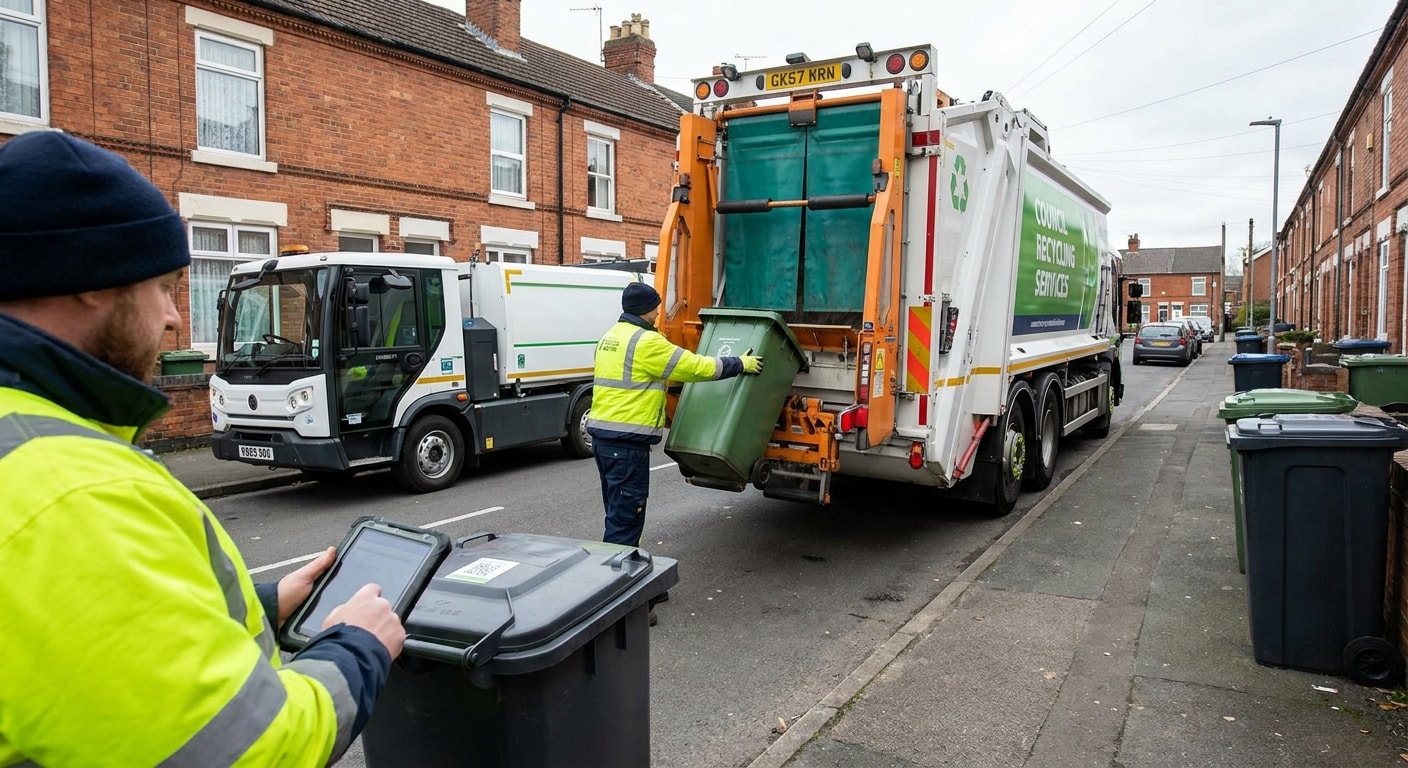
Council waste collection operation using digital compliance checks
Where digital waste tracking appears in a tender
Do not wait for a question titled "digital waste tracking".
The requirement can turn up in several places, and the best scores usually come from weaving the evidence through the bid.
Compliance and legislation
This is the obvious home.
Buyers want to know that you understand current and upcoming waste obligations. They also want reassurance that your process will not leave them exposed.
Your answer should show:
- which waste streams are tracked
- when records are created
- who validates the movement
- how exceptions are flagged
- how long records are retained
- how the client can access evidence
Do not just say "we comply with all relevant legislation". Everyone says that. It scores nothing by itself.
Write the process.
Method statement
The method statement is where digital tracking becomes operational.
For example, if you are describing collections from schools, offices, depots or housing estates, explain exactly where data is captured. Is it at bin lift? Site departure? Weighbridge? Transfer station? Treatment facility?
The evaluator should be able to follow the service from waste generation to final treatment.
If there are manual checks, say so. Manual does not automatically mean weak. Hidden manual steps are the problem.
Quality management
Digital tracking should feed your quality system.
A good tender answer shows how data becomes action. Missed collections, contamination, overweight bins, rejected loads and repeated access issues should all trigger a response.
This is where many bidders lose marks. They describe reporting, but not management.
A report that nobody acts on is just expensive decoration.
Sustainability and carbon
Waste data is sustainability evidence.
If the buyer asks about carbon reduction, recycling improvement, circular economy outcomes or diversion from landfill, digital tracking helps you prove the baseline and monitor movement.
Be careful though. Do not overclaim.
If you cannot calculate full carbon impact at contract start, say how you will establish a baseline and improve it. Evaluators prefer a realistic measurement plan to a heroic promise with no method behind it.
Contract mobilisation
Mobilisation is where tracking either works or collapses.
A good answer explains how you set up sites, users, waste streams, reporting templates, escalation routes and client access before live service starts.
This matters especially in council contracts, where estates can be messy and inherited data may be incomplete.
The evidence buyers expect to see
A digital tracking answer needs proof.
Not twenty attachments. Not a screenshot dump. Proof.
The most useful evidence usually falls into six groups.
1. A simple data chain
Show the journey.
Waste produced. Container emptied. Movement recorded. Waste transferred. Treatment confirmed. Report issued. Exception resolved.
That chain should be clear enough for a non-technical evaluator to understand.
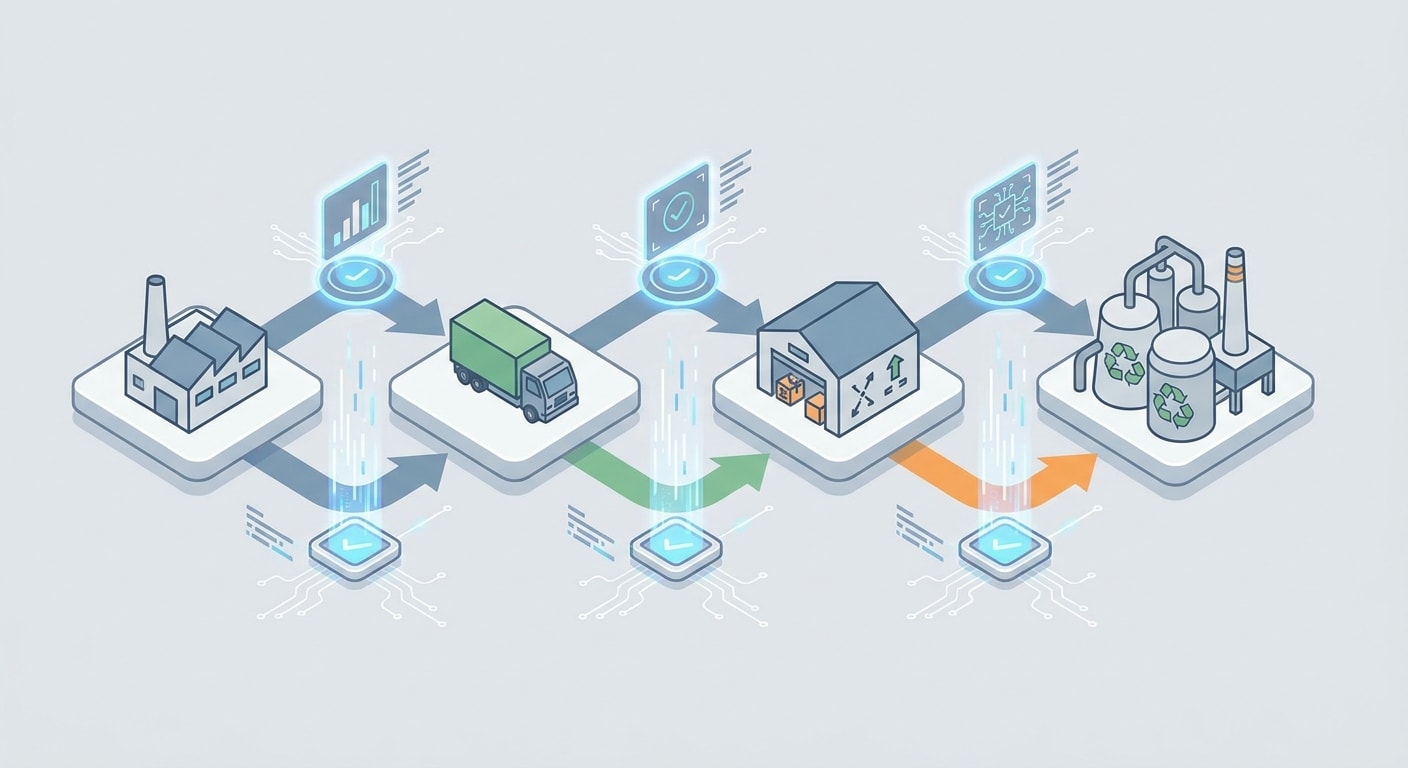
Digital waste journey from producer to carrier to treatment facility
If your system is genuinely strong, resist the urge to make it sound complicated. The best operational answers make control feel boringly reliable.
2. Roles and responsibilities
Who records data? Who checks it? Who corrects it? Who talks to the client?
Name the roles, not just the departments.
For example:
- drivers capture collection events using handheld devices
- depot supervisors review route exceptions daily
- contract managers sign off monthly performance packs
- compliance managers audit sample records
- client account leads review trends in monthly meetings
This gives the evaluator confidence that the process exists outside the bid document.
3. Data quality controls
Digital systems still produce bad data if nobody checks them.
Your tender should explain how you prevent and fix errors. Common controls include mandatory fields, timestamped entries, location validation, exception codes, supervisor review, audit sampling and locked monthly reporting after approval.
One useful line is: data quality is treated as a contract performance issue, not an IT issue.
That is the right mindset.
4. Reporting examples
Buyers want to know what they will actually receive.
Describe the report pack. Monthly dashboard. Waste stream breakdown. Contamination trends. Missed collection analysis. Recycling rate. Tonnage by site. Open actions. Carbon commentary. Improvement plan.
If the tender allows images, include a clean mock-up or anonymised dashboard. If it does not, describe the outputs clearly.
Do not write "bespoke reports are available" and stop. Bespoke can sound like "we will build it later when you complain".
5. Audit trail and retention
This is where digital waste tracking becomes risk reduction.
State how records are stored, how long they are kept, who can access them and how they can be exported for audit or investigation.
For public sector clients, this matters because waste data can be challenged internally, politically or by regulators.
Your bid should make that risk feel managed.
6. Continuous improvement
Data should lead somewhere.
Explain how tracking data will be used to improve routes, container sizing, collection frequency, education campaigns, contamination interventions and recycling performance.
The buyer is not only buying collection. They are buying better control.
The answer structure that works
When you are writing the digital tracking section, use a structure that mirrors the evaluator's concerns.
A practical structure is:
- Start with the risk the buyer cares about.
- Explain your operating model.
- Show the data captured.
- Explain validation and governance.
- Show reporting and client access.
- Link the data to improvement.
- Finish with evidence from a similar contract.
That structure keeps the answer grounded.
Here is a simplified example.
> We recognise that the Council needs reliable, audit-ready waste movement data across all service sites, not just a monthly tonnage summary. Our approach captures collection, transfer and treatment records at the point each event occurs, validates exceptions daily through depot supervision, and turns the data into a monthly performance pack reviewed with the Council contract manager. This gives the Council a clear audit trail and allows us to target contamination, missed collections and route inefficiencies before they become recurring service failures.
That is stronger than:
> We use a market-leading digital waste tracking platform that provides real-time dashboards and full compliance reporting.
The second sentence may be true. It just does not tell the evaluator enough.

Bid team preparing evidence folders and KPI reports for a waste tender
Common mistakes in digital waste tracking answers
Most weak answers fail for predictable reasons.
Mistake 1: selling the software, not the service
Software is not the answer. It is part of the answer.
The buyer cares about whether collections happen properly, records are accurate and problems are fixed. A branded platform name will not save a vague operating model.
If your answer reads like a software brochure, rewrite it from the contract manager's point of view.
Mistake 2: ignoring frontline adoption
Digital waste tracking depends on frontline behaviour.
Drivers, loaders, supervisors and site teams need to use the process every day. If the bid ignores training, device access, offline working, exception handling and supervisor checks, the evaluator may assume the system only works in a demo.
Include a short paragraph on training and adoption. It is not glamorous, but it wins trust.
Mistake 3: hiding messy starting data
Many waste contracts start with imperfect site lists, unclear container inventories and inconsistent historic data.
Do not pretend otherwise.
A better answer explains how you validate the starting position during mobilisation. Site survey. Container audit. Waste stream mapping. Data cleanse. Client sign-off.
That sounds like a supplier who has done this before.
Mistake 4: treating reporting as the final step
Reporting is not the end. Improvement is the end.
If a school has repeated food waste contamination, what happens? If a depot has repeated overweight containers, who acts? If one route keeps missing collections, how is it redesigned?
The tender answer needs to close that loop.
Mistake 5: making unsupported carbon claims
Carbon language is everywhere in waste tenders now.
Some bidders respond by making big claims about emissions reduction without explaining the calculation, baseline or boundary.
That is risky.
Keep carbon evidence specific. State what you can measure now, what you will baseline during mobilisation, and how you will report change over time.
How this links to Simpler Recycling
Digital waste tracking and Simpler Recycling are not the same thing, but they reinforce each other in tenders.
Simpler Recycling pushes organisations toward clearer separation of dry recyclables, food waste and residual waste. That creates a practical problem for buyers: they need to know whether separation is actually happening across sites.
Digital tracking helps evidence that.
For bidders, the tender opportunity is to show how you will move from compliance on paper to compliance in operation.
That might include:
- site-level waste stream mapping
- container labelling and placement checks
- contamination monitoring
- staff engagement materials
- exception reporting by site
- monthly trend reviews
- corrective actions for repeat issues
This is particularly important for local authority, education, healthcare, housing and multi-site corporate contracts.
How to score better on council waste tenders
Council evaluators are usually looking for evidence that can survive real contract pressure.
They know collections get missed. They know residents contaminate bins. They know estates have access problems. They know mobilisation data is rarely perfect.
So a good tender does not pretend the service will be flawless.
It shows control.
Show your escalation route
Explain what happens when something goes wrong.
For example: missed collection logged by driver or resident report, checked against route data, supervisor investigates same day, corrective collection scheduled, root cause recorded, trend reviewed weekly.
That is much more convincing than saying issues are resolved "promptly".
Use local evidence where possible
If the contract is for a specific borough, county or region, make the evidence local.
Nearby depots, similar street types, comparable housing stock, rural route experience, coastal seasonality, urban access constraints. These details matter.
Explain how the client sees the data
Client access is often underwritten.
Will the council have portal access? Named users? Monthly packs? Live dashboards? Exportable reports? Contract review packs? Member-level summaries?
Be specific.
Connect KPIs to action
Waste contracts love KPIs. The better bids explain what happens behind them.
A KPI dashboard should not be a scoreboard after the event. It should be an early warning system.
What to include in a mobilisation plan
Mobilisation is the safest place to prove you have thought about implementation.
For digital waste tracking, include these steps.
Week 1: data intake and validation
Take the buyer's site list, container inventory, waste stream assumptions, service frequencies and historic tonnage. Check it. Flag gaps. Agree the data-cleansing process.
Week 2: system configuration
Set up sites, routes, containers, waste streams, user permissions, exception codes, report templates and escalation workflows.
Week 3: operational training
Train drivers, loaders, supervisors, contract managers and client users. Include fallback processes for device failure or poor connectivity.
Week 4: parallel reporting
Run early reports alongside operational checks. Compare digital records with supervisor reviews and weighbridge or transfer station data.
Go-live: daily exception management
Do not wait until the first monthly review to find problems. Run daily exception checks during the first weeks of service.
This is the kind of detail evaluators trust because it sounds like delivery, not theory.

Local authority procurement panel reviewing waste tender digital tracking evidence
What good evidence looks like
Good digital tracking evidence is not necessarily polished. It is clear.
For example, you might include:
- an anonymised dashboard from a similar contract
- a sample monthly performance pack
- a route exception workflow
- a data quality checklist
- a training matrix
- an audit record sample
- a mobilisation data validation plan
- a case study showing contamination reduction
If you have strong data, use it carefully.
"We reduced contamination from 18% to 11% across 42 school sites in nine months" is useful. "We improve recycling outcomes through best practice" is wallpaper.
How AI can help without weakening the answer
AI can help with digital waste tracking tender answers, but only if it is fed real operational evidence.
The danger is obvious. Generic AI will happily write a confident answer about dashboards, real-time reporting and compliance assurance. It will sound plausible. It may also be completely detached from how your contract actually works.
That is where bid teams need discipline.
Use AI to structure the answer, find gaps and turn evidence into clear prose. Do not use it to invent the operating model.
A better workflow is:
- Upload the tender question and scoring guidance.
- Add your real process notes, dashboard exports and mobilisation plan.
- Ask for a first draft against the score criteria.
- Review every claim with operations.
- Add contract-specific examples and numbers.
- Run a compliance check against the tender documents.
That is exactly the kind of workflow mytender.io is built for: turning messy bid evidence into a focused tender response without losing the operational truth.
A practical checklist for your next waste tender
Before submitting a waste tender in 2026, check whether your digital tracking answer covers these points.
Compliance
- Have we named the relevant waste streams and record points?
- Have we explained how records are validated?
- Have we covered retention, audit access and exports?
- Have we avoided vague "full compliance" language?
Operations
- Have we shown how frontline teams capture data?
- Have we explained training and adoption?
- Have we covered device failure, poor signal and manual fallback?
- Have we shown daily or weekly exception management?
Reporting
- Have we described the buyer's reports clearly?
- Have we linked dashboards to KPIs and contract reviews?
- Have we shown how trends trigger action?
- Have we included examples or anonymised evidence where allowed?
Mobilisation
- Have we explained site and container validation?
- Have we shown system set-up steps?
- Have we included client user access and training?
- Have we planned extra checks during early go-live?
Improvement
- Have we linked tracking data to recycling, contamination, missed collections and route efficiency?
- Have we avoided unsupported carbon claims?
- Have we shown how the service improves over time?
If the answer is weak in any of these areas, fix it before submission.
The commercial case for getting this right
Digital waste tracking is not just a compliance section. It affects win probability.
A bidder with strong tracking evidence can make a better case on quality, risk, mobilisation, sustainability and value for money. That matters under a Most Advantageous Tender evaluation model.
It also helps protect margin.
Better data means fewer surprises, cleaner contract reviews and stronger conversations when service scope changes. If contamination is higher than expected, you have evidence. If access issues cause missed collections, you have timestamps. If the client asks for service changes, you have usage data.
That is commercially useful.
For SMEs, this can be a leveller. You may not have the largest fleet or the biggest brand. But if you can prove operational control, local delivery and clean reporting, you can look lower-risk than a larger incumbent relying on generic promises.
Final thought
Digital waste tracking will not win a tender on its own.
But a weak answer can definitely lose one.
The best waste bidders in 2026 will treat tracking data as bid evidence, not back-office admin. They will show the evaluator how the service is controlled, how compliance is proven, and how data turns into improvement.
That is the standard now.
If you want to find live waste and environmental services opportunities, the Tender Finder is free to use. And if your team is already bidding waste contracts, mytender.io can help turn your operational evidence, policies and past submissions into stronger first drafts.
Tags
Ready to Transform Your Tender Writing?
See how MyTender's AI can help you write winning tenders in a fraction of the time.