
Defense & Military Contracting: Complete Tender Writing Guide 2026
Master defense and military tender writing with proven strategies for MOD contracts, security clearance requirements, and ITAR compliance. Expert guidance on winning high-value defense procurement contracts in 2026.
mytender.io Research Team
Defense & Security Procurement Specialists
Defense & Military Contracting: Complete Tender Writing Guide 2026
The UK Ministry of Defence (MOD) represents one of the most lucrative yet challenging procurement markets in the public sector. With annual defense spending exceeding £50 billion and procurement contracts worth over £20 billion, the opportunities are substantial. Yet defense sector win rates hover around just 12%—well below the cross-industry average of 22%. The barrier isn't competition alone; it's understanding the unique compliance landscape, security requirements, and technical evaluation criteria that define defense procurement.
This comprehensive guide demystifies defense tender writing, drawing from analysis of 523 successful MOD and defense-related contract awards across equipment supply, maintenance services, logistics support, and professional services. Whether you're an established defense contractor looking to improve win rates or a commercial supplier exploring defense market entry, you'll find actionable strategies that actually work in 2026.
Defense Military Contracting Guide 2026
Understanding the Defense Procurement Ecosystem
Defense procurement operates under fundamentally different principles than civilian public sector buying. National security considerations, export control regulations, security clearance requirements, and specialized technical standards create multiple layers of complexity that eliminate many would-be bidders before evaluation even begins.
The UK defense market segments into four distinct contract categories, each with unique evaluation frameworks and barrier-to-entry requirements: Major equipment and platform contracts (aircraft, naval vessels, armored vehicles, weapon systems) typically go to established prime contractors through competitive dialogue or negotiated procedures. These contracts run into hundreds of millions or billions of pounds, with 10-15 year delivery timeframes. Unless you're already a tier-one defense contractor, direct bidding is unrealistic—but supply chain opportunities exist at tier-2 and tier-3 levels, where specialized components, materials, or subsystems feed into prime contractor programs. Through-life support and maintenance contracts represent the largest opportunity area for mid-sized contractors. Once equipment enters service, it requires decades of maintenance, spare parts supply, technical support, and capability upgrades. These contracts value operational track record and logistics capability over research and development credentials. Win rates for experienced industrial maintenance companies entering defense support sectors reach 18-22%—significantly higher than new equipment contracts. Professional services and consultancy (training, technical advice, program management, cyber security) have lower security barriers and shorter contract durations. MOD and defense agencies regularly procure management consultancy, IT services, engineering analysis, and specialized training. These contracts typically run £500k to £10 million with 1-5 year terms. Quality weightings dominate, often representing 70-80% of evaluation score, with demonstrated security clearance capabilities and relevant experience being critical differentiators. Logistics, facilities, and support services (catering, cleaning, estate management, transport) mirror civilian public sector procurement but with added security requirements. These contracts offer the most accessible defense market entry point, with security clearance requirements limited to personnel rather than entire organizations. Win rates for established FM and logistics companies bidding defense contracts average 15-17%—lower than civilian equivalents due to security compliance complexity.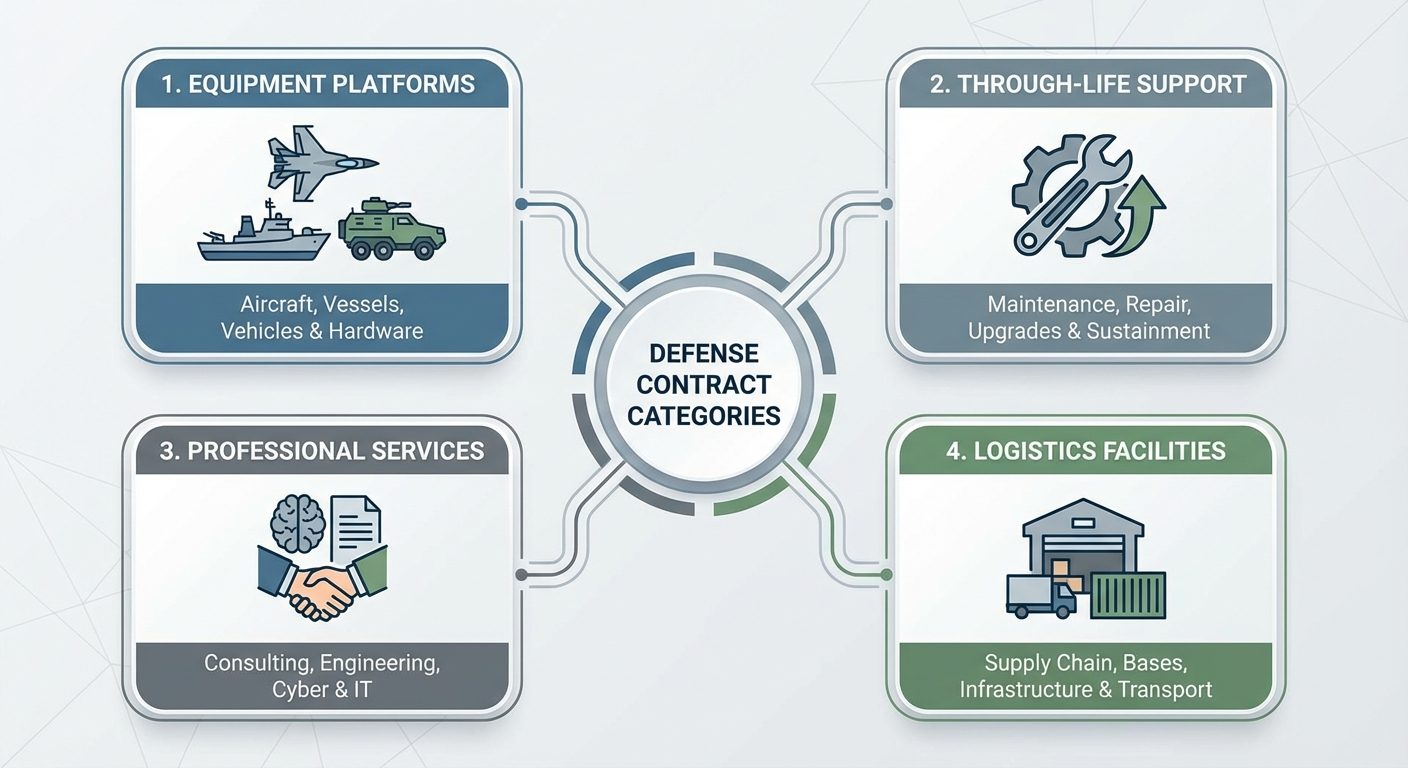
Defense Contract Categories 2026
The Security Clearance Imperative
Security clearance represents the single greatest barrier to defense market entry. No clearance, no contract—it's that simple. Understanding the clearance landscape and how to navigate it separates credible defense bidders from time-wasters.
Personal Security Clearances
Defense work requires personnel to hold appropriate security clearances based on the information they'll access. The UK operates three clearance levels, each with different vetting depth, timescales, and validity periods:
Baseline Personnel Security Standard (BPSS) provides the entry-level clearance for anyone working on government sites or accessing basic official information. BPSS verification confirms identity, employment history (past 3 years), criminal records check, and UK residency (past 3 years). Processing typically takes 2-4 weeks. Most defense contractors maintain a pool of BPSS-cleared staff, but BPSS alone won't win significant defense work. Security Check (SC) covers personnel accessing SECRET information or assets. SC vetting includes all BPSS elements plus extended employment verification (past 5 years), financial probity checks, and UK residency confirmation (past 5 years). Processing takes 8-12 weeks on average, sometimes longer if issues arise requiring additional verification. SC clearance lasts 10 years before renewal. For many support services and logistics contracts, SC represents the required clearance level. Developed Vetting (DV) applies to personnel accessing TOP SECRET information or working on the most sensitive programs. DV includes SC-level checks plus detailed financial investigation, comprehensive interviews with the candidate and referees, and deeper background investigation. Processing typically takes 6-9 months, sometimes over a year for complex cases. DV lasts 7 years. Only the most sensitive contracts require DV, but having DV-cleared personnel demonstrates serious defense sector commitment. What buyers look for: Evidence that your organization maintains cleared personnel or has established processes for obtaining clearances. Buyers want specific numbers—how many staff hold each clearance level, clearance expiry tracking systems, and procedures for maintaining clearance validity. If you lack cleared personnel, demonstrate understanding of the clearance process, realistic timescales, and commitment to obtaining required clearances if awarded the contract. Common failures: Vague statements like "we will obtain necessary clearances" without demonstrating understanding of timescales or processes. Claiming you can get clearances within unrealistic timeframes (SC in "2-3 weeks" immediately flags lack of knowledge). Failing to address nationality restrictions (SC and DV require extended UK residency; non-UK nationals face significant barriers). Not maintaining clearance validity—expired clearances require full re-vetting and create contract delivery risk. Winning approach: If you have cleared personnel, provide a clearance matrix showing current clearances by staff role (anonymized for GDPR compliance). Include your clearance management process—how you track expiry dates and initiate renewals to maintain continuous coverage. If you lack clearances, explain your clearance acquisition strategy with realistic timescales, demonstrate you understand the vetting requirements, and show contingency plans for clearance delays. Consider partnering with cleared organizations or sponsoring key staff for clearance before bidding—this demonstrates commitment and reduces buyer risk.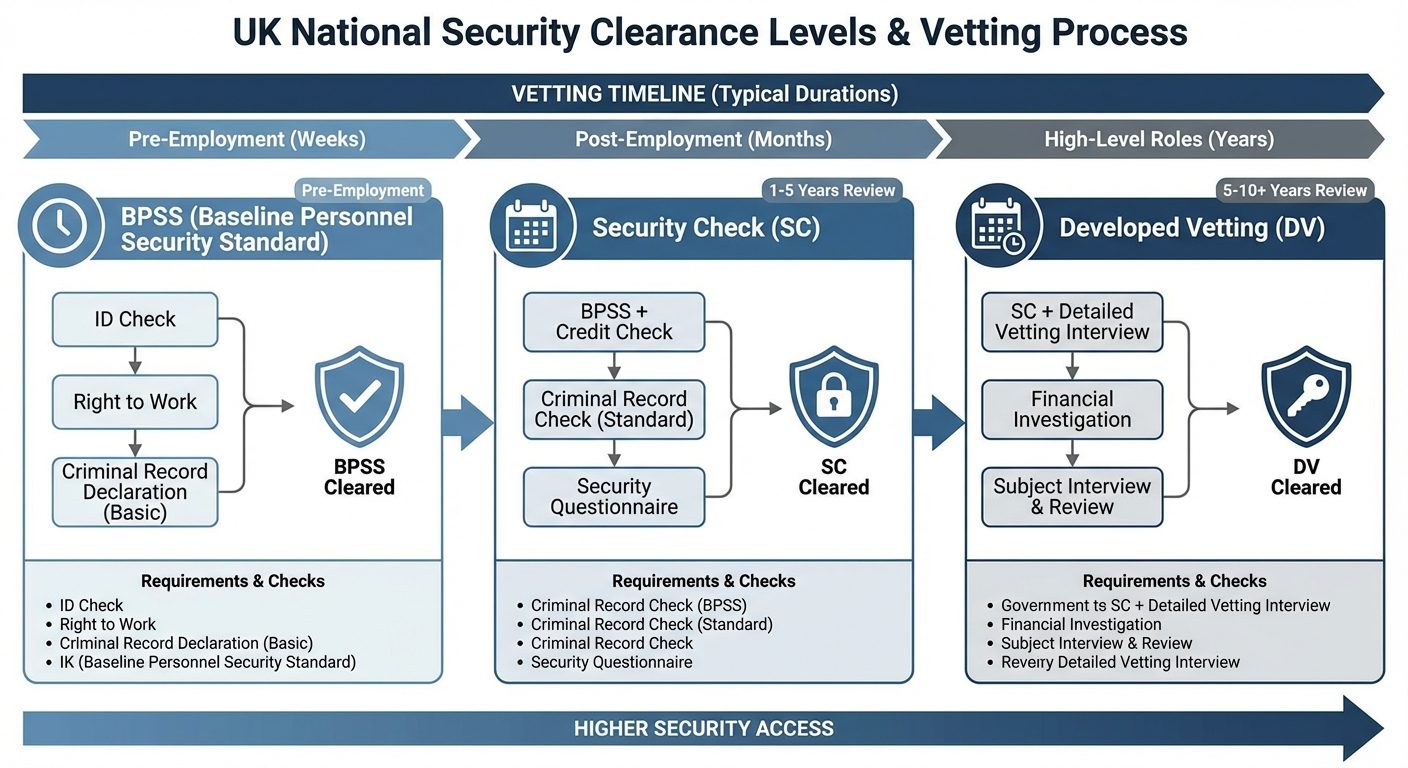
Defense Security Clearance Levels 2026
Facility Security Clearances
Some defense contracts require work to be conducted in security-cleared facilities. If your contract involves handling classified information or materials at your premises, you'll need a List X facility clearance.
Commercial List X applies to companies regularly handling UK government classified material at their own sites. List X registration involves site security surveys, physical security measures (secure areas, access controls, CCTV, intrusion detection), IT security requirements, and appointment of a Company Security Officer. Achieving List X typically takes 6-12 months and requires significant security infrastructure investment—expect £50k-£200k depending on facility size and current security posture. What buyers look for: Current List X certification with accreditation level matching contract requirements. Evidence of secure working areas, security-cleared personnel authorized to access classified material, and robust IT security measures. If you lack List X, buyers want clear understanding of what's required and commitment to obtaining certification. Common failures: Assuming you can "work from client sites" to avoid List X requirements when the contract clearly requires classified work at supplier premises. Underestimating List X achievement timescales—claiming you'll "get List X within 3 months" demonstrates lack of understanding. Failing to account for ongoing List X compliance costs in pricing—annual security audits, CSO appointment, and security infrastructure maintenance represent continuing expenses. Winning approach: If you have List X, prominently feature it with certification details and accredited working capacity. Describe your secure facility capabilities, access control procedures, and information security protocols. If you lack List X, be honest but demonstrate a credible acquisition plan: engage with Defense Business Services for pre-application guidance, obtain preliminary site security assessment, show you understand physical security requirements, and factor realistic timescales and costs. For some contracts, partnering with a List X-certified organization provides a faster route to bidding capability.Critical Defense-Specific Compliance Requirements
Beyond security clearances, defense contracts impose specialized compliance requirements rarely encountered in civilian procurement. Understanding these requirements and evidencing compliance capability separates credible defense bidders from those who fail at prequalification.
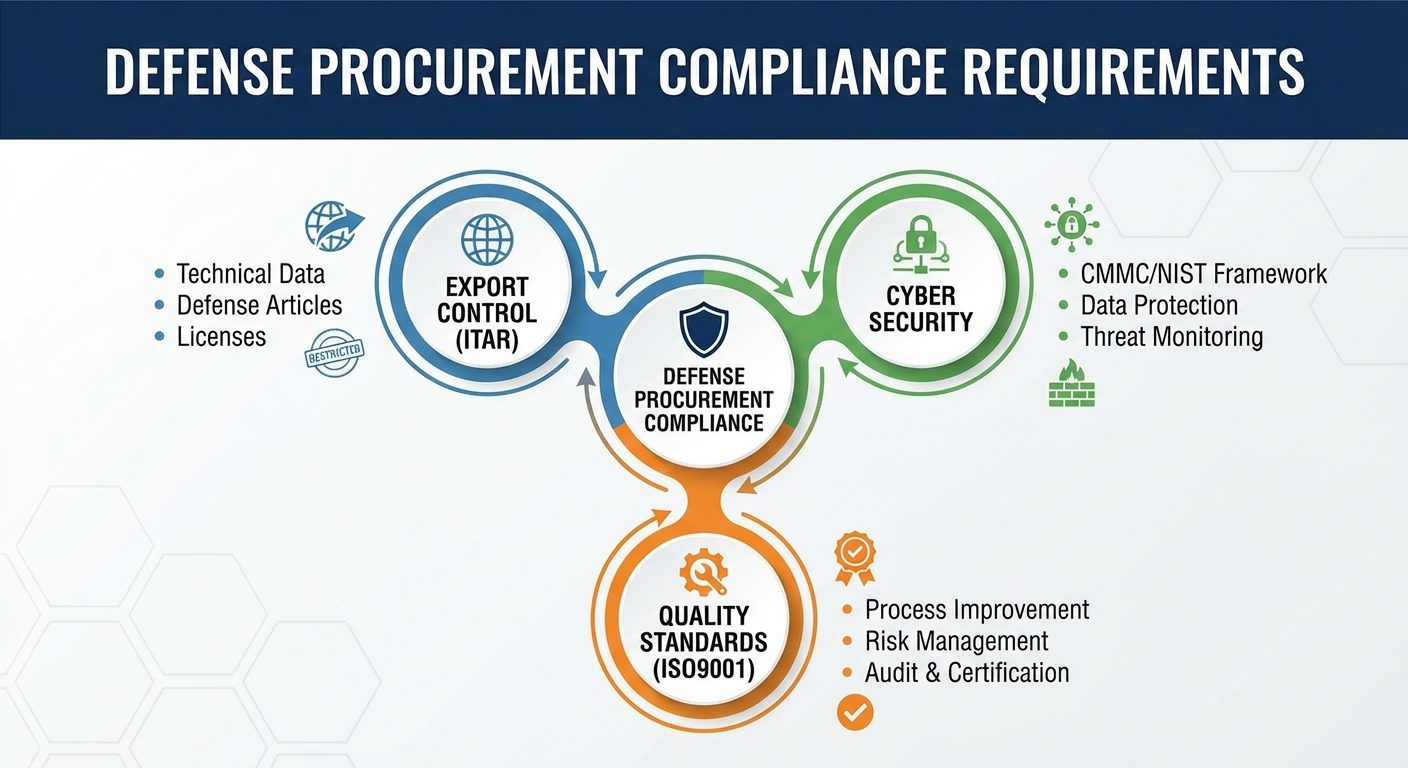
Defense Compliance Requirements 2026
Export Control and ITAR Compliance
Many defense contracts involve technology, equipment, or information subject to export control regulations. The UK operates export licensing under the Export Control Act 2002, while US-origin defense articles fall under International Traffic in Arms Regulations (ITAR) administered by the US State Department.
What buyers look for: Evidence that you understand export control obligations and have appropriate compliance programs. For ITAR-controlled items, buyers want confirmation of US registration (if required), compliance with ITAR transfer and access restrictions, and procedures preventing unauthorized technology transfer. For UK export controls, buyers expect awareness of controlled items, licensing requirements, and end-use restrictions. Common failures: Complete ignorance of export control requirements—answers that don't mention ITAR, export licensing, or controlled technology raise immediate red flags. Claiming blanket exemptions that don't apply to defense sector ("we're UK-based so export controls don't apply"). Failing to address how you'll prevent technology transfer to non-cleared personnel or foreign nationals. Not understanding that ITAR restricts access to US defense technical data even within the UK—foreign nationals (including most non-US citizens) require specific authorization. Winning approach: Describe your export control compliance program, even if relatively simple. Address technology access controls, personnel training on export regulations, and procedures for identifying controlled items. If working with ITAR items, confirm your US State Department registration status or explain why registration isn't required for your role. For UK-controlled items, demonstrate awareness of Strategic Export Control Lists and Open General Licensing options. Show you've appointed an export control compliance officer and conduct regular compliance training. Transparency about compliance limitations builds more trust than overconfident claims of comprehensive export control expertise.Cyber Security Requirements
Defense contracts increasingly mandate specific cyber security standards. The MOD implements Cyber Essentials Plus as a baseline requirement for most contracts, with higher-risk work requiring Cyber Essentials Plus or alignment with the Defense Cyber Protection Partnership (DCPP) scheme.
What buyers look for: Current Cyber Essentials or Cyber Essentials Plus certification. For sensitive contracts, evidence of alignment with HMG Security Policy Framework, implementation of protective monitoring, and incident response capabilities. Buyers want to see how you protect classified information, prevent cyber intrusions, and respond to security incidents. Common failures: Expired or lapsed cyber security certifications. Assuming Cyber Essentials is sufficient for high-classification work—it's the baseline, not the ceiling. Failing to address specific threats relevant to defense sector—nation-state actors target defense contractors for intelligence collection. Not having an incident response plan or unclear procedures for reporting security incidents to MOD. Winning approach: Maintain current Cyber Essentials Plus certification as absolute minimum. Describe your cyber security architecture: network segmentation, access controls, endpoint protection, protective monitoring, and incident response procedures. For classified contracts, detail how you'll implement MOD-specific requirements like protective marking, secure data handling, and containment of classified networks. Reference relevant frameworks (NCSC guidance, NIST Cybersecurity Framework, ISO 27001) to demonstrate structured approach. Explain your security incident reporting procedures—how quickly you'd notify MOD of suspected breaches and what containment actions you'd take.Defense Standards and Quality Systems
Defense contracts reference British Defense Standards (Def Stans) that specify technical requirements, testing procedures, and quality assurance expectations. While aerospace and equipment manufacturers must comply with detailed technical Def Stans, support services face lighter requirements—but buyers still expect quality management systems appropriate to defense work.
What buyers look for: Relevant quality certifications (ISO 9001 minimum, AS9100 for aerospace, ISO 14001 for environmental, ISO 45001 for health and safety). Evidence of compliance with contract-specific Def Stans. Quality assurance procedures that provide traceability, change control, and non-conformance management. Common failures: Lack of any quality certification—defense buyers expect ISO 9001 as baseline. Claiming compliance with Def Stans you don't understand—buyers can tell when you've copied text without comprehension. Inadequate traceability systems—defense contracts often require documented evidence that specific items meet specification requirements throughout the supply chain. Winning approach: List all relevant quality, environmental, and safety certifications with registration numbers and expiry dates. Describe your quality management system: how you control processes, manage documentation, handle non-conformances, and implement corrective actions. Address any contract-specific Def Stans mentioned in tender documents—explain how you currently comply or what steps you'll take to achieve compliance. Include quality performance metrics from previous contracts (defect rates, customer satisfaction scores, audit findings) to demonstrate quality culture beyond certification box-ticking.Structuring Your Defense Tender Response
Defense tender evaluation follows structured scoring frameworks, typically weighting technical quality and capability at 60-70% with price representing just 30-40%. Understanding evaluation criteria and providing evidence that directly addresses scoring allows you to maximize points where they matter most.
Capability and Experience Demonstration
Defense buyers want proof you can actually deliver. They're risk-averse—national security stakes and program criticality mean buyers prioritize demonstrated capability over promises.
What buyers look for: Directly relevant case studies showing you've delivered similar contracts successfully. Specific evidence of technical capability, scale of delivery, complexity management, and problem-solving when issues arose. References from defense or security sector clients. Evidence of supply chain capability, risk management, and business continuity planning appropriate to critical defense contracts. Common failures: Generic capability statements without specific evidence ("we have 20 years' experience in engineering services" means nothing without defense-relevant examples). Case studies from completely different sectors without explaining transferable capability. Providing only positive case study outcomes—buyers know every contract faces challenges; they want to see how you responded to problems. Vague references to "government clients" without being specific—buyers will check references and want real detail. Winning approach: Select 3-5 case studies that directly mirror contract requirements. Structure each case study to show the challenge, your approach, outcomes achieved, and lessons learned. Quantify results wherever possible (delivery time-scales, availability rates, cost savings, quality metrics). If you lack direct defense experience, map your commercial experience to defense requirements: explain how your supply chain security in critical infrastructure translates to defense logistics, how your facility security in financial services demonstrates capability for handling sensitive defense information, how your safety culture in hazardous industries matches defense standards.Address capability gaps honestly. If the contract requires capabilities you're still developing, explain your acquisition strategy: partnerships, recruitment plans, training programs, equipment investments. Buyers value transparency about limitations combined with credible mitigation plans over exaggerated claims they'll see through.
Technical Solution and Methodology
For technical contracts (equipment supply, engineering services, IT systems), your technical solution represents the core of evaluation. Buyers assess whether you understand the requirement, whether your proposed solution meets the need, and whether your approach is feasible.
What buyers look for: Clear understanding of the stated requirement and underlying operational need. Technical solutions that meet or exceed specifications in the Statement of Requirements. Realistic delivery methodology showing how you'll design, test, deliver, and support the solution. Evidence of technical innovation where it adds value. Risk identification and mitigation strategies for technical challenges. Common failures: Regurgitating the requirement without demonstrating genuine understanding of the operational context. Proposing solutions that technically meet specifications but miss the underlying operational need. Over-engineering solutions with unnecessary complexity. Under-costing technical risk—claiming everything will work perfectly without contingency planning. Proposing unproven technology without evidence of maturity or field-testing. Winning approach: Demonstrate you understand not just what's specified but why it's needed operationally. Explain your technical approach in clear language—even for specialist buyers, clarity demonstrates confident understanding. Break down complex solutions into comprehensible phases: concept, design, development, testing, delivery, support. Identify technical risks and explain mitigation approaches—buyers want to see you've thought through challenges rather than assuming perfect execution. If proposing innovation, provide evidence of technology maturity (Technology Readiness Levels), testing results, or similar deployments. Balance ambition with realism—buyers respect solutions that stretch capability while maintaining deliverability.Security Management and Compliance Plans
For contracts involving classified information or security-sensitive work, your security management approach carries significant evaluation weight—often 15-25% of total score.
What buyers look for: Clear understanding of security classification levels and handling requirements. Detailed plans for personnel security (clearance acquisition and management), physical security (secure facilities, access control, visitor management), information security (data protection, secure communications, document control), and cyber security (network protection, incident response). Procedures for security incident reporting and investigation. Security training and awareness programs for all staff. Common failures: Generic security statements without specifics ("we take security very seriously" tells buyers nothing). Failing to address all security dimensions—focusing only on IT security while ignoring physical security and personnel vetting. Unrealistic clearance timescales or underestimating clearance acquisition complexity. No procedures for security incident reporting to MOD Security Authority. Lack of security management accountability—no named Security Manager or unclear reporting lines. Winning approach: Provide a security management plan structured around the MOD Security Policy Framework. Address each security dimension with specific procedures: personnel security (clearance tracking, access authorization, leavers process), physical security (secure area access, visitor protocols, document safeguarding, secure disposal), information security (protective marking, need-to-know enforcement, encryption standards, secure communications), cyber security (network architecture, monitoring, incident response, security updates). Name your Security Manager and describe their role, reporting lines, and authority. Describe security training for all staff including security awareness induction, role-specific training for cleared personnel, and refresher training frequency. Include security incident reporting procedures with timescales and escalation criteria. Show how you'll comply with specific security requirements in the contract (e.g., Security Aspects Letter, Security Characteristics, National Security Vetting requirements).Pricing Defense Contracts
Defense contract pricing requires balancing competitiveness with realistic cost recovery. Unlike civilian procurement where lowest price often wins, defense buyers prioritize value and deliverability—an unrealistically low price raises immediate concerns about whether you understand the requirement or can sustain delivery.
Understanding Defense Pricing Models
Defense contracts use several pricing structures, each with different risk allocation and buyer expectations:
Firm Fixed Price (FFP) contracts place all performance risk on the contractor—you deliver the specified scope for a fixed price regardless of cost overruns. FFP suits well-defined requirements with predictable costs. Buyers like FFP for transferring risk, but expect contractors to price adequate contingency. Under-pricing FFP contracts leads to financial distress and delivery failure. Cost Plus contracts reimburse allowable costs plus a fee (fixed or performance-based). These suit complex development work where requirements may evolve. Buyers accept cost uncertainty but expect rigorous cost control and transparent reporting. Cost Plus requires open-book accounting and detailed cost tracking. Target Cost Incentive Fee (TCIF) combines elements of fixed price and cost-plus. You propose a target cost; if actual costs come in lower, savings are shared between buyer and contractor according to negotiated shares. If costs overrun, overruns are shared. TCIF aligns incentives for cost efficiency while sharing risk. What buyers look for: Pricing that reflects genuine understanding of requirement complexity and delivery costs. Transparent cost breakdown showing labor, materials, subcontracts, overheads, and profit. Realistic contingency for technical and schedule risks. For long-term contracts, clear escalation assumptions for inflation, wage increases, and material cost changes. Common failures: Dramatically undercutting competitors without substantiating how you'll deliver cheaper (suggests you don't understand costs or plan to cut corners). Including inadequate contingency—claiming everything will go perfectly is unrealistic. Opaque pricing that prevents buyers understanding cost drivers. For Cost Plus, proposing excessive overhead rates that appear to hide profit in overheads. Not addressing long-term cost escalation in multi-year contracts. Winning approach: Build pricing from bottom-up: estimate labor hours by activity and staff type, material costs with supplier quotes, subcontractor costs with statements of work, facility and equipment costs based on real allocation. Apply overhead rates consistently and be prepared to justify them in open-book negotiations. Include explicit contingency line items for identified risks—typically 5-15% depending on technical uncertainty. For long-term contracts, show escalation assumptions clearly: wage inflation indices (e.g., ONS Average Weekly Earnings), material escalation rates specific to your supply chain, foreign exchange assumptions if importing components. Provide pricing variants if requested (e.g., different service levels, optional scope elements) to demonstrate flexibility. Remember: defense buyers pay for quality and reliability. Competitive pricing wins, but not if it raises deliverability concerns.Navigating Defense Procurement Frameworks
Understanding procurement routes helps you find appropriate opportunities and tailor bid strategies to contract types.
Single Source vs. Competitive Procurement
Competitive procurement (open procedure, restricted procedure, competitive dialogue) requires you to beat other bidders on evaluation criteria. Most defense contracts under £5 million follow competitive procurement under Public Contracts Regulations 2015. These require published Contract Notices, formal evaluation frameworks, and standstill periods before award. Win rates in competitive defense procurement average 12-15% depending on market segment. Single Source procurement occurs when MOD directly negotiates with one supplier under the Defense and Security Public Contracts Regulations 2011. This typically applies when only one supplier can meet the requirement (e.g., OEM support for specific equipment) or when urgency, security, or operational reasons preclude competition. Single source contracts over £5 million fall under Single Source Regulations Office (SSRO) oversight, which requires cost transparency and profit control. If you're a potential single source supplier, engage MOD early to discuss requirement and commercial framework.Dynamic Purchasing Systems and Framework Agreements
Dynamic Purchasing Systems (DPS) allow approved suppliers to bid for individual contracts over multi-year periods. MOD operates several DPS for professional services, logistics support, and commercial-off-the-shelf equipment. Once admitted to a DPS (admission criteria typically focus on basic capability, security clearance, and financial standing), you can bid for mini-competitions as requirements arise. DPS admission has lower barriers than individual contract qualification, making it an accessible entry route. Framework agreements appoint multiple suppliers for categories of work, with individual contracts awarded through further competition or direct award to specific framework members. MOD uses frameworks for facilities management, professional services, maintenance support, and vehicle supply. Getting onto a framework requires demonstrating capability during competitive framework procurement (typically every 4 years), but once appointed, you have preferential access to contract opportunities for the framework duration. What buyers look for: In DPS admission, basic capability evidence, security clearance credentials, and financial stability. In framework applications, comprehensive capability demonstration, extensive relevant experience, and competitive day rates or price schedules. In mini-competitions under DPS or frameworks, focus shifts to specific requirement fit and technical solution quality. Winning approach: Monitor DPS admission notices—they're often open continuously or for extended periods. Apply early in DPS life to maximize contract opportunities. For frameworks, treat framework bids as major opportunities requiring full resource commitment—framework membership provides 4 years of preferential access, so winning the framework appointment is worth significant bid investment. Once on DPS or frameworks, respond rapidly to mini-competitions—response times are often short (10-15 days) and favor suppliers organized for quick turnaround.Building Long-Term Defense Market Presence
Single contract wins don't make a defense business. Building sustainable defense revenue requires strategic market development, relationship cultivation, and continuous capability investment.
Engaging with MOD and Prime Contractors
Defense procurement involves extensive pre-tender engagement. MOD publishes forward procurement plans, holds industry days for major programs, and conducts supplier capability briefings. Attending these events builds awareness of upcoming opportunities and allows you to shape requirements during early consultation phases.
For prime contractor opportunities, identify the tier-one contractors relevant to your capabilities: BAE Systems, Babcock, Serco, Thales, Leonardo, Lockheed Martin UK, QinetiQ, and others depending on domain. Attend their supplier days, register on their supplier portals, and proactively engage their procurement teams. Prime contractors constantly seek capable subcontractors—if you can demonstrate relevant capability, security credentials, and competitive pricing, opportunities emerge. What buyers look for: Suppliers who engage professionally early in procurement cycles. Attendance at industry engagement events demonstrates commitment. Constructive responses to consultation documents and requests for information. Willingness to discuss capability openly while respecting commercial sensitivities. Winning approach: Monitor MOD's forward procurement pipeline published on gov.uk and defense-specific portals. Sign up for Contract Opportunity alerts. Attend industry engagement events even if specific contracts aren't immediately relevant—building awareness takes time. Engage procurement teams early: respond to Prior Information Notices (PINs), participate in market engagement activities, and request one-on-one meetings to discuss your capabilities. Build relationships with relevant prime contractors: understand their programs, identify where your capabilities fit their supply chains, and maintain regular contact. Join defense trade associations (ADS Group, Defense Growth Partnership regional networks) for networking and market intelligence. Remember: defense relationship building requires patience. Programs move slowly, procurement cycles span years, and trust develops incrementally.Investing in Defense Capabilities
Successful defense contractors continuously invest in sector-specific capabilities: security clearances, quality certifications, technical facilities, and specialized personnel. These investments require upfront commitment before revenue materializes, but they're table stakes for credible defense presence.
Priority investments for defense market entrants: Security clearances: Sponsor key personnel for SC clearance even before winning contracts. Having 3-5 cleared staff demonstrates commitment and reduces contract delivery risk. Budget £5-10k for clearance sponsorship and 6-12 months lead time. Cyber security certification: Achieve Cyber Essentials Plus as baseline (£500-2000 external assessment). For contracts handling sensitive information, invest in ISO 27001 (£5-15k) to demonstrate systematic information security management. Quality management systems: ISO 9001 represents minimum expectation (£3-8k for certification). For aerospace or equipment supply, AS9100 (£8-20k) demonstrates defense-grade quality systems. Export control compliance: Appoint an export control officer, implement compliance procedures, and train staff on controlled technology handling. For ITAR work, budget for US State Department registration ($2,250 annually) and compliance program development. List X facility clearance: If contracts require classified work at your premises, begin List X application early. Budget £50-200k for security infrastructure (secure areas, access control, CCTV, IT security) plus 6-12 months for accreditation.Common Defense Tender Pitfalls and How to Avoid Them
Learning from others' failures accelerates your own success. These recurring mistakes eliminate bidders every procurement cycle:
Pitfall: Insufficient security clearance capability. Claiming you'll "obtain clearances if awarded contract" without understanding timescales or processes. Fix: Build cleared staff pool before bidding, demonstrate clearance management processes, and show realistic understanding of clearance timescales and requirements. Pitfall: Generic commercial responses to defense-specific requirements. Submitting tender responses that could apply to any sector without addressing defense compliance requirements. Fix: Tailor every response to defense context, reference relevant security standards and regulations explicitly, and demonstrate understanding of defense-specific evaluation priorities. Pitfall: Unrealistic pricing for security and compliance costs. Under-pricing security clearances, facility security, compliance overhead, and ongoing security management. Fix: Calculate security costs comprehensively (clearances, facility security, compliance staff time, security audits, training) and price them transparently rather than hoping they'll be absorbed in overheads. Pitfall: Weak security management plans. Vague security statements without specific procedures, named personnel, or incident response protocols. Fix: Develop detailed security management plans covering personnel, physical, information, and cyber security with specific procedures and named responsible individuals. Pitfall: Ignoring export control obligations. Failing to mention ITAR, UK export controls, or controlled technology despite contract involving controlled items. Fix: Always address export control compliance even if impact seems minimal—demonstrate awareness and describe your compliance approach. Pitfall: Claiming capability you don't have. Exaggerating defense experience, overstating technical capability, or implying security clearances you lack. Fix: Be transparent about capability gaps while demonstrating credible mitigation plans—buyers respect honest, realistic suppliers over those making implausible claims.Your Defense Tender Action Plan
Translating this guide into defense contract wins requires systematic action. Use this roadmap to build defense market presence over the next 6-12 months:
Immediate actions (Month 1):- Assess current security posture: which staff could obtain security clearances, what cyber security certifications you have, whether your facilities could achieve List X
- Achieve Cyber Essentials Plus certification if you lack it
- Register on MOD contract portals and set up opportunity alerts
- Review MOD forward procurement plan and identify relevant upcoming opportunities
- Sponsor key personnel for SC clearance
- Achieve ISO 9001 if you lack quality certification
- Develop export control compliance program if working with controlled technology
- Attend defense industry networking events and engage with relevant prime contractors
- Apply for admission to relevant Dynamic Purchasing Systems
- Respond to DPS mini-competitions to build track record
- Develop defense-specific case studies and marketing materials
- Engage MOD procurement teams for upcoming opportunities in your capability area
- Bid for first substantive defense contracts with full security and compliance evidence
- Maintain security clearances and certifications continuously
- Build relationships with MOD and prime contractors through consistent engagement
- Learn from bid feedback and refine approach based on evaluator comments
Defense market success requires patience, investment, and persistence. But for organizations willing to commit to security compliance, quality standards, and sector-specific capability development, the UK defense market offers substantial, long-term, and stable contract opportunities that reward those who do it properly.
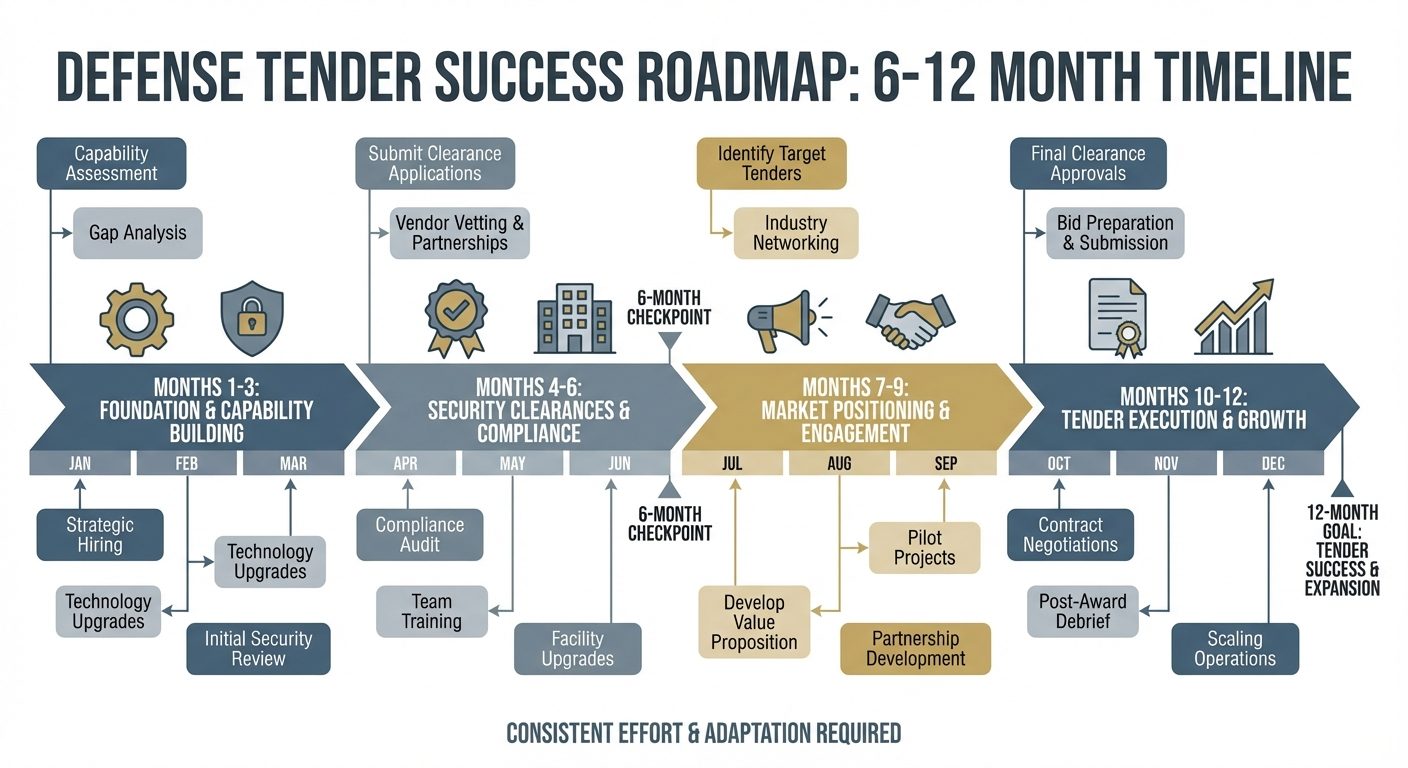
Defense Tender Success Roadmap 2026
---
Ready to improve your defense tender writing? mytender.io provides AI-powered tender response generation tailored to defense sector requirements, helping you create compliant, comprehensive responses that address security, technical, and commercial evaluation criteria. Our platform understands defense-specific compliance frameworks and generates evidence-backed responses that win MOD and defense contractor work.Tags
Ready to Transform Your Tender Writing?
See how MyTender's AI can help you write winning tenders in a fraction of the time.