
Cyber Supply Chain Resilience Tender Evidence: How to Prove You Can Protect Public Sector Buyers in 2026
A practical guide for bid teams on turning cyber security, subcontractor assurance, incident response and continuity controls into stronger public sector tender evidence.
mytender.io Research Team
Tender Writing & Bid Management Specialists
Cyber Supply Chain Resilience Tender Evidence: How to Prove You Can Protect Public Sector Buyers in 2026
Cyber security questions in public sector tenders used to be treated as compliance admin.
A bidder would attach a certificate, paste a paragraph about policies, mention annual training, and move on to the commercial response. That approach is now too thin.
In 2026, buyers are not only asking whether your organisation has cyber controls. They are asking whether your whole delivery chain can keep services running, protect public data, report incidents quickly, recover from disruption and prove that critical subcontractors are not the weakest point in the contract.
That shift matters for every supplier, not just technology companies. Facilities management providers run CAFM systems and hold estate data. Construction firms manage design files, access systems and project platforms. Healthcare suppliers handle sensitive patient-adjacent information. Professional services firms receive confidential documents. Waste, transport, security and cleaning suppliers increasingly use connected devices, portals, mobile apps and subcontracted delivery networks.
If your tender answer treats cyber as an IT annex, you will miss marks.
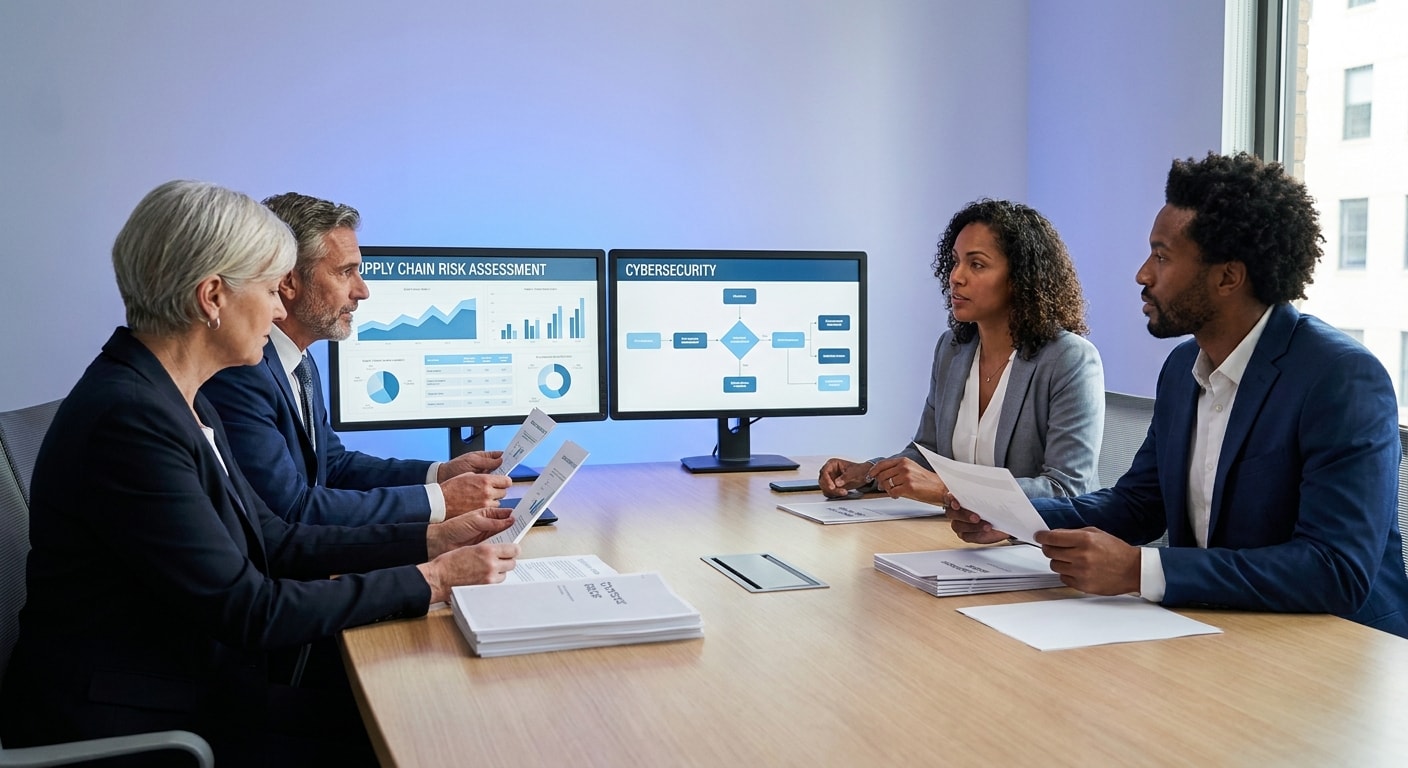
Bid team reviewing cyber supply chain risks for a public sector tender response
This guide explains how to turn cyber supply chain resilience into credible tender evidence. It is written for bid teams, commercial directors, compliance leads, IT managers and operational teams who need to answer security questions without sounding generic.
The key point is simple: buyers want evidence of controlled resilience, not a list of good intentions.
Why cyber supply chain evidence matters more in 2026
Public sector procurement is now shaped by two forces that meet in the same tender response.
The first is the Procurement Act 2023 regime. Buyers have more emphasis on transparency, past performance, supplier reliability, contract management and lifecycle accountability. They are expected to think about whether a supplier can actually deliver what it promises, not only whether the submission is well written.
The second is the rising cyber risk around public services. Government, NHS, local authority, education, housing, utilities and infrastructure contracts all depend on digital systems and supplier networks. Attackers rarely need to breach the buyer directly if they can get in through a contractor, software provider, managed service, installer, temporary labour platform or document-sharing tool.
That is why tender questions are becoming more practical. They ask about incident response, subcontractor assurance, Cyber Essentials, access control, business continuity, backup testing, data segregation, phishing training, vulnerability management, security governance, supplier onboarding and recovery times.
For high-risk contracts, buyers may also expect alignment with recognised frameworks, evidence of board oversight, NCSC services, penetration testing, security operations, third-party risk monitoring or software supply chain controls.
The change is not that every supplier must suddenly become a cyber consultancy. The change is that every supplier must explain how cyber risk is managed in the service they are bidding to deliver.
That distinction is important.
A cleaning contractor does not need to write like a managed security provider. But if cleaners use a mobile workforce app, access secure public buildings, depend on a scheduling platform and subcontract specialist services, the buyer needs confidence that those arrangements are controlled.
A construction firm does not need to overclaim on technical security. But if the project uses a common data environment, BIM files, design consultants, remote project meetings and site access systems, the buyer needs to know who can access what, how permissions are controlled, what happens if a supplier is compromised and how work continues during a disruption.
Cyber resilience has moved from a back-office IT topic into a scored delivery risk.
The tender trap: certificates without a story
Many suppliers already have some of the right ingredients.
They may hold Cyber Essentials. They may have ISO 27001. They may use multi-factor authentication. They may run staff training. They may have a business continuity plan. They may include security clauses in subcontractor agreements.
Those things help. They are not enough on their own.
A certificate proves a baseline. It does not explain how the contract will be protected day to day. A policy proves an intention. It does not prove a tested process. A supplier questionnaire proves someone answered a form. It does not prove critical subcontractors are being monitored.
Tender evaluators need a clear line between the buyer risk and the supplier control.
Weak answer:
We take cyber security very seriously and maintain robust policies, training and controls across our organisation.
Better answer:
For this contract, cyber risk is owned jointly by our Contract Director and Head of IT. Before mobilisation, we will map every system, user group and subcontractor that can access contract data. Access will be role-based, protected by multi-factor authentication and reviewed monthly during mobilisation and quarterly once steady state is reached. Critical subcontractors will be required to evidence Cyber Essentials or equivalent controls before handling contract data. Any incident affecting buyer information, service continuity or connected systems will be escalated to the buyer within the agreed reporting window, with a named incident lead, containment actions and service recovery plan.
The second answer is stronger because it shows contract-specific control. It names ownership, timing, scope, assurance, access, subcontractors and escalation.
That is the difference between compliance language and tender evidence.
What buyers are really trying to protect
Cyber questions can look technical, but the buyer concern is usually practical.
They want services to continue. They want public data protected. They want critical systems available. They want incidents reported quickly. They want subcontractors controlled. They want to avoid reputational damage. They want confidence that the supplier will not disappear into vague internal processes when something goes wrong.
A good tender response should therefore start with the service risk, not the security policy.
For example, a local authority FM contract may involve helpdesk tickets, building access arrangements, asset data, planned maintenance records and resident or staff information. The cyber risk is not abstract. It is the risk that the helpdesk goes down, building data is exposed, an unauthorised person gains system access, remedial works are delayed or the buyer is not told quickly enough.
A healthcare support contract may involve appointment data, staff records, operational rotas, clinical-adjacent environments and critical uptime requirements. The tender answer must show stricter access controls, faster escalation and stronger continuity planning.
A construction project may involve design information, payment data, commercial documents, site access, drone imagery, drawings, subcontractor portals and programme-critical software. The buyer needs confidence that design integrity, commercial confidentiality and programme delivery will survive a cyber event.

Public sector buyer risk map linking service continuity, data protection, subcontractors and incident response
Before writing the cyber section, bid teams should ask four questions:
- What information will we hold or access for this buyer?
- Which systems are essential to delivering the service?
- Which subcontractors or software providers could affect delivery?
- What would the buyer need from us in the first 24 hours of an incident?
Those answers give the response a practical spine.
The five evidence areas that score well
Most cyber supply chain questions can be answered through five evidence areas. The exact weighting and wording will change by tender, but the underlying themes are consistent.
1. Governance and accountability
Buyers want to know who owns cyber risk.
Do not leave this as a vague reference to the IT department. Public contracts often involve operational teams, account managers, subcontractors and frontline staff. Cyber resilience has to sit across that whole model.
A strong answer explains:
- the senior role accountable for cyber risk on the contract
- the operational role responsible for day-to-day controls
- how cyber risk is reviewed during mobilisation and contract meetings
- how exceptions are escalated
- how lessons from incidents or near misses are captured
- how security obligations are flowed into subcontractor management
If you have board-level oversight, say so. If cyber appears on a risk register, explain how often it is reviewed. If contract risk reviews include cyber, business continuity and supplier assurance, describe that rhythm.
The point is not to create a governance chart for decoration. The point is to show the buyer that cyber risk has an owner and a review mechanism.
2. Access control and identity management
Access control is one of the easiest areas to write badly.
Many tender responses say that access is role-based. Fewer explain how roles are created, approved, changed and removed.
For public sector buyers, leavers, subcontractors, temporary workers and project-based access are obvious risk points. If someone leaves your organisation or a subcontractor changes staff, how quickly is access removed? If a project team member moves to a different contract, who checks permissions? If a supplier needs emergency access, who approves it and how is it logged?
A stronger response covers:
- named approval routes for new users
- least-privilege access by role
- multi-factor authentication for key systems
- joiner, mover and leaver controls
- regular access reviews
- privileged access restrictions
- subcontractor access rules
- audit logs and exception handling
If the contract involves buyer systems, explain how you will follow the buyer's identity process. If it involves your systems, explain how access is granted and reviewed. If it involves shared portals, explain who administers them and how permissions are checked.
This is especially important for bid teams in FM, construction, healthcare, security, transport and professional services because delivery often involves mixed teams. A clean answer shows that mixed delivery does not mean uncontrolled access.
3. Subcontractor and third-party assurance
This is where many suppliers lose credibility.
They write strong words about their own controls, then say very little about the suppliers they depend on.
Public buyers know the risk sits in the chain. A main contractor may rely on specialist subcontractors. An FM provider may rely on software, engineers, helpdesks and specialist compliance contractors. A professional services firm may use document platforms, consultants and offshore support. A technology supplier may rely on cloud hosting, open-source components and managed security tools.
Your answer should show that third-party risk is identified before it becomes the buyer's problem.
A practical model includes:
- supplier classification by risk and data access
- due diligence before onboarding
- minimum security requirements for critical suppliers
- contractual flow-down of cyber obligations
- evidence collection, such as Cyber Essentials, ISO certificates or security questionnaires
- periodic reassessment
- incident notification obligations
- exit and replacement planning for critical suppliers
Do not overcomplicate it. A small supplier can still write a strong answer if the process is proportionate.
For example:
We classify subcontractors as critical, standard or low-risk based on their access to buyer data, systems and service continuity. Critical suppliers must provide evidence of current cyber controls before mobilisation and accept contract clauses requiring prompt incident notification, secure handling of buyer information and cooperation with recovery activity. We record assurance status in the contract mobilisation tracker and review it at quarterly contract governance meetings.
That is clear, practical and believable.

Supplier assurance dashboard showing cyber status for subcontractors and software providers
4. Incident response and reporting
Buyers care deeply about what happens when something goes wrong.
An incident response answer should not simply say that a plan exists. It should explain how the supplier detects, escalates, contains, communicates and recovers.
A good tender response covers:
- what counts as a reportable incident for this contract
- who receives the first internal alert
- who tells the buyer
- target reporting times
- containment steps
- evidence preservation
- service continuity arrangements
- post-incident review
- corrective actions
The exact reporting window should match the tender requirements. If the buyer sets a four-hour, 24-hour or 72-hour reporting standard, mirror it clearly. If the tender does not specify a window, propose a sensible one and state that it will be finalised during mobilisation.
The first 24 hours are often the most important part of the answer. Evaluators want to know that they will not be left guessing.
A useful structure is:
- identify and triage the incident
- contain affected accounts, systems or suppliers
- notify the buyer through the agreed route
- protect service continuity using manual or alternative processes
- provide updates at agreed intervals
- agree recovery and communications activity
- complete root-cause review and corrective action
This turns incident response from a policy claim into a delivery promise.
5. Continuity and recovery
Cyber resilience is not only about stopping attacks. It is about keeping services running.
Business continuity answers often sit in a separate tender section, but cyber disruption should be connected to them. If a scheduling platform, helpdesk, document system, payment process or design environment is unavailable, what happens?
The answer should cover:
- critical systems for the contract
- manual workarounds
- backup and restore arrangements
- recovery time objectives where known
- recovery point objectives where relevant
- alternative communication channels
- supplier substitution routes
- emergency governance
- evidence from tests or exercises
The strongest answers include proof. That might be a tabletop exercise, backup test, business continuity drill, incident simulation, disaster recovery test or lessons learned from a real disruption.
Avoid claiming perfect resilience. Buyers do not believe it. A more credible answer says what you protect, how you test, what assumptions exist and how the buyer will be kept informed.
How to make evidence contract-specific
The most common weakness in cyber tender answers is generic writing.
Bid teams often paste the same cyber response into every tender because the subject feels technical and intimidating. The result is a polished answer that does not quite fit the buyer's risk.
To tailor it, build a simple bridge between the tender requirement and your control.
Use this pattern:
- Identify the buyer's risk.
- State the control.
- Explain how it works on this contract.
- Provide evidence.
- Explain what happens if performance slips.
For example, if the tender asks about subcontractor security, do not start with a corporate policy. Start with the service model.
This contract will use two specialist subcontractors during mobilisation and one software platform for planned maintenance reporting. We will treat those suppliers as critical because they can affect service continuity and buyer data. Before mobilisation, our Contract Director will confirm cyber assurance status for each supplier, including certification, access controls, incident notification obligations and named contacts. Any supplier that does not meet the agreed baseline will require a documented risk acceptance or replacement plan before handling contract data.
That answer is stronger because it is anchored in the contract.
For a construction tender, you might write about design data, common data environments and specialist packages. For a healthcare tender, you might write about sensitive information, continuity and staff access. For a local authority tender, you might write about resident data, public-facing services and political sensitivity. For an IT tender, you might go deeper into technical architecture and monitoring.
The same evidence areas apply, but the emphasis changes.
Cyber Essentials, ISO 27001 and other credentials: how to use them properly
Credentials are useful in tenders. They create confidence and may be mandatory. But they should support the answer, not replace it.
Cyber Essentials shows that baseline technical controls are in place. Cyber Essentials Plus adds independent testing. ISO 27001 shows a management system for information security. Depending on the sector, buyers may also ask about NCSC guidance, Cyber Assessment Framework alignment, penetration testing, vulnerability scanning, data protection impact assessments or specific government security requirements.
The best way to write credentials is to connect them to delivery.
Instead of:
We are Cyber Essentials certified and operate an ISO 27001-aligned information security management system.
Write:
Our Cyber Essentials controls set the baseline for devices, access, malware protection, secure configuration and software updates used by the contract team. For this contract, those controls will be applied to the helpdesk, mobile devices and reporting platform used to process buyer information. Our information security management system provides the review cycle for access exceptions, supplier assurance, incident actions and continual improvement.
This tells the evaluator why the credential matters.
If a credential is in progress, be honest. Do not imply certification you do not hold. Explain the current status, target date and interim controls. Overclaiming on cyber is dangerous because buyers may request evidence and contract clauses may turn the claim into an obligation.
Building a reusable cyber tender evidence library
Cyber evidence is often scattered across IT, operations, HR, legal, compliance and procurement. That makes tender writing slow and risky.
A bid team should not be searching inboxes for the latest certificate two hours before submission. It should have a maintained evidence library.
The library should include:
- current Cyber Essentials or ISO certificates
- information security policy summary
- acceptable use policy summary
- access control process
- joiner, mover and leaver process
- incident response plan summary
- business continuity plan summary
- latest backup or recovery test evidence
- training completion metrics
- phishing simulation results if available
- supplier onboarding checklist
- subcontractor security clauses
- data processing and confidentiality templates
- risk register extract
- sample mobilisation cyber checklist
- post-incident review template
- relevant case studies
Do not dump all of this into every bid. Use it to write tailored, accurate answers quickly.
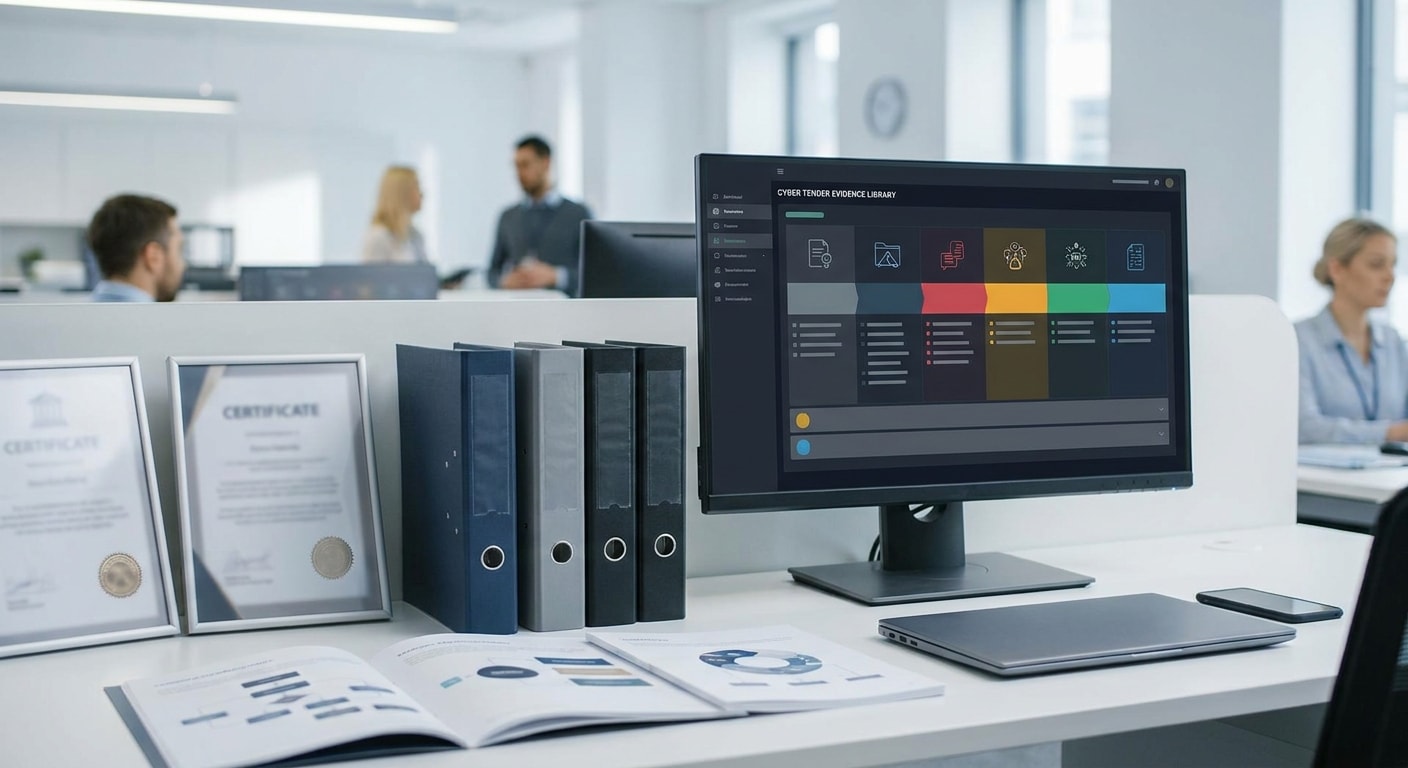
Organised cyber tender evidence library with policies, certificates, incident plans and supplier assurance records
The evidence library should also record ownership and expiry dates. Certificates expire. Policies change. Training data becomes stale. Supplier assurance needs refreshing.
This is where many organisations quietly create tender risk. They have the evidence, but not a reliable way to know whether it is current.
mytender.io helps bid teams manage this by turning scattered documents and previous answers into a structured knowledge base. Instead of starting from scratch, teams can retrieve the latest approved content, adapt it to the buyer risk and keep responses consistent across opportunities.
That matters for cyber questions because inconsistency is a red flag. If one tender says incidents are reported within 24 hours and another says 48 hours, the organisation has created confusion. If one response names a process that has changed, the bid team may be promising something operations no longer does.
A governed content library reduces that risk.
What good cyber case studies look like
Case studies are underused in cyber tender answers.
Suppliers often reserve case studies for service delivery, mobilisation or social value. But a short cyber resilience example can make a security answer much more credible.
A good example does not need to reveal sensitive details. In fact, it should not. It should show the evaluator that the supplier has applied controls in a comparable setting.
A useful structure is:
- contract type and environment
- relevant cyber or continuity risk
- control implemented
- result or learning
- relevance to the buyer
For example:
On a multi-site public sector support contract, we identified that several subcontractors required access to the scheduling platform during mobilisation. We created a role-based access model, restricted subcontractor permissions to assigned work packages and introduced a monthly access review chaired by the Contract Manager. This reduced standing access, improved auditability and gave the buyer a clear record of who could view contract data.
That is not flashy. It is exactly the kind of evidence evaluators trust.
Another example:
During a supplier platform outage on a comparable contract, our team moved to the agreed manual continuity process within two hours, prioritising critical tasks and issuing buyer updates through the contract escalation route. The post-incident review led to a revised contact tree, clearer recovery roles and a quarterly check of manual workarounds.
This proves recovery behaviour without exposing security-sensitive information.
Common mistakes to avoid
Cyber tender responses fail in predictable ways.
The first mistake is over-technical writing. Evaluators may include IT specialists, but many readers will be procurement, operations, estates, finance or service leads. Explain controls in plain English. Use technical detail where it adds confidence, not to sound clever.
The second mistake is overclaiming. Do not say controls are continuous if they are quarterly. Do not say all subcontractors are certified if only critical suppliers are checked. Do not promise an incident reporting window operations cannot meet. Cyber claims can become contractual commitments.
The third mistake is treating subcontractors as an afterthought. If delivery depends on them, assurance must be in the answer.
The fourth mistake is writing policy instead of process. Policies matter, but tenders score the practical application. Who does what, when, using which evidence, and what happens if something changes?
The fifth mistake is ignoring mobilisation. Many cyber risks appear before steady-state delivery begins: new users, data transfers, system setup, temporary access, subcontractor onboarding and rushed document sharing. A strong answer explains how mobilisation will be controlled.
The sixth mistake is separating cyber from business continuity. Buyers want to know how the service continues during disruption. Link the two.
A practical structure for a scored answer
If you are staring at a cyber resilience question and do not know where to start, use this structure.
First, open with the buyer risk.
State what you understand about the contract. Mention the systems, data, service continuity and supply chain dependencies that matter.
Second, explain governance.
Name the accountable roles, review rhythm and escalation route.
Third, explain preventive controls.
Cover access, devices, training, secure configuration, data handling and supplier assurance. Keep it relevant to the contract.
Fourth, explain detection and response.
Say how incidents are identified, triaged, contained, reported and reviewed.
Fifth, explain continuity.
Describe manual workarounds, backups, recovery, alternative communications and critical supplier replacement.
Sixth, provide evidence.
Include certifications, test results, training metrics, supplier checks, case studies or redacted examples.
Seventh, close with improvement.
Explain how lessons are captured during contract reviews and how cyber controls will stay current over the contract term.
That structure works because it follows the evaluator's question: can this supplier protect us before, during and after a cyber event?
The role of AI in writing cyber tender responses
AI can help bid teams answer cyber questions faster, but it must be used carefully.
The risk is that a generic AI tool will produce plausible security language that does not match the organisation's actual controls. That is dangerous. A polished but inaccurate cyber answer can create compliance risk, evaluation risk and operational risk.
The better approach is grounded AI: use approved policies, certificates, previous successful answers, case studies and contract-specific evidence as the source material.
A good AI-assisted workflow looks like this:
- upload the tender question and evaluation criteria
- retrieve the latest approved cyber evidence
- identify the buyer's specific risk
- draft an answer using only verified material
- flag missing evidence or overclaim risks
- review with IT, compliance and operations
- store the improved response for future use
That is exactly the kind of workflow mytender.io is built for. The platform helps teams generate first drafts from their own knowledge base, not from generic internet assumptions. It also helps keep bid content organised so future answers can start from stronger evidence.
For cyber questions, that matters because the safest answer is not the longest one. It is the answer that is accurate, tailored and provable.
Quick checklist before submission
Before submitting a cyber supply chain response, run this checklist.
- Have we named the buyer's actual service and data risks?
- Have we explained who owns cyber risk for the contract?
- Have we shown how user access is approved, reviewed and removed?
- Have we included subcontractor and software supplier assurance?
- Have we matched incident reporting to the tender requirement?
- Have we connected cyber disruption to business continuity?
- Have we included current evidence, not expired certificates?
- Have IT, compliance and operations reviewed any claims they must deliver?
- Have we avoided promising controls we do not actually operate?
- Have we stored the final answer and evidence for reuse?

Final tender review checklist for cyber resilience, supplier assurance and incident response evidence
This review does not need to slow the bid down. It should make the final answer safer and sharper.
Final thought: resilience is now a bid differentiator
Cyber supply chain resilience is no longer a technical appendix. It is part of how buyers judge whether a supplier is safe to award.
The opportunity is that many competitors will still answer these questions generically. They will list policies, attach certificates and hope the evaluator gives them credit.
A stronger bidder will do something different. They will show how cyber risk connects to the contract, how subcontractors are controlled, how incidents are reported, how services recover and what evidence proves the model works.
That kind of answer does more than satisfy compliance. It builds confidence.
And in public sector tenders, confidence is often what separates a competent response from a winning one.
Tags
Ready to Transform Your Tender Writing?
See how MyTender's AI can help you write winning tenders in a fraction of the time.