
Cost Optimization Strategies for Winning Tenders: A Complete Guide for SMEs in 2026
Master cost optimization strategies that help SMEs win more tenders whilst maintaining profitability. Proven techniques for procurement efficiency, competitive pricing, and resource management in 2026.
Evie
PA & Office Admin at mytender.io
Winning public sector tenders as a small or medium-sized enterprise (SME) requires a delicate balance: submitting competitive bids that secure contracts whilst maintaining healthy profit margins. The challenge intensifies in 2026, with tighter budgets, increased competition, and the UK Procurement Act 2023 shifting evaluation criteria beyond pure price to "Most Advantageous Tender" (MAT) principles.
This comprehensive guide explores proven cost optimization strategies that empower SMEs to deliver value-driven, competitive tender submissions without sacrificing quality or profitability. Whether you're bidding for local authority contracts, NHS frameworks, or central government opportunities, these techniques will strengthen your position whilst protecting your bottom line.
Understanding the 2026 Cost Optimization Landscape

Professional business illustration showing SME procurement cost optimization strategy
The procurement environment for SMEs has evolved significantly. The traditional race to the lowest price has been replaced by more sophisticated evaluation models that consider total value, social impact, sustainability, and long-term cost-effectiveness. This shift creates opportunities for well-prepared SMEs to compete effectively against larger competitors by demonstrating superior value delivery rather than simply undercutting on price.
Research from the Cabinet Office indicates that contracts awarded based purely on lowest price often result in poorer outcomes, including service failures, contract variations, and ultimately higher total costs for the public sector. The new Procurement Act 2023 explicitly encourages contracting authorities to evaluate bids holistically, considering quality, innovation, risk management, and whole-life costs alongside initial pricing.
For SMEs, this regulatory evolution demands a fundamental rethinking of cost optimization. Rather than simply cutting margins to win work, successful bidders must demonstrate efficiency, value engineering, and intelligent resource management. The businesses that thrive will be those that genuinely reduce operational costs through smart procurement, automation, and strategic planning—then pass those savings to clients whilst maintaining sustainable profit margins.
The stakes are high. Public sector procurement in the UK exceeds £300 billion annually, with government policy explicitly targeting increased SME participation. Local authorities with annual procurement spend above £100 million must now set and publish three-year SME spending targets, creating substantial opportunities for smaller suppliers who can demonstrate both competitive pricing and robust value propositions.
Internal Cost Optimization: Building Efficiency Before Bidding
Before crafting competitive tender pricing, SMEs must optimise their own operational costs. A lean, efficient organisation can offer better value to clients whilst preserving profitability—a competitive advantage that shows in every proposal you submit.
Strategic Procurement and Supplier Management
Your own procurement function directly impacts the costs reflected in tender pricing. Inefficient purchasing inflates overheads, reduces margins, and undermines competitiveness. Start by conducting a comprehensive spend analysis to understand exactly where money flows and identify optimisation opportunities.
Category management represents one of the most powerful cost reduction techniques available to SMEs. Rather than purchasing reactively across disparate suppliers, group similar goods and services into categories and develop strategic approaches for each. For example, consolidate office supplies, IT equipment, and professional services under separate category strategies with dedicated supplier relationships and negotiated terms.
Supplier consolidation delivers multiple benefits. By concentrating spend with fewer, strategically selected suppliers, you increase purchasing power, qualify for volume discounts, reduce administrative overhead, and build stronger relationships that facilitate better terms and priority service. However, maintain balance—over-reliance on single suppliers creates vulnerability. Aim for a concentrated but diversified supply base with primary suppliers backed by contingency options.
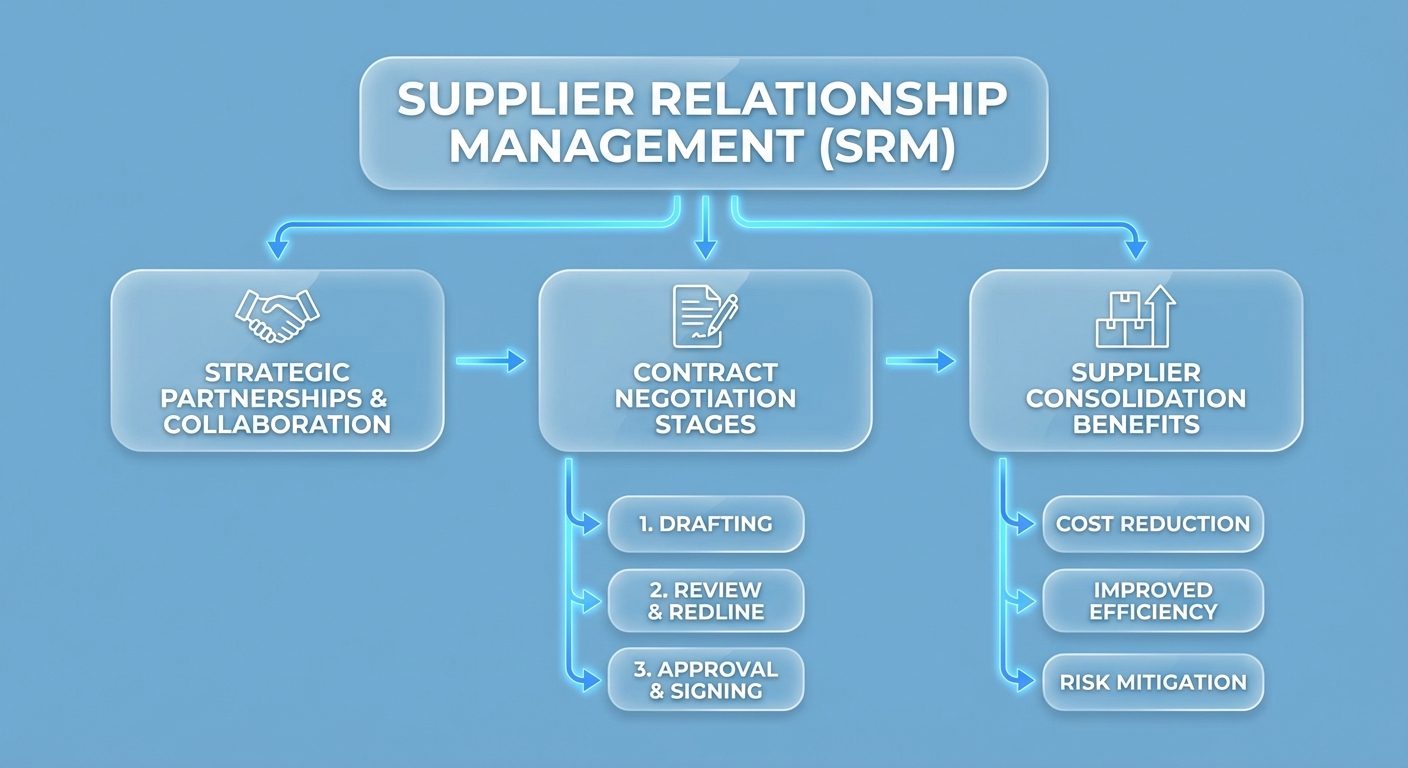
Business process flowchart showing supplier relationship management and cost savings
Long-term strategic partnerships with key suppliers transform procurement from transactional exchanges to collaborative value creation. When suppliers understand your business model, growth plans, and operational challenges, they can tailor solutions, suggest cost-saving innovations, and provide preferential pricing. This collaborative approach often uncovers hidden costs and inefficiencies that neither party would identify independently.
Regular contract review and renegotiation prevents cost creep and ensures terms remain competitive. Markets evolve, supplier capabilities change, and your own requirements shift. Establish a schedule—quarterly or semi-annually—to review major supply contracts and renegotiate where appropriate. Don't focus solely on unit price; consider payment terms, delivery schedules, service levels, and bundled offerings that reduce total procurement costs.
For SMEs with limited purchasing power individually, group purchasing organisations (GPOs) or buying consortiums offer a practical solution. By partnering with complementary businesses—even non-competitors in adjacent sectors—you can aggregate demand and negotiate terms typically available only to much larger organisations. This approach delivers economies of scale without requiring internal growth or capital investment.
Technology and Automation: The Efficiency Multiplier
Technology adoption separates efficient SMEs from those burdened by manual processes and outdated systems. While procurement automation traditionally required significant capital investment, modern cloud-based solutions are accessible to businesses of all sizes, delivering rapid return on investment through reduced administrative costs and improved decision-making.
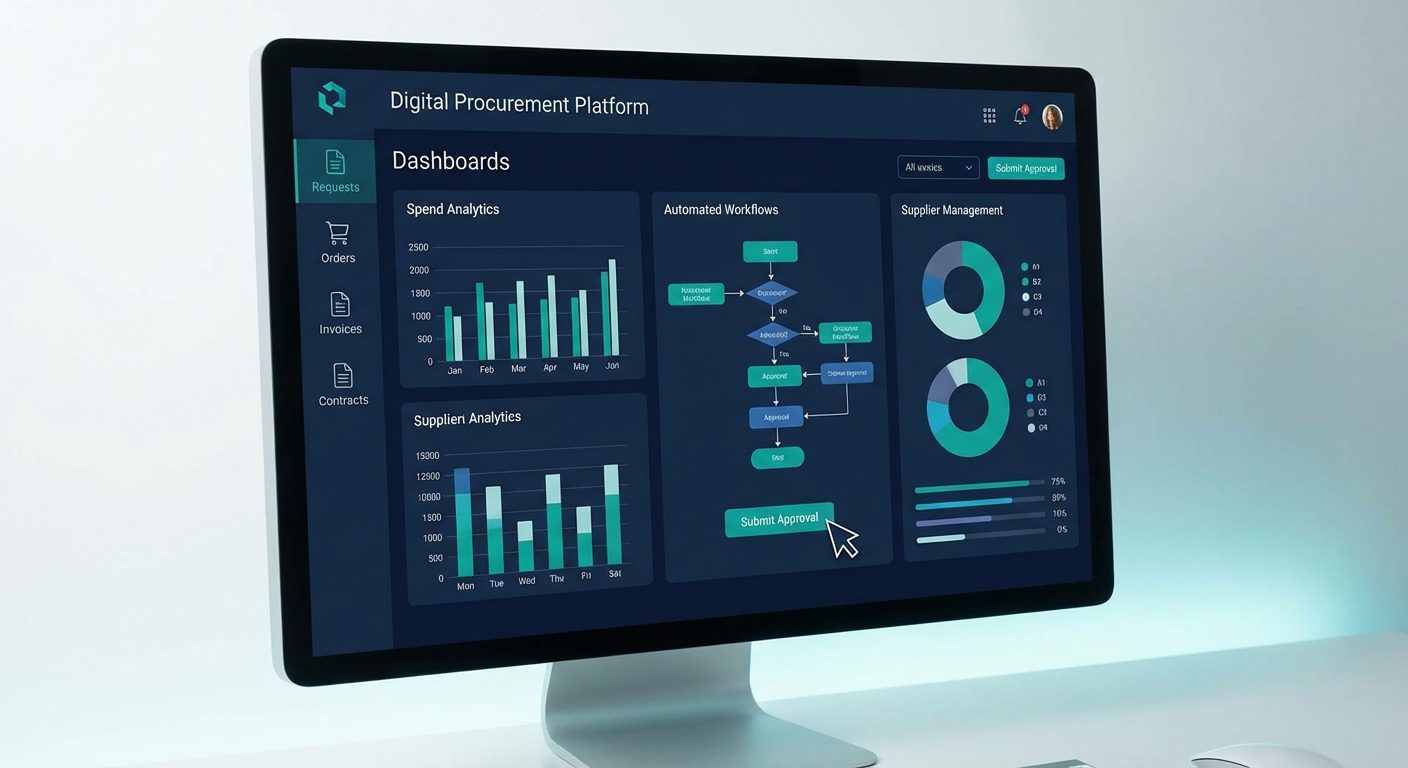
Technology automation concept for procurement showing digital platform interface
Automating purchasing processes eliminates repetitive manual tasks, reduces processing time, minimises human error, and frees staff to focus on strategic activities like market analysis, supplier negotiation, and value engineering. A robust procure-to-pay platform streamlines the entire cycle from requisition through approval, ordering, receiving, and payment—reducing both processing costs and payment delays that damage supplier relationships.
Spend analytics software transforms raw procurement data into actionable intelligence. Real-time visibility into spending patterns reveals anomalies, identifies cost-saving opportunities, and supports informed negotiation. For example, analytics might reveal that 15% of spend goes to non-preferred suppliers at premium prices, or that certain categories show significant price variation across departments—both issues easily corrected once identified.
Integration with existing ERP systems maximises the value of automation investments. When procurement platforms connect seamlessly with financial management, inventory control, and project management systems, you eliminate duplicate data entry, reduce errors, and gain comprehensive operational visibility. This integration enables sophisticated techniques like demand forecasting and inventory optimisation that prevent both stockouts and excess stock—each of which carries substantial hidden costs.
The productivity gains from procurement automation compound over time. Initial benefits include faster processing and reduced errors. Longer-term advantages encompass better supplier terms through data-driven negotiation, elimination of maverick spending through enforced compliance, and strategic insights that inform business planning. Many SMEs report 20-30% reduction in procurement administrative costs within the first year of implementation.
Demand Forecasting and Inventory Optimisation
Accurate demand forecasting prevents two costly extremes: stockouts that disrupt operations and damage client relationships, and excess inventory that ties up capital and incurs storage costs. For SMEs bidding on public sector contracts, particularly those involving supply of goods or materials-intensive services, inventory management directly impacts both costs and competitive positioning.
Implement forecasting models based on historical data, seasonal patterns, and forward-looking indicators relevant to your business. If you typically see increased demand following successful tender wins in specific sectors, factor that into planning. If certain months show consistent patterns—procurement teams rushing to spend budget before year-end, for instance—anticipate and prepare.
Just-in-time (JIT) inventory principles, adapted appropriately for your business model and risk tolerance, minimise holding costs whilst maintaining service capability. The goal isn't zero inventory—that creates fragility—but rather optimised stock levels that balance cost efficiency with operational reliability. This balance point varies by industry, product characteristics, supplier lead times, and the penalties for stockouts in your particular context.
Technology enables sophisticated inventory optimisation beyond what's practical manually. Automated reorder points, supplier-managed inventory arrangements, and predictive analytics help maintain optimal stock levels with minimal management overhead. For SMEs competing on both price and delivery reliability, these capabilities represent a genuine competitive advantage that shows in tender proposals.
Competitive Pricing Strategies for Tender Success
Optimising internal costs creates the foundation for competitive tender pricing—but translating operational efficiency into winning bids requires strategic thinking about pricing models, value demonstration, and competitive positioning.
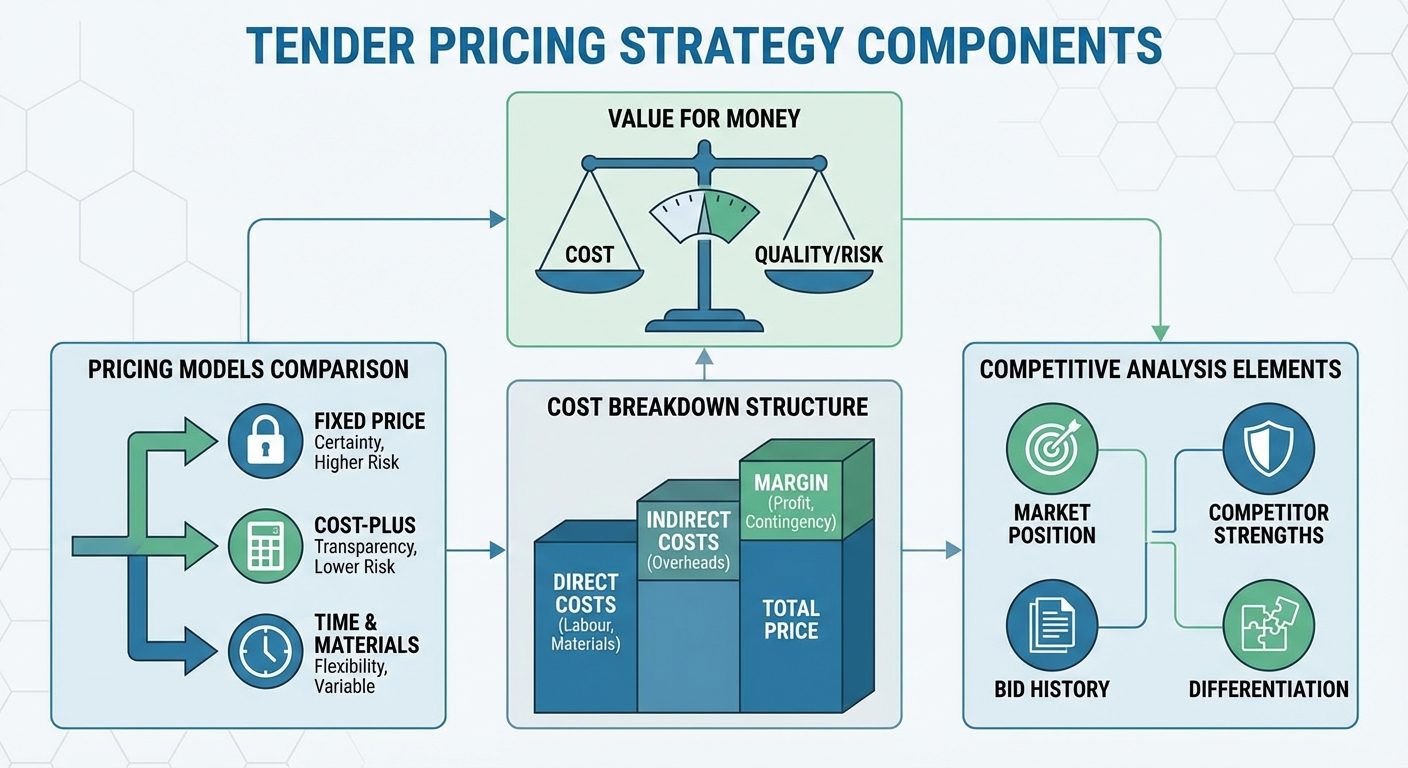
Infographic showing tender pricing strategy components and value for money balance
Moving Beyond Lowest Price: Value-Based Pricing
The shift from "Most Economically Advantageous Tender" (MEAT) to "Most Advantageous Tender" (MAT) under the Procurement Act 2023 fundamentally changes pricing strategy. Contracting authorities now evaluate total value across economic, social, and environmental dimensions—meaning the lowest price frequently doesn't win.
This evolution favours SMEs willing to articulate and evidence their value proposition. Rather than engaging in margin-destroying price wars, focus on demonstrating how your approach delivers superior outcomes when total cost of ownership, risk mitigation, quality, innovation, and social value are properly considered.
Whole-life cost analysis helps evaluators understand the true economic impact of their procurement decision beyond initial price. If your solution reduces ongoing maintenance costs, extends asset life, improves energy efficiency, or prevents expensive failures, quantify these benefits clearly. Public sector clients increasingly recognise that apparently "cheap" solutions often prove expensive when hidden costs emerge.
For example, an SME bidding on facilities management might price 8% higher than competitors but demonstrate that superior preventive maintenance reduces equipment downtime by 25%, energy-efficient practices cut utilities by 15%, and proactive compliance management eliminates fines and remediation costs. When contracting authorities evaluate the full financial picture over the contract term, this "premium" pricing actually represents the lowest total cost.
Value-based pricing requires confidence in your offering and excellent communication. You must help evaluators understand and believe your value proposition through clear explanations, robust evidence, case studies, testimonials, and quantified benefits. This approach works best when you genuinely deliver superior value—attempting to mask inferior offerings with clever pricing narratives will fail under scrutiny.
Competitive Positioning and Market Intelligence
Effective pricing requires understanding your competitive position and the broader market context. Who else is likely bidding? What are their typical pricing models? What advantages and disadvantages do you have relative to competitors? How price-sensitive is this particular client and opportunity?
Market intelligence gathering should be continuous, not reactive. Monitor public tender opportunities even when not bidding to understand pricing trends, competitive dynamics, and client priorities. Review published contract award notices that often include pricing information. Attend industry events and engage with procurement communities to understand current market conditions.
When appropriate, leverage published frameworks and rate cards to benchmark your pricing. If comparable services are available through government frameworks at specific rates, pricing significantly above those levels requires strong justification. Conversely, pricing dramatically below established benchmarks may raise questions about quality, sustainability, or hidden costs.
Consider your strategic objectives when pricing individual bids. A new client relationship might justify more competitive pricing to establish credibility and create opportunities for future work. Breaking into a new sector or geography might similarly warrant strategic pricing. Conversely, renewals with existing clients where you've demonstrated value often support premium pricing based on your track record and the client's switching costs.
Dynamic pricing strategies recognise that every opportunity differs. Rather than applying standard markup formulas across all bids, evaluate each opportunity individually based on strategic value, competitive intensity, client budget constraints, and your own capacity and pipeline. This tailored approach maximises win rates whilst protecting margins.
Transparent and Competitive Pricing Structures
How you present pricing matters as much as the numbers themselves. Public sector evaluators appreciate clear, transparent pricing structures that they can easily understand, compare, and verify. Avoid complex formulas, hidden costs, or ambiguous terms that create confusion and risk.
Break down pricing into clear components that show value and build confidence. If you're bidding on a service contract, separate labour costs, materials, overhead allocation, and profit margin. This transparency helps evaluators understand your pricing logic and provides a basis for discussion if negotiations occur.
Consider pricing structures that align incentives and share risk. Outcome-based pricing models, where payment links partially to performance metrics or delivered results, demonstrate confidence in your capabilities and align your interests with the client's objectives. Gain-share arrangements where cost savings are split between client and supplier create powerful collaborative incentives.
For longer contracts, consider how to handle price adjustments over time. Fixed pricing provides certainty but carries risk if costs increase unexpectedly. Index-linked pricing protects against inflation but transfers that risk to the client. Hybrid models with fixed pricing for controllable elements and indexed pricing for market-driven inputs (energy, materials) often represent fair risk allocation.
Payment terms impact both your costs and competitiveness. While clients typically prefer extended payment terms, these impose financing costs on suppliers—especially SMEs with limited working capital. If you can offer competitive payment terms (accepting longer payment cycles or milestone-based payments), this may provide a differentiator. Conversely, if you require prompt payment to manage cash flow, ensure your pricing reflects this and explain why in your proposal.
Risk Management and Cost Control During Delivery
Winning tenders at competitive prices creates value only if you can deliver profitably. Risk management and cost control during contract execution protect margins and ensure sustainable performance.
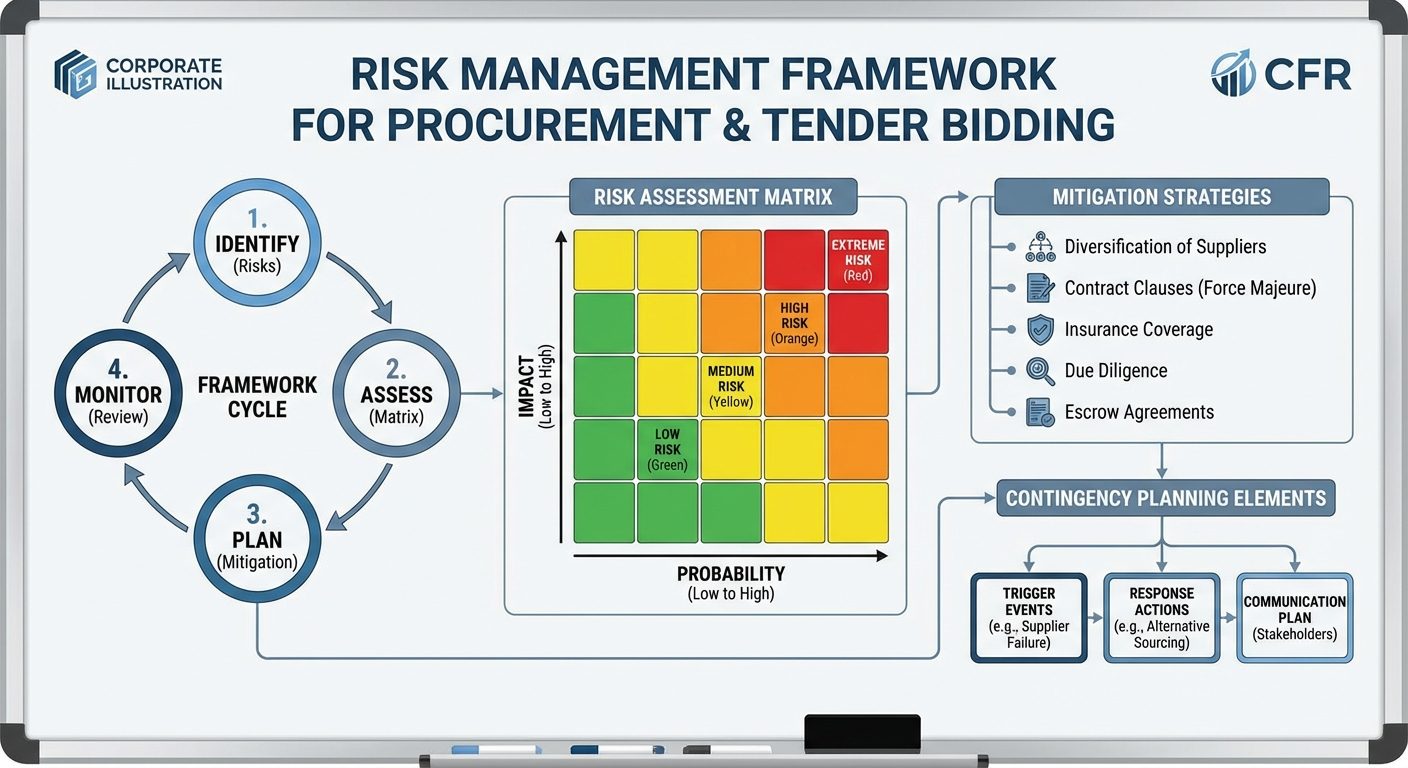
Risk management framework diagram for procurement and tender bidding
Pre-Bid Risk Assessment
Before committing to competitive pricing, rigorously assess delivery risks that could erode margins or create losses. Common risk categories include:
Scope and specification risks: Ambiguous requirements, incomplete scope definition, or unrealistic specifications create cost uncertainty. If the tender documents lack clarity, request clarification formally. Price based on reasonable assumptions and document those assumptions clearly in your proposal. Consider contingency allowances for genuinely uncertain elements, but avoid padding that makes you uncompetitive. Operational risks: Can you actually deliver what you're proposing at the prices you've quoted? Do you have necessary resources, capabilities, equipment, and expertise? If the contract requires scaling up operations, recruiting staff, or acquiring new capabilities, factor these costs and risks into pricing. Underbidding to win work you can't profitably deliver damages your reputation and finances. Supplier and supply chain risks: If your pricing depends on third-party suppliers or subcontractors, ensure you have firm commitments at known prices before submitting your bid. Assuming you can negotiate favourable terms after winning creates dangerous exposure. Build relationships with key suppliers, obtain quotations valid for your bid period, and maintain backup options for critical inputs. Regulatory and compliance risks: Public sector contracts carry substantial compliance obligations around employment law, health and safety, data protection, insurance, and sector-specific regulations. Ensure your pricing includes all costs of full compliance. Cutting corners to reduce costs may work temporarily but creates expensive problems when discovered. Financial stability of suppliers: If your delivery depends on critical suppliers, assess their financial health. A supplier failure mid-contract can derail your operations and force expensive emergency alternatives. Where possible, build supply chain resilience through diversification, contractual protections, and contingency planning.Cost Control Mechanisms
Once you've won a contract, vigilant cost management ensures that the margins you predicted actually materialise. Implement systems and disciplines that track costs against budget, identify variances early, and enable corrective action before small overruns become large losses.
Regular financial reporting specific to each contract provides visibility into performance. Track actual costs against budget for all major categories: labour, materials, subcontractors, overhead allocation, and contingency spend. Weekly or monthly reviews (depending on contract size and duration) help catch problems early when they're easier to correct.
Change control processes protect against scope creep—the gradual expansion of deliverables without corresponding price adjustments. Public sector contracts typically include formal variation procedures. Use them. When clients request additional work or changes to specifications, evaluate the cost implications, price accordingly, and obtain formal approval before proceeding. Being helpful is good; delivering free extras that erode your margins is not.
Resource management disciplines ensure you deploy people and assets efficiently. If your contract pricing assumed specific utilisation rates or productivity levels, track actual performance against those assumptions. Address underperformance through training, process improvement, or reallocation. Conversely, if you're exceeding productivity assumptions, understand why—you may be able to capture lessons for future bids or identify opportunities to improve margins on this contract.
Subcontractor and supplier management remains critical during delivery, not just during bidding. Monitor subcontractor performance, costs, and compliance continuously. Address issues promptly through contractual mechanisms. Where suppliers or subcontractors underperform or impose unexpected costs, don't simply absorb those costs—exercise contractual rights and seek remedies.
Continuous Improvement and Lessons Learned
Every contract provides learning opportunities that inform future bidding and delivery. Implement structured processes to capture insights, both successes and challenges, and incorporate those lessons into future work.
Post-contract reviews should examine:
- Cost estimation accuracy: How did actual costs compare to bid pricing? What categories showed significant variance? Why? Use these insights to improve future cost estimation.
- Operational efficiency: What worked well? What processes, tools, or approaches delivered better-than-expected productivity? How can you replicate this success?
- Risk management effectiveness: Which risks materialised? How well did your mitigation strategies work? Were there unanticipated risks that should inform future risk assessment?
- Client relationship: What did the client value most? Where did perceptions differ from reality? How can you better align future proposals with client priorities?
- Competitive positioning: Why did you win this contract? How did your pricing compare to competitors? What strengths should you emphasise in future bids? What weaknesses need addressing?
This continuous improvement cycle transforms experience into competitive advantage. SMEs that systematically learn from each contract progressively improve their cost estimation accuracy, operational efficiency, and win rates—creating a virtuous cycle of better bids, improved margins, and sustained growth.
Leveraging Technology for Tender Cost Optimisation
Technology plays an increasingly central role in tender success, both by reducing operational costs that feed into pricing and by streamlining the tender preparation process itself. SMEs that embrace appropriate technology gain substantial competitive advantages.
Bid Management and Tender Response Tools
Tender preparation is inherently resource-intensive. Manually crafting each response from scratch wastes time, increases costs, and introduces inconsistency. Modern bid management platforms streamline this process, reducing preparation costs and improving response quality.
Quality bid libraries store pre-written content that addresses common tender questions and requirements. Rather than rewriting standard material for each bid—company background, accreditations, case studies, policies—maintain curated, approved content that teams can quickly adapt and customise. This approach ensures consistency, accelerates preparation, and frees senior staff to focus on bid strategy and differentiation rather than administrative writing.
Collaboration tools enable distributed teams to work efficiently on complex tender responses. When multiple specialists must contribute—technical staff for methodology, finance for pricing, operations for delivery plans, quality for accreditation evidence—coordinated platforms keep everyone aligned, prevent version control chaos, and ensure timely completion.
Compliance checking automation helps ensure your submission meets all mandatory requirements before submission. Missing mandatory elements or formatting requirements disqualifies otherwise strong bids. Automated checks against tender requirements catch these issues during preparation, not after submission when it's too late.
AI-assisted tender writing tools have emerged as powerful productivity enhancers, but require thoughtful application. These tools can accelerate initial drafting, suggest relevant content from previous bids, and improve writing quality. However, evaluators increasingly recognise generic, AI-generated content that lacks specificity and genuine understanding. Use AI as a productivity tool for first drafts and routine content, but ensure human expertise, client-specific insights, and authentic voice permeate your final submission.
Customer Relationship Management (CRM) for Tender Pipeline
Systematic opportunity management prevents wasted effort on unsuitable tenders and ensures you focus resources on high-probability, strategic opportunities. A well-implemented CRM system tracks the entire tender lifecycle from early opportunity identification through submission, evaluation, award, and post-contract review.
Early visibility into upcoming opportunities provides time for thorough preparation, relationship building, and strategic decision-making about whether to bid. Many SMEs only become aware of opportunities when they're published, leaving minimal time for quality bid preparation. Proactive pipeline management—tracking client procurement plans, engaging with procurement teams, monitoring forward schedules—extends your preparation window and improves bid quality.
Bid/no-bid decisions deserve disciplined evaluation. Not every opportunity warrants pursuit. Assess each against clear criteria: strategic fit, win probability, resource availability, profitability potential, client relationship, and contract delivery feasibility. Pursuing opportunities with low win probability or poor strategic fit wastes resources that could deliver better returns elsewhere.
CRM systems capture institutional knowledge about clients, contracts, competitors, and outcomes that inform future decisions. When business development staff leave or change roles, their knowledge shouldn't disappear with them. Systematic documentation of client interactions, tender insights, win-loss analysis, and lessons learned creates organisational capabilities that transcend individuals.
Financial Management and Pricing Tools
Accurate cost estimation underpins competitive pricing. Spreadsheet-based approaches work for simple bids but become unwieldy and error-prone for complex, multi-year contracts with numerous cost components. Dedicated pricing tools bring structure, accuracy, and sophistication to cost estimation.
Activity-based costing models allocate overhead accurately based on actual resource consumption rather than arbitrary formulas. This precision matters when comparing opportunities with different cost profiles—labour-intensive versus capital-intensive contracts, for example, or different geographic locations with varying overhead structures.
Scenario modelling capabilities let you evaluate pricing sensitivity and risk. What happens if labour costs increase 5%? If materials prices spike? If productivity falls 10% below assumptions? Understanding these sensitivities helps you price appropriately and decide whether to include contingencies or seek contractual protections.
Integration between pricing tools and delivery systems enables cost tracking against budget during contract performance. When the same data structures and categories flow from bid pricing through to operational cost tracking, you can meaningfully compare actual performance to bid assumptions—generating insights that improve future cost estimation accuracy.
Practical Implementation: Building Your Cost Optimisation Framework
Understanding cost optimisation principles is valuable; implementing them systematically transforms your competitive position. Here's a practical framework for SMEs to develop robust cost optimisation capabilities.
Assess Your Current State
Begin with honest assessment of your current procurement, operational efficiency, and tender preparation processes. Where do costs hide? What inefficiencies exist? How do your processes compare to best practices? This baseline understanding identifies priorities for improvement and measures future progress.
Conduct comprehensive spend analysis across all categories. Where does money go? Which suppliers receive the most spend? What prices do you pay for common items? Are there volume discount opportunities? How much goes to non-preferred suppliers? This analysis almost always reveals immediate cost reduction opportunities.
Process mapping for key workflows—procurement, tender preparation, contract delivery—reveals inefficiencies and bottlenecks. How long do approvals take? How many manual handoffs occur? Where do errors concentrate? What percentage of time goes to value-adding activities versus administration? These insights highlight automation opportunities and process improvement priorities.
Benchmark your performance against competitors and industry standards. How do your overhead rates compare? Your productivity metrics? Your win rates? Profitability? Understanding your competitive position identifies gaps to close and strengths to leverage.
Prioritise and Plan Improvements
Not all improvements deliver equal impact or require equal effort. Prioritise based on potential savings, implementation difficulty, resource requirements, and time to benefit. Quick wins that deliver meaningful savings with minimal investment should come first, building momentum and funding for longer-term initiatives.
Typical high-impact, relatively accessible improvements for SMEs include:
- Supplier consolidation and contract renegotiation in high-spend categories
- Procurement automation for routine purchases
- Bid library development for tender responses
- Structured opportunity pipeline management
- Post-contract review processes to capture lessons learned
These initiatives require modest investment, deliver fairly rapid returns, and build capabilities that support ongoing improvements.
Longer-term, more transformational initiatives might include:
- Comprehensive ERP system implementation
- Advanced analytics for predictive demand forecasting
- Supply chain resilience programmes
- Strategic supplier partnerships with integrated systems
- AI-enhanced bid development and cost estimation
These investments require more substantial resources and longer time horizons but can fundamentally transform competitive positioning.
Implement Systematically with Clear Governance
Successful cost optimisation requires clear ownership, accountability, and governance. Assign responsibility for each initiative to specific individuals with appropriate authority, resources, and success metrics. Casual, unfunded good intentions rarely deliver results.
Establish regular reviews to monitor progress, address obstacles, and maintain momentum. Monthly or quarterly steering meetings provide forums to review metrics, celebrate successes, course-correct where necessary, and ensure alignment across initiatives.
Communicate changes clearly to affected staff, explaining why improvements matter and how they benefit both the business and individuals. Process changes and new systems can create resistance if people don't understand the purpose or feel imposed upon. Inclusive communication and genuine engagement with staff concerns smooth implementation and build support.
Provide adequate training and support for new systems and processes. Budget includes not just software and tools but also the time and resources for people to learn and adapt. Underinvestment in training ensures new capabilities underperform and creates frustration.
Measure, Learn, and Improve Continuously
Cost optimisation is not a one-time project but an ongoing discipline. Establish clear metrics that track both process performance (procurement costs, tender preparation time, win rates) and business outcomes (contract margins, profitability, growth).
Regular reporting maintains visibility and accountability. Monthly dashboards that track key procurement metrics, tender pipeline health, and contract financial performance help leadership spot trends, identify problems, and make informed decisions.
Create feedback loops that ensure insights from contract delivery inform procurement practices and future tender preparation. When actual costs vary from estimates, understand why and adjust future assumptions. When supplier performance differs from expectations, adjust supplier strategies. When client feedback reveals misalignment between proposals and priorities, refine your approach.
Celebrate successes and share lessons across the organisation. When a new process delivers meaningful savings, recognise the team responsible and share the approach so others can learn. When a contract performs exceptionally well, document what worked and incorporate those practices into standard procedures.
Conclusion: Sustainable Competitive Advantage Through Cost Excellence
Cost optimisation for SMEs bidding public sector tenders is not about becoming the cheapest option—it's about becoming the best value option whilst maintaining sustainable profitability. The businesses that thrive in 2026 and beyond will be those that genuinely operate efficiently, demonstrate clear value, and price competitively based on real cost advantages rather than unsustainable margin compression.
The shift to Most Advantageous Tender evaluation creates opportunities for SMEs willing to articulate comprehensive value propositions that go beyond price. By combining internal operational excellence with sophisticated pricing strategies and compelling value communication, smaller suppliers can compete effectively against larger competitors.
The strategies outlined in this guide—strategic procurement and supplier management, technology adoption and automation, demand forecasting and inventory optimisation, value-based pricing, risk management, and continuous improvement—represent a comprehensive framework for building sustainable competitive advantage. Implementation requires commitment, resources, and discipline, but the returns—improved win rates, better margins, stronger client relationships, and sustained growth—justify the investment.
Start with thorough assessment of your current capabilities and costs. Identify quick wins that build momentum and fund longer-term improvements. Implement systematically with clear governance and accountability. Measure results, learn continuously, and refine your approach based on real-world feedback.
Cost optimisation is a journey, not a destination. Markets evolve, technologies advance, client expectations change, and competitors improve. The SMEs that embed cost consciousness and continuous improvement into their culture will adapt, compete, and thrive regardless of how the landscape shifts.
For businesses ready to move beyond ad-hoc bidding to strategic, data-driven tender success, platforms like mytender.io provide the intelligence, tools, and insights that transform opportunity identification and bid preparation. By combining smart technology with the strategic approaches outlined in this guide, SMEs can level the playing field with larger competitors and win profitable work that drives sustainable growth.
The question is not whether cost optimisation matters—it manifestly does—but whether you'll approach it strategically and systematically, or continue with reactive, inconsistent practices that undermine competitiveness. The businesses that choose the former will find themselves winning more work, delivering more profitably, and building sustainable competitive advantage that compounds over time.
Tags
Ready to Transform Your Tender Writing?
See how MyTender's AI can help you write winning tenders in a fraction of the time.