
Contract Termination Notices: What Suppliers Need to Know Under the Procurement Act
Contract termination is no longer just the end of a public sector contract. Under the Procurement Act transparency regime, how a contract ends can shape your future bid credibility. Here is how suppliers should prepare.
mytender.io Research Team
Tender Writing & Bid Management Specialists
Contract Termination Notices: What Suppliers Need to Know Under the Procurement Act
Most bid teams spend their time thinking about how contracts start. They build mobilisation plans, implementation timelines, governance structures, risk registers and first-100-day activity plans. That makes sense. Mobilisation is scored heavily, it is operationally difficult, and it is often where a new supplier earns or loses buyer confidence.
But in 2026, the way a public sector contract ends matters just as much.
The Procurement Act has moved UK public procurement further into a transparent, lifecycle-based model. Buyers are expected to publish more information about procurements, awards, contract management and contract outcomes. That includes the end of the contract. Contract Termination Notices are part of that wider shift.
For suppliers, this changes the commercial reality. A contract exit is no longer only a private handover between the incumbent, the buyer and the incoming supplier. It can become part of the public record that future buyers, evaluators and competitors may inspect. A clean exit can strengthen your reputation. A messy exit can follow you into the next tender.
That is why bid teams need to treat termination, demobilisation and contract close-out as tender evidence, not just operational admin.

Public sector bid team reviewing a contract termination notice dashboard
Why Contract Termination Notices now matter
A Contract Termination Notice records that a public contract has ended. That may sound simple, but the implications are bigger than the name suggests.
Under the new procurement regime, the public record around contracts is becoming richer. Buyers publish notices across the procurement lifecycle, from early pipeline visibility to tender notices, award information, contract details, performance reporting, payment information, change notices and termination notices. The direction of travel is obvious: public sector contracting is becoming easier to scrutinise.
That scrutiny does not stop when a supplier wins. It continues during delivery and at exit.
For years, suppliers could treat difficult endings as closed-door matters. A contract might end because the service reached natural expiry, the buyer re-procured, budgets changed, scope shifted, performance concerns escalated, the supplier withdrew, the authority insourced, or the parties agreed a negotiated exit. Unless the issue became public through a dispute, audit report or press coverage, future bid teams often had room to describe the contract history selectively.
That room is narrowing.
Where termination information is published, future evaluators may have a clearer view of whether a contract ended normally, early, cleanly or badly. Even where the notice itself is brief, it can prompt further questions. Why did the contract end early? Was performance a factor? Was the supplier cooperative? Was there a service disruption? Were exit obligations met? Did the buyer need to take emergency action? Did the supplier leave behind usable data, assets, records and staff information?
These are not abstract questions. They affect tender scoring.
A supplier bidding for a new public contract is increasingly judged on evidence of delivery maturity. Buyers want to know whether the supplier can mobilise, manage, report, improve and exit responsibly. If your public contract history shows repeated early terminations, unresolved performance issues or weak handovers, your written answer has to work harder.
The reverse is also true. If you can show clean exits, constructive demobilisation, strong governance and transparent lessons learned, termination history can become proof of professionalism.
The mistake suppliers make about termination
The common mistake is treating termination as something that only the contract management team needs to worry about.
That is too narrow. Termination has bid implications from the moment you write the first response.
Every tender response makes promises about continuity, governance, reporting, data management, risk control, contract review and exit. Those promises may sit in different sections: mobilisation, business continuity, quality assurance, social value, information security, TUPE, asset transfer, transition, exit management, complaints, stakeholder engagement and continuous improvement.
If those promises are not delivered at the end of the contract, the next bid inherits the problem.
Imagine a facilities management supplier that wins a council estate contract. In the tender, it promises full asset data, monthly lifecycle reporting, collaborative handover, orderly TUPE support, transparent subcontractor management and a no-surprises exit. Five years later, the contract ends. The asset register is incomplete, subcontractor records are scattered, TUPE data is late, social value evidence is weak, and the outgoing team is defensive because it has already lost the re-bid.
That is not just a delivery issue. It is a future bidding issue.
The next buyer may ask for examples of contract exit management. The supplier may want to use the council contract as a case study. The incumbent buyer may provide a reference. The termination notice may show that the contract ended earlier than expected. The supplier then has to explain the gap between what it claimed it would do and what it actually did.
That is why contract termination should be designed into the bid, not patched at the end.
What Contract Termination Notices mean for bid strategy
A good bid strategy now needs to think across the whole contract lifecycle.
The traditional bid question was: can we win this contract? The better question is: can we win it, deliver it, evidence it and leave it in a way that helps us win the next one?
That mindset changes the way you write.
First, your exit plan needs to be credible. Many tender responses include a generic paragraph saying the supplier will work collaboratively with the authority and incoming provider. That is not enough. Buyers want to see the mechanics: records, data, people, assets, systems, knowledge transfer, risk ownership, communications, final reporting, lessons learned and governance.
Second, your performance evidence needs to be organised while the contract is live. If you wait until the final month to find evidence, you will discover that the strongest proof was never captured. Monthly reports, KPI dashboards, complaints trends, audit findings, social value outcomes, innovation logs and continuous improvement records should be preserved in a way the bid team can use later.
Third, your contract commitments need an owner. Exit obligations often sit in the legal contract but get lost operationally. If the bid says you will maintain a live exit plan, someone has to own it after award. If the bid says you will transfer data in a defined format, someone has to check that the format is possible. If the bid says you will support the incoming supplier, someone has to plan for the commercial reality of helping a competitor take over.
Fourth, your next bid needs an honest narrative. If a contract ended early, do not pretend it did not. Explain the facts, the lessons, the controls implemented and the outcome for the buyer. Buyers do not expect every contract history to be perfect. They do expect suppliers to understand their own record.
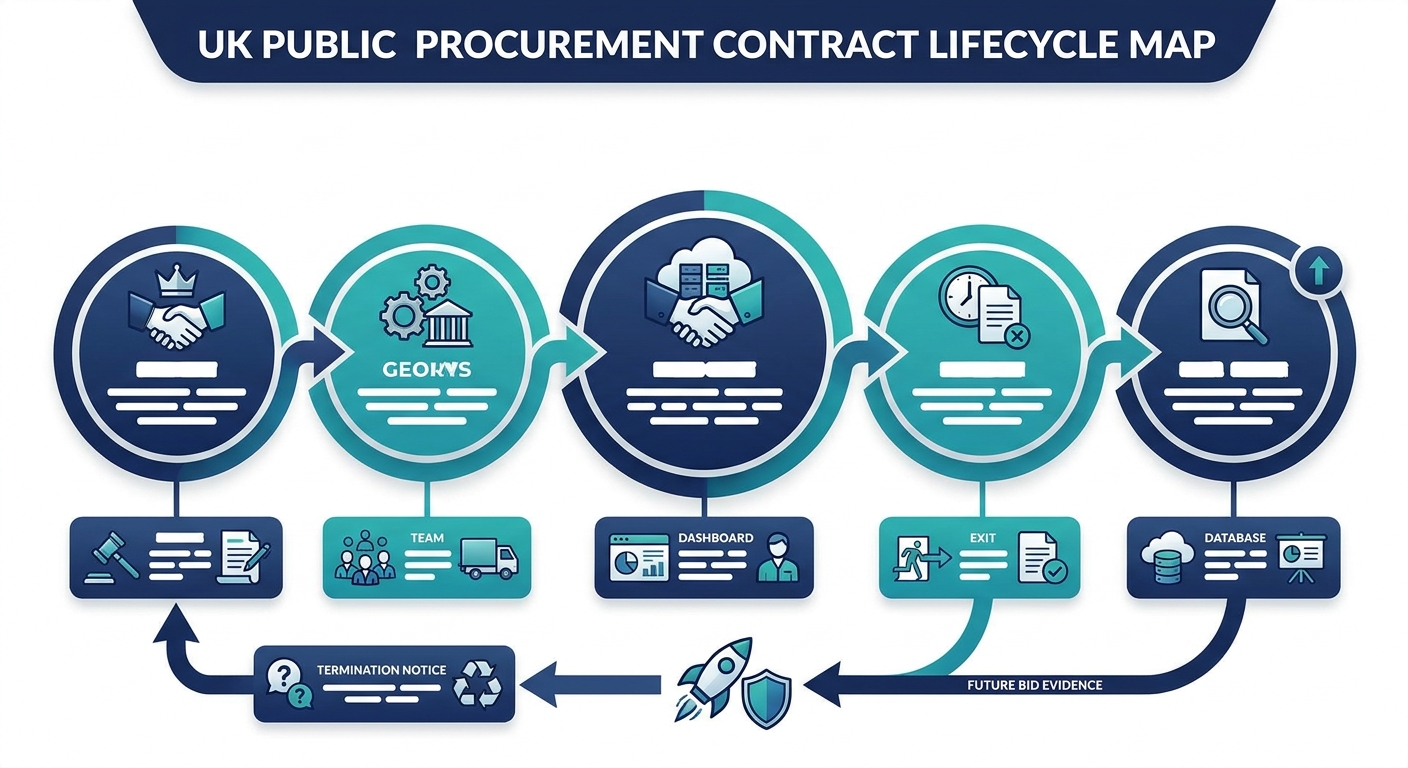
Contract lifecycle map from tender award to delivery, exit and future bid evidence
Natural expiry versus early termination
Not every termination is negative.
Most contracts end because they reach their planned expiry date. The buyer may re-procure, extend, bring services in-house, combine lots, change scope or move to a different framework. A termination notice in that context is simply part of contract administration.
The risk comes when future readers cannot tell the difference between a planned end and a problematic exit, or when the public record creates questions the supplier is not ready to answer.
A planned expiry should still be managed carefully. You want the buyer to remember you as organised, helpful and professional. You want final reports to be accurate. You want outstanding actions closed. You want social value commitments evidenced. You want contract performance data reconciled. You want disputes resolved or clearly recorded. You want the incoming supplier to receive usable information. You want your internal team to preserve a clean case study.
Early termination needs more care.
A contract may end early for reasons outside supplier performance. Funding may disappear. The buyer may restructure services. A policy change may make the contract unnecessary. A new statutory duty may require a different model. Demand may fall. A pilot may finish. A larger framework may replace a local arrangement.
But early termination can also be linked to poor performance, breach, insolvency, repeated KPI failure, safety concerns, loss of confidence, non-compliance, data issues, relationship breakdown or inability to deliver the contracted scope.
From a bid perspective, the label matters less than the explanation. If there is an early end, you need a documented, consistent and evidence-backed account of what happened. That account should be agreed internally between operations, commercial, legal and bid teams. Otherwise future tender responses will be inconsistent, vague or defensive.
The best suppliers create a contract exit summary for every material public sector contract. It should cover why the contract ended, whether it was planned or early, what obligations were completed, what performance looked like, what risks were managed, what lessons were learned and what evidence can safely be reused in future bids.
What evaluators may infer from a termination history
Evaluators rarely score termination notices directly in isolation. They use available information to build confidence or doubt.
If your organisation has a clean record of completing contracts, handing over well and resolving issues maturely, your claims about governance feel more believable. If your record contains avoidable disruption, missed exit obligations or unexplained early endings, your claims need more proof.
An evaluator may infer several things from a termination history.
They may infer delivery reliability. A supplier that repeatedly reaches natural expiry with good performance has a stronger story than one that regularly exits early under pressure.
They may infer governance maturity. Clean termination suggests that the supplier has contract controls, escalation routes, record keeping and senior oversight. Chaotic exit suggests the opposite.
They may infer data discipline. Contract close-out relies on good information: asset registers, TUPE data, service records, performance reports, compliance documents, licence records, subcontractor details and customer communications. If those records are poor at exit, the buyer may question the supplier’s day-to-day management.
They may infer cultural fit. Suppliers show their character when they are leaving. A supplier that remains constructive after losing a re-bid looks safer than one that becomes obstructive, slow or argumentative.
They may infer risk to mobilisation. If you are bidding as an incoming supplier, the buyer knows an incumbent exit can make or break mobilisation. If your own exit record is poor, your mobilisation assurances are less convincing.
This is why termination is not just a legal endpoint. It is reputation evidence.
How to write stronger exit plans in tenders
A strong exit plan is specific without being over-engineered.
It should give the evaluator confidence that you understand the practical end of the contract. That means moving beyond warm words about collaboration and setting out a controlled process.
Start with triggers. Explain when the exit plan is created, reviewed and activated. For a multi-year public contract, the exit plan should not be written in the final quarter. It should be created during mobilisation, reviewed annually and updated whenever there is a material change to scope, assets, systems, subcontractors or personnel.
Then describe governance. Name the roles involved: contract manager, buyer lead, finance owner, data owner, HR or TUPE lead, asset lead, subcontractor lead, information security owner and senior sponsor. Explain how decisions are logged, risks are escalated and open actions are tracked.
Next, cover information. Buyers worry about data because poor data creates mobilisation pain for the next supplier. Your response should say what records you will maintain, how frequently they will be updated, what format they will be provided in, how accuracy will be checked and how confidential information will be protected.
Then cover people. If TUPE may apply, explain how employee liability information will be managed, how consultation support will work, and how continuity will be protected without breaching confidentiality or employment obligations. Even where TUPE is not relevant, explain how key knowledge will be transferred.
Then cover assets and systems. If you manage equipment, stock, buildings, software, licences, vehicles, documents, keys, passes or devices, show how they will be identified, reconciled, returned, transferred or decommissioned.
Then cover service continuity. Buyers want to know the exit period will not become a service cliff edge. Explain how service levels will be maintained, how incident response will continue, how customer communications will be handled and how disputes will be managed.
Finally, cover evidence and lessons learned. A professional exit should produce a final report: performance summary, KPI record, improvement activity, social value delivery, unresolved issues, risk log, buyer feedback and recommendations for future service design.

Exit evidence pack for a public sector contract close-out meeting
The evidence to collect before a contract ends
A termination notice may tell the market that a contract ended. Your evidence explains how it ended.
The evidence should not be assembled in panic. It should be collected throughout the contract.
For bid teams, the most valuable evidence usually falls into eight groups.
The first is KPI performance. Keep the full performance record, not only the highlights. Buyers trust balanced evidence more than perfect claims. If performance dipped, show the recovery action and the sustained improvement.
The second is governance. Keep agendas, action logs, escalation records, service review minutes and examples of decisions made jointly with the buyer. This proves that the contract was actively managed.
The third is change control. Keep a clear record of scope changes, contract variations, service redesign, price adjustments and agreed deviations. This helps explain why outcomes changed over time.
The fourth is social value and sustainability. Keep the evidence, not just the claim. Apprenticeships, local spend, volunteering, carbon reduction, waste reduction, community activity and supplier diversity need measurable proof.
The fifth is complaints and issue resolution. A contract with no recorded issues can look unrealistic. A contract with issues handled well can be a strong case study.
The sixth is mobilisation and demobilisation activity. If you can prove you started well and exited well, you have evidence for both ends of the tender lifecycle.
The seventh is buyer feedback. Capture formal feedback where available, but also preserve approved testimonials, reference permissions and agreed wording for case studies.
The eighth is lessons learned. This is often the most overlooked. Future evaluators want to know that suppliers improve. A documented lessons-learned process turns difficulty into maturity.
mytender.io helps bid teams by turning scattered contract evidence into reusable, governed content. Instead of hunting through old folders, email chains and outdated SharePoint libraries, teams can build a living evidence base that supports future responses. That is especially useful where Procurement Act transparency creates more questions about contract performance and exit history.
How to respond if a past contract ended badly
Some contracts end badly. Pretending otherwise is usually a mistake.
A weak response tries to hide the issue, blames the buyer, or uses vague language like commercial reasons. That may get through a light-touch question, but it will not survive proper clarification, reference checking or evaluator scrutiny.
A stronger response is controlled, factual and improvement-led.
Start with context. Explain the contract, scope and reason the exit became difficult. Keep the tone calm. Do not write like you are arguing a legal case unless the tender specifically requires one.
Then separate what was within your control from what was not. If the buyer changed scope, demand shifted, the incumbent data was poor, or a funding decision changed the model, say so with evidence. If your own controls failed, acknowledge the issue clearly.
Then explain mitigation. What did you do to protect service users, the buyer, staff, subcontractors, data, assets and continuity? Who was involved? How quickly did you act? What governance was put in place?
Then explain outcome. Did the buyer accept the exit plan? Were services maintained? Were assets transferred? Were final accounts resolved? Were lessons captured? Was there a dispute? If so, what is the current status?
Then explain what changed. This is the most important part. Buyers are not only assessing the past. They are assessing whether the same risk could happen to them. New controls, improved mobilisation checks, strengthened contract review, better risk triggers, clearer ownership, upgraded data management and stronger senior oversight all matter.
A bad ending does not automatically make you a bad supplier. A bad ending that you cannot explain makes you a risky one.
Building termination readiness into your bid process
Termination readiness starts before submission.
When you review a tender, identify the exit obligations early. Do not leave them to legal at the end. Look for requirements on data transfer, TUPE, asset handover, system access, exit plans, intellectual property, licences, subcontractor continuity, final reporting, disposal, destruction, archiving, payment, dispute resolution and cooperation with an incoming supplier.
Then test whether your operational model can support those obligations. If the buyer wants monthly asset data, can your system produce it? If the buyer wants an exit plan updated every six months, who will update it? If the buyer wants social value outcomes reported at contract close, where will the evidence live? If the buyer wants support for a new supplier, what resource is included in the price?
Build the answer into your bid governance.
A simple termination-readiness checklist should sit alongside your compliance matrix, risk register and commitment register. It should ask:
- What exit obligations are stated in the tender or draft contract?
- Which obligations affect cost, resource, systems, data, staff or subcontractors?
- Which commitments are we making voluntarily in the response?
- Who owns each commitment after award?
- What evidence will prove compliance during the contract?
- What could create a poor termination record?
- How will we protect future case study value?
This is not bureaucracy. It is bid insurance.

Tender risk register showing contract termination readiness, evidence owners and exit obligations
How incoming suppliers should use termination information
Contract Termination Notices are not only about your own record. They can also help when you are bidding to replace someone else.
If a current contract is ending, ask what the ending tells you. Is it natural expiry, early termination, insourcing, re-scoping, consolidation, budget pressure or dissatisfaction with the current model? Has the buyer published performance information? Are there contract change notices, award notices, payment data or public reports that explain the story?
That intelligence should shape your bid.
If the incumbent struggled with mobilisation, show a stronger implementation plan. If the buyer is ending a contract because outcomes were unclear, show better KPIs. If the contract was terminated because demand changed, show flexibility. If the buyer is moving from single-service lots to an integrated model, show governance across interfaces. If the buyer is insourcing part of the service, show how your offer supports retained teams rather than replacing them clumsily.
Do not overplay it. Evaluators dislike suppliers that attack incumbents without evidence. The smarter move is to show that you understand the buyer’s risk and have designed a safer transition.
This is where AI-assisted tender analysis can help. A purpose-built bid platform can review tender documents, public notices and your internal evidence base together. The value is not generic drafting. The value is connecting buyer signals with the proof your team already has.
Sector examples: where termination evidence matters most
Termination risk looks different by sector.
In facilities management, exit quality often depends on asset records, PPM history, helpdesk data, statutory compliance, subcontractors, TUPE and site knowledge. A poor FM exit can disrupt buildings quickly. A strong exit proves operational discipline.
In construction, termination may involve incomplete works, design responsibility, warranties, defects, retention, health and safety files, building safety information, programme delay, materials, plant and subcontractor claims. Future bids need to show lessons learned and robust project controls.
In healthcare and care services, termination can affect vulnerable people, clinical interfaces, safeguarding, staffing continuity, information governance and family communications. Buyers will be highly sensitive to service disruption.
In waste and environmental services, contract exit may involve fleet, depots, route data, container ownership, permits, customer communications, contamination records and service continuity across collection rounds.
In IT and digital services, exit risk sits around data migration, cyber security, licences, integrations, access control, documentation, knowledge transfer, service desk continuity and vendor lock-in.
In professional services, termination evidence is often about knowledge transfer, document quality, stakeholder relationships, conflicts, confidentiality and maintaining momentum on complex programmes.
The common thread is this: every sector has termination risks that should be visible in the tender response. If you write the same generic exit paragraph for all of them, you are leaving marks on the table.
The bid library problem
Most suppliers already have the raw material for strong termination answers. It is just scattered.
Operations has service review packs. Finance has final account information. HR has TUPE data. Legal has contract correspondence. Sustainability has social value evidence. Contract managers have lessons learned. Sales has buyer feedback. The bid team has old case studies. Nobody has the whole story.
That is why termination evidence often disappears.
By the time the next tender asks for a contract exit example, the contract manager has moved on, the folder structure has changed, the buyer contact has left, and the bid writer is left with a thin paragraph from an old response.
The fix is to treat contract close-out as a bid library event.
When a public sector contract ends, create a reusable record. Capture the scope, buyer, dates, reason for ending, exit activities, performance data, challenges, outcomes, evidence links, approved references and lessons learned. Tag it by sector, service line, buyer type, contract value, risk theme and tender section.
Then make it searchable.
This is exactly the kind of work mytender.io is built to support. Bid teams should not have to rebuild corporate memory every time a tender asks for evidence. A governed content library lets teams find the right proof, check it is current and adapt it into a stronger answer quickly.

AI bid library connecting contract close-out evidence to future tender responses
A practical supplier action plan
If you want to get ahead of Contract Termination Notices, start with five actions.
First, audit your live public sector contracts. Identify which ones are due to end in the next 24 months, which may be re-procured, which are at risk of early termination and which could become important case studies.
Second, review exit obligations. Check the contract, schedules, tender response and any later variations. Make sure you know what you promised.
Third, build exit evidence now. Do not wait until the final quarter. Gather KPI history, governance records, social value proof, risk logs, change records and buyer feedback while people still remember the detail.
Fourth, create a standard contract exit summary. Make it short enough that contract managers will complete it and structured enough that bid teams can use it. The output should support future tender answers, references and case studies.
Fifth, update your bid templates. Your exit plan answer should reflect the Procurement Act transparency environment. It should show lifecycle thinking, evidence discipline and contract management maturity.
The suppliers that do this well will have a quieter advantage. They will not just say they manage contracts professionally. They will prove it from award to exit.
How mytender.io helps
Procurement Act transparency rewards suppliers that can find, trust and reuse their evidence.
That is hard when contract information lives across SharePoint folders, email chains, spreadsheets, old tender responses and individual laptops. It is even harder when bid teams are under time pressure and need to answer a live tender quickly.
mytender.io helps teams bring structure to that mess. The platform can help bid teams analyse tender requirements, break down what the buyer is really asking for, retrieve relevant past evidence and turn it into first drafts that are grounded in the organisation’s actual record.
For contract termination and exit planning, that matters because the best answer is rarely a generic policy. The best answer is a credible operating model backed by real proof: named roles, clean records, performance data, handover processes, lessons learned and examples of past exits.
AI should not invent that evidence. It should help your team find it, organise it and write from it.
That is the difference between a thin exit paragraph and a bid response that gives evaluators confidence.
Final thought
Contract Termination Notices are easy to underestimate because they arrive at the end of the contract. But for suppliers, they sit at the beginning of the next opportunity.
A public contract does not finish when the last invoice is paid. It finishes when the buyer has received the service, the records are complete, the risks are closed, the handover is controlled, the evidence is preserved and the lessons have been turned into better future bids.
That is the standard modern public procurement is moving towards.
Bid teams that understand this will write better exit plans, manage cleaner contract endings and build stronger evidence for the next competition. Bid teams that ignore it will keep treating termination as admin and then wonder why future evaluators are not convinced.
The contract ending is part of your sales story now. Treat it like one.
Tags
Ready to Transform Your Tender Writing?
See how MyTender's AI can help you write winning tenders in a fraction of the time.