
Contract Details Notices: How Suppliers Can Turn Award Data Into Better Tender Strategy
A practical guide for UK suppliers on using Contract Details Notices, award data and procurement transparency to build pipeline, study incumbents and prepare stronger bids.
mytender.io Research Team
Tender Writing & Procurement Specialists
Contract Details Notices: How Suppliers Can Turn Award Data Into Better Tender Strategy
Most suppliers look at public procurement data when a tender is live.
That is useful, but it is late.
The better habit is to study what buyers have already awarded. Not because you can change the result. You cannot. The value is in what the award tells you about buyer behaviour, incumbent strength, pricing direction, contract length, renewal timing and the kind of evidence that is likely to matter next time.
A Contract Details Notice is one of the most practical pieces of public procurement intelligence available to suppliers under the Procurement Act 2023 regime. It sits after award, but before the next opportunity. That makes it a bridge between what has happened and what your bid team should prepare for.

Supplier team reviewing Contract Details Notices on a procurement intelligence dashboard
If your team only watches new Tender Notices, you see the market at the point everyone else sees it. If you also watch Contract Details Notices, you start building context months or years before the next competition.
This guide explains what Contract Details Notices are, why they matter to suppliers, and how to turn award data into a better bid pipeline, stronger account strategy and sharper tender responses.
It is not legal advice. It is a practical supplier playbook.
What Is a Contract Details Notice?
A Contract Details Notice is a post-award notice used under the Procurement Act 2023 framework.
In plain English, it tells the market that a public contract has been entered into and gives useful details about it. Depending on the contract and the notice, that can include the buyer, supplier, contract title, value, procurement route, award date, contract start and end dates, options, lots, classification codes and links to related notices.
For suppliers, the important point is simple: this is not just admin after the race is over. It is market data.
A Contract Award Notice tells you who the buyer intends to award to. A Contract Details Notice helps confirm the contract that has actually been entered into. Together, these notices create a clearer picture of who is winning, what buyers are buying, how contracts are structured and when the next commercial window may open.
That matters because public sector bidding is not a collection of isolated deadlines. It is a market with patterns. Buyers renew services. Frameworks create call-off behaviour. Incumbents build relationships. Contract values move. Delivery problems trigger changes. Performance notices create evidence. Termination notices create new opportunities.
Contract Details Notices help you see those patterns earlier.
The mistake is treating them as something for procurement lawyers, data teams or bid portals to file away. A good bid team should be reading them as commercial intelligence.
Why Contract Details Notices Matter More in 2027
The Procurement Act has pushed the market toward greater lifecycle transparency. Suppliers are no longer looking only at the moment of tender. They can track a wider chain of signals: Pipeline Notices, Preliminary Market Engagement Notices, Planned Procurement Notices, Tender Notices, Transparency Notices, Contract Award Notices, Contract Details Notices, Contract Change Notices, Contract Performance Notices and Contract Termination Notices.
That is a lot of notices. It can feel like noise.
But the noise becomes useful when you know what each notice is for.
Contract Details Notices are valuable because they show what the buyer actually committed to. This is where strategy becomes more concrete. A Pipeline Notice might tell you a buyer expects to buy facilities management services next year. A Tender Notice tells you the competition is live. A Contract Details Notice tells you who won, for how much, for how long, and often under what structure.
That information feeds three supplier decisions.
First, should this buyer go into your future pipeline? If the contract matches your offer, geography, value range and sector focus, it may be worth tracking for the next renewal, extension, framework refresh or related service.
Second, what does the result teach you about the buyer? The award may reveal whether the buyer prefers bundled services, smaller lots, long contracts, short pilots, incumbent continuity, specialist providers, regional delivery or framework routes.
Third, what should you prepare now? If a four-year contract has just been awarded in your target sector, waiting three and a half years to learn about it is daft. The next competition starts now from an intelligence point of view.
Public procurement transparency only helps suppliers who turn it into action.
The Commercial Questions a Notice Can Answer
A Contract Details Notice will not tell you everything. It will not usually reveal the full winning response. It will not tell you every evaluator comment. It may not expose all pricing assumptions or delivery risks.
But it can still answer useful commercial questions.
Who won the contract? That tells you the incumbent you may need to beat next time, partner with, avoid, or benchmark against.
Which buyer awarded it? That tells you whether the opportunity sits in a target account, target region or target framework ecosystem.
What was the contract value? That gives you a rough sense of contract scale, buyer budget and whether the opportunity fits your business model.
How long is the contract? That helps you estimate renewal timing and decide when to start account development.
Are there extension options? That changes the likely next competition date and the incumbent's runway.
Was the contract divided into lots? That tells you whether the buyer is open to specialist suppliers, SME participation, regional competition or service separation.
Which procurement route was used? That helps you understand whether future work may appear as an open procedure, competitive flexible procedure, framework call-off, dynamic market opportunity or direct award.
What classification codes were used? That helps you refine alerts, category tracking and search terms.
Were related notices published? That lets you trace the whole story from early market engagement to tender, award, contract detail, change and performance.
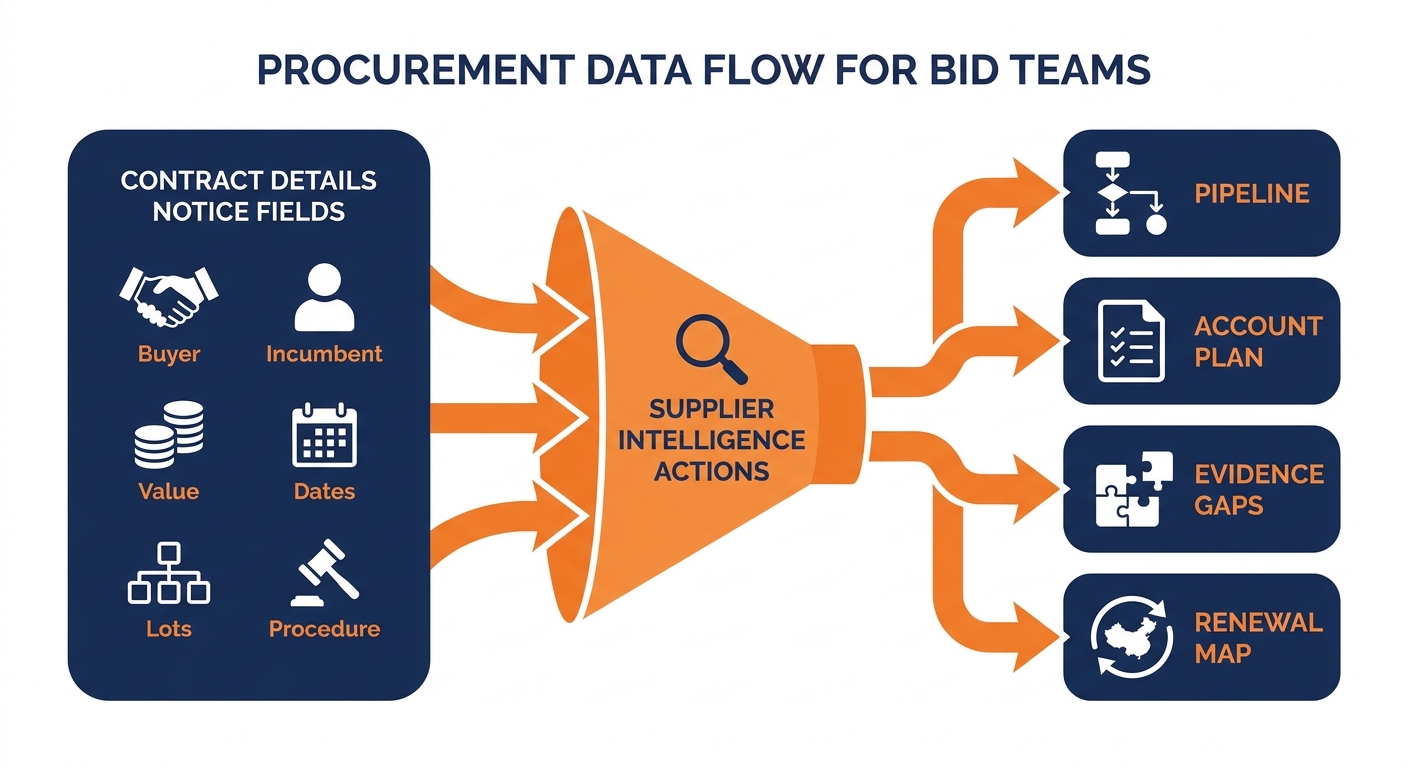
Flow diagram showing how Contract Details Notice fields become supplier intelligence actions
None of those questions wins a tender by itself. Together, they give your team a better map of the market.
How to Read a Contract Details Notice Like a Bid Team
Most people read notices like records. Bid teams should read them like clues.
Start with the buyer and contract title. Ask whether this is a target buyer, a target sector, a target geography or a related service. If the answer is no, the notice may only be useful for market context. If the answer is yes, it should go into your pipeline intelligence system.
Then look at the supplier. Is the winner an incumbent you already know? A national provider? A regional specialist? A consortium? A framework supplier? A new entrant? The type of winner tells you something about the buyer's appetite for scale, specialism, risk and relationship continuity.
Next, study the value. Do not treat it as perfect pricing intelligence. Published contract values can include extensions, options, VAT, multiple lots or estimated spend. Still, value matters. It can show whether a buyer is buying a premium service, consolidating multiple requirements, running a small pilot, or breaking work into accessible lots.
Now check the dates. Contract start, end and extension periods are pipeline gold. If a contract runs for three years plus two optional one-year extensions, your team should not create one reminder for the final possible end date. You should track the earliest break point, extension decision windows, performance review points and likely reprocurement lead time.
Finally, follow the notice trail. A Contract Details Notice makes more sense when read alongside the Tender Notice, award notice, any clarification history you captured, later change notices and performance notices. The story is rarely in one record.
The habit to build is simple: every relevant Contract Details Notice should produce a next action. Add to pipeline, monitor incumbent, research buyer, prepare evidence, review account plan, track extension window, or deliberately ignore.
No action means no value.
Turning Award Data Into Pipeline
Tender pipeline is often built from future notices. That is necessary, but incomplete.
Award data should sit beside it.
A live tender tells you where to bid now. A Contract Details Notice tells you where to prepare for later. That difference matters for capacity planning, especially in sectors where contracts renew predictably: facilities management, cleaning, security, waste, grounds maintenance, construction frameworks, consultancy, technology services, transport and healthcare support.
The simplest workflow is a renewal map.
For each relevant Contract Details Notice, record the buyer, service, supplier, value, start date, end date, extension options, procurement route, lots, region, category and source link. Then assign a future review date. That review date should come well before expiry. For complex services, 12 to 18 months before the earliest possible renewal is not excessive. For smaller contracts, six to nine months may be enough.
Why so early?
Because the next tender may be shaped long before publication. The buyer may run preliminary market engagement. They may publish a Pipeline Notice. They may review incumbent performance. They may test a new lotting strategy. They may decide whether to extend or reprocure. If you appear only when the Tender Notice is live, you are late to the thinking.
A good renewal map also helps with bid capacity. If you can see that four target contracts are likely to return in the same quarter, you can plan subject matter expert time, pricing support, site visits, governance and evidence refreshes before the team is overloaded.
This is where procurement data becomes operational planning. Not a spreadsheet graveyard. A living bid calendar.
Understanding the Incumbent Advantage
The incumbent has natural advantages.
They know the buyer. They know the service. They may have performance data, relationships, site knowledge, mobilisation lessons and a credible story about continuity. If they have delivered well, they can write with confidence.
But Contract Details Notices help challengers close part of the information gap.
You can identify who the incumbent is. You can estimate how long they have been in place. You can check whether the contract has been modified. You can watch for performance notices. You can look for related lots or neighbouring services. You can study the buyer's public strategy. You can prepare a challenger narrative long before the rebid.
That does not mean attacking the incumbent blindly. Evaluators do not reward vague claims that you are better. They reward evidence that you understand the contract, the buyer's risk, the transition plan and the outcomes that matter.
For a challenger, the strongest angle is usually not disruption for its own sake. It is controlled improvement.
That might mean a better mobilisation plan, stronger reporting, lower transition risk, clearer social value delivery, more credible staffing, sharper KPI governance, stronger supply chain control, better technology adoption, or a more transparent continuous improvement model.
The notice tells you where the incumbent relationship started. Later notices and market research tell you how it is evolving. Your job is to turn that into a bid strategy that feels specific, not generic.
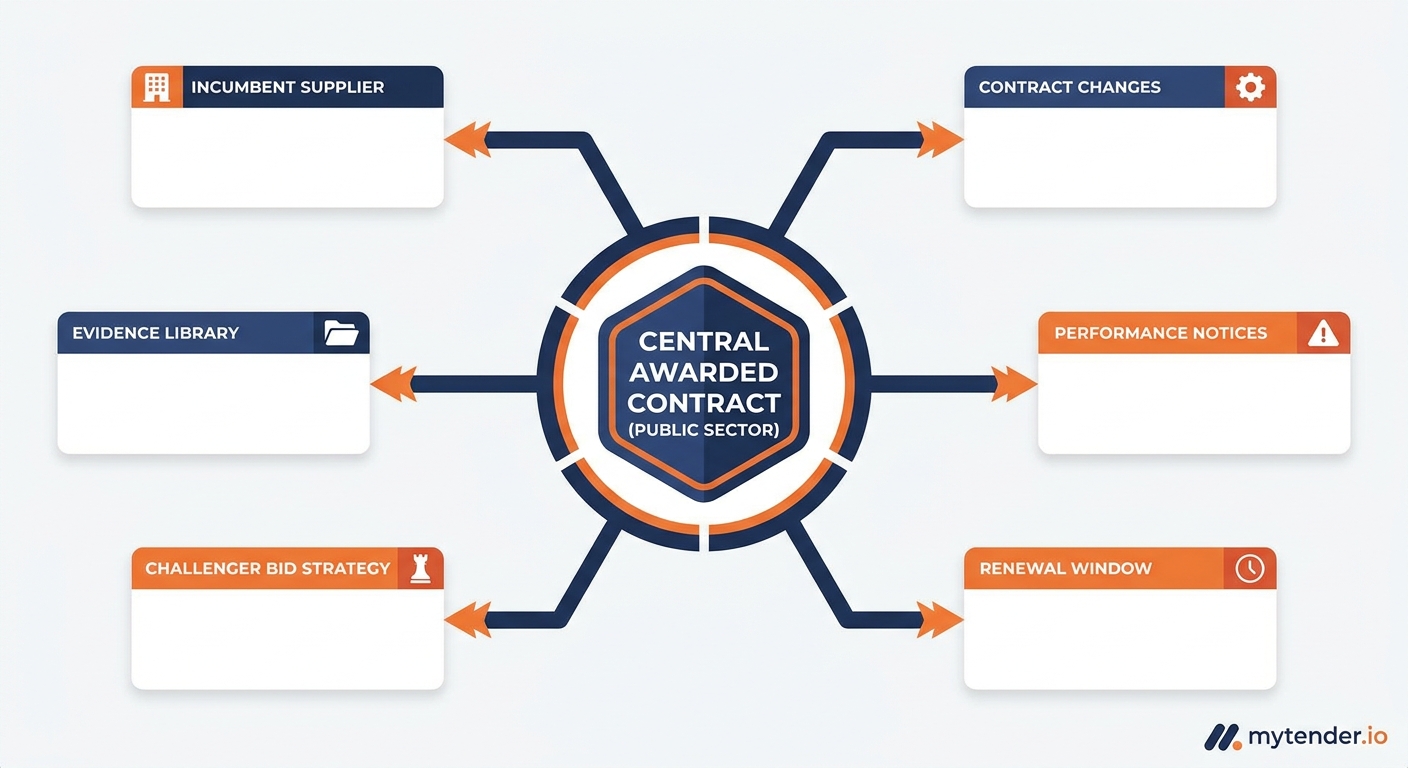
Incumbent intelligence map showing contract details, change notices, performance data and challenger bid strategy
What Incumbents Should Do With Their Own Notices
Incumbents should read Contract Details Notices too.
It is easy to assume the work is done once the contract is awarded. In reality, the rebid starts on day one of delivery. The public record now shows that you hold the contract. Competitors can track the value, term, scope and renewal window. If you are not preparing your evidence throughout delivery, they may be preparing harder than you are.
Incumbents should use the Contract Details Notice as the starting point for a rebid evidence file.
Capture the baseline. What did the buyer buy? What outcomes were promised? What KPIs matter? What mobilisation risks existed? What social value commitments were made? What contract management rhythm was agreed? What assumptions were built into pricing?
Then document delivery against that baseline. Keep monthly or quarterly evidence. Record performance improvements, savings, complaints resolved, innovations delivered, service changes, risk reductions, social value outputs, carbon improvements, user satisfaction, supply chain performance and lessons learned.
The goal is not to create a glossy case study at the end. The goal is to build evidence while the contract is live.
When the buyer reprocures, your strongest response should be full of measured proof: here is what we promised, here is what we delivered, here is what changed, here is what we learned, and here is how the next contract can be better.
If you cannot say that clearly, the incumbent advantage gets weaker.
Using Notices to Spot Account Expansion
Contract Details Notices can also reveal adjacent opportunities.
A buyer that awards a cleaning contract may later need security, maintenance, waste, helpdesk support, grounds maintenance or full integrated FM. A council that awards a waste collection contract may later procure fleet maintenance, recycling education, depot works, digital tracking or environmental consultancy. A healthcare buyer awarding estates work may also need compliance surveys, backlog maintenance, decarbonisation support or specialist consultancy.
The notice is a prompt to ask: what sits around this contract?
That question matters because many public sector opportunities are connected. The contract you see today may not be the one you bid next. It may point to a buyer strategy, budget pressure, service transformation or operational problem that creates other competitions.
Build a simple account expansion view. For each target buyer, map the contracts they have recently awarded in your category and neighbouring categories. Look for repeated suppliers, repeated frameworks, repeated routes and repeated pain points. Then decide where your offer fits.
This is especially useful for SMEs. You may not be ready to bid the largest integrated contract, but you may be perfect for a specialist lot, subcontracting role, local service, niche consultancy package or framework call-off. Contract Details Notices help you see the ecosystem.
Common Mistakes Suppliers Make
The first mistake is ignoring post-award notices because the opportunity has already gone. That is too narrow. Today's award is tomorrow's pipeline.
The second mistake is treating contract value as exact competitor pricing. It rarely is. Use it as a directional signal, not a perfect margin model.
The third mistake is tracking only the final expiry date. Extension options, break clauses, performance issues and buyer planning cycles can all shift the real opportunity window.
The fourth mistake is failing to connect notices. A Contract Details Notice becomes far more useful when linked to earlier tender documents and later change, performance or termination notices.
The fifth mistake is collecting data without assigning ownership. If nobody owns the account, the insight dies in a spreadsheet.
The sixth mistake is waiting too long to prepare evidence. If a target contract ends in 18 months, your team should already know what proof it needs to win: case studies, KPI records, mobilisation examples, staffing evidence, social value outputs, pricing assumptions and partner options.
The final mistake is confusing intelligence with action. Knowing the incumbent is not enough. Knowing the value is not enough. Knowing the end date is not enough. The value comes from what you do next.
A Practical Workflow for Bid Teams
Create a weekly notice review. Keep it short. The purpose is not to read every notice in the country. The purpose is to capture relevant awards in your sectors, regions and target accounts.
Classify each notice into one of four groups.
First, strategic target. These are contracts you definitely want to track for future competition or account development.
Second, watchlist. These are relevant, but not yet strong enough to justify active work.
Third, competitor intelligence. These show what key rivals are winning, even if the buyer is not a current target.
Fourth, ignore. These are outside your market, too small, too large, geographically wrong, or irrelevant.
For strategic targets, create an action record. Assign an owner. Capture the contract facts. Link related notices. Add review dates. Identify the likely rebid window. Research the buyer's public strategies. Note the incumbent. List evidence gaps. Decide whether to start engagement, partner research or content preparation.
For watchlist items, set a lighter review. You might revisit quarterly or when a change notice appears.
For competitor intelligence, look for patterns. Are they winning certain regions? Are they appearing on specific frameworks? Are they winning larger lots than before? Are they moving into your category?
For ignored notices, be disciplined. Not every data point deserves attention. A useful intelligence system is selective.
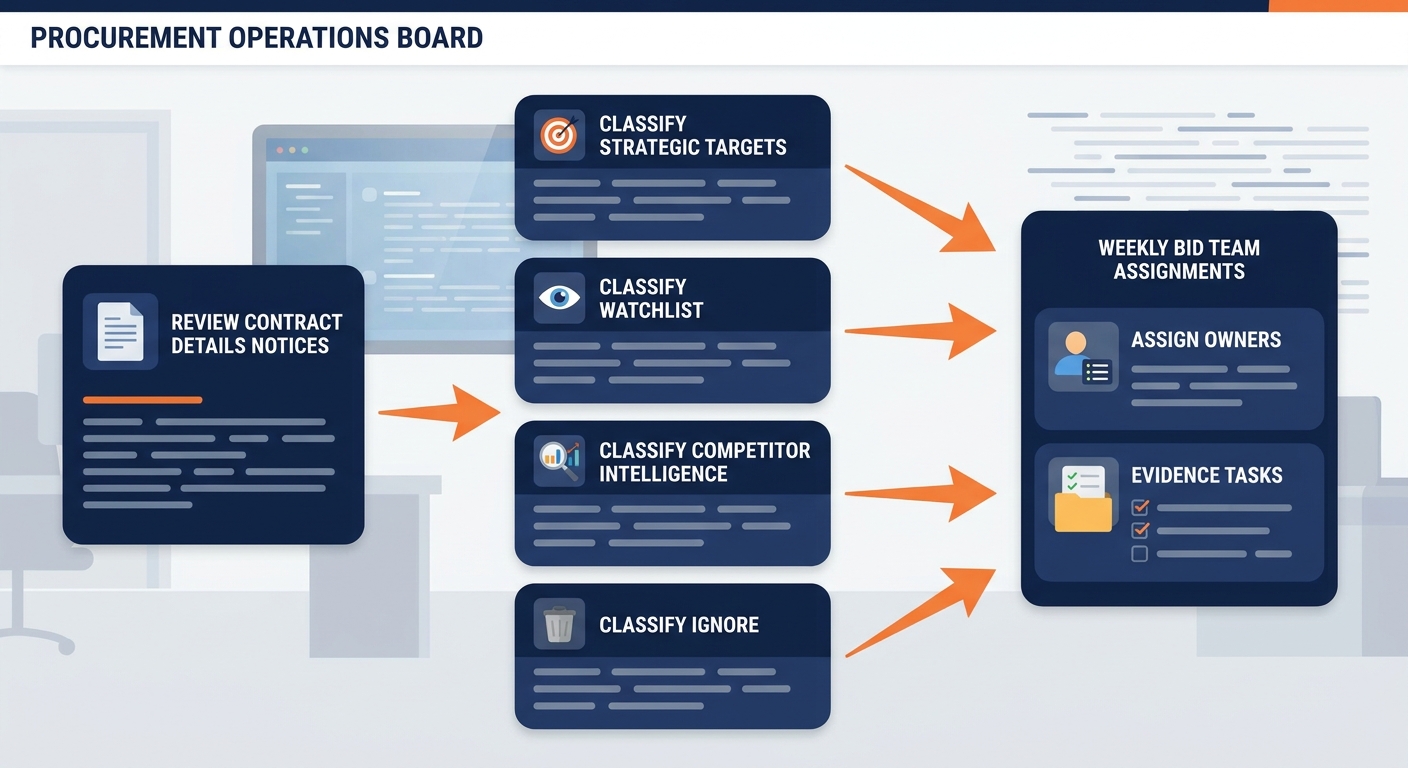
Weekly workflow for turning Contract Details Notices into pipeline actions, account plans and evidence tasks
How mytender.io Helps Turn Notice Data Into Bid Readiness
The hard part is not finding a notice once. The hard part is turning notice intelligence into better responses months later.
That means bid teams need a way to connect market signals with evidence, content and workflow. Otherwise the same thing happens every time: someone spots a useful contract, adds it to a tracker, then everyone forgets until the tender is live.
mytender.io helps teams build a more useful bridge between intelligence and response. You can organise past answers, surface relevant evidence, analyse requirements, build first drafts from approved material, check compliance and coordinate the people involved in the bid.
For Contract Details Notices, the upstream benefit is readiness. If you know a target contract is likely to return, you can start preparing the evidence library before the document pack arrives. You can gather case studies, improve policy answers, update social value proof, prepare mobilisation narratives and identify gaps in your current content.
Then, when the tender lands, your AI-supported drafting is not generic. It is grounded in your own material and shaped by the market intelligence you have been collecting.
That is the grown-up version of AI in bidding. Not last-minute filler. Better preparation, better evidence and faster tailoring.
A Contract Details Notice Checklist
When a relevant Contract Details Notice appears, ask these questions.
Who is the buyer, and is the buyer strategically important? What was bought, and does it match your offer? Who won, and are they an incumbent, competitor, partner or new entrant? What is the value, and is it within your target range? What is the contract start date, end date and extension structure? Which lots were awarded, and could future lotting create an opportunity? Which procedure or framework route was used? What related notices exist? When should your team review the account again? What evidence would you need to beat the incumbent next time? Who owns the next action?
If you cannot answer those questions, do not just bookmark the notice. Investigate it.
The Bottom Line
Contract Details Notices are not exciting on the surface. They are administrative, structured and easy to skim past.
That is exactly why they are useful.
Most suppliers are distracted by live deadlines. The teams that build advantage look earlier and later. Earlier means Pipeline Notices, market engagement and planned procurement signals. Later means award data, contract details, changes, performance and termination signals.
A Contract Details Notice tells you what a buyer has just committed to. Read properly, it also tells you where to build relationships, when to prepare, which incumbents to study, what evidence to strengthen and how to plan the next bid before the market wakes up.
If you want to see live opportunities matched to your sector while you build longer-term pipeline intelligence, the Tender Finder is free to use.
The strongest bid teams do not wait for tenders. They study the market between tenders. Contract Details Notices are one of the best places to start.
Tags
Ready to Transform Your Tender Writing?
See how MyTender's AI can help you write winning tenders in a fraction of the time.