
Contract Award Notices: How Suppliers Can Turn Public Procurement Results Into a Better Bid Strategy
A practical supplier guide to using Contract Award Notices for win/loss analysis, competitor tracking, rebid planning and better public sector tender strategy under the Procurement Act.
mytender.io Research Team
Tender Writing & Bid Management Specialists
Contract Award Notices: How Suppliers Can Turn Public Procurement Results Into a Better Bid Strategy
Contract Award Notices are not just procurement admin. They are one of the most useful sources of bid intelligence available to suppliers in 2026.
Under the Procurement Act 2023, UK public procurement is becoming more transparent across the full lifecycle. Suppliers now have more public signals to work with: pipeline notices, preliminary market engagement notices, tender notices, contract award notices, contract details notices, contract performance notices and payment compliance notices. Most bid teams notice the opportunity notices. Fewer use the award notices properly.
That is a missed advantage.
A Contract Award Notice tells you who won, what they won, who bought it, which route was used, when the award decision happened and, depending on the notice and procurement, useful clues about value, lot structure, standstill timing and the shape of the competition. One notice will not give you a full competitor strategy. Fifty notices, reviewed consistently, will.

Bid team reviewing public contract award notices on a digital procurement dashboard
For suppliers that bid regularly, this is where procurement transparency becomes practical. Award notices help you spot repeat winners, identify active buyers, understand incumbent movement, improve bid/no-bid decisions and build a stronger evidence base for the next response. They also turn losses into learning faster than waiting for a formal debrief alone.
This guide explains how to use Contract Award Notices as a repeatable win/loss analysis process, what to record, what signals matter, and how AI-powered bid teams can turn public procurement results into sharper tender strategy.
Why Contract Award Notices matter now
Public procurement has always produced traces. Award notices existed before the Procurement Act, and experienced commercial teams have long watched them to understand market movement. What has changed is the direction of travel. The new regime places heavier emphasis on transparency, published procurement information and lifecycle accountability.
That matters because bid teams can no longer treat tendering as a series of isolated submissions. A tender is part of a visible market. Buyers publish plans. They engage the market. They advertise requirements. They award contracts. For larger contracts, they may publish performance information later. Each stage creates intelligence.
Contract Award Notices sit at the point where speculation becomes evidence. Before award, you may think a buyer values price over mobilisation quality. You may suspect an incumbent is vulnerable. You may believe a competitor is expanding into a new region. After award, you can start testing those assumptions.
A good award notice review can answer questions like:
- Which competitors are winning similar work?
- Are buyers consolidating lots or splitting them to increase SME access?
- Are contracts being awarded to incumbents or challengers?
- Which authorities are repeatedly buying a service you deliver?
- Which frameworks or procedures are producing opportunities in your market?
- Where did you lose, and what patterns are emerging across losses?
- Which accounts should sales, bid and marketing teams prioritise next?
That is useful for every supplier, but especially for organisations with limited bid capacity. If you can only pursue a fraction of the tenders you find, you need better evidence about where you are likely to win. Award notices are one of the best ways to build that evidence without waiting months for internal anecdotes to accumulate.
What a Contract Award Notice can tell you
A Contract Award Notice is a public record that a contracting authority intends to, or has decided to, award a contract. The exact fields can vary, and the surrounding notices matter, but a notice often gives you enough information to improve your market map.
At minimum, you are usually looking for the buyer, the supplier, the contract title, the procurement reference, the value, the date, the procedure and the lot information. In some cases, you may see additional information about the award criteria, unsuccessful suppliers, number of tenders received, SME or VCSE status, standstill dates or contract duration.
The trick is not to read the notice once and move on. The value appears when you structure the information and compare it over time.
For example, if a facilities management provider sees that three local authorities in one region have awarded hard FM contracts to the same competitor within six months, that is a signal. It might suggest the competitor has a strong regional mobilisation story, an aggressive pricing model, a framework route the supplier should join, or a set of case studies that resonate with local government evaluators.
If a construction supplier sees repeated awards where lots are split by geography, project scale or work type, that informs positioning. It may be smarter to target specialist lots than to chase every whole-contract opportunity. If a healthcare services supplier sees awards flowing through a particular framework or dynamic market, joining that route becomes a strategic priority rather than an admin task.
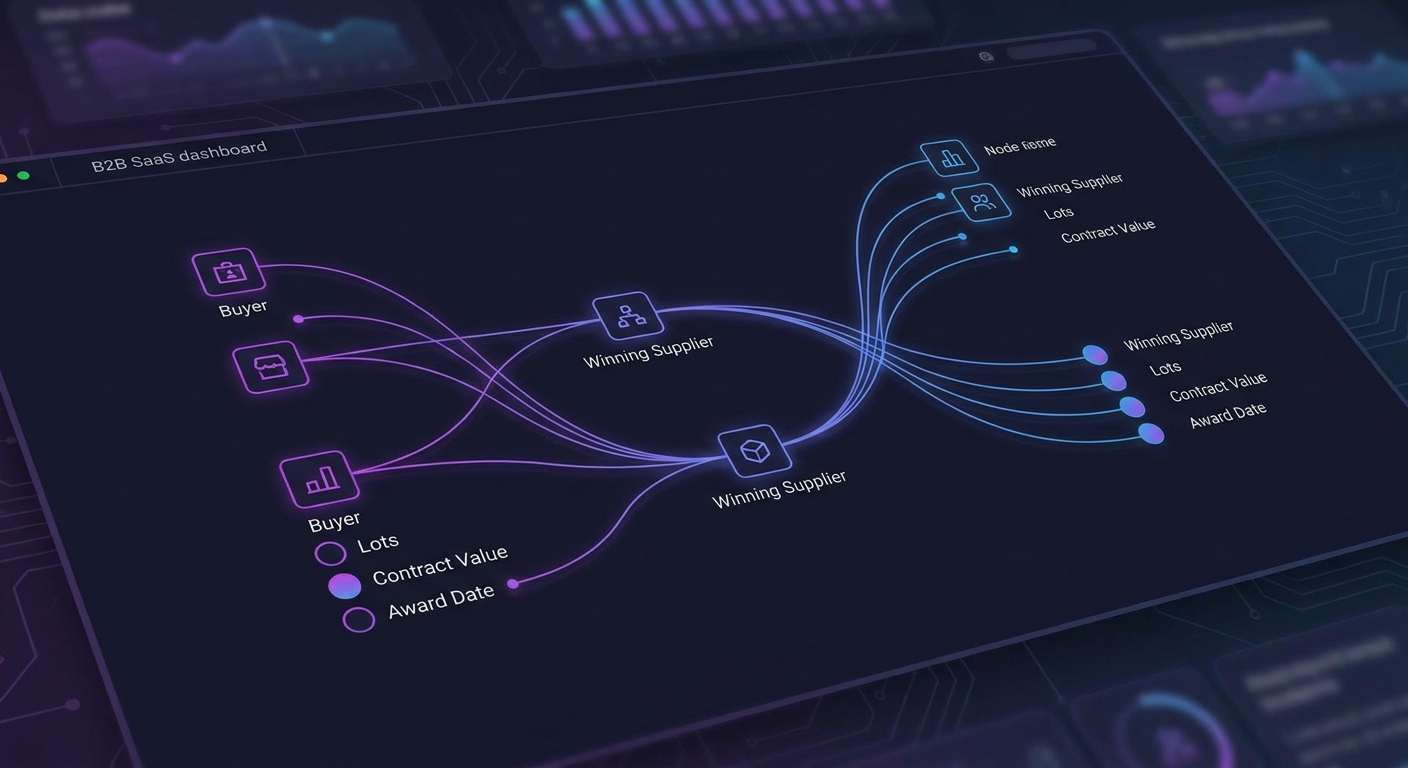
Contract award notice intelligence map showing buyers, winners, lots and values
The most useful fields are:
| Field | Why it matters |
|---|---|
| Buyer | Shows which authorities are active and worth account planning |
| Winning supplier | Reveals competitor momentum and incumbent strength |
| Contract value | Helps estimate market size and opportunity quality |
| Lot structure | Shows whether the buyer favours specialisation, geography or bundled delivery |
| Procedure | Indicates how the buyer likes to run competition and whether early engagement matters |
| Contract duration | Helps forecast rebid windows and future pipeline |
| Award date | Lets you track recent momentum and seasonal buying cycles |
| Number of bids | Suggests competitiveness and whether a market is crowded |
| Award criteria | Helps infer what the buyer valued when making the decision |
The difference between reading and analysing
Most suppliers technically read award notices. They see a competitor win, feel annoyed for a moment, maybe forward the link to sales, and then return to the next deadline. That is not analysis. It is procurement doomscrolling with a spreadsheet nearby.
Analysis means turning each notice into a decision. It means asking what the result changes about your pipeline, positioning or bid library.
There are four levels of maturity.
The first level is awareness. The team knows who won and roughly what happened. This is better than nothing, but it rarely changes behaviour.
The second level is recording. The team logs buyer, winner, value, service line, region and contract dates. This creates a useful history, but only if the data is clean enough to query.
The third level is interpretation. The team looks for patterns: buyers that repeatedly award to SMEs, competitors that win particular lot types, frameworks that dominate a category, price pressure in certain regions, or evidence that social value and mobilisation quality are affecting outcomes.
The fourth level is action. The team changes how it bids. It updates qualification criteria, improves case studies, prepares for rebid dates, joins routes to market, targets buyer engagement earlier and builds responses around the evidence evaluators appear to reward.
Most bid teams get stuck between level one and level two. They have the data in fragments, but not the workflow to use it. The best teams build a light, repeatable process that joins procurement research, bid management and sales activity.
How to build a Contract Award Notice tracker
You do not need an overcomplicated system to start. A simple tracker is enough if it is consistent. The goal is to make every award notice searchable, comparable and actionable.
Create fields for:
- Notice URL and reference
- Buyer name
- Buyer type, such as local authority, NHS, university, housing association or central government
- Region
- Category or service line
- Contract title
- Winning supplier
- Incumbent, if known
- Contract value
- Contract duration
- Award date
- Start date and end date
- Procurement route or framework
- Lots awarded
- Number of tenders received, if published
- Your status: did not bid, bid and lost, bid and won, partner opportunity, future target
- Reason for interest
- Follow-up owner
- Next action
That last part matters. A tracker without next actions becomes an archive. A tracker with owners becomes pipeline intelligence.
For every relevant notice, assign one of five actions:
- Add to competitor watchlist
- Add rebid date to pipeline
- Review buyer for account planning
- Update bid/no-bid scoring assumptions
- Update content library or case study evidence
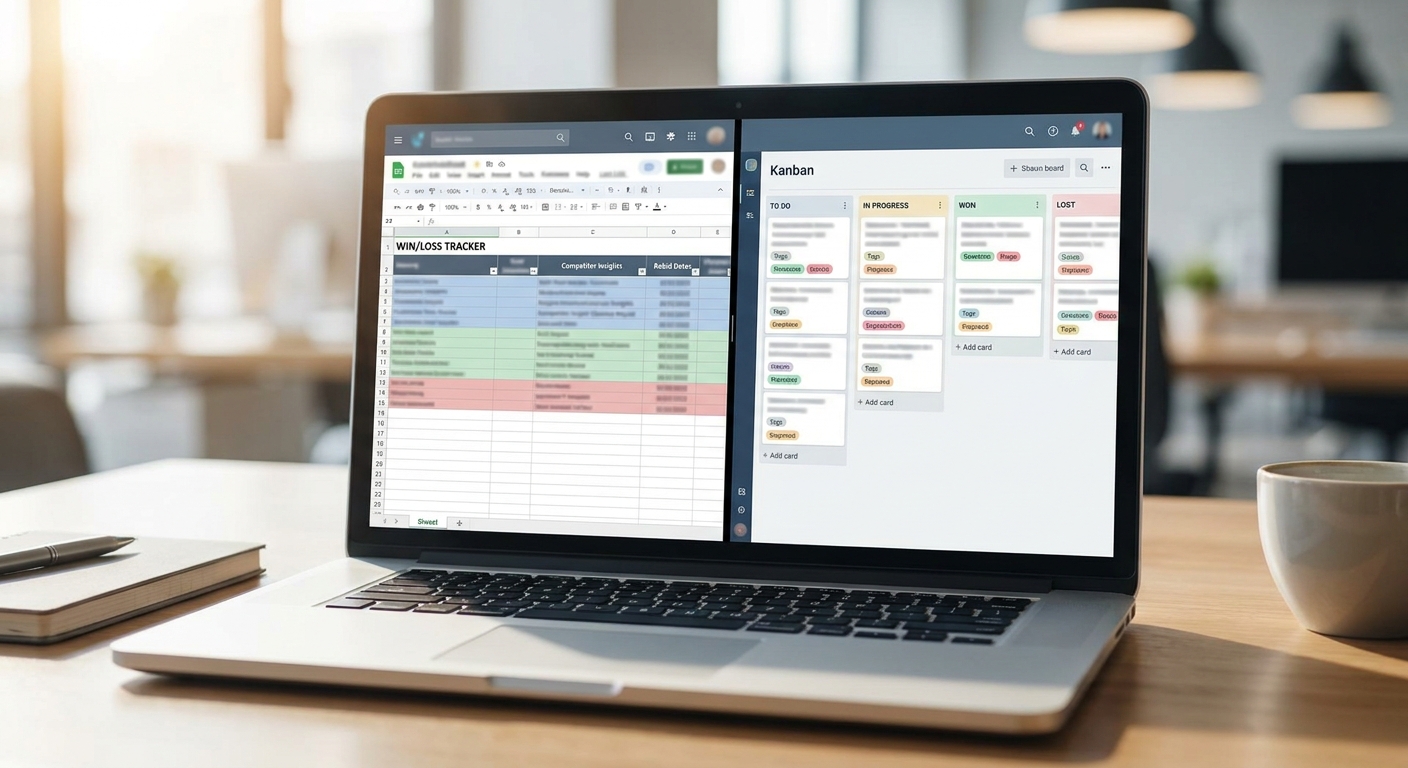
Structured win loss tracker for contract award notices and competitor insights
The tracker should be owned jointly by bid and commercial teams. Bid teams understand evaluation patterns and submission quality. Sales teams understand relationships, incumbents and account strategy. Marketing can use the intelligence to shape thought leadership and sector campaigns. Leadership can use it to decide which sectors deserve investment.
The biggest mistake is making this a purely administrative task. If a junior team member is told to copy notices into a spreadsheet without context, the tracker will quickly become noisy. The person logging the notice must know what a useful signal looks like.
What to look for when you lost
When you lose a tender, the formal feedback route still matters. You should request and analyse assessment summaries, evaluation comments and scores wherever available. But the Contract Award Notice gives you an immediate external reference point.
Start with the obvious question: who won?
If the winner is the incumbent, ask whether the buyer was genuinely open to change. Did the tender specification heavily reflect the existing delivery model? Was the mobilisation window short? Did the award criteria favour continuity, existing knowledge or low transition risk? If so, your future strategy may need stronger incumbent displacement evidence, not just a better written method statement.
If a challenger won, study their positioning. Do they have a specialist service model? Are they local? Are they known for aggressive pricing? Did they recently win similar contracts? If they beat both you and the incumbent, there is probably something important to learn.
If a large national supplier won a lot you expected to suit SMEs, look at the structure. Was the lot too broad? Were insurance, turnover or accreditation requirements higher than expected? Did the buyer bundle services in a way that favoured scale? That may influence future clarification questions and preliminary market engagement.
If an SME won against larger suppliers, look for the opposite. The buyer may have valued local presence, specialist expertise, social value credibility or a lower-risk mobilisation plan. That is a useful sign if you are also a specialist supplier.
A loss review should combine three sources:
- Your submitted response and internal quality review
- The buyer feedback and scoring information
- The public award notice and competitor context
Together, those sources help you separate response problems from strategy problems. Sometimes you lost because the answer was weak. Sometimes you lost because the opportunity was never a good fit. Sometimes you lost because the buyer wanted a delivery model you did not evidence. Those are different lessons.
What to look for when you did not bid
The notices you ignored can be just as useful as the tenders you lost.
Every bid team has opportunities that were parked because of capacity, poor fit, short deadlines or uncertainty. When those contracts are awarded, review them. This is how you improve future qualification decisions.
Ask:
- Was the winning supplier similar to us?
- Was the contract value worth the effort?
- Did the buyer receive many bids or only a few?
- Did the award go to an incumbent, a specialist, an SME, a national provider or a new entrant?
- Did the notice reveal a framework route or lot structure we should understand?
- Would we make the same no-bid decision again?
This is where teams often find hidden mistakes. A tender may have looked too broad at first glance, but the award notice shows that a specialist lot went to a supplier very similar to you. Another opportunity may have looked attractive, but the award went to the entrenched incumbent after a process with little evidence of competitive movement. Both lessons are valuable.
Bid/no-bid decisions improve when they are tested against outcomes. Without that feedback loop, teams rely on instinct, and instinct tends to overvalue urgent tenders and undervalue strategically important ones.
Using award notices for competitor analysis
Competitor analysis should be more than a list of names. Contract Award Notices let you build a practical picture of where each competitor is strong and what kind of buyer they attract.
For each competitor, track:
- Sectors where they win
- Buyer types where they win
- Typical contract values
- Regions where they are active
- Lot types they prefer
- Frameworks or dynamic markets they use
- Evidence themes they appear to sell, such as local delivery, innovation, cost control, social value or compliance assurance
- Whether they win new work or mostly retain incumbent contracts
Over time, this creates a competitor profile that helps your bid team write sharper responses. If a competitor is consistently winning on mobilisation confidence, your mobilisation plan needs to be more concrete. If they are winning in local authority work with strong community benefits, your social value evidence needs to move beyond generic pledges. If they dominate low-price competitions, you may need to qualify out earlier or bring a clearer value-for-money argument.
Do not turn this into paranoia. Competitor tracking is not about obsessing over rivals. It is about understanding what buyers are rewarding.
Using award notices for account planning
Award notices also show which buyers are active, what they buy and when they are likely to buy again. That makes them useful for account planning long before a tender appears.
Suppose a council awards a five-year waste management contract in 2026. If you are not the winner, that opportunity is not gone forever. It becomes a future account plan. You know the likely rebid window. You know the incumbent. You know the approximate value. You can watch contract performance notices, local scrutiny reports, cabinet papers, budget documents and related preliminary engagement notices over the contract lifecycle.
That long-term view matters. The best time to influence a future tender is rarely the week the tender notice is published. It is months or years earlier, when the buyer is learning what good looks like and suppliers are building credibility.
For strategic accounts, use the award notice to create a future pursuit record:
- Who won and why we think they won
- When the contract may return to market
- What relationships we need to build
- What evidence we need before the next competition
- What case studies would make us credible
- Which partner relationships may help
- Which early engagement points to watch
This turns procurement transparency into proactive business development.

Supplier account planning board built from contract award and future rebid dates
Connecting award notices to your bid library
The most underused part of award notice analysis is content improvement. Teams gather market intelligence, then fail to connect it to the content library that actually shapes future bids.
Every material pattern should trigger a content review.
If award notices show buyers increasingly splitting lots by geography, your library needs stronger local mobilisation narratives. If buyers are awarding to suppliers with demonstrable digital reporting capability, your management information responses need better screenshots, process diagrams and KPI examples. If sustainability-led suppliers are winning in your category, your carbon reduction and environmental evidence needs refreshing.
The process is simple:
- Identify a pattern in award results
- Translate it into a likely evaluator priority
- Audit your content library against that priority
- Fill evidence gaps with proof, not generic prose
- Add reviewer notes so future bid writers understand when to use the material
This is where mytender.io is especially useful. A bid team can use AI to search previous responses, policies, case studies and evidence, but the AI needs good underlying material. Award notice analysis tells you which material is missing or weak. The platform then helps organise and reuse that evidence when the next opportunity arrives.
AI should not invent competitor insight or fabricate proof. It should help you structure evidence, compare patterns, draft first responses and check that every claim is supported by your own knowledge base. The advantage comes from combining public procurement intelligence with verified internal evidence.
A practical monthly review workflow
A monthly award notice review is enough for most suppliers. Weekly may be useful in fast-moving categories, but monthly creates a manageable rhythm.
The review should take 60 to 90 minutes and involve bid, sales and sector leads.
Use this agenda:
- Review new award notices in target sectors
- Flag awards involving key competitors
- Review awards for tenders you bid on
- Review awards for tenders you chose not to bid
- Add rebid dates to the pipeline
- Identify changes to bid/no-bid assumptions
- Identify content library improvements
- Assign follow-up actions
Keep the outputs tight. The meeting should produce decisions, not a long market commentary.
A good monthly summary might say:
- Two local authorities awarded integrated FM contracts to regional SMEs, suggesting lot structure is opening space for specialists
- Three healthcare awards went through the same framework, so joining that route should be reviewed
- A competitor has won four mobilisation-heavy contracts in six months, so our mobilisation evidence needs strengthening
- We no-bid a tender that went to a supplier similar to us, so our qualification scoring may be too conservative in that sub-sector
- The next likely rebid for a target account is in Q3 2028, with engagement to start in 2027
That is the kind of intelligence leaders can act on.
Common mistakes to avoid
The first mistake is over-interpreting one result. A single award does not prove a buyer preference. It gives you a hypothesis. Patterns prove more.
The second mistake is ignoring context. A supplier may have won because of price, incumbent knowledge, technical quality, social value, framework position, risk appetite or simply because the field was weak. Do not assume the reason unless you have supporting evidence.
The third mistake is tracking too broadly. If you log every notice in every adjacent category, the process becomes noise. Start with your core sectors, priority regions and named competitors.
The fourth mistake is separating commercial intelligence from bid writing. The point is not to create a beautiful market spreadsheet. The point is to win more of the right tenders.
The fifth mistake is treating AI as a shortcut for judgement. AI can summarise notices, classify suppliers, extract fields and suggest patterns. Human experts still need to decide what the patterns mean and how the business should respond.
How AI changes the workflow
AI makes award notice analysis more practical because the raw information volume is too high for most teams to process manually.
An AI-supported workflow can:
- Extract buyer, supplier, value, dates, procedure and lot data from notices
- Classify notices by sector, region, buyer type and relevance
- Match awards against your target account list
- Flag competitor movement
- Compare awards with your historic bid/no-bid decisions
- Suggest likely rebid windows
- Draft short internal summaries for sales and bid teams
- Identify gaps in your bid library based on repeated market signals
The important word is supported. You still need a controlled process. Public data can be inconsistent. Supplier names can vary. Values may be estimates. Notices can be corrected. AI can misread context if it is not grounded in the actual notice and your internal records.
The safest model is human-in-the-loop. Let AI do the extraction and first-pass pattern recognition. Let experienced bid and commercial people validate the interpretation and decide the action.
That is the same principle that applies to tender writing itself. AI is powerful when it is grounded in real documents, past performance and human review. It is risky when it becomes a confident narrator without evidence.
The mytender.io view
At mytender.io, we see award notice analysis as part of a broader bid intelligence layer. Winning more bids is not only about writing faster. It is about choosing better opportunities, understanding buyer priorities, reusing stronger evidence and learning from every result.
The teams that improve fastest tend to have three habits.
First, they centralise knowledge. They do not leave feedback, notices, debrief notes, case studies and policies scattered across inboxes and SharePoint folders.
Second, they review losses honestly. They separate poor qualification, weak strategy, missing evidence and writing quality instead of blaming everything on price.
Third, they use AI for leverage, not theatre. They generate first drafts in minutes, but they also use AI to check compliance, surface relevant evidence and reduce the admin burden around bid learning.
Award notices fit naturally into that operating model. They give teams an external view of what the market is doing. Combined with internal bid data, they help answer the question every bid leader cares about: where should we spend our next hour?

AI assisted bid intelligence layer combining award notices, tender feedback and content library evidence
Contract Award Notice checklist for suppliers
Use this checklist when reviewing a new notice:
- Record the buyer, winner, value, date, procedure and lot structure
- Check whether the winner is the incumbent, a challenger, an SME, a national provider or a specialist
- Compare the award with your target sectors and account list
- If you bid, connect the notice to your feedback and score review
- If you did not bid, test whether the no-bid decision still looks right
- Add the contract end date and likely rebid window to your pipeline
- Flag competitor movement if the winner is strategically relevant
- Update your bid/no-bid assumptions if the result changes your view of the market
- Identify any bid library gaps revealed by the award
- Assign one clear follow-up action
The key is consistency. A ten-minute review repeated every week or month is more valuable than a heroic competitor analysis project that happens once and is forgotten.
A worked example: turning one result into five actions
Imagine you sell hard and soft facilities management services and a university awards a five-year integrated FM contract to a regional competitor. You did not bid because the initial notice looked too broad and the deadline clashed with another submission. The award notice shows the contract was split into lots, the cleaning and security lot went to a supplier similar to you, and only three bids were received.
That single result should create more than a note in a spreadsheet.
The first action is qualification review. Your no-bid decision may have been too fast. The next time a similar notice appears, the team should check lot detail before rejecting it. A broad contract title can hide a specialist opportunity.
The second action is route-to-market review. If the award came through a framework, check whether you are already on it, whether you can join at the next opening, or whether a partner already has access. If the same framework appears repeatedly across award notices, it deserves a formal decision.
The third action is competitor review. The winning supplier may now have a credible higher education case study in your region. That does not mean you panic. It means you record their momentum and prepare a stronger alternative story for the next university opportunity: how you mobilise, how you manage term-time disruption, how you evidence student experience, and how you report service quality.
The fourth action is content review. If the buyer selected a supplier with a strong local employment or sustainability proposition, your social value and carbon content may need more specific proof. Generic commitments about apprenticeships and community engagement will not be enough if competitors are evidencing actual outcomes.
The fifth action is account planning. Add the contract end date, likely extension points and future rebid window. Watch for performance notices, estates strategy updates and future market engagement. By the time the contract comes back to market, you should not be discovering the buyer for the first time.
That is the difference between passive tracking and bid intelligence. The award notice is the trigger. The value comes from the actions that follow.
Final thought
Contract Award Notices are public, practical and underused. They show who is winning, where buyers are spending and how markets are shifting. For suppliers, that makes them a low-cost source of bid intelligence with direct impact on qualification, account planning, competitor analysis and content improvement.
Do not treat them as procurement paperwork. Treat them as the results page for your market.
The suppliers that learn from those results will make sharper bid/no-bid decisions, build better evidence, target earlier engagement and improve faster after both wins and losses. In a more transparent procurement regime, that learning loop is becoming a competitive advantage.
Tags
Ready to Transform Your Tender Writing?
See how MyTender's AI can help you write winning tenders in a fraction of the time.