
Continuous Improvement for Bid Teams: How to Turn Every Tender Into a Better Bid Library
A practical guide for bid teams who want to turn tender feedback, assessment summaries and evaluator scores into a stronger bid library and higher win rate.
mytender.io Research Team
Tender Writing & Bid Management Specialists
Continuous Improvement for Bid Teams: How to Turn Every Tender Into a Better Bid Library
Most bid libraries are museums.
They hold old answers, old policies, old case studies and old proof points. Everyone knows they are useful. Nobody quite trusts them.
So the team does what bid teams always do under pressure. They search the folders, copy something that looks close enough, patch the obvious gaps, then promise to clean it up after submission.
After submission, the next tender lands.
That is how bid libraries decay. Not through laziness. Through volume.
The fix is not another tidy-up project that dies after two weeks. The fix is a continuous improvement loop: every tender result, clarification, evaluator comment and internal review should make the next answer stronger.

Bid team reviewing tender feedback and improving their bid library
This guide shows how to build that loop without creating a monster admin process.
Why this matters more in 2026
The Procurement Act 2023 has made feedback and transparency more useful for suppliers.
Assessment summaries are giving bid teams clearer signals about why they scored well or badly. Contract performance notices, KPI reporting and payment transparency are also changing what evaluators care about.
At the same time, the shift from MEAT to MAT (Most Advantageous Tender) means the best answer is not always the cheapest answer. Evaluators are looking harder at quality, delivery confidence, social value, sustainability, risk and proof.
That creates a problem for teams with static libraries.
A recycled answer that scored well in 2023 may be average in 2026. A generic social value paragraph that once sounded impressive may now look thin next to a competitor with named partners, local outcomes and measurable KPIs.
Your bid library cannot be a storage folder. It has to be a learning system.The real reason bid libraries go stale
People usually blame poor ownership.
That is partly fair. If nobody owns the library, it will rot.
But ownership is not the whole problem. Many teams do have a named owner. The library still goes stale because the inputs are weak.
Most teams update their library when:
- a policy expires
- a new case study is written
- someone complains an answer is out of date
- a major tender exposes an obvious gap
That is maintenance. It is not improvement.
Continuous improvement needs better inputs. The strongest ones are:
- evaluator comments from wins and losses
- assessment summaries under the Procurement Act
- clarification questions from buyers
- internal red team comments
- client implementation lessons
- contract KPIs and performance evidence
- recurring content gaps across multiple bids
The library improves when those inputs are captured, sorted and turned into better content.
Not someday. As part of the bid rhythm.
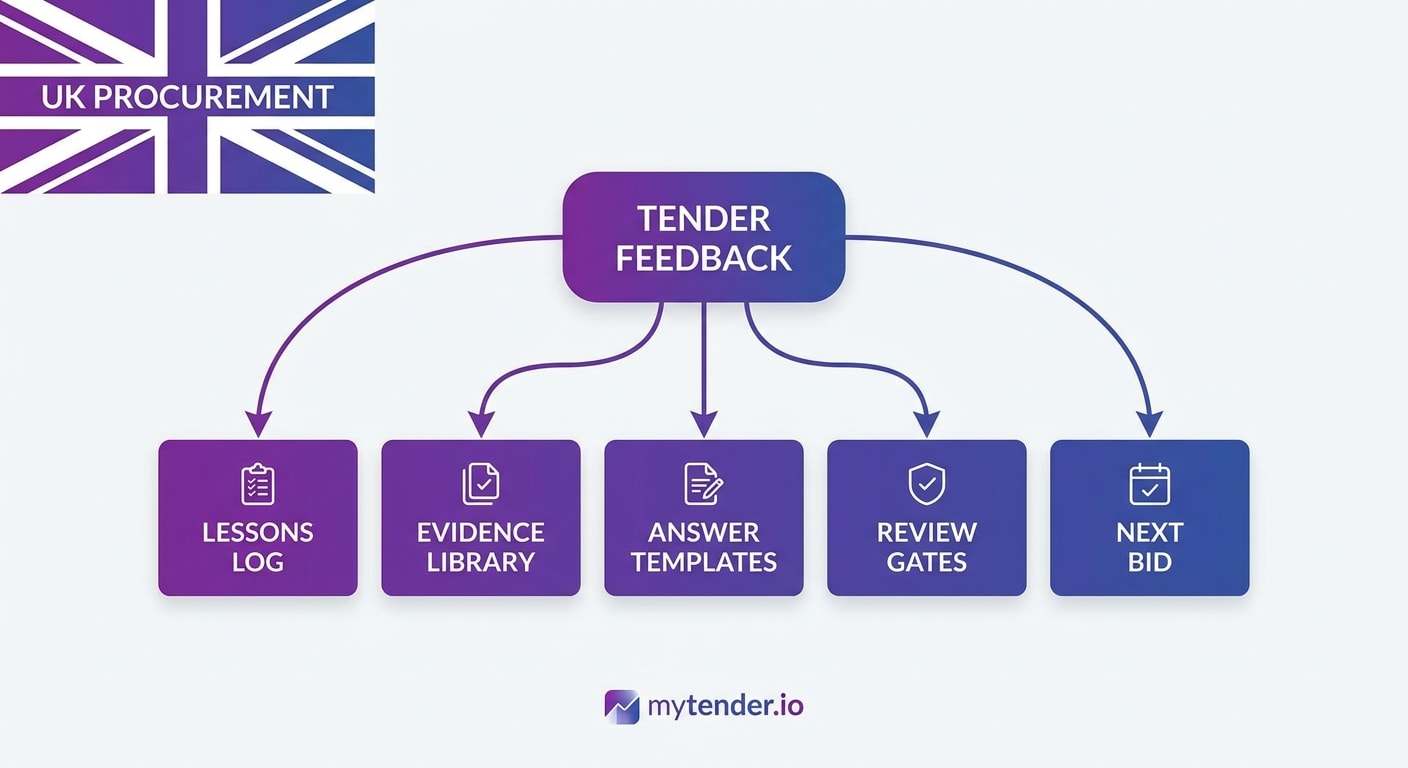
Continuous improvement loop from tender feedback to lessons log, evidence library, templates and next bid
Build the loop around five moments
Do not try to review everything all the time. That is how good intentions become admin sludge.
Build the process around five moments where useful information already appears.
1. Bid qualification
Before you write, record why you are bidding.
That sounds basic, but it matters later. If you lose, you need to know whether the loss came from a weak response or a weak pursuit decision.
Capture:
- why the opportunity was worth pursuing
- your expected win themes
- incumbent position
- known risks
- required evidence gaps
- likely price pressure
- strategic value beyond revenue
This creates a baseline. Without it, every loss becomes a vague writing problem.
Sometimes the lesson is not "write better". Sometimes it is "we should not have bid this at all".
2. Clarification stage
Clarification questions reveal hidden uncertainty.
If your team asks the same type of question across multiple tenders, that is a library signal. It means your standard content, assumptions or compliance checklist are not doing enough work.
For example:
- repeated TUPE questions may mean your mobilisation content is too generic
- repeated KPI questions may mean your performance evidence is scattered
- repeated social value questions may mean your commitments are not specific enough
- repeated AI-use questions may mean you need a clear AI governance statement
Do not just save buyer answers in the tender folder. Tag the underlying issue.
3. Red team review
A red team review should not only improve the live submission.
It should expose library weaknesses.
If reviewers repeatedly write "needs evidence", "too generic", "where is the example?" or "does this actually answer the question?", do not treat those as one-off comments.
They are content defects.
Create a simple rule: every red team review must produce two outputs.
First, changes for the current bid. Second, library actions for future bids.
That second output is where the compounding value lives.
4. Award result and assessment summary
This is the big one.
Tender results create emotional noise. Wins get celebrated. Losses get rationalised. Near misses get argued over.
You need a calmer process.
For each result, log:
- score by criterion
- score gap to winner
- evaluator strengths
- evaluator weaknesses
- price position, where known
- whether the weakness was content, evidence, strategy or qualification
- the exact library action needed
Do this quickly while the team still remembers the bid.
The point is not to blame anyone. The point is to stop paying for the same lesson twice.
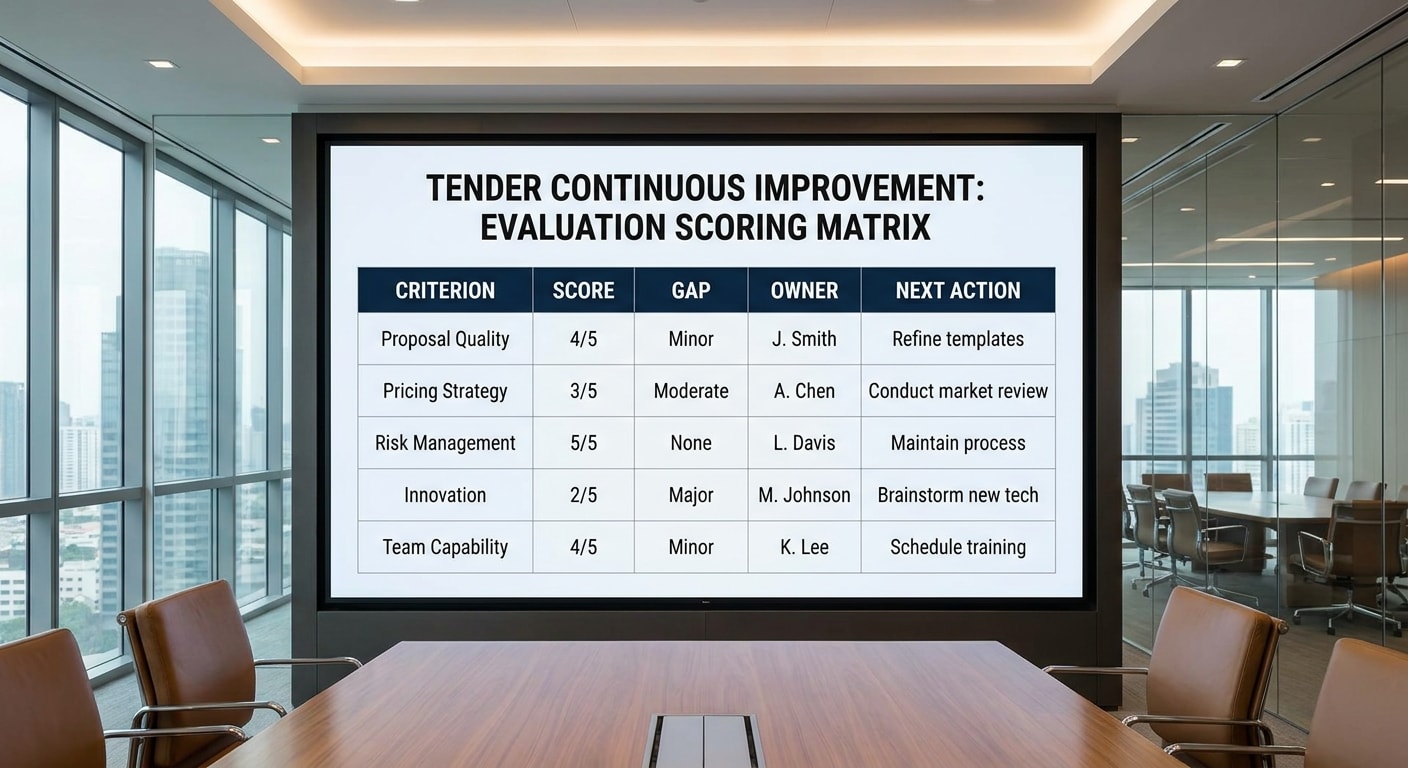
Tender scorecard matrix for logging criterion scores, gaps, owners and library actions
Use a lessons log, not a lessons meeting
Lessons learned meetings sound sensible. They often fail.
People are busy. The loudest voice dominates. Someone writes a page of notes. Then the notes sit in a folder nobody opens.
A lessons log is harder to ignore because it connects each lesson to an owner and a library action.
Keep it simple. You need these fields:
- tender name
- sector
- buyer type
- criterion
- score
- evaluator comment
- root cause
- library action
- owner
- due date
- status
The root cause field matters most.
Do not write "weak answer". That tells you nothing.
Use categories like:
- missing evidence
- outdated evidence
- weak local relevance
- poor structure
- unclear method
- overclaimed capability
- price misalignment
- compliance gap
- poor bid decision
Now patterns become visible.
If six tenders show "missing evidence" in mobilisation, you do not have six separate problems. You have one library problem.
Turn feedback into library actions
Feedback only matters when it changes something.
Here is how to translate common comments into action.
"The response lacked detail"
This usually means the answer made claims but did not show method.
Library action: add a process map, RACI, timescale, decision gates or sample deliverables.
Do not just add more words. Add mechanics.
"The response lacked evidence"
This means the evaluator did not believe you, or could not score you confidently.
Library action: attach proof to the answer. That might be KPIs, audit results, client references, mobilisation records, screenshots, certificates or contract performance data.
A claim without proof is just noise.
"The response was generic"
This is one of the most common bid library failures.
Library action: create sector variants. A mobilisation answer for FM, construction and waste should not read the same. The governance may be similar, but the risks, stakeholders and proof points should differ.
"The response did not address local priorities"
This often happens in social value, sustainability and community benefit sections.
Library action: build a local relevance checklist. Include labour market data, local partner research, buyer strategy references, community needs and measurable commitments.
"The response did not clearly explain risk management"
Risk answers often become policy summaries.
Library action: create risk registers by tender type. Show triggers, controls, owners, escalation routes and lessons from previous contracts.
Create a library governance model people will actually use
The best governance is boring.
If it requires a committee, a 40-page taxonomy and three approval stages, bid teams will route around it.
Use four levels.
Level 1: Core approved content
This is stable material.
Examples include company overview, insurance, accreditations, standard governance, quality systems, security policies and financial information.
It should have a named owner and review date.
Level 2: Evidence packs
These are proof assets.
Examples include case studies, KPI dashboards, testimonials, audit outcomes, social value delivery records, mobilisation plans and contract performance results.
Evidence should be tagged by sector, buyer type, contract size and relevance.
Level 3: Answer frameworks
These are not final answers. They are structures.
Examples include mobilisation, risk, social value, sustainability, innovation, contract management, complaints, TUPE and continuous improvement.
Frameworks stop people starting from a blank page. They also stop people blindly pasting old answers.
Level 4: Tender-specific responses
These belong in the tender folder, not the core library.
A submitted answer may contain useful material, but it should not be promoted wholesale. Pull out the reusable pattern, evidence or phrasing. Leave the buyer-specific padding behind.
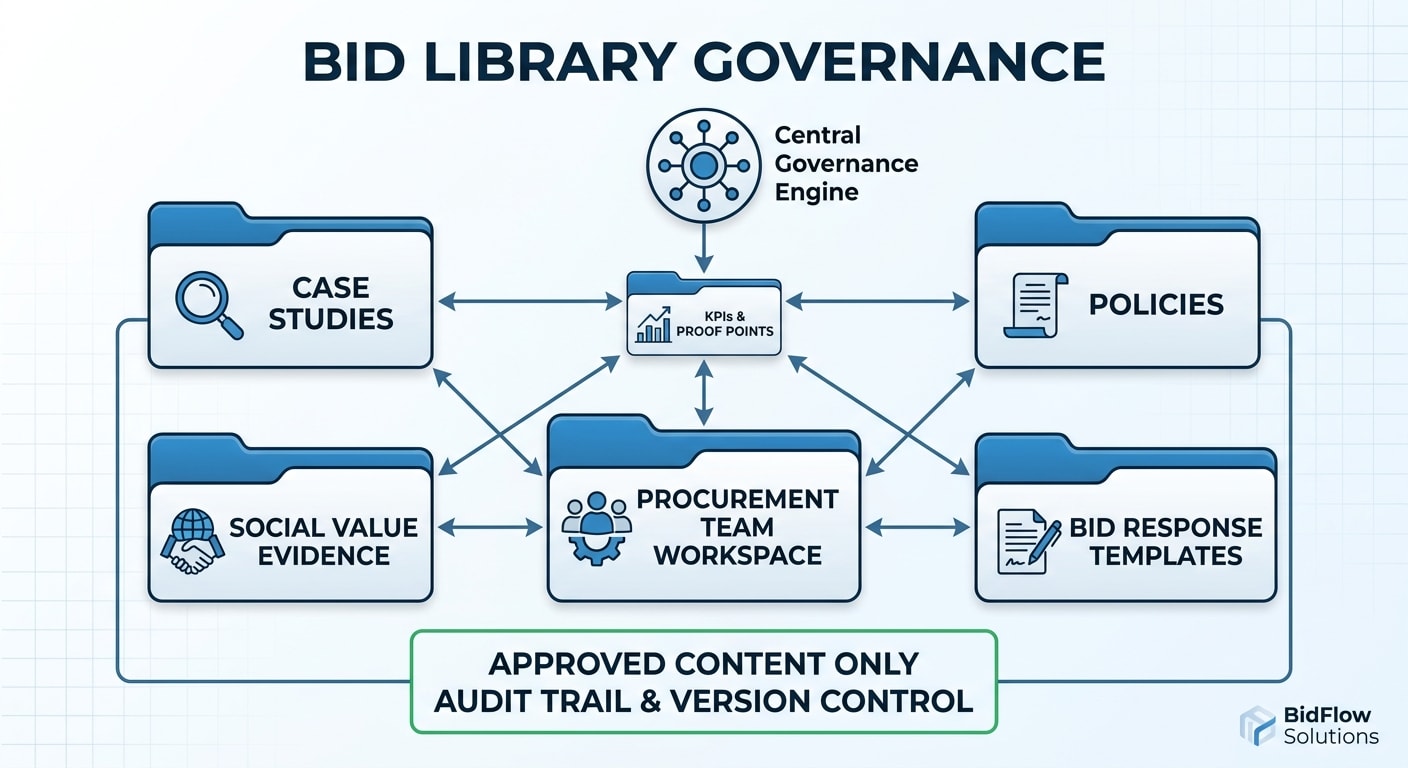
Bid library governance model with case studies, policies, KPIs and proof points
Appoint owners by evidence type
One library owner cannot own every fact.
They can own the system, but not the substance.
A better model is distributed ownership:
- Operations owns mobilisation and delivery evidence
- Finance owns financial standing and insurance inputs
- HR owns training, apprenticeships and workforce data
- SHEQ owns health, safety, quality and environment
- Commercial owns pricing assumptions and contract risk
- Bid management owns structure, wording and evaluator fit
This matters because old content often looks fine to bid writers. The people closest to delivery know when it has drifted.
Give each owner a small monthly task, not a giant annual chore.
For example: review two evidence packs, update one KPI, approve one case study.
That is manageable. It also builds trust.
Make win themes reusable, but not generic
A win theme is not a slogan.
"Trusted partner with proven experience" is not a win theme. It is wallpaper.
A useful win theme connects buyer need, your differentiator and proof.
Use this structure:
- Buyer need: what problem are they trying to solve?
- Your position: why are you credible?
- Proof: what evidence supports it?
- Evaluator benefit: why should they care?
For example:
"The council needs a low-risk mobilisation across dispersed sites. We have mobilised 43 similar sites in 12 weeks with 98% planned completion and zero service-critical failures. That reduces transition risk and protects service continuity from day one."
That can become reusable without becoming bland.
Store win themes as modular components. Keep the evidence attached. Add notes on when not to use them.
Use AI carefully in the improvement loop
AI is useful here, but only if you point it at the right material.
A general AI tool can summarise feedback, spot repeated phrases and draft revised structures. But it can also flatten nuance and invent confidence where there is none.
The safer approach is to use AI for pattern detection and first drafts, then keep human ownership over evidence and scoring judgement.
For example, you can use AI to:
- compare evaluator comments across ten losses
- group weaknesses by criterion
- identify repeated missing evidence
- turn red team comments into library tasks
- draft a stronger answer framework from approved evidence
- flag outdated claims or unsupported statements
That is exactly where specialist platforms such as mytender.io help. The value is not just faster writing. It is keeping your bid intelligence, evidence and improvement loop connected to the work your team is already doing.
The warning is simple: do not let AI create proof you do not have.
If the evidence is missing, the action is to find the evidence. Not to write around the gap.
Build a 30-minute post-result ritual
You do not need a two-hour wash-up for every bid.
You need a repeatable ritual.
Within five working days of a result, run a 30-minute review with the bid lead and relevant content owners.
Use this agenda:
- What did we expect to happen?
- What actually happened?
- Where did we score above expectation?
- Where did we score below expectation?
- Was the gap content, evidence, price, compliance or pursuit fit?
- What must change in the library?
- Who owns it and by when?
End with actions, not opinions.
One strong library update is better than 14 vague lessons.

Bid team running a practical post-result retrospective workshop
Measure whether the loop is working
If you do not measure the loop, it becomes another process people tolerate.
Track a handful of numbers:
- percentage of results logged within five working days
- number of library actions created
- percentage of actions closed on time
- repeated weaknesses by criterion
- content reused from approved library rather than old tender folders
- win rate by sector or buyer type
- average quality score by criterion
Do not obsess over perfect attribution. Bid outcomes are messy.
Look for direction. If mobilisation scores rise after you rebuild the mobilisation evidence pack, that matters. If social value comments keep saying "generic", your changes are not working.
What good looks like after three months
After three months, a working continuous improvement loop should feel practical.
You should have:
- a lessons log with live actions
- clearer ownership of evidence packs
- fewer unsupported claims
- stronger answer frameworks for recurring sections
- better sector variants
- a cleaner view of which tenders you should not bid
- fewer late-night searches for "that one good answer"
The biggest change is confidence.
Bid writers stop guessing whether content is current. Reviewers stop repeating the same comments. Leaders can see whether losses are writing issues, evidence issues or qualification issues.
That is when the library starts doing its job.
Common mistakes to avoid
Updating the wording but not the evidence
A better sentence does not fix a weak proof point.
If the evaluator wanted evidence, update the evidence pack first. Then rewrite the answer.
Promoting whole tender answers into the library
This clutters the system.
Submitted responses are full of buyer-specific context. Extract the reusable part and tag it properly.
Treating every comment equally
Some comments are noise. Some are gold.
Prioritise comments that repeat, affect high-weighted criteria or explain a meaningful score gap.
Waiting for the annual library review
Annual reviews are where stale libraries go to die.
Small monthly updates beat heroic yearly clean-ups.
Letting the bid team own delivery facts
Bid teams can manage the words. Delivery teams must own the truth.
If operations, SHEQ, finance and HR are not part of the evidence loop, the library will drift.
A simple starting plan
If your bid library is already messy, do not try to fix everything.
Start with the content that appears in the most tenders and carries the most marks.
Week one: create the lessons log and review the last five results.
Week two: pick the three weakest recurring criteria.
Week three: rebuild one answer framework and attach real evidence.
Week four: agree owners and review dates for the top ten evidence packs.
Then repeat.
That is enough to create momentum.
The point is compounding
A bid library is not valuable because it saves typing time.
It is valuable because it stops the team relearning the same lessons under deadline pressure.
Every clarification question should sharpen an assumption. Every red team review should improve a framework. Every assessment summary should strengthen the next bid.
That is continuous improvement in bidding. Not a slogan. A loop.
If you want to find live opportunities where that improved library can start earning its keep, the mytender.io Tender Finder is free to use.
Tags
Ready to Transform Your Tender Writing?
See how MyTender's AI can help you write winning tenders in a fraction of the time.