

Construction Waste Management Tenders in 2026: How to Evidence Circular Economy Performance
Construction waste questions are moving beyond disposal routes and recycling percentages. This guide shows contractors how to evidence waste prevention, circular economy thinking and credible project controls in 2026 tenders.
mytender.io Research Team
Tender Writing & Bid Management Specialists
Construction Waste Management Tenders in 2026: How to Evidence Circular Economy Performance
Construction waste questions used to be fairly predictable.
Tell the evaluator where skips go. Promise high diversion from landfill. Mention the waste hierarchy. Add a line about toolbox talks. Move on.
That is not enough now.
Public buyers are asking harder questions because waste is no longer just an environmental side issue. It affects cost, carbon, logistics, resident disruption, supply chain performance and whether the project actually reflects the buyer's sustainability policy.
In 2026, the strongest construction waste tender responses do not simply say, "we recycle". They show how waste is designed out before site works begin, controlled during delivery and evidenced after completion.
The winning answer is not a waste policy pasted into a method statement. It is a project-specific control system with numbers, owners and proof.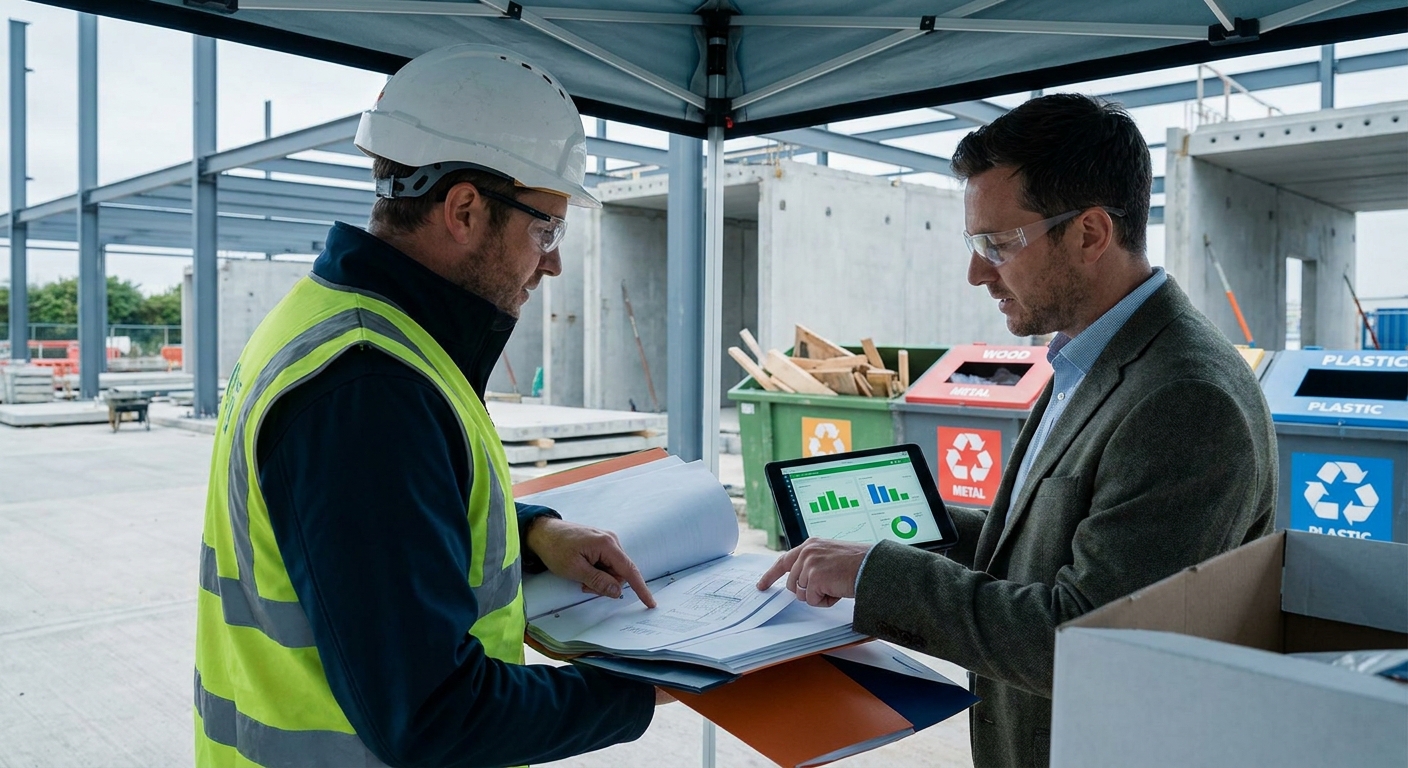
Construction project team planning circular economy controls for a public sector tender
Why Construction Waste Is Becoming a Scored Tender Issue
A current scan of UK procurement trends shows three things shaping tenders in 2026.
First, public buyers are still bedding in the Procurement Act era. They are using wider value measures, more transparent notices and stronger contract performance management.
Second, construction clients are under pressure to control cost and carbon at the same time. That means waste is being treated as a design, procurement and delivery risk, not just a site housekeeping matter.
Third, environmental claims are being checked more closely. It is no good promising 98% diversion from landfill if you cannot explain the waste streams, the subcontractor controls or the records you will provide.
This is why waste questions are appearing in several places:
- sustainability method statements
- environmental management questions
- social value responses
- mobilisation plans
- quality management sections
- cost and value engineering sections
- KPI schedules
- contract management questions
For bid teams, that creates a problem. If each section is written in isolation, the waste story fragments.
The best bids join it up.
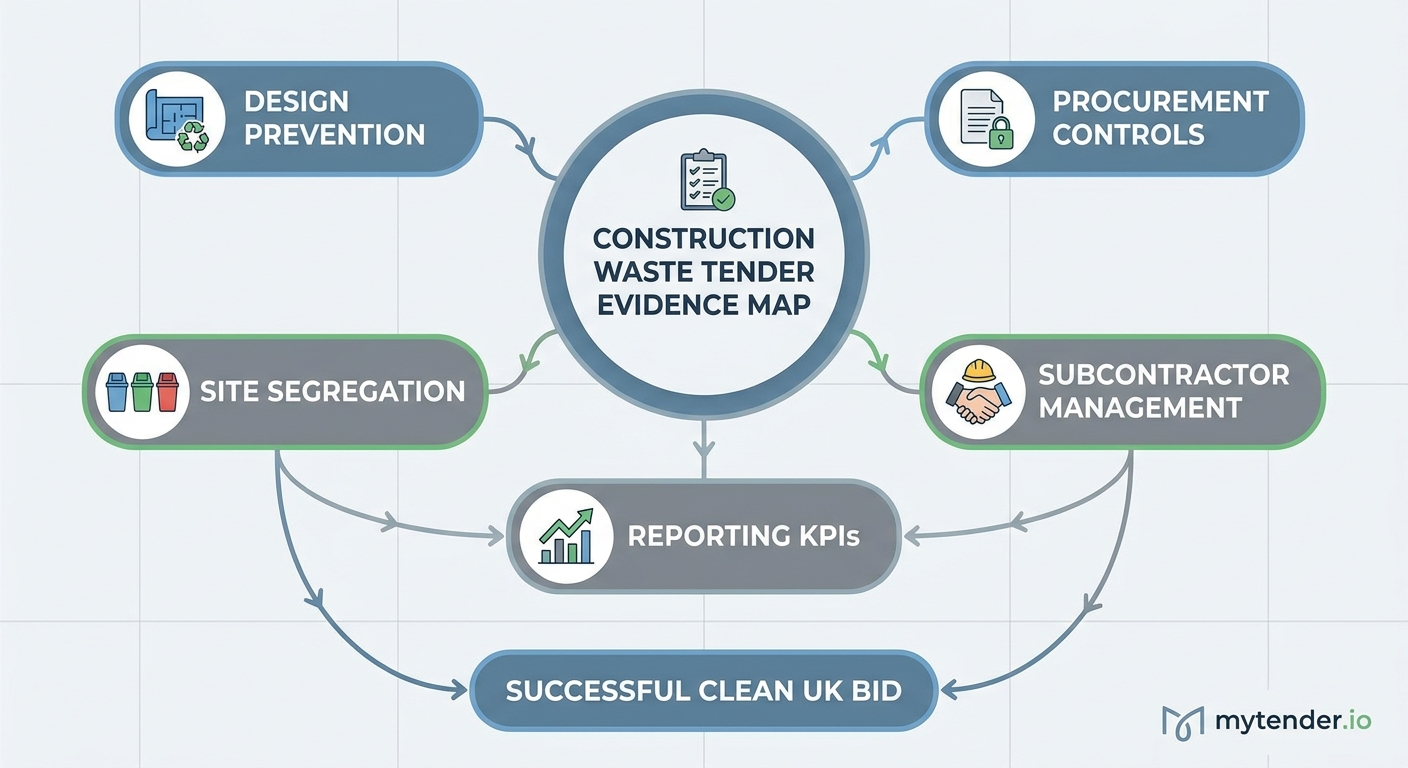
Diagram showing how construction waste evidence connects design, procurement, site controls and contract KPIs
The Search Gap: Plenty of Waste Advice, Not Enough Bid Advice
There is a lot of general guidance on construction waste.
Much of it explains the waste hierarchy, recycling routes, hazardous waste rules or environmental management systems. Useful, yes. But not enough when you are staring at a scored tender question with a 750-word limit.
The bid problem is different.
You need to turn operational practice into evaluator-friendly evidence. You need to show that your approach is credible for this site, this client, this programme and this supply chain.
That is where many contractors lose marks.
They know how to manage waste. They just do not prove it well enough in the response.
A strong answer needs to cover five questions:
- What waste will this project create?
- How will you prevent avoidable waste before it reaches site?
- How will you segregate, track and report what remains?
- Who owns each control?
- What evidence will the client see during the contract?
If your response cannot answer those, it will feel generic.
Start With the Evaluator's Real Concern
When a buyer asks about construction waste, they are rarely asking because they love waste strategies.
They are worried about delivery risk.
Waste affects the things clients actually care about:
- blocked access routes
- noisy collections near residents or live operations
- missed carbon targets
- disposal cost creep
- non-compliant documentation
- poor subcontractor behaviour
- negative local perception
- weak reporting after award
Your answer should speak to those worries.
Do not open with a broad commitment to sustainability. Open with the project risks you have identified and the controls you will use.
For example:
> This project is likely to generate high-volume packaging waste during MEP fit-out, mixed demolition waste during early strip-out and offcuts from internal finishes. Our waste approach therefore focuses on design-stage prevention, trade-by-trade segregation and weekly evidence-led reporting against agreed KPIs.
That is instantly more useful than:
> We are committed to reducing waste and protecting the environment.
The first answer tells the evaluator you have read the tender. The second tells them you own a policy.
Build the Answer Around the Waste Hierarchy, But Do Not Stop There
The waste hierarchy still matters.
Prevention comes first. Then reuse. Then recycling. Recovery is lower value. Disposal is the last resort.
Most bidders mention it. Fewer show how it changes decisions.
That distinction matters.
A good response turns the hierarchy into actions:
- Prevent: standardise dimensions, reduce over-ordering, use BIM checks, coordinate design freeze dates
- Reuse: protect temporary materials, reuse pallets, return unused products, identify salvage opportunities
- Recycle: segregate streams, brief trades, use licensed partners, audit transfer notes
- Recover: document recovery routes where recycling is not viable
- Dispose: define exceptional circumstances and approval controls
Evaluators do not need a textbook definition. They need to see how the hierarchy will operate on their project.
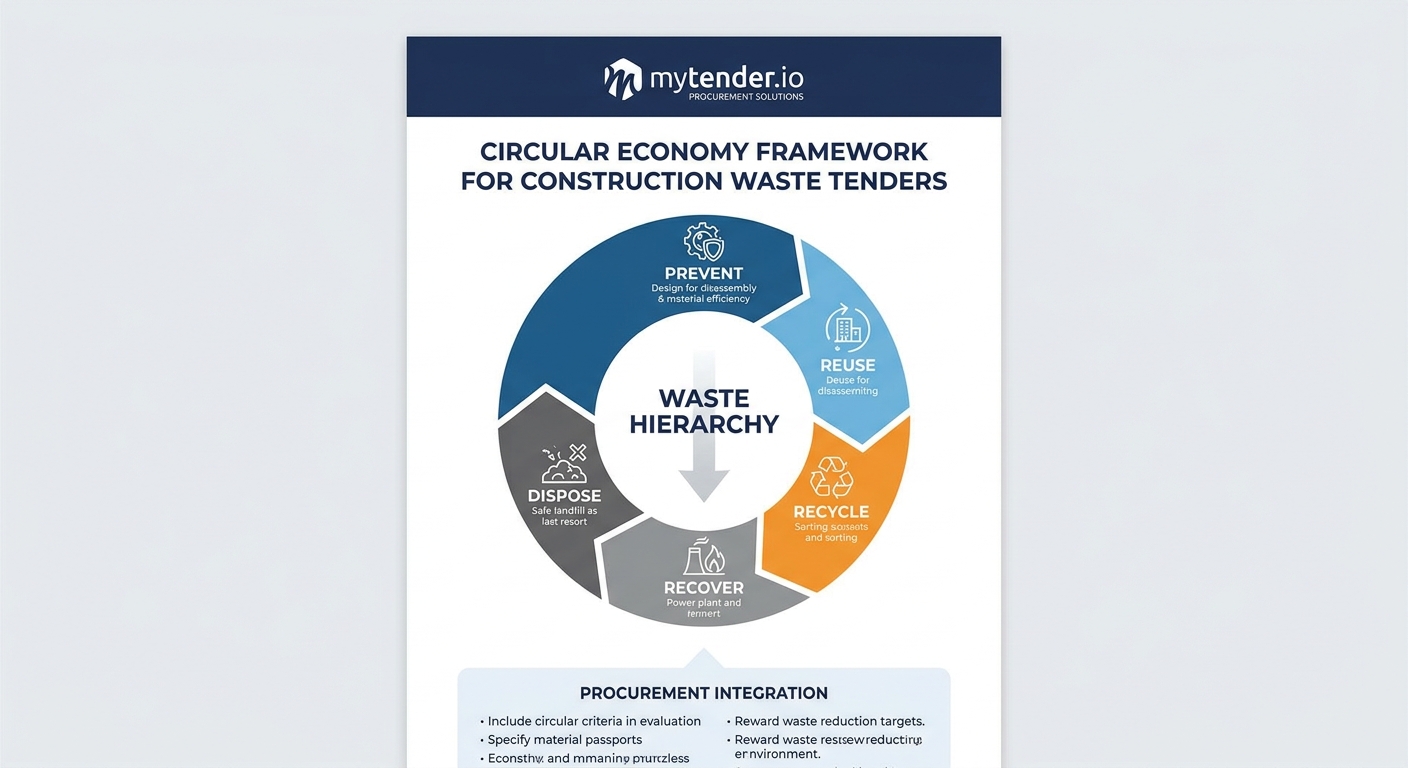
Circular economy framework for construction tender responses, from prevention through reuse and recycling to residual disposal
Evidence Prevention, Not Just Diversion
Diversion from landfill is still useful, but it can be a lazy headline metric.
A contractor can divert most waste from landfill and still create too much waste in the first place. That is not circular economy performance. That is tidying up after avoidable inefficiency.
Public buyers are getting sharper on this.
If the question mentions circular economy, resource efficiency, carbon reduction or sustainability outcomes, make prevention visible.
Useful evidence includes:
- examples of design coordination that reduced material offcuts
- packaging reduction agreements with suppliers
- take-back schemes for pallets, cable drums or unused materials
- standardised component sizing
- prefabrication or modular approaches
- procurement controls that prevent over-ordering
- lessons from previous projects where waste volumes fell
The phrase to keep in mind is simple: show the avoided waste, not only the recycled waste.
If you can quantify that from past projects, do it.
For example:
> On a comparable school refurbishment, early coordination between our site manager, joinery subcontractor and supplier reduced plasterboard offcuts by 18% against the original estimate. We will apply the same cut-sheet review process during the pre-start period for this contract.
That is the sort of sentence evaluators remember.
Make the Site Waste Management Plan Project-Specific
A Site Waste Management Plan can be valuable evidence.
It can also be dead weight if you describe it as a document that will exist after award.
Tender evaluators want to know what will be in it, who will own it and how it will control delivery.
Your response should explain:
- when the plan is produced
- which waste streams it covers
- how forecast quantities are set
- how subcontractors feed into it
- how segregation areas are planned
- who checks transfer documentation
- how performance is reviewed
- how lessons are captured for future phases
If the project is in a tight urban site, say how storage and collections will work. If it is a live healthcare or education environment, address segregation, safety and disruption. If it involves demolition or refurbishment, explain surveys and hazardous waste controls.
Do not make the evaluator infer the project fit. Spell it out.
Use a Waste Stream Matrix
One of the clearest ways to write this section is to include a waste stream matrix.
Even if the final portal only allows plain text, you can still structure it cleanly.
Use columns like this:
- waste stream
- expected source
- prevention measure
- segregation method
- recycling or reuse route
- owner
- evidence record
For a refurbishment project, that might include:
- plasterboard from partition changes
- timber from temporary works and joinery
- metals from MEP strip-out
- packaging from fit-out deliveries
- inert material from minor demolition
- hazardous items identified through surveys
This works because it gives the evaluator a working model, not a promise.
It also helps your own team. If you cannot fill the matrix during bidding, you probably do not understand the project well enough yet.
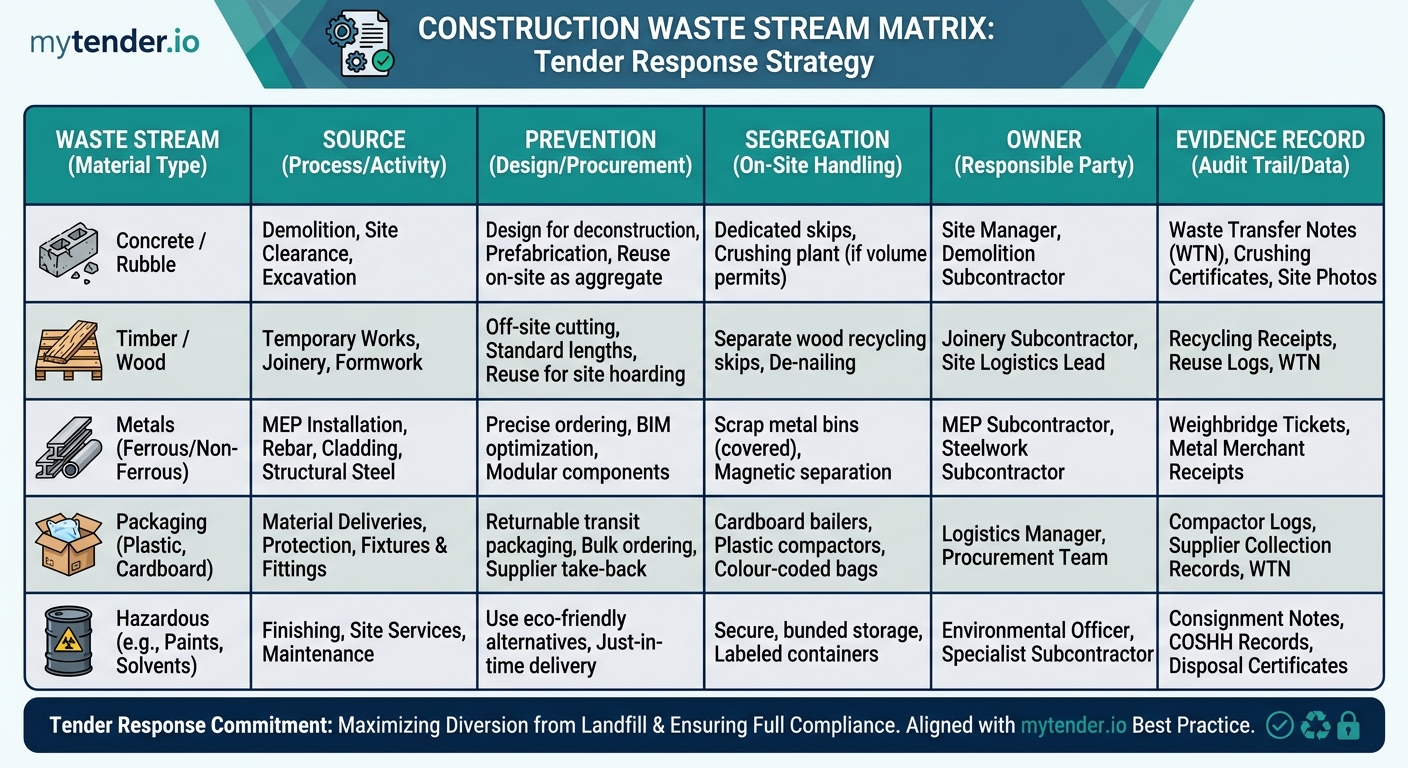
Waste stream matrix for a construction tender showing prevention measures, owners and evidence records
Show How Subcontractors Will Be Controlled
Waste performance usually fails at the interfaces.
The main contractor can have a strong policy, but the project still suffers if trades bring excess packaging, mix waste streams or ignore site rules under programme pressure.
That means subcontractor control has to be more than a line saying "all subcontractors will comply".
A strong tender response explains the control points:
- waste expectations included in tender enquiries and subcontract orders
- pre-start briefings for each trade
- packaging reduction and take-back requirements
- trade-specific waste forecasts
- daily housekeeping checks
- non-conformance escalation
- performance review in subcontractor meetings
- evidence records tied to payment or completion where appropriate
Be careful with punitive language. Evaluators do not want to hear that you will spend the contract fighting subcontractors.
Frame it as clear standards, early briefing and visible checks.
Tie Waste Controls to Programme and Logistics
Waste is not only an environmental issue. It is a logistics issue.
This is especially true for public sector construction projects in schools, hospitals, housing estates, civic buildings and constrained town-centre sites.
If the site is tight, explain how waste areas will be located and managed.
If the client has live operations, explain collection timing.
If resident or stakeholder disruption matters, explain communication and housekeeping.
If the project has phased handovers, explain how waste controls reset between phases.
A good answer might say:
> Waste collection windows will be aligned to the logistics plan and agreed with the client's site representative during mobilisation. We will avoid peak access periods, maintain segregated waste zones away from public routes and review collection frequency weekly during high-volume phases to prevent overflow.
That sentence earns trust because it connects waste to delivery reality.
Reporting: Give the Buyer Evidence They Can Use
Under the Procurement Act regime, buyers are more conscious of published performance, KPIs and contract management records.
Even where a waste KPI is not formally published, the client still needs credible reporting.
Do not simply say you will report monthly.
Explain what the report includes:
- waste volume by stream
- destination and treatment route
- diversion from landfill
- reuse and take-back activity
- carbon or cost implications where measurable
- non-conformances and corrective actions
- photographs of segregation areas
- transfer note checks
- trend against baseline or forecast
The key is to make reporting useful for contract management, not just compliance filing.
If you can provide a sample dashboard or previous report extract, mention it.
If you use a digital system, explain what it changes. Do not just name the software.
Avoid Greenwashing Language
Tender evaluators are allergic to vague sustainability claims.
These phrases sound good but score badly:
- we are passionate about sustainability
- we will minimise waste wherever possible
- we aim to recycle as much as we can
- we use responsible suppliers
- we are committed to circular economy principles
They are not wrong. They are just empty.
Replace them with specifics:
- which waste streams
- which targets
- which controls
- which named roles
- which review frequency
- which records
- which comparable project evidence
This is not about writing more. It is about writing proof.
How to Structure a Scored Tender Answer
For a 1,000-word construction waste question, use a structure like this.
1. Project-specific risk summary
Open with the waste streams and delivery constraints you expect.
Mention the project type, site constraints and relevant phases. Keep it short.
2. Prevention and circular economy controls
Show how you will reduce waste before it reaches site.
Include design coordination, procurement controls, supplier packaging, reuse and take-back routes.
3. Site controls and segregation
Explain storage areas, signage, responsibilities, inspections and trade briefings.
Use a waste stream matrix if space allows.
4. Subcontractor management
Show how waste standards flow into orders, briefings, checks and reviews.
5. Reporting and continuous improvement
Describe the evidence the client will receive and how underperformance will be corrected.
This structure helps because it follows the evaluator's likely scoring logic. It moves from risk understanding to action, then evidence.
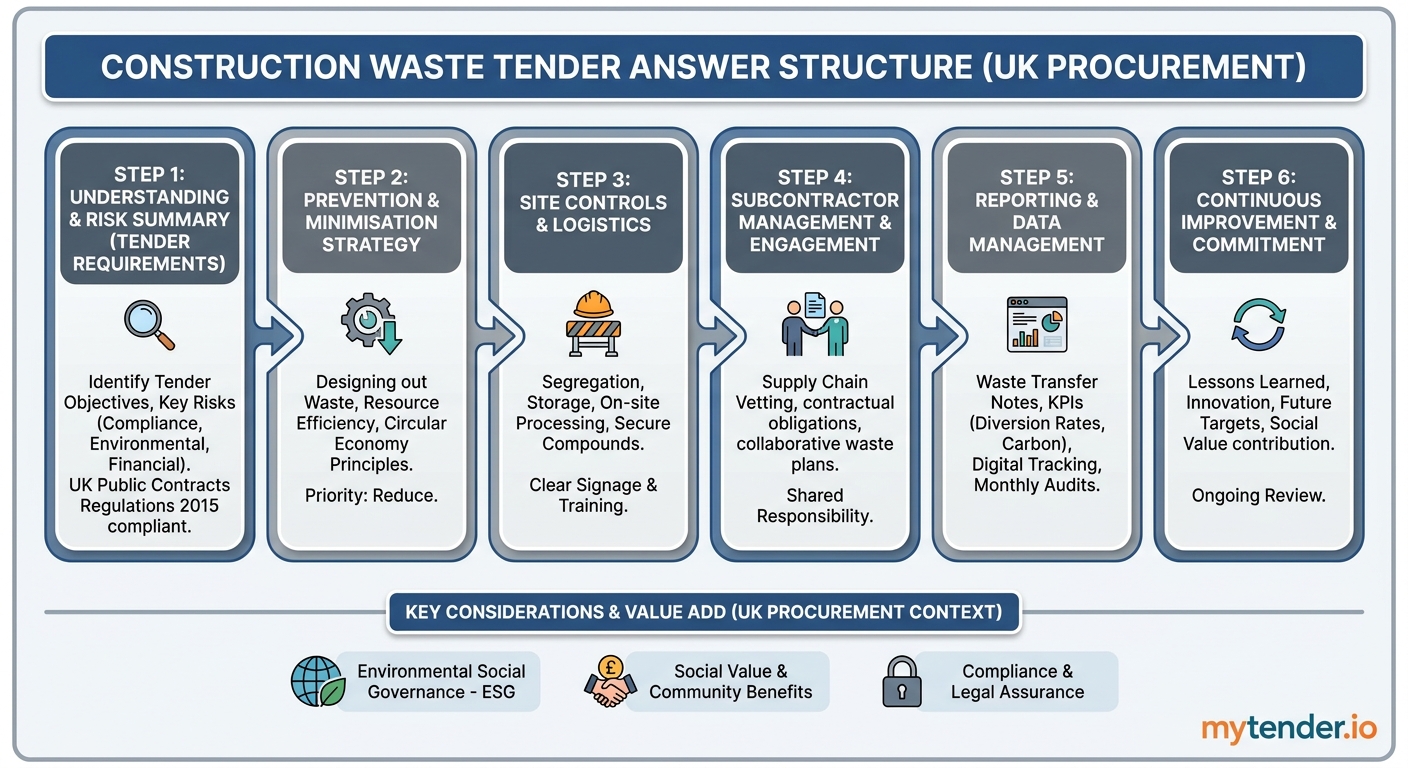
Step-by-step structure for writing a scored construction waste management tender answer
What Good Evidence Looks Like
Good evidence is recent, relevant and specific.
It does not have to be perfect. It does have to be believable.
Strong examples include:
- a comparable project with waste volumes and diversion data
- a before-and-after reduction in packaging waste
- a subcontractor briefing template
- a sample waste dashboard
- transfer note audit results
- photos of segregated waste areas from similar sites
- supplier take-back records
- lessons learned from a project with similar constraints
Weak evidence looks like this:
- generic ISO 14001 statements
- old case studies from unrelated projects
- broad recycling percentages with no context
- policy extracts with no project application
- claims that cannot be measured after award
A useful test: could the evaluator imagine checking this evidence during the contract?
If yes, keep it. If no, rewrite it.
Common Scoring Traps
Construction waste answers often lose marks for small but avoidable reasons.
Trap 1: Only talking about skips
Skips matter, but they are not the strategy. Talk about prevention, procurement and design coordination first.
Trap 2: Giving one recycling percentage
A single percentage hides the detail. Break it down by stream where you can.
Trap 3: Forgetting hazardous or regulated waste
If surveys, asbestos, WEEE, contaminated material or COSHH-related waste could be relevant, show how you will identify and control it.
Trap 4: Ignoring logistics
Waste storage and collection can disrupt the site. Explain how you will avoid that.
Trap 5: Making claims the project team cannot deliver
Do not promise a sophisticated dashboard if site teams will only produce a spreadsheet. Better to be simple and credible than shiny and fictional.
How mytender.io Helps Bid Teams Build Better Evidence
Most weak waste answers are not weak because the business lacks operational knowledge.
They are weak because the evidence is scattered.
The best example is in a previous bid. The useful waste dashboard is in a project folder. The subcontractor control wording is buried in an old mobilisation plan. The lessons learned note is in someone's inbox.
That is exactly the sort of problem mytender.io is built to solve. It helps bid teams find relevant past evidence, shape it around the question and avoid starting from a blank page every time.
The important point is not automation for its own sake. It is making sure the answer reflects what your business already knows.
A Simple Checklist Before Submission
Before you submit a construction waste response, check it against this list.
Does the answer:
- name the likely waste streams for this project?
- show prevention before recycling?
- explain trade-by-trade controls?
- include named role ownership?
- connect waste to logistics and programme?
- define what evidence the client will receive?
- include comparable project proof?
- avoid vague sustainability language?
- align with any KPI schedule or contract management requirements?
- sound like it was written for this tender, not copied from a policy?
If the answer passes those tests, it is in decent shape.
If it does not, fix the evidence before polishing the prose.
Final Thought
Construction waste management is becoming a useful test of bid quality.
It shows whether you understand the project, whether your sustainability claims are real and whether your contract management will produce evidence after award.
The bidders that win will not be the ones with the grandest environmental language. They will be the ones who make waste prevention practical, measurable and believable.
If you want to find live construction and environmental opportunities where this kind of evidence matters, the Tender Finder is free to use.
Tags
Ready to Transform Your Tender Writing?
See how MyTender's AI can help you write winning tenders in a fraction of the time.