
Construction Tender Success: Winning Strategies for Contractors in 2026
Comprehensive guide to winning construction tenders in 2026. Master cost estimation, risk management, competitive pricing, and negotiation strategies to increase your bid success rate.
mytender.io Team
Construction and Procurement Specialists
The construction industry remains one of the most competitive sectors for tender opportunities, with margins continually under pressure and client expectations higher than ever. Whether you're a main contractor pursuing large infrastructure projects or a specialist subcontractor targeting niche opportunities, your ability to craft winning tender responses whilst maintaining profitability determines your business's long-term viability.
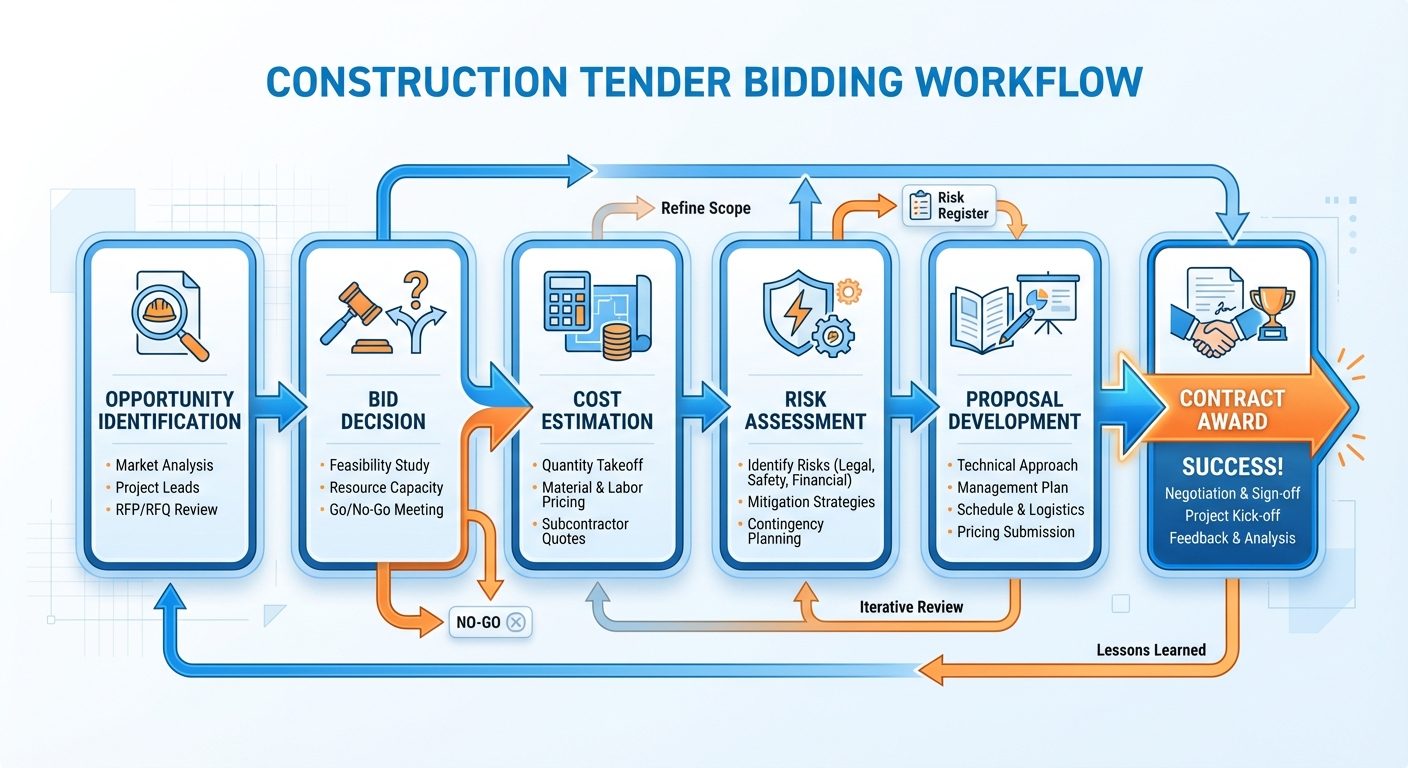
Construction tender bidding workflow diagram
The landscape has shifted dramatically. Digital transformation, artificial intelligence, sustainability mandates, and evolving procurement regulations have fundamentally changed how construction tenders are evaluated and won. The contractors who thrive in 2026 understand that tender success requires far more than competitive pricing—it demands strategic thinking, rigorous risk management, compelling value propositions, and increasingly, technological sophistication.
This comprehensive guide draws on current industry best practices and emerging trends to provide construction professionals with actionable strategies for improving tender success rates whilst protecting margins and building sustainable client relationships.
Understanding the Modern Construction Tendering Environment
The construction tendering landscape in 2026 operates within a complex ecosystem of regulatory requirements, technological advancement, and shifting client priorities. Contractors must navigate multiple challenges simultaneously whilst maintaining competitive positioning.
Public sector procurement has undergone substantial reform with the full implementation of the Procurement Act 2023, which fundamentally changed evaluation criteria from Most Economically Advantageous Tender (MEAT) to Most Advantageous Tender (MAT). This shift grants contracting authorities greater flexibility to define "advantageous" beyond pure cost considerations, encompassing quality, social value, environmental sustainability, and broader public benefit.
For construction contractors, this regulatory evolution means bids must demonstrate measurable contributions to carbon reduction, local employment creation, supply chain sustainability, and community engagement. Generic sustainability statements no longer suffice—clients demand quantifiable commitments with robust delivery mechanisms and transparent reporting frameworks.
The Central Digital Platform has become the primary publication service for procurement notices, replacing legacy systems and creating new transparency requirements. Contractors must adapt their market intelligence processes to effectively monitor opportunities across this consolidated platform whilst ensuring their own compliance with evolving reporting obligations.
Simultaneously, digital transformation has accelerated across the tendering lifecycle. Advanced cost estimation software, building information modelling integration, AI-powered document analysis, and sophisticated risk modelling tools have become standard practice amongst leading contractors. Those who fail to embrace these technological capabilities increasingly find themselves at competitive disadvantage.
Client expectations have evolved correspondingly. Modern construction tenders demand comprehensive evidence of technical competence, robust quality assurance frameworks, proven safety performance, supply chain resilience, and innovative approaches to project delivery. Clients increasingly evaluate contractor capability rather than simply comparing prices on like-for-like specifications.
This environment rewards contractors who invest in tender capability development, build strong commercial intelligence functions, cultivate client relationships proactively, and maintain rigorous internal quality assurance processes. Success requires strategic thinking at every stage from opportunity identification through to contract negotiation.
Strategic Bid/No-Bid Decision Making
Before investing significant resources into tender preparation, conducting rigorous bid/no-bid analysis represents perhaps the single most important strategic decision contractors can make. Research consistently demonstrates that selective bidding—focusing resources on opportunities with genuine win potential—delivers substantially better outcomes than pursuing every available tender.
Effective bid/no-bid evaluation examines multiple dimensions systematically. Win probability assessment considers your competitive positioning relative to likely competitors, existing client relationships, technical differentiation, geographic advantage, and sector experience. If your honest assessment suggests win probability below 20-25%, the opportunity likely represents poor resource allocation regardless of potential value.
Strategic alignment evaluation examines whether the project advances your business objectives. Does it provide entry into target markets or client relationships? Does it leverage core competencies and existing supply chain relationships? Does it align with your growth strategy and risk appetite? Opportunities that score poorly on strategic alignment often prove problematic even when won, potentially distracting resources from more valuable pursuits.
Resource availability represents another critical consideration. Comprehensive tender responses for major construction projects demand significant input from estimators, planners, technical specialists, and senior management. Realistic assessment of available capacity—considering both tender preparation requirements and potential delivery obligations if successful—prevents resource conflicts that compromise quality across multiple bids.
Financial evaluation extends beyond potential revenue to consider profitability potential, payment terms, cash flow implications, and commercial risk. Projects with problematic contract terms, unrealistic programmes, or inadequate risk allocation may present more liability than opportunity regardless of headline value.
Due diligence should also examine client reputation, payment performance, and past project outcomes. Contractors who pursue work for clients with poor payment histories or unreasonable expectations often discover that winning these opportunities creates more problems than value.
Implementing structured bid/no-bid processes with clearly defined criteria and decision authority ensures consistent, objective evaluation. Leading contractors use scoring matrices that weight key factors according to business priorities, requiring projects to achieve minimum thresholds before resources are committed.
This disciplined approach allows contractors to focus resources on opportunities offering genuine value alignment, reasonable win probability, and acceptable risk/reward balance. The result: higher win rates, better margin protection, and more efficient resource utilisation across the tender function.
Comprehensive Cost Estimation and Pricing Strategy
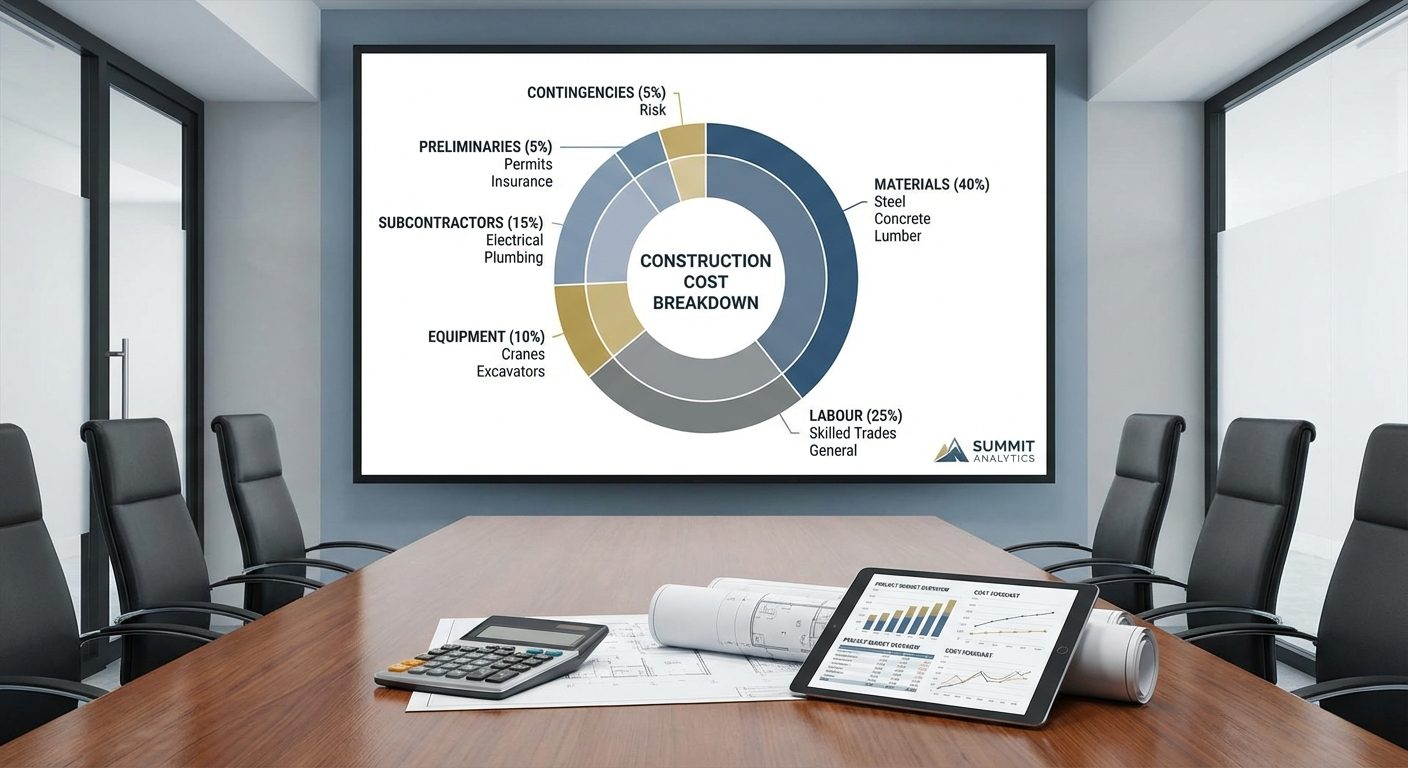
Construction cost estimation breakdown visualization
Accurate cost estimation forms the foundation of competitive yet profitable tender pricing. Systematic approaches to cost development protect contractors from the dual risks of overpricing (losing winnable work) and underpricing (winning unprofitable projects that threaten business viability).
The estimation process begins with meticulous document review, ensuring complete understanding of project scope, specifications, quality requirements, programme constraints, and commercial terms. Experienced estimators conduct multiple detailed read-throughs, highlighting ambiguities, inconsistencies, or omissions that require clarification through formal queries.
Breaking down the estimate into discrete work packages enables detailed bottom-up costing whilst facilitating accountability during project delivery. Leading contractors structure estimates to align with anticipated subcontract packages, allowing direct comparison between tender-stage assumptions and actual subcontractor quotations.
Material quantity take-offs demand particular rigour, ideally supported by digital measurement tools that reduce human error and enable rapid scenario analysis. Modern construction software can extract quantities directly from BIM models when available, improving accuracy whilst accelerating the estimation timeline.
Labour productivity assumptions should reflect realistic outputs based on similar project experience, accounting for site-specific conditions, access constraints, sequencing complexities, and quality requirements. Overly optimistic productivity assumptions represent a common source of tender-stage underestimation that erodes margins during delivery.
Plant and equipment costs must account for utilisation rates, mobilisation/demobilisation expenses, and potential standing time during programme gaps. Contractors should verify whether specialist equipment will be readily available when required or whether longer hire periods may be necessary.
Subcontractor engagement represents a critical but often problematic element of construction tendering. Securing firm, fixed-price quotations from qualified subcontractors before tender submission provides price certainty and demonstrates deliverability. However, the industry's endemic practice of "bid shopping"—where main contractors leverage tender-stage quotations to negotiate lower prices post-award—has eroded subcontractor confidence in providing early-stage support.
Progressive contractors are addressing this challenge through preferred supply chain frameworks that provide volume commitments to subcontractors in exchange for competitive, reliable pricing support during tenders. These strategic relationships create competitive advantage whilst improving delivery predictability.
Indirect costs including insurance, performance bonds, warranties, site establishment, temporary works, statutory fees, and professional indemnities must be comprehensively captured. Project-specific insurance requirements can vary significantly, warranting early engagement with insurance brokers to validate assumptions.
Preliminaries pricing deserves particular attention, as clients increasingly scrutinise these costs. Detailed breakdowns demonstrating alignment with programme requirements and efficiency measures strengthen credibility and resist value engineering challenges.
Contingency allowances should reflect specific project risks rather than applying blanket percentages. Risk-based contingency development links allowances directly to identified uncertainties, enabling informed discussion with clients about risk allocation and appropriate pricing protection.
Overhead allocation methodologies should ensure recovery of business operating costs whilst remaining market competitive. Understanding your overhead recovery requirements enables informed minimum margin decisions during final pricing reviews.
Mark-up determination represents the final pricing judgement, balancing competitiveness against profitability objectives, resource opportunity cost, risk appetite, and strategic value. Market intelligence regarding likely competitor pricing provides valuable context, though contractors must resist the temptation to "buy" work at unsustainable margins during market downturns.
Tiered pricing strategies can create competitive advantage by offering clients multiple options at different price points. Base scope pricing demonstrates competitiveness whilst value-added alternatives showcase innovation and additional benefits. This approach enables clients to make informed choices whilst potentially improving project value.
Leading contractors invest in estimation technology, maintain comprehensive historical cost databases, conduct regular market benchmarking, and implement structured estimation review processes to continuously improve pricing accuracy and competitiveness.
Robust Risk Management Frameworks
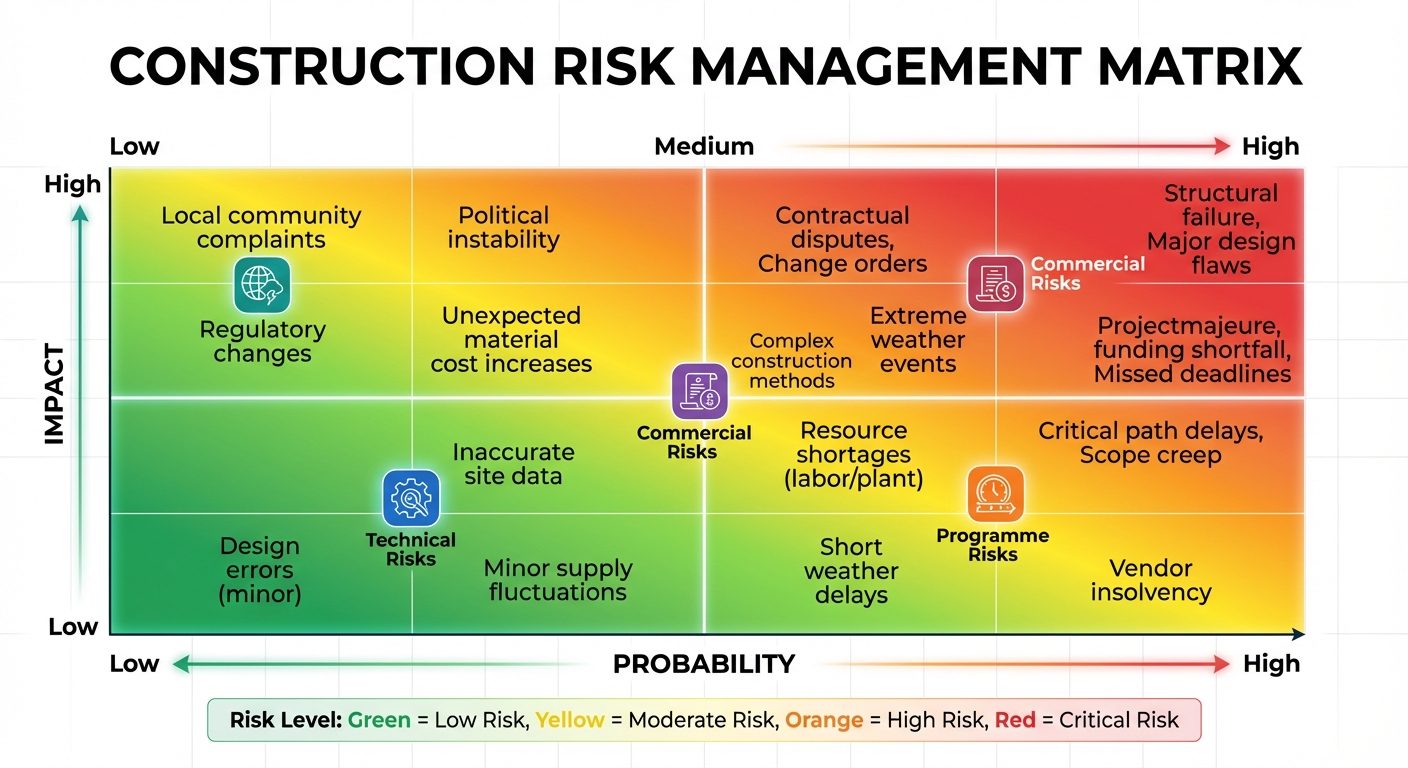
Construction risk management matrix diagram
Construction projects inherently involve substantial uncertainty spanning technical, commercial, programme, and external dimensions. Contractors who systematically identify, analyse, and mitigate tender-stage risks protect margins whilst demonstrating commercial maturity that clients increasingly value during evaluation.
Risk identification should commence early in tender evaluation, examining all aspects of project delivery. Technical risks encompass design uncertainties, ground conditions, existing structure interfaces, buildability challenges, and performance specification compliance. Commercial risks include contract term acceptability, payment mechanisms, variation procedures, liability caps, and parent company guarantee requirements. Programme risks consider design information availability, statutory approval timelines, interface coordination, critical supply chain lead times, and seasonal constraints.
External risks span regulatory compliance, planning conditions, environmental requirements, community stakeholder management, and market conditions affecting material or labour availability. Early identification enables proactive mitigation development rather than reactive problem-solving during delivery.
Risk analysis should evaluate both probability and potential impact, prioritising attention on high-consequence scenarios. Qualitative assessment often suffices during tender stage, though quantitative risk analysis using Monte Carlo simulation or similar techniques provides valuable insight for major projects with complex risk profiles.
Risk ownership allocation represents a critical commercial consideration. Construction contracts attempt to allocate various risks between client and contractor, but actual ability to manage specific risks varies substantially. Contractors should critically evaluate whether risks they're being asked to assume can be effectively controlled through their actions or whether they represent inappropriate transfer of risks better managed by others.
For risks within contractor control—such as productivity, supply chain management, or construction methodology—accepting ownership with appropriate pricing protection makes commercial sense. For risks beyond contractor influence—such as design adequacy, unforeseen ground conditions, or client-caused delays—contractors should seek appropriate relief mechanisms through contract terms or price allowances.
Risk register development creates structured documentation of identified risks, ownership allocation, mitigation strategies, and residual exposure. Sharing abbreviated versions with clients during tender interviews demonstrates commercial sophistication and can facilitate productive dialogue about risk allocation and pricing basis.
Mitigation strategies should address key risks through multiple approaches. Design development and early contractor involvement can reduce technical uncertainty. Preferred supplier agreements mitigate supply chain risk. Robust programme planning with adequate float protects against sequencing challenges. Contractual protections including adequate extension of time provisions, change management procedures, and limitation of liability clauses reduce commercial exposure.
Insurance and bonding strategies transfer certain risks to third parties, though contractors must ensure coverage actually responds to claimed exposures rather than providing false security. Early insurance broker engagement during tenders identifies coverage gaps and validates pricing assumptions.
Contingency allocation should link directly to residual risks after mitigation measures, providing transparent pricing basis that withstands client challenge. Risk-based contingency also enables informed negotiation—if clients seek price reductions, corresponding risk transfers or mitigation investments can be discussed rationally.
Post-tender risk workshops with delivery teams validate tender-stage assessments and ensure smooth transition from commercial to operational focus. These sessions identify any overlooked exposures whilst building team ownership of mitigation strategies.
Construction professionals who embed systematic risk management throughout the tender process protect company finances whilst strengthening client confidence in delivery capability—a dual benefit that improves both win rates and project outcomes.
Crafting Compelling Value Propositions

Modern construction team collaborating on tender proposal
Modern construction tenders require far more than competitive pricing and compliant technical submissions. Clients increasingly evaluate supplier capability, innovation, sustainability credentials, and value-added contributions beyond basic scope delivery. Contractors who articulate clear, compelling value propositions that differentiate their offering from competitors significantly improve win probability.
Effective value propositions begin with deep understanding of client priorities, project objectives, and evaluation criteria. Reviewing tender documentation purely for technical compliance misses critical strategic intelligence about what clients truly value. Careful analysis of weighting matrices, quality criteria definitions, and evaluation methodologies reveals what matters most to decision makers.
For some clients, programme certainty and early delivery may be paramount. For others, whole-life cost optimisation, sustainability performance, or local economic benefit could dominate evaluation. Contractors must tailor their value proposition accordingly rather than presenting generic capabilities.
Demonstrating genuine understanding of client challenges creates immediate credibility. Referencing specific project constraints mentioned in tender documents, acknowledging particular complexities, or highlighting opportunities for improved outcomes shows attentive engagement rather than template responses.
Differentiation requires honest assessment of your genuine competitive advantages. These might include specialist technical capabilities, proven track record in similar projects, established supply chain relationships enabling cost or programme benefits, innovative construction methodologies, superior safety performance, or strong local presence facilitating community engagement.
Critically, claimed differentiators must be evidenced convincingly. Vague assertions about "quality focus" or "innovation culture" lack credibility. Specific case studies demonstrating how you've solved similar challenges for previous clients, quantified performance data showing measurable advantages, or independent accreditations validating claimed capabilities provide substantiation that evaluation panels value.
Innovation and value engineering opportunities should be developed thoughtfully, ensuring suggested alternatives genuinely enhance client outcomes rather than simply reducing contractor cost. The best value engineering proposals save clients money whilst improving performance, programme, or sustainability—creating clear win-win scenarios that strengthen rather than undermine credibility.
Sustainability and social value responses demand particular attention given their increased weighting in modern evaluations. Generic commitments to "support local suppliers" or "minimise environmental impact" score poorly against competitors presenting specific, quantified commitments with clear delivery mechanisms.
Strong social value proposals include concrete targets for local labour employment, apprenticeship creation, SME supply chain spend, community engagement activities, and educational outreach. These should link directly to project location and client priorities, demonstrating tailored thinking rather than boilerplate responses.
Environmental commitments must align with client carbon reduction targets, presenting clear methodologies for measurement, regular reporting frameworks, and innovative approaches to minimising embodied carbon, construction waste, and operational energy consumption. Contractors with established environmental management systems, carbon measurement capabilities, and proven track records have substantial competitive advantage.
Quality and safety credentials should be evidenced through certifications, performance data, and robust management system descriptions. Leading safety statistics, continuous improvement programmes, and lessons learned from previous projects demonstrate mature capability that reduces client risk.
The proposal document itself requires careful attention to structure, clarity, and professional presentation. Evaluators often review dozens of submissions under time pressure—well-structured responses with clear compliance matrices, informative graphics, and concise writing substantially improve evaluator experience and scoring outcomes.
Executive summaries should distil key value messages into compelling, scannable format that enables evaluators to quickly grasp your competitive advantages and win themes. These summaries are often the most-read section and warrant disproportionate attention during development.
Throughout the response, maintaining client focus rather than contractor focus improves engagement. Writing that emphasises "you will benefit" rather than "we will deliver" creates subtle but meaningful psychological alignment with client interests.
Contractors who invest in understanding client priorities, developing genuine differentiators, and communicating value propositions compellingly transform tender responses from transactional price comparisons into strategic partnership discussions—fundamentally improving competitive positioning.
Leveraging Technology and Digital Tools

Digital construction technology and BIM visualization
The construction sector has historically lagged other industries in technology adoption, but the tide has turned decisively. Contractors who embrace digital transformation throughout the tendering lifecycle achieve measurable advantages in efficiency, accuracy, competitive positioning, and client value demonstration.
Estimating software has evolved from basic spreadsheet replacement to sophisticated platforms integrating quantity take-off, resource libraries, real-time cost intelligence, and scenario analysis. Modern estimating tools can extract measurements directly from digital drawings or BIM models, dramatically reducing manual measurement effort whilst improving accuracy.
These systems enable rapid exploration of alternative construction methodologies, material specifications, or programme sequencing, allowing estimators to identify optimal cost/value balances that manual approaches cannot achieve within tender timescales. Historical cost databases integrated within estimating platforms improve pricing accuracy by referencing actual outcomes from previous projects rather than relying purely on theoretical rates.
Building Information Modelling capabilities increasingly represent expected baseline competency rather than competitive differentiator. Clients specify BIM requirements throughout design development and construction phases, and contractors must demonstrate suitable capabilities during tender evaluation. For design-build or design-and-build procurement, BIM-enabled design coordination identifies clashes and buildability issues during tender stage, reducing risk and strengthening technical submissions.
Document management platforms transform tender coordination, particularly for major bids requiring input from multiple internal teams and external supply chain partners. Cloud-based collaboration tools enable version control, simultaneous editing, structured review workflows, and secure external sharing—replacing email chaos with organised efficiency.
AI-powered tools are emerging as significant accelerators for specific tender tasks. Natural language processing can rapidly extract key requirements from lengthy tender documents, populating compliance matrices and highlighting ambiguities or omissions that warrant clarification. These tools don't replace human judgement but substantially reduce mechanical processing effort.
AI writing assistants can accelerate draft development for methodology descriptions, case study preparation, and similar narrative sections—though human expertise remains essential for quality control, customisation, and ensuring responses genuinely address client priorities rather than generating generic content.
Proposal automation platforms enable contractors to build response libraries for frequently-requested information such as company background, accreditations, standard methodologies, case studies, and management system descriptions. When combined with intelligent search and version control, these libraries dramatically accelerate response development whilst ensuring consistency and currency.
Risk management software provides structured frameworks for risk identification, analysis, and mitigation planning. Integration between risk registers and estimating systems enables risk-based contingency allocation that provides transparent pricing rationale during client negotiations.
Programme planning tools have advanced substantially, with critical path analysis, resource levelling, 4D simulation, and scenario modelling enabling sophisticated programme development and visualisation. Clients increasingly evaluate programme robustness and criticality during tender assessment—well-developed programmes supported by appropriate technology demonstrate competence and reduce perceived delivery risk.
Customer relationship management systems help contractors track client interactions, manage opportunity pipelines, and analyse win/loss patterns. These platforms ensure institutional memory survives personnel changes whilst providing commercial intelligence that informs bid/no-bid decisions and win strategy development.
Data analytics capabilities enable contractors to mine historical tender performance, identifying patterns in successful bids, common loss reasons, accurate estimating versus actual cost correlation, and resource efficiency. These insights drive continuous improvement in tender processes and outcomes.
Despite these technological advantages, successful implementation requires thoughtful change management. Technology alone cannot compensate for poor processes, inadequate training, or resistance to new ways of working. Leading contractors invest in user training, establish clear governance for technology use, and maintain realistic expectations about implementation timelines and adoption challenges.
The competitive landscape increasingly divides between contractors who effectively leverage technology to enhance capability and those who persist with manual approaches. The efficiency, accuracy, and capability gap will only widen—making digital transformation essential rather than optional for tender competitiveness.
Effective Stakeholder Management and Relationship Building
Construction tendering occurs within relationship contexts that profoundly influence outcomes. Contractors who strategically cultivate client relationships, architect connections, consultant networks, and supply chain partnerships create competitive advantages that extend far beyond individual tender responses.
Early client engagement provides invaluable insight into upcoming opportunities, project priorities, procurement approaches, and evaluation criteria. Contractors who participate constructively in pre-tender market engagement events gain intelligence advantages whilst demonstrating interest and capability. These interactions enable calibration of tender strategies to client preferences and early identification of potential teaming arrangements or subcontractor requirements.
However, market engagement requires careful attention to procurement rules, particularly in public sector contexts where equality of treatment and transparency obligations constrain client discretion. Contractors must understand what information can legitimately be shared at different procurement stages and ensure their engagement respects these boundaries whilst maximising strategic intelligence gathering.
Design team relationships often prove critical, particularly for design-build procurement where contractor capabilities must integrate with design consultants. Early architect and engineer engagement helps contractors understand design intent, identify buildability opportunities, and demonstrate collaborative approach that evaluators value.
Some procurement routes explicitly encourage early contractor involvement in design development, and contractors who engage constructively during these phases establish credibility and influence that improves tender competitiveness. These relationships also facilitate more accurate estimating through better design understanding and reduced uncertainty.
Supply chain relationship management represents perhaps the most impactful long-term investment contractors can make in tender capability. Reliable subcontractor and supplier partnerships provide competitive pricing support during tenders, reduce delivery risk, and enable innovative approaches that generic supply relationships cannot achieve.
Progressive contractors invest in strategic supply chain development through preferred partner frameworks, regular performance feedback, fair payment practices, and volume commitments that create mutual value. These relationships transform supply chain engagement from transactional price-shopping to strategic collaboration with shared success incentives.
Client relationship continuity beyond individual projects creates repeat opportunity advantages. Contractors who deliver successfully, maintain post-completion engagement, and demonstrate interest in long-term partnership dramatically improve success rates on future opportunities with the same clients.
Regular client feedback sessions—both on completed projects and lost bids—provide critical intelligence for continuous improvement. Understanding why you won or lost specific tenders informs strategy refinement and demonstrates commitment to learning and development that clients appreciate.
Professional body involvement, industry event participation, and thought leadership activities build market profile and credibility that support tender competitiveness. Speaking at industry conferences, publishing technical articles, or contributing to industry working groups establishes expertise recognition that influences evaluation outcomes.
Alumni networks and personnel relationships also matter—procurement and project teams move between client organisations, and positive relationships endure beyond specific roles. Contractors who treat all stakeholder interactions as reputation-building opportunities create goodwill that eventually returns value.
However, relationship-building must operate within appropriate ethical boundaries. Inappropriate inducements, conflicts of interest, or attempts to circumvent fair competition processes risk serious reputational and legal consequences. Professional relationship cultivation focuses on demonstrating competence, reliability, and value rather than seeking improper advantage.
Contractors who view tendering as relationship development rather than purely transactional competition create sustainable competitive advantages that compound over time. These investments in people, partnerships, and professional networks deliver returns far exceeding individual tender outcomes.
Negotiation Strategies and Contract Formation
Many contractors view tender submission as the culmination of the competitive process, but significant commercial opportunity and risk remains during subsequent negotiation and contract formation phases. Effective negotiation protects interests whilst building constructive client relationships that support successful project delivery.
Understanding negotiation positioning begins during bid preparation. Contractors should identify which commercial terms present genuine obstacles requiring resolution versus preferences that can be conceded during negotiation. This prioritisation enables focused negotiation on material issues whilst demonstrating flexibility on secondary matters.
Some contract terms warrant firm positions—adequate extension of time provisions, reasonable liability limitations, clear change management procedures, and fair risk allocation represent legitimate baseline requirements that contractors should protect. Accepting fundamentally unbalanced terms to win work creates project delivery problems and potential business-threatening liability.
However, negotiation requires distinguishing between unacceptable terms and merely suboptimal positions. Contractors who dig in on every contractual detail frustrate clients and risk losing opportunities over issues that don't justify the stance. Effective negotiators calibrate their positions according to genuine commercial impact and materiality.
Pre-negotiation preparation should include clear understanding of your BATNA (Best Alternative To a Negotiated Agreement) and WATNA (Worst Alternative To a Negotiated Agreement). Knowing your walkaway point and understanding opportunity cost influences negotiation positioning and prevents emotionally-driven decision making during discussions.
Opening positions should be carefully considered. Leading with aggressive positions on multiple fronts may create adversarial tone that undermines collaboration, whilst immediately conceding ground weakens negotiating credibility. Thoughtful opening positions that acknowledge client priorities whilst protecting essential contractor interests establish constructive negotiation foundation.
During negotiations, focusing on interests rather than positions creates problem-solving orientation rather than positional deadlock. When clients resist contractor positions on specific terms, understanding their underlying concerns often reveals alternative solutions that address both parties' genuine interests.
For example, clients may resist liquidated damages reductions due to external funding constraints requiring project completion guarantees, but might accept alternative formulations that protect client interests whilst capping contractor exposure at reasonable levels. Interest-based negotiation unlocks creative solutions that positional bargaining cannot achieve.
Objective criteria and industry benchmarks provide powerful negotiation tools. When discussing liability caps, payment terms, or other commercial provisions, referencing standard industry positions or relevant precedents from comparable projects strengthens arguments beyond mere assertion of preference.
Throughout negotiations, maintaining professional relationships and avoiding personal confrontation protects long-term client relationships regardless of specific negotiation outcomes. Contractors who "win" negotiations through aggressive tactics but damage relationships often discover pyrrhic victories when facing delivery challenges requiring client cooperation.
Documentation discipline during negotiations prevents misunderstanding and protects against subsequent disputes. Formal records of agreed positions, outstanding issues, and negotiation progress create clarity and accountability that informal discussions cannot provide.
For complex negotiations spanning multiple sessions, interim agreements on resolved issues build momentum whilst preventing regression on settled points. These incremental victories create psychological progress that facilitates ultimate deal closure.
Knowing when to walk away from unreasonable terms represents crucial commercial discipline. Contractors who accept fundamentally flawed commercial terms to avoid "losing" opportunities often discover they've won projects that threaten business viability. Sometimes the best outcome is no deal rather than a bad deal.
However, walking away should be reserved for genuine dealbreakers after exhausting reasonable resolution efforts. Premature withdrawal over negotiable issues wastes previous investment and risks reputation damage if perceived as bad faith negotiation.
Post-negotiation contract review ensures agreed positions are accurately reflected in formal documentation before execution. Misalignment between negotiation outcomes and final contract language creates immediate problems and erodes trust established during negotiation.
Contractors who approach negotiation strategically, prepare thoroughly, focus on interests rather than positions, maintain professional relationships, and exercise appropriate commercial discipline achieve better outcomes whilst building client partnerships that support successful project delivery.
Continuous Improvement and Learning
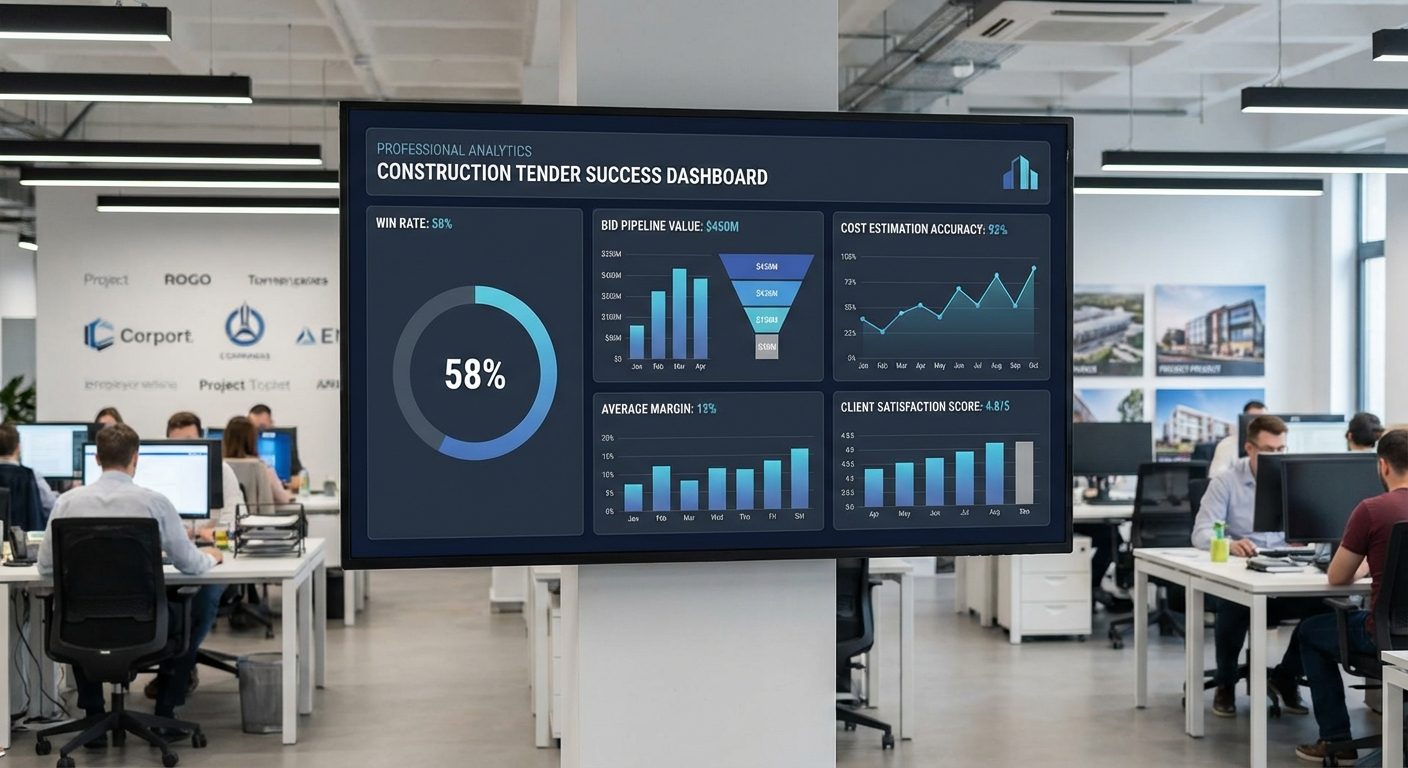
Construction tender success metrics dashboard
Tender success rates rarely improve through chance—consistent advancement requires deliberate investment in capability development, systematic performance analysis, and cultural commitment to learning from both victories and defeats.
Post-tender reviews represent perhaps the most valuable yet frequently neglected practice in tendering excellence. Whether successful or unsuccessful, every significant bid provides learning opportunities that inform future performance. Structured debrief sessions examining what worked well, what could be improved, and what should be done differently next time create actionable insights that compound over successive opportunities.
For lost bids, client feedback—where available—provides invaluable external perspective on competitive positioning, response quality, pricing competitiveness, and evaluation perception. Many contractors avoid requesting loss debrief due to disappointment or embarrassment, but this feedback represents free consulting advice that would be expensive to acquire elsewhere.
Effective debrief processes go beyond capturing lessons to ensuring insights actually influence future behaviour. Documenting lessons learned without implementing resulting improvements wastes the exercise. Progressive contractors build feedback loops between debrief outcomes and tender process updates, training development, and proposal library enhancements.
Tender process documentation enables consistency and knowledge transfer beyond individual practitioners. Comprehensive procedural guidance covering bid/no-bid criteria, responsibility matrices, quality assurance checkpoints, approval authorities, and timeline expectations prevents tribal knowledge dependency whilst supporting newer team members.
However, processes must balance standardisation with flexibility—overly rigid procedures that don't accommodate project-specific requirements or changing circumstances create compliance burdens without value. Effective tender processes provide structured frameworks whilst enabling appropriate adaptation.
Quality assurance mechanisms prevent submission errors and ensure response quality meets company standards. Structured review processes involving fresh eyes not involved in initial drafting frequently identify gaps, inconsistencies, or unclear messaging that authors miss through familiarity. These reviews should occur with sufficient time before submission to enable meaningful refinement rather than superficial checking under deadline pressure.
Proposal libraries capturing reusable content components accelerate response development whilst ensuring messaging consistency. Well-curated libraries of company descriptions, case studies, methodology descriptions, CVs, accreditations, and standard project materials prevent reinventing content for each tender whilst maintaining quality control through central management.
Training investment in estimating skills, proposal writing, risk management, commercial awareness, and technology capabilities builds team competency systematically. Tender success increasingly demands multidisciplinary expertise—estimators need commercial awareness, commercial managers need technical understanding, and bid coordinators need project management skills.
Benchmarking against industry peers provides external perspective on tender performance, win rates, resource efficiency, and capability gaps. While absolute performance comparisons prove difficult given varying market positions and opportunity types, trend analysis and relative positioning inform improvement priorities.
Technology evaluation should be ongoing—the digital tools available for tendering evolve rapidly, and contractors must periodically reassess whether current systems remain fit for purpose or whether emerging platforms offer meaningful capability advancement.
Cultural factors profoundly influence tender performance. Organisations that view tendering as administrative burden rather than strategic commercial activity underinvest in capability and consequently underperform. Building cultures that value tender excellence, celebrate wins whilst learning from losses, and recognise outstanding contributions creates competitive advantage that processes and technology alone cannot achieve.
Senior leadership engagement signals organisational commitment to tendering excellence. When executives actively participate in major bid reviews, provide coaching to tender teams, and resource capability development appropriately, the entire organisation responds accordingly.
Perhaps most fundamentally, continuous improvement requires honest self-assessment rather than defensive attribution of losses to external factors. Contractors who reflexively blame client bias, unfair evaluation, or competitor sharp practice when losing miss opportunities to address genuine capability gaps or positioning weaknesses within their control.
Construction organisations that embed systematic learning, invest in capability development, celebrate excellence, and maintain honest assessment of performance create virtuous cycles of improvement that compound competitive advantage over time.
Conclusion
Construction tender success in 2026 demands far more than competitive pricing and technical compliance. The contractors who consistently win profitable work whilst building sustainable client relationships master strategic bid selection, rigorous risk management, compelling value proposition development, technological leverage, stakeholder relationship cultivation, effective negotiation, and systematic continuous improvement.
The competitive landscape continues evolving—regulatory requirements become more sophisticated, client expectations advance, technology capabilities expand, and sustainability imperatives intensify. Contractors who view these developments as opportunities rather than burdens position themselves to thrive whilst others struggle adapting.
Success ultimately depends on commitment to excellence throughout the tendering lifecycle. This means investing in capability development, maintaining commercial discipline, embracing innovation, building genuine partnerships, and learning systematically from experience. Contractors who make these investments position themselves not merely to survive but to lead in an increasingly demanding and sophisticated market.
The strategies outlined in this guide provide framework for advancing tender performance, but implementation requires sustained organisational commitment. No single intervention transforms capability overnight—improvement results from consistent application of sound practices refined through experience and adapted to your specific market positioning.
Construction remains fundamentally a project-based industry where opportunity capture determines business viability. Contractors who excel at tendering create the foundation for everything else—project delivery excellence, client relationships, team development, and business growth all depend on winning the right work at the right terms. Investment in tendering capability therefore represents perhaps the highest-return activity construction businesses can undertake.
Whether you're targeting your first major framework opportunity or refining practices honed over decades, maintaining focus on continuous advancement ensures you remain competitive regardless of market conditions. The contractors who win tomorrow's opportunities are building their capabilities today—make sure you're amongst them.
Tags
Ready to Transform Your Tender Writing?
See how MyTender's AI can help you write winning tenders in a fraction of the time.