
Construction Product Compliance in Tenders: How to Evidence Traceability, Substitutions and Safety in 2026
Construction tenders are putting more weight on product compliance, substitution control and golden-thread evidence. Here is how to write a response that reassures evaluators without drowning them in policy wording.
mytender.io Research Team
Tender Writing & Bid Management Specialists
Construction Product Compliance in Tenders: How to Evidence Traceability, Substitutions and Safety in 2026
A product compliance question looks simple until you start writing it.
The tender asks how you will make sure specified products are safe, compliant and traceable. Most bidders reach for the same answer: approved suppliers, quality checks, manufacturer data sheets, site inspections and handover files.
Fine. But not enough.
Construction buyers in 2026 are more nervous about product risk than they used to be. They have lived through years of cladding failures, product testing disputes, gateway delays, supply shortages, design changes and painful remediation programmes. They know that one quiet substitution can create years of trouble.
So when they ask about construction product compliance, they are not asking whether you keep certificates in a folder. They are asking whether your organisation can stop the wrong product reaching the building in the first place.
A strong answer proves three things: you know what was specified, you control any proposed change, and you can trace what was actually installed.
Construction product compliance evidence board showing specification, approval, installation and golden-thread handover stages
Why product compliance has become a scoring issue
Product compliance used to sit quietly inside quality management. It was important, but it rarely got the spotlight in a tender response.
That has changed.
The Building Safety Act has made competence, information management and accountability harder to treat as generic compliance themes. Buyers now expect contractors to show how product choices are governed, especially where fire safety, structural safety, energy performance or maintainability are affected.
The wider procurement market has moved the same way. Recent procurement changes have put more emphasis on transparency, supplier performance, payment discipline and evidence across the contract lifecycle. For construction bidders, that means evaluators are more willing to score the management system behind the promise.
They want to see how decisions are made when a product becomes unavailable, when a supplier suggests an alternative, when a design detail changes, or when the programme is under pressure.
That is where weak answers fall apart.
They describe the happy path. They do not describe the moment where the risk appears.
The SEO gap: lots of compliance guidance, not enough bid-writing guidance
There is plenty of public commentary on building safety, product regulation and construction competence.
There is much less practical guidance on what to write in a tender response.
That is the gap this article fills. It sits inside the construction bid mastery pillar, alongside Building Safety Act competence, CDM compliance, organisational capability and construction waste management evidence.
The target reader is the bid manager or commercial lead who has received a scored question along these lines:
- Describe your product approval and substitution control process.
- Explain how you will evidence compliance with the Building Safety Act.
- Show how product information will be captured for the golden thread.
- Demonstrate how you manage supply-chain product risk.
- Explain how you verify that installed materials match the approved design.
Those questions are not asking for a policy dump. They are asking for a controlled delivery story.
What evaluators are really testing
Most tender questions on product compliance test five areas.
First, specification control. Do you understand the employer's requirements, performance criteria, named products and prohibited substitutions?
Second, approval governance. Who can approve a product, what evidence do they need, and how is the decision recorded?
Third, supply-chain discipline. How do you make sure subcontractors and merchants do not quietly swap products to protect price or programme?
Fourth, site verification. How do you check that what arrives on site is what was approved?
Fifth, handover information. Can the client see what was installed, where it was installed, and which certificates support it?
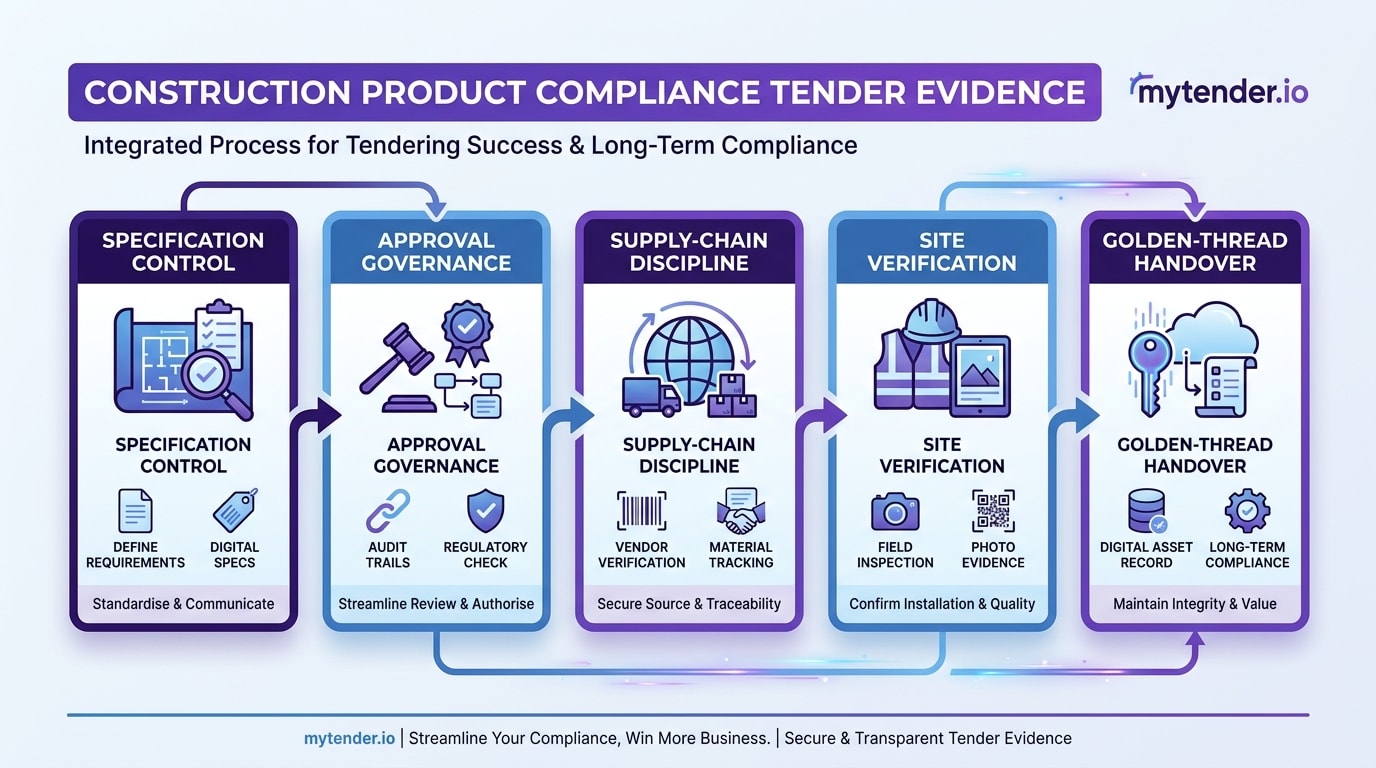
Five-part construction product compliance framework covering specification, approval, supply chain, site verification and handover
A good answer follows those five tests in order.
A poor answer jumps straight to ISO certificates and inspection forms.
Start with the product risk profile
Do not start this section with your quality policy.
Start with the project.
A school roof replacement, a hospital ward refurbishment, a high-rise residential facade package and a highways depot build all carry different product risks. The evaluator wants to see that you can tell the difference.
Before writing, sort products into risk bands.
High-risk products are those linked to life safety, structural performance, fire resistance, water ingress, statutory compliance or long-term maintenance. Examples might include fire doors, passive fire stopping, cladding systems, structural steel connections, smoke control systems, waterproofing membranes and critical M&E components. Medium-risk products are those that could affect quality, lifecycle cost, energy performance, resident experience or programme if substituted badly. Low-risk products are routine items where standard purchasing controls and inspection may be enough.This framing immediately makes the answer sharper. It tells the evaluator you will not treat a fire stopping product like a paint colour.
It also helps you avoid overpromising. Not every screw needs board-level approval. But the products that could change safety, compliance or maintainability need named control.
The evidence evaluators expect to see
A strong tender response does not just say the product will be compliant. It shows the evidence trail.
For high-risk construction products, include evidence such as:
- Manufacturer declarations and certificates relevant to the specified use.
- Test reports that match the proposed system, not just the individual product.
- Installation requirements and competence requirements for installers.
- Compatibility checks with adjacent materials and design details.
- Fire, acoustic, thermal, structural or durability evidence where relevant.
- Product data captured in the common data environment or asset information model.
- Inspection and hold-point records linked to the location of installation.
- Handover records that the client can use after completion.
The important phrase is "specified use".
Many products are compliant in one build-up and wrong in another. A certificate that proves a component passed a test in a different system is not enough for a serious evaluator. Your answer should say how you check the product against the actual design condition.
That one line separates a careful bidder from a copy-and-paste one.
Write the approval process as a sequence, not a slogan
Most bidders say they have a product approval process.
Very few explain it clearly.
Use a simple sequence. For example:
- The package manager reviews the employer's requirements, drawings, specifications and performance criteria.
- The subcontractor submits the proposed product with supporting technical evidence.
- The design manager checks compliance against the design intent and statutory requirements.
- The quality manager checks certificates, test reports, warranties and installation requirements.
- The building safety lead reviews any product affecting fire or structural safety.
- The client or contract administrator approves where the contract requires it.
- The approved product is logged in the product register and locked for procurement.
- Delivery tickets, batch numbers and inspection records are matched back to the approved register.
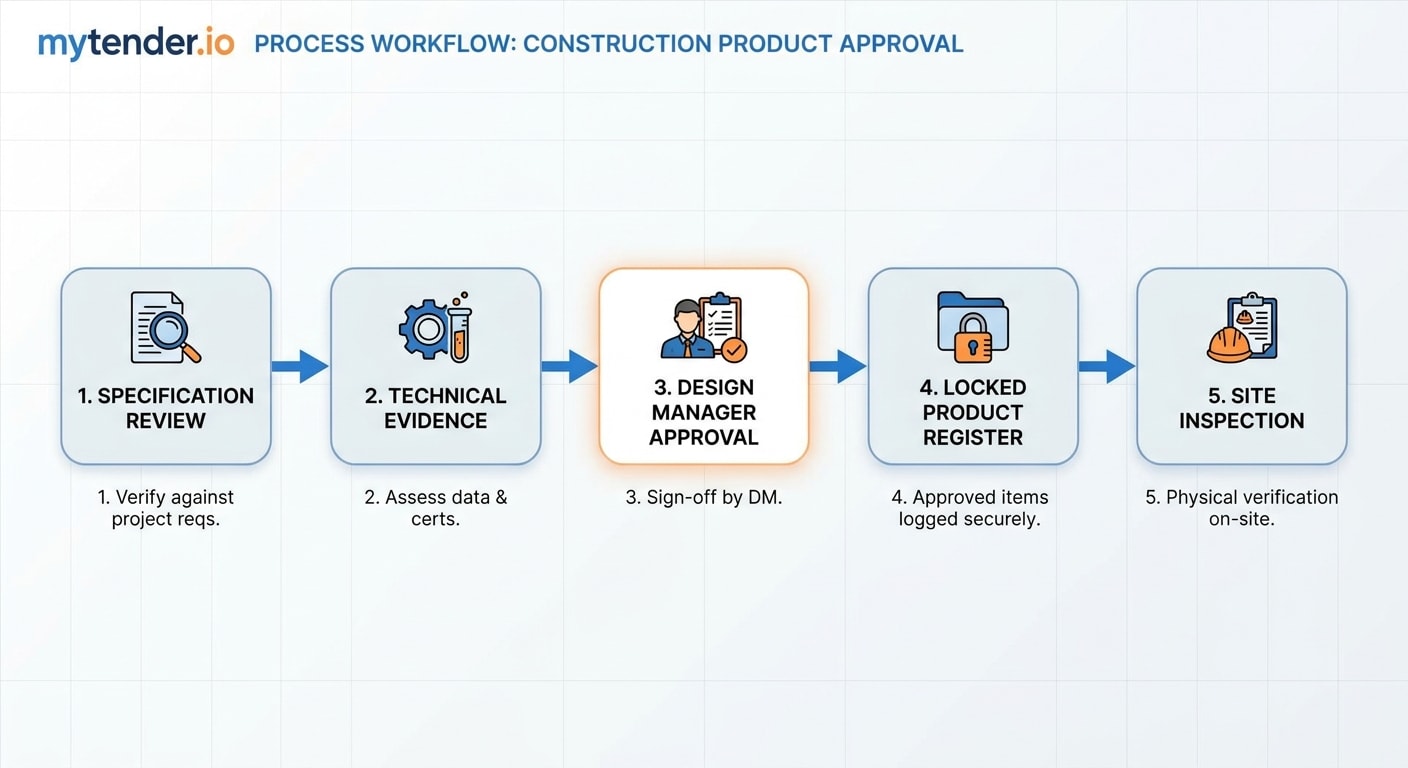
Product approval workflow for construction tenders from specification review to locked product register and site inspection
That is much more reassuring than "all products are checked before installation".
It gives the evaluator named roles, decision points and records.
Substitution control is where marks are won
Substitution is the awkward bit.
Every construction team knows substitutions happen. Products become unavailable. Lead times move. Prices change. Manufacturers update ranges. Subcontractors have preferred suppliers. A value engineering exercise opens up alternatives.
The tender response should not pretend this never happens.
A stronger answer says substitutions are allowed only through a controlled change route, and that no product affecting safety, performance, warranty or maintainability can be swapped informally.
Spell out the rule:
No alternative product is purchased, delivered or installed until the proposed substitution has been technically reviewed, risk assessed, approved by the right authority and recorded in the product register.Then explain the tests used for approval.
A substitution should be checked against:
- The original specification and employer's requirements.
- Fire, structural, acoustic, thermal and durability performance.
- Compatibility with adjacent products and systems.
- Warranty and insurance implications.
- Installation competence and maintenance requirements.
- Whole-life cost, not just purchase price.
- Golden-thread information requirements.
- Client approval requirements under the contract.
This is where many bid teams lose marks. They talk about value engineering as if cheaper equals better.
In 2026, that is a risky message. A good substitution control answer makes clear that any saving is secondary to compliance, performance and approved use.
Connect product compliance to the golden thread
The golden thread is not just a phrase for higher-risk buildings. It has changed buyer expectations across construction procurement.
Clients increasingly expect digital, structured product information that can be used after handover. They do not want a messy folder of PDFs uploaded two days before practical completion.
Your tender answer should explain what information is captured during delivery, not only at the end.
For each high-risk product, say you will record:
- Approved product name and manufacturer.
- Version, model, batch or serial number where relevant.
- Location of installation.
- Date of installation and installer details.
- Inspection and test records.
- Certificates, declarations and warranties.
- Operation, maintenance and replacement requirements.
- Any approved substitution history.
This makes the handover promise believable.
If the project uses a common data environment, asset management platform or BIM process, name it if appropriate. But do not hide behind the software. The evaluator cares less about the tool than the discipline behind it.
A useful line is:
> The product register will be maintained as a live contract record, not assembled retrospectively at handover.
That sentence earns trust because it addresses a real failure mode.
Show how the supply chain is controlled
Product compliance is not controlled by the main contractor alone.
It lives in the supply chain.
That means your answer needs to show how subcontractors, suppliers and installers are briefed, checked and managed.
Include three layers.
First, onboarding. Explain that high-risk packages receive a product compliance briefing before procurement starts. The briefing should cover approved products, evidence requirements, substitution rules, inspection hold points and consequences of unauthorised change.
Second, procurement checks. Explain that purchase orders reference the approved product register, not just a broad specification heading. This helps stop the wrong product being bought because someone worked from an old schedule.
Third, site checks. Explain that deliveries are checked against the approved register before installation. For high-risk products, use hold points where work cannot be closed up until evidence is complete.
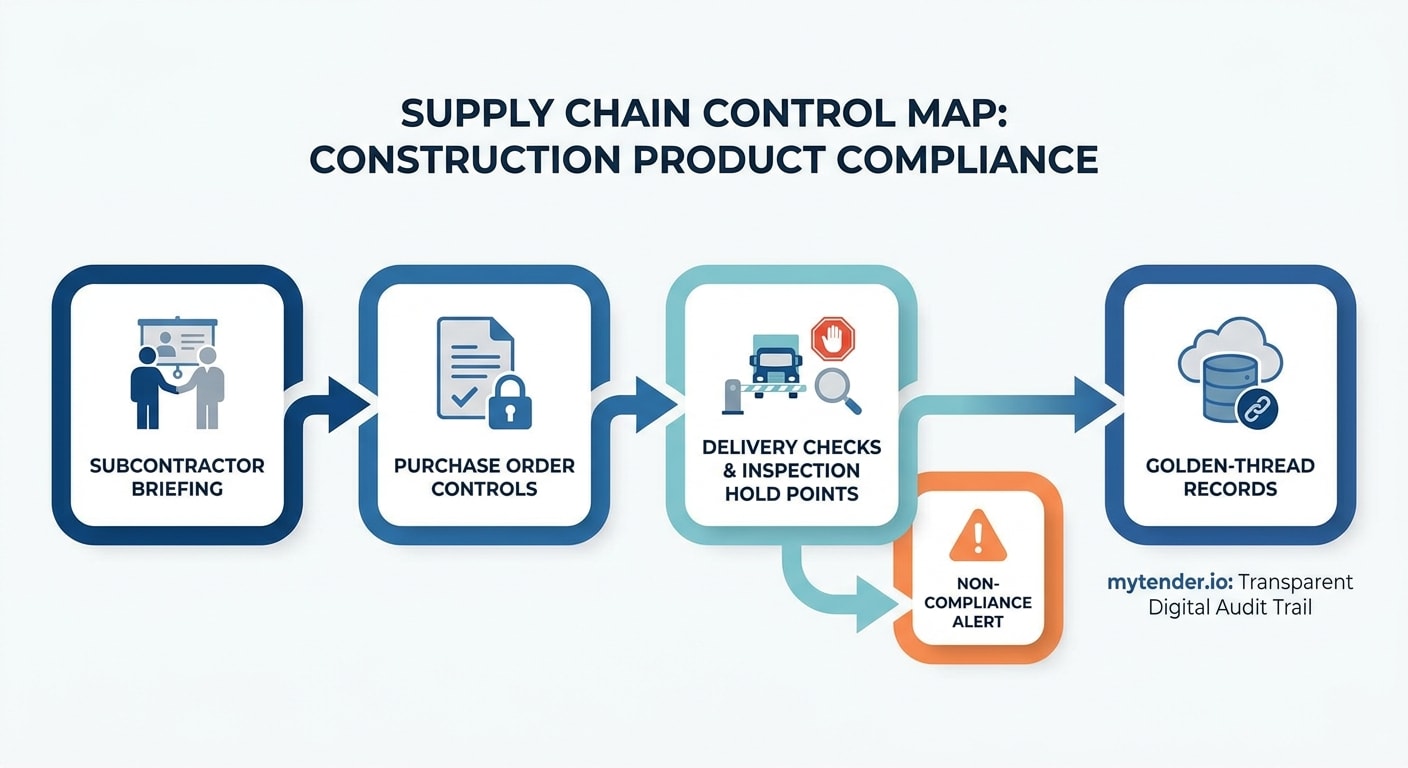
Supply-chain control map for product compliance showing subcontractor briefing, purchase order controls, delivery checks and inspection hold points
This section should feel operational. The evaluator should be able to imagine your site team using it.
Avoid the certificate trap
Certificates matter. But they are not the whole answer.
A weak response says:
> We will obtain all relevant certificates and product data sheets.
A better response says:
> We will check certificates and test evidence against the specific product, system build-up, installation context and performance requirement. Where evidence relates to a different use, we will request further manufacturer confirmation or reject the product before procurement.
That difference is huge.
The first answer collects documents. The second answer evaluates evidence.
Evaluators know the certificate trap well. They have seen handover files full of documents that do not quite prove what the contractor claims they prove. Your response should show that your team checks relevance, not just existence.
Make the roles unmistakable
Product compliance answers often become vague because nobody wants to name who owns the process.
Do the opposite.
A clear answer might assign roles like this:
- Project Director: accountable for compliance governance and client escalation.
- Design Manager: checks design intent, interfaces and technical suitability.
- Building Safety Lead: reviews products affecting fire and structural safety.
- Quality Manager: verifies certificates, inspection records and non-conformance close-out.
- Package Manager: controls subcontractor submissions and site delivery checks.
- Document Controller: maintains the approved product register and handover records.
- Commercial Manager: makes sure value engineering proposals do not bypass compliance review.
This does not need a huge RACI table. A short role map is usually enough.
The key is to show that commercial pressure cannot quietly override technical approval.
How to write the response in a scoring-friendly structure
Use this structure when the tender gives you a broad product compliance question.
1. Contract-specific risk statement
Open with the project's product risks. Name the packages that matter. Avoid generic promises.
Example:
> For this project, we will treat fire stopping, external wall components, structural connections, waterproofing and critical M&E systems as high-risk product categories because they affect safety, statutory compliance, lifecycle performance and handover information.
2. Governance and named roles
Say who owns approval, who reviews evidence, who can authorise substitutions, and who maintains the product register.
3. Approval workflow
Show the sequence from specification review to locked procurement. Keep it simple and concrete.
4. Substitution control
State the rule clearly. No informal swaps. No purchase before approval. No installation before verification.
5. Site verification
Explain delivery checks, hold points, inspection records, photo evidence and non-conformance escalation.
6. Golden-thread handover
Explain how product information is captured live and handed over in a usable format.
7. Continuous improvement
Close by saying how product issues, rejected substitutions and non-conformances feed into future package briefings and bid library evidence.
That structure gives the evaluator a complete chain. It starts with the specification and ends with usable records.
A short example answer
Here is a condensed example you can adapt.
> We will manage product compliance through a contract-specific product register controlled by the Design Manager and Quality Manager. At mobilisation, we will identify high-risk product categories, including fire stopping, external wall components, structural fixings, waterproofing and critical M&E systems. Each high-risk product will require evidence confirming suitability for the specified use, including certificates, test reports, manufacturer guidance, compatibility checks and installation requirements. > > No product substitution will be purchased or installed without formal review. The Package Manager will submit the proposed alternative with supporting evidence. The Design Manager will check technical suitability and design compatibility. The Building Safety Lead will review any fire or structural safety impact. The Commercial Manager will confirm that cost or programme benefits do not compromise compliance, warranty, lifecycle performance or handover obligations. Client approval will be obtained where required by the contract. > > Site teams will verify deliveries against the approved product register before installation. For high-risk products, hold points will prevent works being covered until inspection records, batch details and photographic evidence are complete. Product information will be captured during delivery and maintained as part of the golden-thread handover record, including approved product details, location, installation date, certificates, warranties and any approved substitution history.
It is not flowery. It scores because it is specific.
Common mistakes that cost marks
The first mistake is relying on ISO language. Certification supports the answer, but it cannot replace the contract-specific process.
The second is failing to address substitution. Evaluators know substitutions happen. If you do not explain how you control them, they assume the process is weak.
The third is treating handover as an end-of-project admin task. Product evidence should be captured during delivery.
The fourth is using vague role ownership. "The project team" is not a responsible person.
The fifth is making product compliance sound like a purchasing issue. It is a design, safety, quality, commercial and supply-chain issue.
How AI can help without creating risk
AI can help bid teams draft product compliance answers faster, but only if the source evidence is clean.
The danger is obvious. If a generic AI tool invents a product approval process, copies wording from an old project, or overstates compliance, the bid gets weaker and the delivery team inherits a promise it may not follow.
The safer use is narrower.
Use AI to pull approved process wording from your bid library, adapt it to the tender's risk profile, and highlight where evidence is missing. Then have the technical lead check the answer before submission.
That is how we think about mytender.io. The value is not magic prose. It is helping bid teams reuse the right evidence, spot gaps and turn delivery knowledge into a response that sounds like the organisation can actually deliver it.
The bid library angle
Product compliance is a perfect example of why bid libraries need to be more than old answers in folders.
A useful library should hold:
- A standard product approval workflow.
- Role descriptions for product compliance governance.
- Substitution control wording.
- Golden-thread handover wording.
- Examples of high-risk product registers.
- Evidence lists for common packages.
- Lessons learned from product non-conformances.
- Sector-specific examples for housing, education, healthcare and infrastructure.
Then each tender answer can be adapted from a strong base rather than rebuilt under deadline pressure.
The trick is not to paste the library answer untouched. The trick is to make the library good enough that bid writers can start from proof, not panic.
Final checklist before you submit
Before submitting a product compliance response, check the answer against these questions.
- Have you named the high-risk product categories for this contract?
- Have you explained who approves products and substitutions?
- Have you shown how evidence is checked for the specified use?
- Have you made unauthorised substitutions impossible in the process?
- Have you linked delivery checks to the approved product register?
- Have you explained how product data enters the golden-thread record?
- Have you shown how subcontractors are briefed and controlled?
- Have you avoided relying on certificates without explaining review?
- Have you made commercial value engineering subordinate to compliance?
- Have you written it in a way the delivery team could actually follow?
If the answer passes those tests, it is probably stronger than most of the field.
The bottom line
Construction product compliance is no longer a quiet quality-control paragraph.
It is a trust question.
The buyer wants to know whether your organisation can protect the specification, control substitutions, verify installation and hand over usable information. The best tender responses make that chain visible.
Not with a policy dump. With named roles, clear decision points and evidence that follows the product from design to handover.
If you want to find live construction opportunities where this kind of evidence is starting to matter, the Tender Finder is free to use. It is a useful way to see what buyers are asking for before the next deadline lands.
Tags
Ready to Transform Your Tender Writing?
See how MyTender's AI can help you write winning tenders in a fraction of the time.