

Picking the Right Delivery Model for the Client's Risk Appetite: D&B, Traditional or ECI
Most bid teams pick a delivery model and write around it. The evaluators who actually score the submission are asking a different question: does the proposed model match what the client has signalled they want? This guide explains how to read the signals and write a response that lands.
mytender.io Research Team
Tender Writing & Bid Management Specialists
Picking the Right Delivery Model for the Client's Risk Appetite: D&B, Traditional or ECI
You are three days into a construction tender. The ITT runs to 140 pages. The scope is clear, the pricing schedule is manageable, and you know the sector well. But then you hit question 3.2: "Describe your proposed delivery model and how it meets the project's objectives."
And the team pauses.
Because the client hasn't said which delivery model they want. The contract form is listed as NEC4 Option C but the Employer's Requirements document looks like it was written for a traditional contract. One sentence mentions "two-stage" in passing. Nobody on the bid team is sure whether to propose Design and Build, ECI, or just respond as if it is a straightforward managed contract.
This happens constantly on construction tenders. And it costs marks every time.
The delivery model question is not just a formality. Evaluators want to see that you understand how the client wants risk to sit, what they are trying to achieve with the procurement route they have chosen, and whether your proposed approach actually matches their situation. Getting it wrong signals that you have not read the brief properly. Getting it right, and explaining why, is one of the fastest ways to separate your submission from the pack.
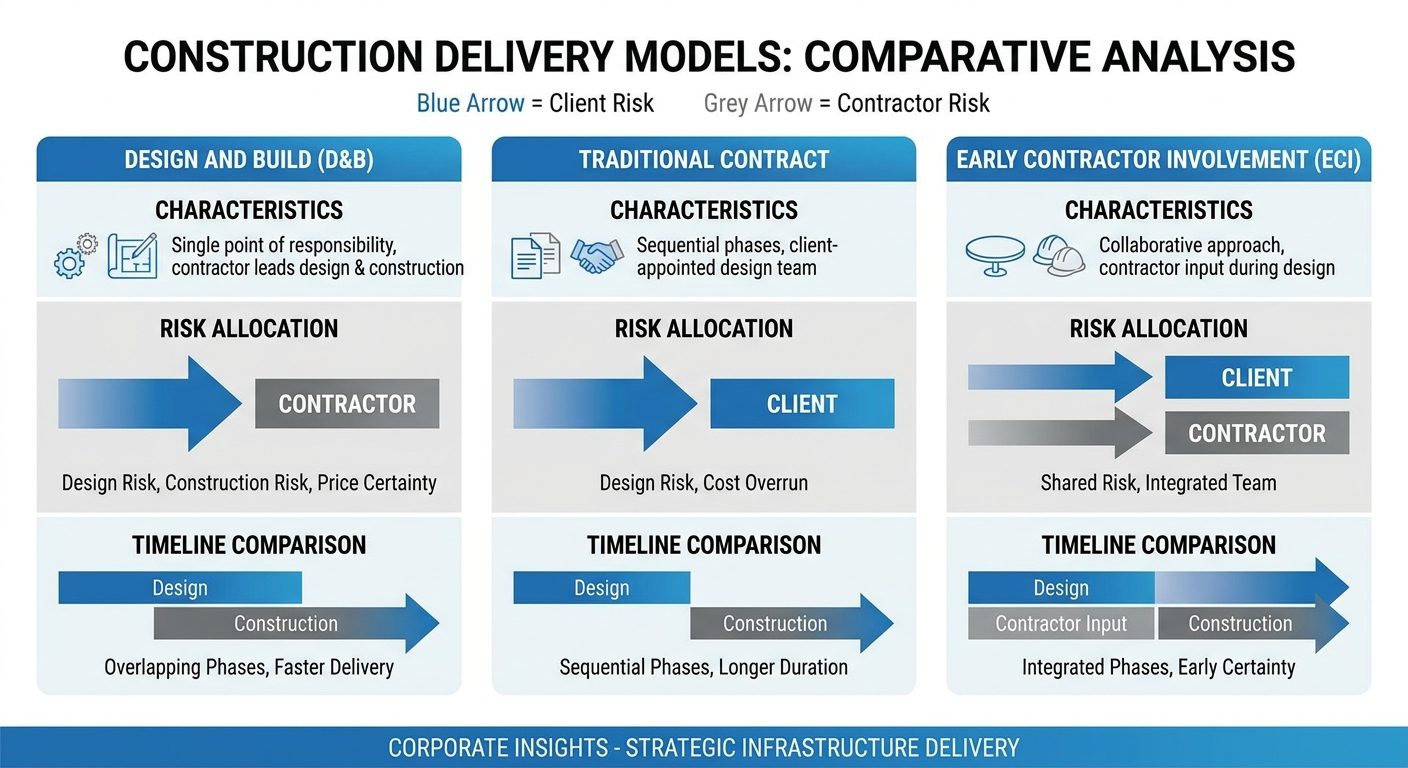
Construction delivery model comparison: Design and Build, Traditional Contract, and ECI
The Three Models Most UK Construction Tenders Use
Before we get into how to write the response, it is worth being precise about what each model actually means, because bid teams often use the labels loosely.
Traditional Contract (or Traditional Procurement)
The client appoints a design team first. Architects, engineers, and consultants produce a full set of drawings and specifications. The contractor then bids to build what has been designed. Risk for design sits with the client and their consultants. The contractor prices to a complete specification and is responsible for delivering to it.
Traditional procurement suits clients who want full design control and are comfortable carrying design risk. It is common in refurbishment projects, heritage work, bespoke civic buildings, and any situation where the client has a strong design vision they want to protect.
For bid writers: if the tender documents include a full set of drawings and a detailed specification, you are almost certainly in traditional territory, even if nobody has said so explicitly.
Design and Build (D&B)
The client produces an Employer's Requirements (ER) document setting out what they want the finished building to achieve. The contractor takes on both design responsibility and build responsibility. Single point of contact, single point of accountability, and the contractor carries design risk.
D&B suits clients who want cost certainty, programme certainty, and to transfer design risk. It is the dominant model for volume housing, commercial fit-out, industrial and logistics, healthcare facilities built to a brief, and education through standardised frameworks like ProCure23.
For bid writers: the presence of an ER document rather than a full drawing package is the giveaway. So is a contract form with Contractor's Proposals as a required submission.
Early Contractor Involvement (ECI)
A two-phase approach. In Phase 1, the contractor is appointed early, before design is complete, to contribute technical input during the design development process. This phase is usually paid at cost or on a target cost basis. In Phase 2, the contractor builds what has been designed, with a price agreed before Phase 2 commences.
ECI suits clients where design is complex, where buildability input adds real value, or where the programme is tight and pre-construction activity needs to start alongside design. It is common in infrastructure, large civil engineering, complex healthcare projects, and frameworks where the client wants collaborative risk management.
For bid writers: ECI tenders almost always say so. You will see references to two-stage, pre-construction services, NEC4 Option A or C with Phase 1 defined, or an explicit invitation to provide a Pre-Construction Services Agreement (PCSA) alongside the main tender.
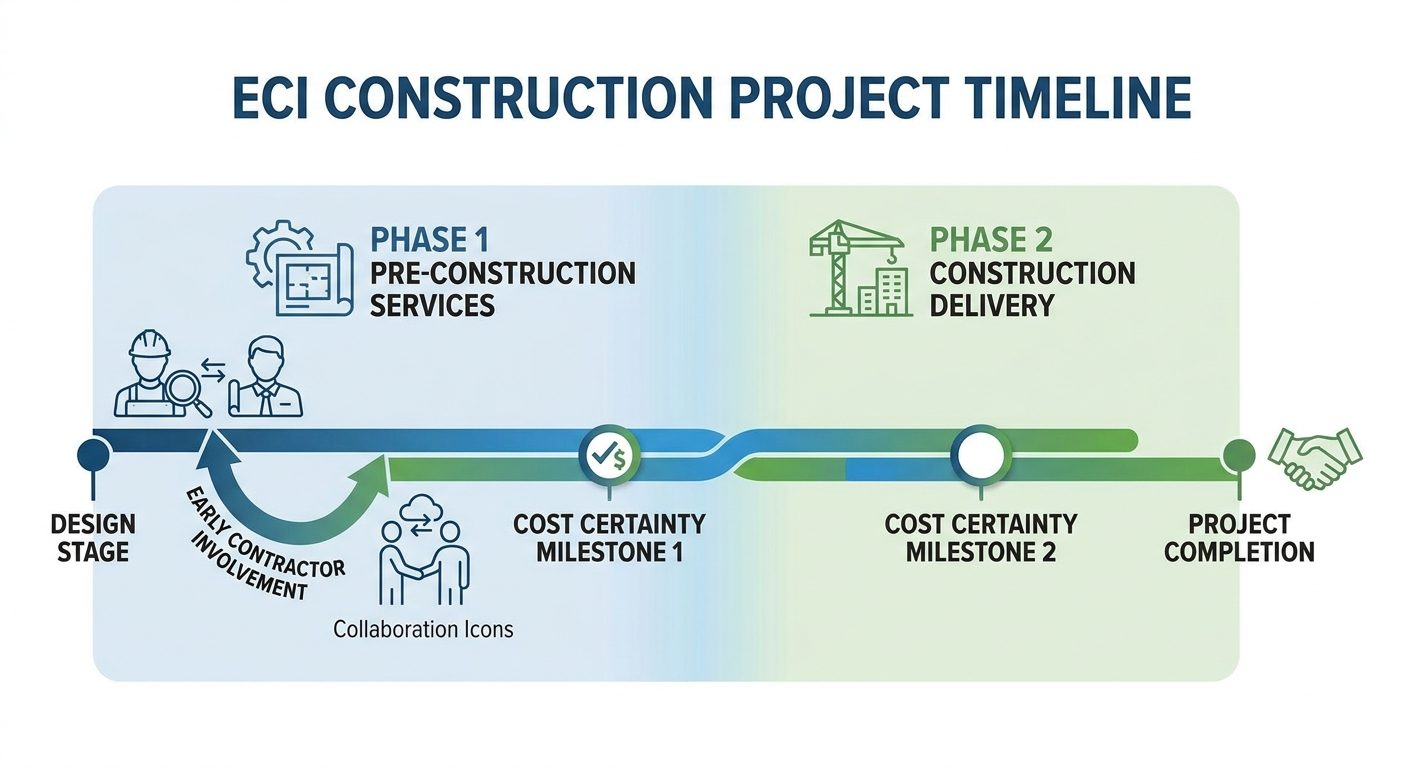
ECI two-phase timeline: Phase 1 pre-construction services, Phase 2 construction delivery
Reading the Client's Risk Appetite Before You Write Anything
The model in the ITT is the starting point, not the whole story. Clients signal their actual risk appetite in ways that are easy to miss if you are scanning rather than reading.
The contract form tells you where risk is meant to sit. JCT Design and Build 2016 means the client wants a single accountable party for design. NEC4 Option C (target cost with activity schedule) means the client wants pain-and-gain sharing, not a fixed-price transfer. NEC4 Option A (priced contract) means fixed price, risk with contractor. JCT SBC/Q means traditional procurement. If the contract form and your proposed model do not align, that is a problem evaluators will notice. The Employer's Requirements document tells you how much design the client has already done. A thick ER with performance specifications, room data sheets, and M&E schedules suggests a client who has invested heavily in their brief and wants the contractor to develop it further, not reinvent it. A thin ER with outline objectives and adjacency diagrams suggests a client who wants genuine design input. The depth of the ER tells you how much design risk the client is comfortable handing over. The evaluation criteria tell you what they are actually scoring. If "collaborative approach" and "pre-construction value" are explicit scoring criteria, ECI is probably on their mind. If "cost certainty" and "programme deliverability" dominate, they want D&B or traditional with a clear fixed price. If "design quality" and "aesthetic vision" carry weight, they probably want a traditional route where they retain design control. The questions themselves tell you what worries them. A client who asks specifically about your design management process, your novation strategy, or your employer's agent appointments is signalling that design risk is on their mind. A client who asks about your Phase 1 delivery plan and your transition to Phase 2 is telling you they are thinking ECI even if they have not used the word.How to Write the Delivery Model Section for Each Route
Writing for Design and Build Tenders
The core thing evaluators want to see in a D&B response is that you understand single point responsibility and will not try to dilute it.
Start by acknowledging the client's objectives. What does the ER tell you they are trying to achieve? Cost certainty, programme certainty, design that meets performance output, transfer of design liability? Name those objectives and confirm that D&B addresses them directly.
Then explain your design management structure. Who leads design? How does your team interface with the client's employer's agent? Who is the lead designer (usually your appointed architect working under your novation or appointment)? How do you manage design development through RIBA stages? Evaluators marking a D&B response want to see a credible design management process, not just a commitment to deliver the ER.
Address the Employer's Requirements explicitly. If there are specific technical outputs required, reference them. Show you have read and understood the ER. A submission that treats the ER as generic background noise always scores below one that treats it as the brief to respond to.
Finally, explain how you handle change. In D&B, scope changes are a frequent source of dispute. Describe your process for managing ER changes, value engineering, and instruction management. Clients who have been burned on previous D&B contracts specifically look for this.
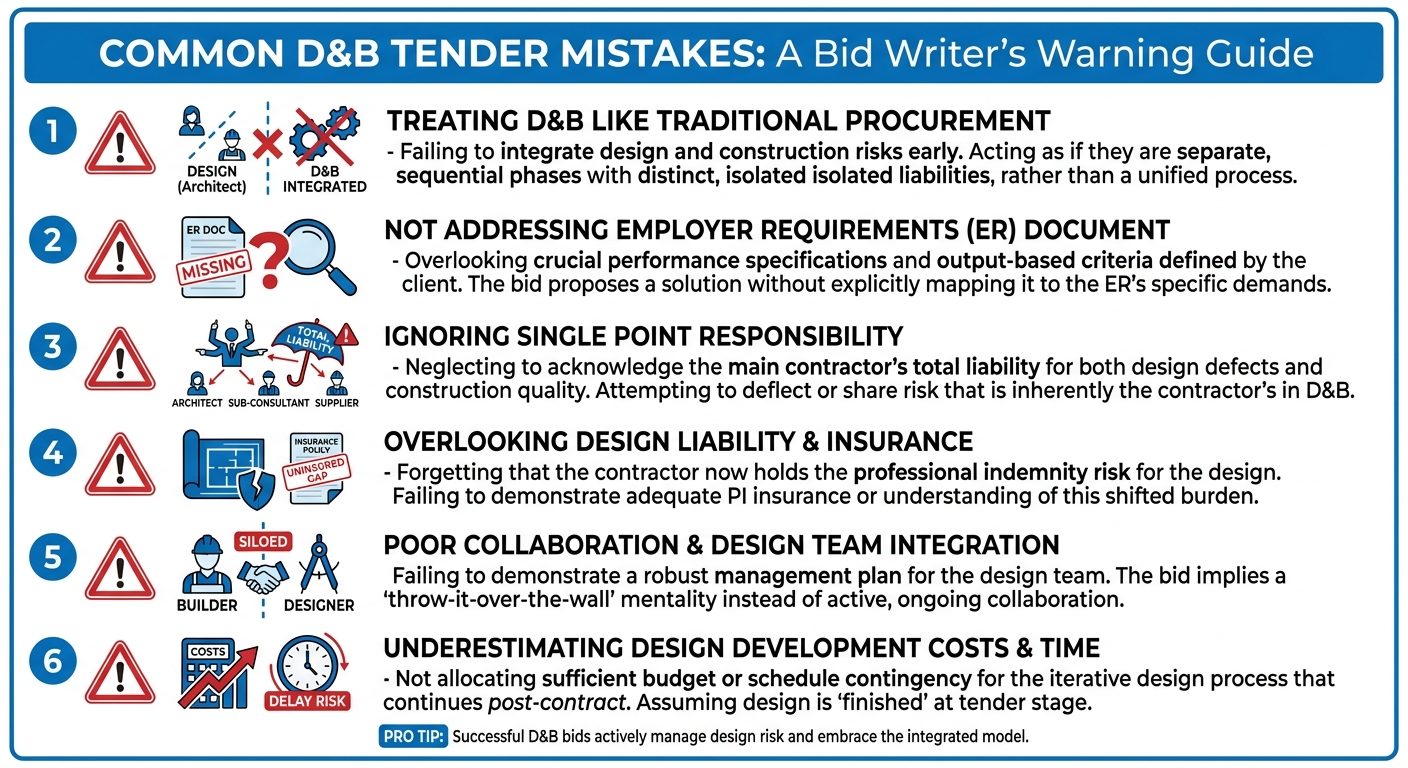
Common mistakes in Design and Build tender responses
Writing for Traditional Contract Tenders
In a traditional procurement, the client has already done significant design work. Your job is not to redesign the project; it is to demonstrate that you can build it to the specification they have produced, on time, within budget, and to the quality standard they have specified.
The delivery model section here is about construction management, not design management. How will you sequence the works? How will you resource the programme? How will you manage the interface with the client's design team (who remain accountable for the design) during the construction phase?
Common mistakes on traditional tenders:
Proposing design changes or "value engineering" alternatives when the client has not asked for them. In traditional procurement, unsolicited redesign suggestions signal that you have not understood who carries design responsibility. Unless the ITT explicitly invites Contractor's Proposals or alternative approaches, do not offer them.
Writing a generic methodology that ignores the specific design in front of you. If you have been given full drawings, reference them. Show evaluators you have looked at the drawings closely enough to identify sequencing considerations, construction programme dependencies, and site logistics challenges that are specific to this project.
Underplaying quality management. In traditional procurement, defects liability sits firmly with the contractor for work quality (if not for design). Your quality management section needs to be specific: inspection and test plans, workmanship standards, materials approval process, snagging and handover approach.
Writing for ECI Tenders
ECI tenders have a different structure from D&B and traditional. You are not just selling your ability to deliver a project; you are selling your value as a collaborative partner during the pre-construction phase before full costs are agreed.
Phase 1 content needs to demonstrate three things: the technical input you will contribute during design development, the commercial transparency you will bring to target cost development, and your track record of successfully transitioning from Phase 1 to Phase 2.
Phase 1 technical input is the area most bid teams undersell. Evaluators on ECI tenders typically have some technical sophistication. They want to see specific examples of where early contractor involvement has added genuine value: buildability improvements that reduced programme, value engineering that maintained quality while reducing cost, supply chain pre-engagement that reduced procurement risk. Generic statements about "collaborative working" score badly. Named examples with quantified outcomes score well.
Commercial transparency in Phase 1 is where many ECI submissions fall over. The client is trusting you to help develop a target cost that is fair to both parties. How do you demonstrate that your open-book approach is genuine? What transparency mechanisms do you put in place? What is your approach to the pain-gain share mechanism? If you have used NEC4 Option C on previous projects, walk through how you managed it.
Transition from Phase 1 to Phase 2 is the governance question evaluators often ask about but bid teams often duck. What is your process for agreeing the Phase 2 target cost? What happens if Phase 1 design development identifies scope that significantly changes the cost envelope? How do you handle the scenario where Phase 2 cannot be agreed? Clients who commission ECI tenders have usually been through a painful Phase 1 to Phase 2 transition on a previous project. Answer the transition question directly.
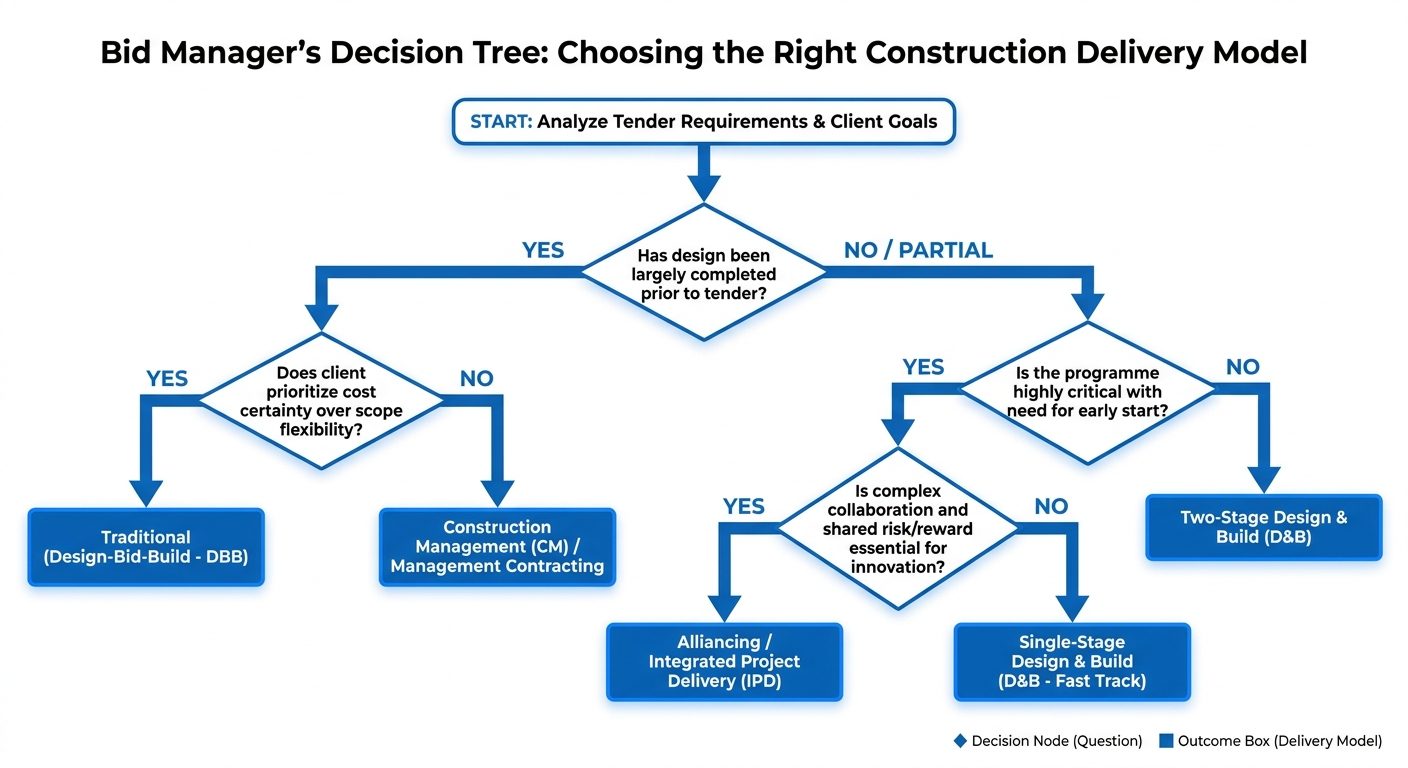
Decision flowchart for bid managers: how to identify the right construction delivery model
Where Bids Actually Lose Marks on Delivery Model Questions
After reviewing hundreds of construction tender feedback letters, a few patterns emerge consistently.
Misidentifying the model. A bid team assumes D&B and writes a D&B response to a tender that is actually traditional. The presence of a Bill of Quantities should have been the giveaway. The evaluators notice that the submission talks extensively about design management obligations the contractor will not actually hold, and marks drop sharply on relevance. Generic methodology that ignores the specific project. The worst offending submissions are those where the delivery model section could have been copied from any other tender without changing a word. No reference to the site, the programme, the specific scope, the client's stated objectives, or the constraints visible in the tender documents. Evaluators score on specificity. If your answer reads as a template, it marks as a template. Conflict between contract form and proposed model. The contract says NEC4 Option C (target cost), but the submission proposes a fixed-price lump sum approach and does not mention the pain-gain mechanism at all. The evaluators conclude, reasonably, that the bid team has not read the contract. This is an avoidable error. Undercooked risk allocation narrative. Every delivery model involves risk transfer. Where does design risk sit? Where does cost risk sit? Where does programme risk sit? Clients choosing D&B, traditional, or ECI are making deliberate decisions about risk allocation. If your submission does not address risk allocation explicitly, the evaluators have no evidence that you understand why they chose the procurement route they chose. Ignoring the client's stated pain points. If the tender documents mention programme criticality, address it. If they mention a difficult planning condition, address it. If they mention interface with an existing building in operation, address it. Clients write ITTs partly to test whether bidders have actually read the brief. The delivery model section is one of the best places to demonstrate that you have.The Risk Allocation Framework Evaluators Are Using
Understanding how clients think about risk allocation helps you write delivery model sections that actually score.
At its simplest, the three models place risk very differently:
Traditional procurement: Design risk stays with the client and their consultants. Construction risk sits with the contractor. The interface between the two (variations, information releases, design changes during construction) is where most disputes happen, and where robust contract management earns its money. Design and Build: Design risk transfers to the contractor. The client retains the right to specify what they want through the ER, but how it is achieved is the contractor's responsibility and liability. Cost risk is largely fixed if the ER does not change. Programme risk sits with the contractor. Single point of liability means fewer disputes about who is responsible, but it does mean the contractor needs credible design management capability. ECI: Risk is shared and managed collaboratively in Phase 1. The pain-gain mechanism in Phase 2 (under NEC4 Option C, for instance) means both parties have a financial interest in managing cost efficiently. Design risk is typically with the client's design team but the contractor contributes to its management. Programme risk is shared through the collaborative approach to planning.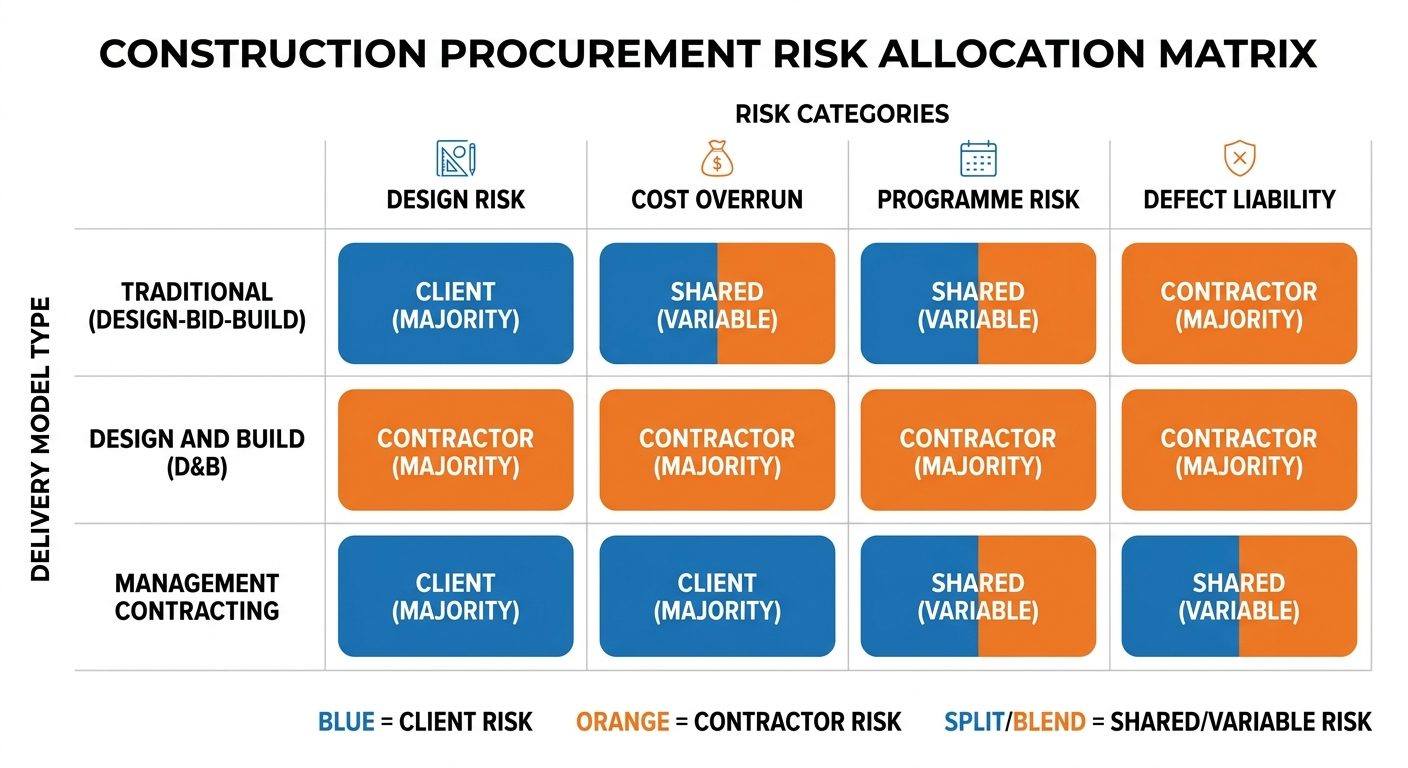
Construction procurement risk allocation matrix across delivery models
When you write a delivery model section, you are implicitly making claims about how risk is allocated. Make those claims explicit, because evaluators are looking for them. Phrases like "under this D&B contract, [Contractor] accepts single point design liability and will manage all design risk through our appointed lead designer" show you understand the risk position. Vague references to "working collaboratively with the client's team" on a D&B contract signal you might not.
Matching Your Narrative to the Client's Sophistication
One factor that is easy to overlook: the procurement sophistication of the client you are bidding for.
A volume housebuilder commissioning a D&B infrastructure package knows exactly what D&B means and will score your response on the technical detail. An NHS trust commissioning their first major capital project under ECI may be less confident about the mechanics of Phase 1 to Phase 2 transition, and will score more highly a response that explains the process clearly and builds their confidence.
A local authority highways team procuring a traditional civils contract has probably seen hundreds of traditional responses and can spot a recycled methodology section from half a page. A housing association doing their first framework call-off will be more influenced by tone and confidence.
Read the client as well as the procurement documents. What does their choice of procurement route tell you about their experience and their priorities? A client who has used ECI before and has a mature commercial team wants a technically credible response. A client trying ECI for the first time wants to understand what they are getting into.
Making It Specific to Win the Section
The single most effective thing you can do with a delivery model section is anchor it to the specific project in front of you.
Do not describe how D&B works in general. Describe how you will manage design development for this project, with this scope, on this programme, for this client. Name the design consultants you will appoint (or have already identified). Reference the specific constraints in the ER. Identify the specific sequencing challenges visible in the drawings. Link your proposed approach to the specific objectives the client has stated in their tender documents.
This level of specificity takes more time than recycling a methodology template. It is also worth significantly more on the scoresheet.
Most bids that score 68 out of 100 on a delivery model question do so because the response is professionally written and broadly correct but could have been written for any project. Most bids that score 85 do so because the evaluator can tell that someone actually read this ITT.
A Final Note on the Transition Between Models
One situation that causes particular pain for bid teams is when the client has chosen a delivery model that does not intuitively match the scope.
The most common variant: a client specifies Design and Build but produces an ER that is so detailed and complete that it is functionally a traditional specification. This happens when procurement teams use D&B to transfer liability without genuinely understanding that D&B requires the contractor to hold design.
When you encounter this, do not pretend the tension does not exist. Address it. Acknowledge that the ER has been developed to a detailed level, confirm that your team has reviewed it thoroughly, and explain your approach to treating the ER as the design brief you will develop to RIBA Stage 4 while maintaining design liability under the D&B contract form.
This kind of nuanced, honest response scores better than a response that ignores the tension and copies across a generic D&B methodology. Evaluators who have written the ER know exactly how detailed it is. Showing that you have noticed, and that you have thought about what it means in practice, signals a level of preparation that scores marks.
---
If you want to find live construction tender opportunities matched to your sector, trade, and geography, the Tender Finder is free to use. You can filter by contract value, region, and procurement route, which means you can focus your bid effort on tenders that actually match your delivery model strengths rather than responding to everything and hoping.
Tags
Ready to Transform Your Tender Writing?
See how MyTender's AI can help you write winning tenders in a fraction of the time.