
Conditions of Participation in Procurement Act Tenders: The Supplier Guide for 2026
A practical guide for UK suppliers on passing Conditions of Participation under the Procurement Act 2023, building better eligibility evidence, and avoiding preventable disqualification before scored tender evaluation begins.
mytender.io Research Team
Tender Writing & Procurement Specialists
Conditions of Participation in Procurement Act Tenders: The Supplier Guide for 2026
A supplier can write the strongest technical answer in the competition and still lose before anyone scores it.
That is the uncomfortable truth behind Conditions of Participation.
Under the Procurement Act 2023, public buyers can set conditions that suppliers must satisfy before they are allowed to continue in a procurement. These conditions sit at the front of the tender journey. They test whether the supplier has the legal, financial and technical capacity to perform the contract. If the answer is no, the bid may never reach the evaluation panel.
For bid teams, that changes the order of work. It is no longer enough to treat qualification questions as administrative attachments while the writers focus on the narrative. Conditions of Participation are strategic. They decide whether your response is even in the room.

Bid team reviewing Conditions of Participation evidence for a UK public sector tender
The timing matters. Public procurement is now operating under a regime that gives contracting authorities more flexibility in how they design competitions. Open procedures still exist, but the Competitive Flexible Procedure lets buyers create multi-stage processes with down-selection, presentations, dialogue, negotiation and best and final offer stages. In that world, Conditions of Participation become the first set of gates in a longer race.
This guide explains how suppliers should approach them in 2026: what they are, why they matter, where bid teams go wrong, and how to build an evidence system that makes qualification calmer, faster and safer.
What Are Conditions of Participation?
Conditions of Participation are requirements a supplier must meet to participate in a procurement.
They are not the same as scored award criteria. Award criteria decide which eligible tender is the most advantageous. Conditions of Participation decide whether a supplier is eligible and capable enough to be considered in the first place.
A contracting authority might use them to test whether a bidder has sufficient financial standing, professional ability, regulatory licences, insurance cover, technical resources, previous experience, cyber controls, quality management systems, health and safety competence, environmental credentials or specialist certifications.
In plain English, they answer one buyer question:
Can this supplier realistically and safely deliver the contract?
That question is fair. A council outsourcing waste collection, an NHS trust buying estates services, or a government department procuring complex technology cannot simply award to the best-written promise. They need evidence that the supplier is stable, compliant and operationally capable.
For suppliers, the challenge is that these conditions often look deceptively simple. They may appear as short questions, upload requirements or pass/fail declarations. But behind each question is a buyer risk: financial failure, weak delivery history, unsafe operations, poor governance, inadequate resource, unsupported subcontracting or non-compliant documentation.
The bid team that understands the risk behind the question writes and assembles evidence differently.
Why They Matter More Under the Procurement Act
The Procurement Act did not invent supplier qualification. Public buyers have always checked capability. What has changed is the level of visibility, procedural flexibility and connected procurement data around those checks.
First, buyers have more scope to design the competition around the contract. In a straightforward open procedure, the conditions may be checked once alongside the tender. In a Competitive Flexible Procedure, they may be used to decide who enters the next stage, who is invited to dialogue, who submits a refined proposal, or who reaches final negotiation.
Second, the public procurement lifecycle is more transparent. Tender notices, pipeline information, contract performance, payment information and award notices all create a more visible environment. Supplier identity, performance history and compliance evidence are no longer background paperwork. They are part of the public confidence story.
Third, the Central Digital Platform and Tell Us Once direction mean standard supplier information is becoming more reusable. That is helpful, but it also raises the bar. If buyers expect core supplier data to be current and consistent, bid teams cannot afford contradictions between the platform, Companies House, accounts, insurance certificates, policies, case studies and tender answers.
Finally, buyers are under pressure to run procurements that are fair, proportionate and defensible. A condition that is too vague or too demanding can be challenged. A condition that is clear and relevant can be enforced. That means suppliers need to read conditions carefully, not assume they can explain problems away later.
Conditions of Participation Are Not Just Pass or Fail Admin
The biggest mistake is treating conditions as a compliance checklist divorced from win strategy.
Yes, many conditions are pass or fail. But they still shape the buyer's perception of risk. A supplier that submits clean, current and well-labelled evidence feels controlled. A supplier that provides contradictory certificates, old case studies and vague explanations feels risky even before the scored questions begin.
That matters because procurement is human as well as procedural. Evaluators may not score a qualification document, but confidence accumulates. So does doubt.
A strong qualification response tells the buyer:
We know what you are testing. We meet the requirement. Our evidence is current. Our delivery model is credible. You will not need to chase us for basic assurance.
A weak response says the opposite.
In a tight competition, that difference can affect clarification rounds, down-selection decisions, negotiation posture and final confidence. It can also protect your team from wasting days writing a full response to an opportunity you were never likely to qualify for.
The Main Types of Conditions Suppliers Face
Conditions vary by sector and contract, but most fall into a few repeatable categories.
Legal Identity and Exclusion Checks
Buyers need to know who they are contracting with. That sounds basic, but group structures, trading names, subsidiaries, joint ventures and subcontractor arrangements can complicate the answer.
Your legal name, company number, registered office, VAT details, directors, persons with significant control and parent company position should be consistent across all evidence. If a different group entity holds an accreditation or insurance policy, explain the relationship clearly. If you are relying on another organisation's resources, make that reliance explicit and supported.
Exclusion questions also matter. Mandatory and discretionary exclusion grounds are not a space for creative writing. They require careful internal checks and clean declarations. If there is a historic issue, late payment record, regulatory matter or serious performance concern, involve the right senior owner early. Do not let the bid writer discover it two hours before submission.
Economic and Financial Standing
Financial standing conditions usually test whether the supplier is large and stable enough for the contract. Buyers may look at turnover, liquidity, profit history, credit ratings, audited accounts, parent company guarantees, insurance levels or ratios linked to contract value.
This is where many SMEs and growing suppliers get nervous. The right answer is not to hide weakness. The right answer is to understand the threshold early and decide whether the opportunity is commercially realistic.
If the tender requires annual turnover at a specific level, check whether the threshold applies to the bidder, the group, a consortium or combined entities. If the requirement is disproportionate, consider a clarification question. If it is proportionate but you do not meet it, look at teaming, subcontracting or a parent guarantee before investing heavily in the bid.
A disciplined bid process includes a financial standing check at bid or no-bid stage, not after the first draft is written.

Qualification gates showing financial standing, technical ability, compliance evidence and delivery capacity
Technical and Professional Ability
This is the heart of many Conditions of Participation. The buyer wants proof that you have delivered similar work before, or that your team has the competence, capacity and systems to do so now.
Typical evidence includes contract examples, references, case studies, method summaries, mobilisation experience, staff qualifications, accreditations, organisational charts, equipment lists, regional coverage, management systems, KPIs and service delivery data.
The trap is using generic case studies. A condition asking for experience delivering hard FM across occupied healthcare estates is not satisfied by a broad facilities management brochure. A condition asking for cyber support in a public sector environment is not satisfied by a generic IT support case study. The evidence must match the risk profile of the contract.
Good bid teams maintain a library of case studies tagged by sector, service line, contract size, buyer type, complexity, geography, mobilisation model, TUPE exposure, social value commitments, carbon evidence and performance outcomes. That tagging makes qualification faster and more precise.
Licences, Certifications and Standards
Some conditions are binary because the contract cannot be delivered lawfully or safely without a licence, accreditation or standard.
Examples include ISO 9001, ISO 14001, ISO 27001, Cyber Essentials, CHAS or SSIP, CQC registration, waste carrier licences, security industry licences, Constructionline status, professional memberships, product approvals, safeguarding checks or specialist sector authorisations.
The key is not just possession. It is scope, currency and entity match.
A certificate can be in date but irrelevant if it covers the wrong entity or service scope. An ISO certificate can exist but exclude the site or function relevant to the contract. A cyber certification can expire during evaluation. A licence can sit with a subcontractor when the tender requires the prime contractor to hold it.
Create a certification register with expiry dates, renewal owners, scope notes and tender relevance. If you only check certificates when a tender asks for them, you are already late.
Insurance and Risk Transfer
Insurance conditions often appear simple, but they can expose delivery model problems. Buyers may specify employer's liability, public liability, professional indemnity, product liability, cyber insurance, motor fleet cover or sector-specific policies.
Check the required limits, exclusions, named insured entities and whether subcontractors are covered. If the contract requires professional indemnity and your organisation normally carries a lower limit, involve finance or the broker before submission. A promise to increase cover on award may be accepted in some cases, but only if the tender permits it.
Do not leave insurance to the final upload. It is one of the most avoidable causes of late panic.
Capacity and Resource
Buyers increasingly want confidence that suppliers can actually resource delivery. This is especially important in labour-intensive sectors such as FM, cleaning, security, home care, waste, grounds maintenance, construction and professional services.
Capacity evidence may include staffing levels, regional teams, escalation routes, recruitment pipelines, mobilisation plans, subcontractor agreements, plant and equipment, technology platforms, TUPE approach, training capacity and business continuity arrangements.
The strongest answers connect capacity to the contract's specific profile. If the contract covers multiple sites, show coverage. If mobilisation is tight, show the mobilisation team and timeline. If the buyer needs resilience, show contingency resource. If the work is regulated, show competence controls.
How Conditions Work in a Competitive Flexible Procedure
The Competitive Flexible Procedure creates particular risk for suppliers because the process may be staged.
A buyer can design a procedure with an initial participation stage, a written tender stage, dialogue sessions, workshops, site visits, demonstrations, negotiation, down-selection, revised submissions and final offers. The tender notice should set out the rules, including how suppliers move through each stage.
Conditions of Participation can be used at the start, but the practical effect continues throughout the process. If you pass the first gate with a thin answer, you may still struggle when the buyer probes your capability in dialogue. If you rely on a subcontractor without a clear governance model, that may surface during negotiation. If your case studies are weak, you may reach a presentation stage without credible stories to defend your claims.
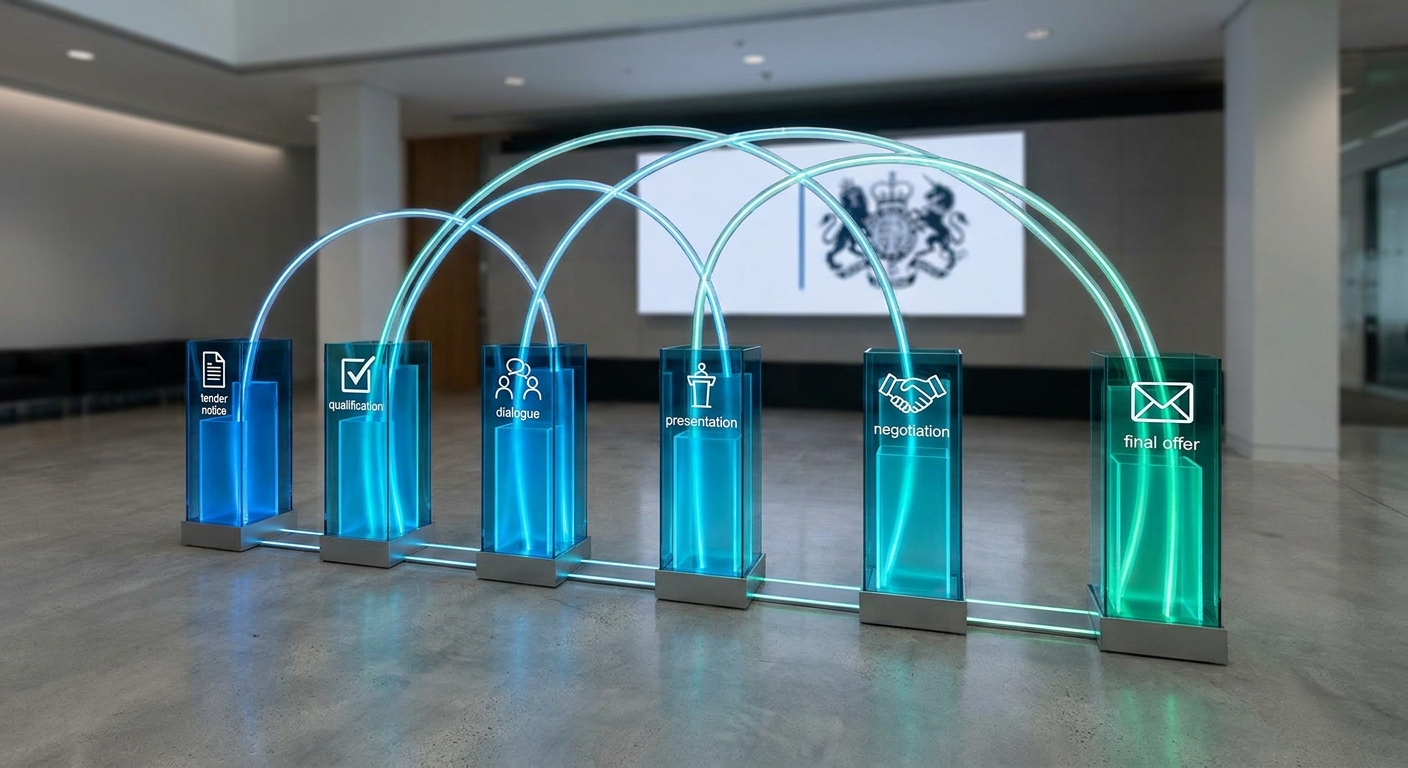
Competitive Flexible Procedure stage gates for suppliers preparing evidence and down-selection answers
The supplier response should therefore do more than squeeze through the first checkpoint. It should prepare for the next question.
Ask:
What capability will the buyer need to trust at every stage? Which evidence might they revisit? Which claims could be challenged in a presentation? Which thresholds might affect final contract terms? Which subcontractor dependencies need to be explained before negotiation?
That is how Conditions of Participation become part of a full bid strategy rather than a one-off form.
The Bid or No-Bid Test: Qualify Yourself First
The cleanest way to manage Conditions of Participation is to test them before committing to the bid.
A proper bid or no-bid review should include four questions.
First, do we clearly meet every mandatory condition? If not, is there a permitted route to compliance through a parent company, consortium partner, subcontractor, guarantee, licence update or clarification?
Second, can we prove it with current evidence? A confident internal claim is not enough. If the tender asks for audited accounts, certificates, named examples or references, make sure they exist and can be used.
Third, are the conditions proportionate to the value and risk of the contract? If they appear excessive, raise a clarification early. Buyers can correct disproportionate conditions, but only if suppliers ask in time.
Fourth, does passing the condition still leave a winnable opportunity? Some suppliers technically qualify but remain weak against competitors with deeper references, stronger local presence or more aligned certifications. That does not always mean no-bid, but it should influence the strategy.
A qualification check should produce a decision, not a shrug.
For example:
Bid, because we meet all mandatory conditions and have three matched case studies.
Bid with mitigation, because turnover is close to the threshold and finance will confirm the parent guarantee route.
Clarify before bid, because the required accreditation appears broader than the service scope.
No-bid, because the licence requirement is mandatory and cannot be met before submission.
That discipline saves time, protects win rate and prevents teams from confusing activity with opportunity.
Building an Evidence Matrix for Conditions of Participation
The most useful tool is an evidence matrix.
This is a simple table that maps every condition to the exact evidence you will submit, the internal owner, the expiry or currency check, the risk level and the response status. It should be created as soon as the tender is opened, before narrative drafting begins.
A good matrix includes:
Condition reference.
Buyer requirement.
Pass or fail status.
Evidence needed.
Evidence location.
Named owner.
Expiry date or validity note.
Entity covered.
Known gaps.
Clarification needed.
Final upload name.
That might sound basic. It is not. It is the difference between controlled qualification and email archaeology.
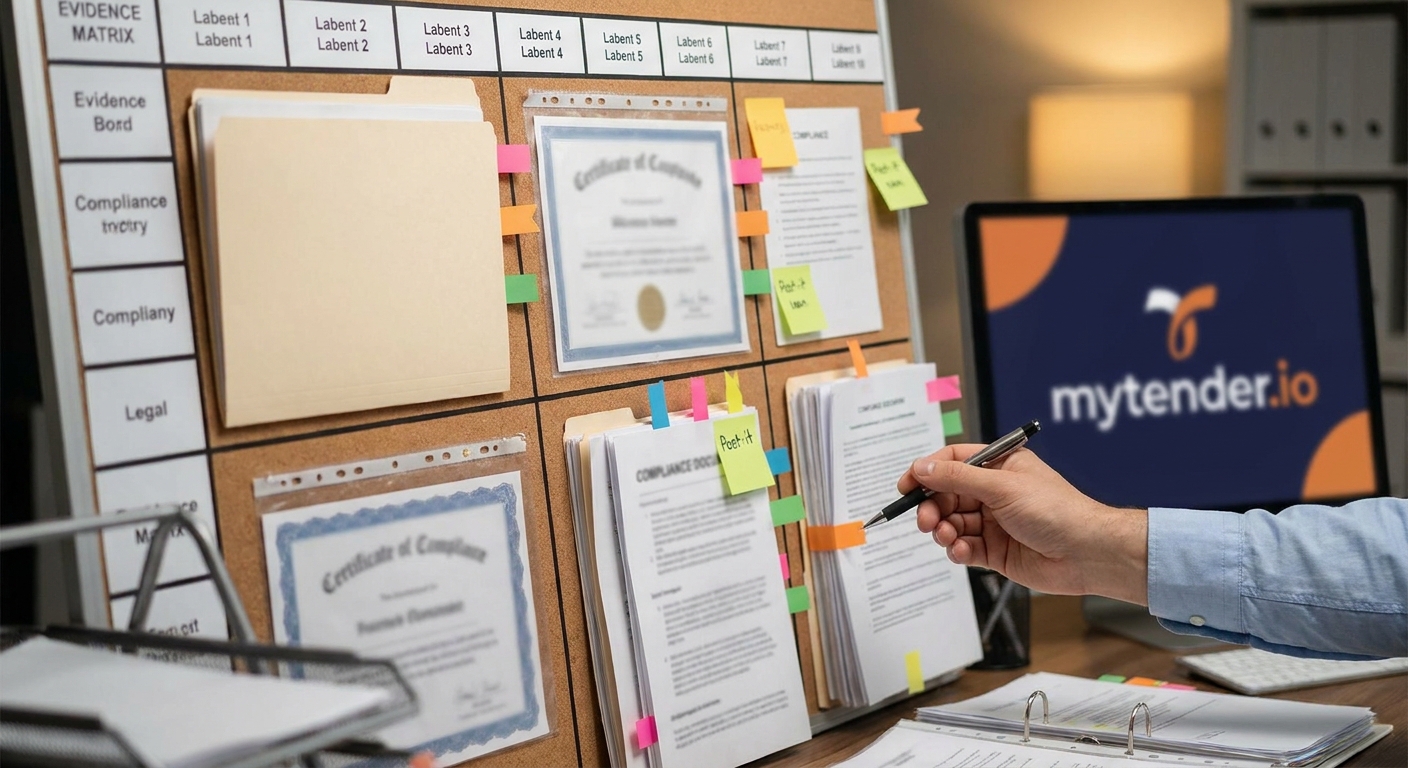
Evidence matrix linking tender participation conditions to approved documents and bid library records
The evidence matrix also helps prevent one of the most common bid team problems: duplicated effort. Without a matrix, finance, operations, HR, compliance and delivery teams may all be asked for similar evidence in slightly different ways. With a matrix, the bid manager can show exactly what is needed, why it is needed, and who owns it.
For recurring tendering organisations, the matrix should feed back into the bid library after submission. If a certificate was missing, add it. If a case study was too weak, rewrite it. If a policy was out of date, assign an owner. Every tender should make the next tender easier.
How to Answer When You Partially Meet a Condition
Sometimes the answer is not clean.
You may meet most of the requirement but not all of it. You may have the experience through a predecessor contract. You may hold the accreditation at group level. You may be renewing a certificate. You may rely on a specialist subcontractor. You may have equivalent experience in the private sector rather than the public sector.
Do not bluff. But do not panic either.
Start by reading the condition precisely. Is it mandatory or desirable? Does it require the bidder to hold the evidence, or can the bidder rely on another entity? Does it ask for equivalent evidence? Does it specify a date, value, sector, geography or contract type? Does the tender allow clarifications or alternative proof?
Then decide whether to clarify, explain or withdraw.
Clarify if the requirement is ambiguous, potentially disproportionate or silent on equivalent evidence. Explain if the tender allows equivalent evidence and your position is defensible. Withdraw if the condition is mandatory, clear and unmet.
A good partial-compliance explanation is specific. It does not say we have extensive experience. It says we meet the intent of the condition through named contracts, specific resources, equivalent standards and a clear delivery model. It acknowledges any difference and explains why that difference does not increase buyer risk.
The tone matters. Defensive answers create doubt. Controlled answers create confidence.
How AI Helps, and Where It Cannot Replace Judgement
AI can make Conditions of Participation far easier to manage, especially for teams with large evidence libraries.
A well-designed AI bid platform can extract requirements from tender documents, flag mandatory thresholds, summarise qualification conditions, identify missing evidence, search past bids for relevant case studies, match certificates to questions, build first drafts of compliance answers and create a live evidence matrix.
That is exactly the kind of work mytender.io is built to accelerate. Bid teams should not be spending their best hours hunting for the latest insurance certificate or manually comparing policy wording across folders. They should be using that time to make strategic decisions, tailor evidence and improve the scored response.

AI-assisted tender compliance workspace matching Conditions of Participation to reusable evidence
But AI does not remove accountability.
A human still needs to confirm whether the organisation genuinely meets the condition. Finance still needs to approve financial evidence. Compliance still needs to confirm certifications and policies. Operations still needs to validate delivery capacity. Legal or senior leadership still needs to handle exclusion issues, guarantees, consortia and material risk.
The best use of AI is not to make compliance look easy. It is to make the facts visible early enough for the team to make better decisions.
Sector Examples: What Buyers Are Really Testing
Conditions of Participation become easier to answer when you understand the buyer risk behind them.
In facilities management, the buyer may be testing whether you can mobilise across multiple sites, manage TUPE, maintain statutory compliance, evidence planned preventative maintenance, handle reactive work, manage subcontractors and report meaningful KPIs.
In construction, the buyer may be testing financial resilience, health and safety competence, Building Safety Act capability, design management, supply chain control, insurance cover, relevant project experience and the ability to manage programme risk.
In healthcare and NHS procurement, the buyer may be testing clinical governance, information governance, carbon reduction plans, Evergreen sustainability readiness, safeguarding, infection control, cyber security and the ability to work safely in live care environments.
In waste management, the buyer may be testing licences, fleet availability, depot coverage, environmental permits, collection round design, health and safety, emissions data and contingency arrangements.
In IT and technology, the buyer may be testing cyber certifications, data protection, service desk maturity, implementation experience, security architecture, business continuity, financial stability and access to qualified technical staff.
The wording may vary, but the pattern is consistent. The buyer is reducing delivery risk before they spend time scoring value.
Common Mistakes That Lead to Disqualification or Clarification
The first mistake is missing a mandatory upload. This still happens far too often. A tender response can be beautifully written and still fail because the team forgot an insurance certificate, signed declaration or financial attachment.
The second mistake is submitting expired evidence. Evaluators are unlikely to treat an expired certificate as a minor formatting issue if the tender clearly required current proof.
The third mistake is entity mismatch. The tender is submitted by one company, but the certificate, accounts or case study belongs to another. Sometimes that is acceptable. Often it needs explanation. Silence creates risk.
The fourth mistake is using irrelevant examples. A case study from the wrong sector, scale or service type may not satisfy a technical ability condition even if it looks impressive.
The fifth mistake is ignoring subcontractor and consortium rules. If you rely on another organisation's capacity, the tender may require specific declarations, commitments or evidence from that organisation.
The sixth mistake is asking clarifications too late. If a condition seems unfair or unclear, waiting until the final week is a bad strategy. Buyers need time to answer, and your team needs time to respond.
The seventh mistake is treating the qualification response as separate from the main win themes. If your technical answer promises innovation, resilience and quality, your participation evidence should reinforce those claims, not sit in a disconnected admin pack.
A Practical Readiness Checklist
Before your next public sector tender lands, run this readiness check.
Confirm your legal entity data is consistent across Companies House, the Central Digital Platform, accounts, insurance and tender templates.
Maintain a live register of accreditations, licences, certificates and policies with expiry dates and owners.
Create a financial standing pack with the latest accounts, turnover figures, insurance details, parent company information and approval routes for guarantees.
Tag case studies by sector, service line, contract value, buyer type, location, complexity, performance outcomes and relevance to common conditions.
Build a standard evidence matrix template for Conditions of Participation.
Agree who signs off exclusion declarations, financial evidence, insurance responses, legal commitments and subcontractor reliance.
Check whether your AI bid system can extract qualification conditions and match them to approved evidence.
Review lessons from recent bids: which conditions caused panic, clarifications or weak answers?
This is not glamorous work. It is the plumbing of a strong bid function. But when the next tender drops with a ten-day deadline, good plumbing is what stops the whole thing flooding.
How mytender.io Helps Bid Teams Stay Qualification-Ready
mytender.io helps tender teams move from reactive document hunting to controlled, AI-assisted bid management.
The platform can analyse tender documents, identify compliance requirements, break down qualification questions, search your previous successful bids and content library, and help your team build first drafts grounded in your own evidence. Instead of starting from a blank page or scattered folders, bid teams can work from organised, reusable knowledge.
That matters for Conditions of Participation because speed without control is dangerous. You need to move quickly, but you also need to know which claims are supported, which documents are current and which gaps need senior attention.
With the right content library and review workflow, your team can reduce repeated admin, improve consistency, and spend more time on the parts of the bid that determine the score.
The goal is not to automate judgement. The goal is to give your experts the information they need early enough to use their judgement well.
The Bottom Line
Conditions of Participation are the tender gates most suppliers underestimate.
They look administrative, but they decide whether your bid can compete. They look generic, but they reveal buyer risk. They look separate from scoring, but they shape confidence in everything that follows.
The best bid teams treat them as part of strategy. They check eligibility before committing. They maintain current evidence. They use an evidence matrix. They clarify early. They connect participation evidence to the wider win story. And they use AI to surface requirements and reuse approved content without losing human control.
If your organisation bids regularly for public sector work, this is worth fixing before the next deadline lands.
Because the fastest way to improve win rate is not always writing better answers. Sometimes it is making sure your best answers actually get scored.
Tags
Ready to Transform Your Tender Writing?
See how MyTender's AI can help you write winning tenders in a fraction of the time.