
Cleaning Tenders 2026: How to Write a Bid That Wins
Master cleaning services tender writing with proven strategies for commercial, NHS, education, and local authority contracts. Expert guidance on pricing, compliance, social value, and AI-powered bid writing.
mytender.io Research Team
Procurement & Bid Writing Specialists
Cleaning Services Tender Writing Guide 2026: Win More Contracts
The UK commercial cleaning industry generates over £10 billion in revenue annually, with a significant proportion of that flowing through public sector contracts procured via competitive tender. Local authorities, NHS trusts, schools, universities, and housing associations collectively spend hundreds of millions each year on cleaning and janitorial services — and virtually all of it goes through a formal tender process.
For the fundamentals that apply in every sector, see our bid writing guide, how to respond to an invitation to tender and how to write a method statement.
That creates enormous opportunity. But it also creates fierce competition. A single NHS cleaning contract can attract dozens of submissions. A council-wide cleaning framework might see 50 or more applicants at the selection stage. Winning consistently requires more than a competitive price — it demands a well-structured, evidence-rich bid that scores strongly across every evaluation criterion.
This guide gives you the complete picture: from understanding how public sector buyers evaluate cleaning tenders, to pricing strategy, compliance requirements, social value, and how AI tools like mytender.io are changing the game for cleaning contractors of all sizes.
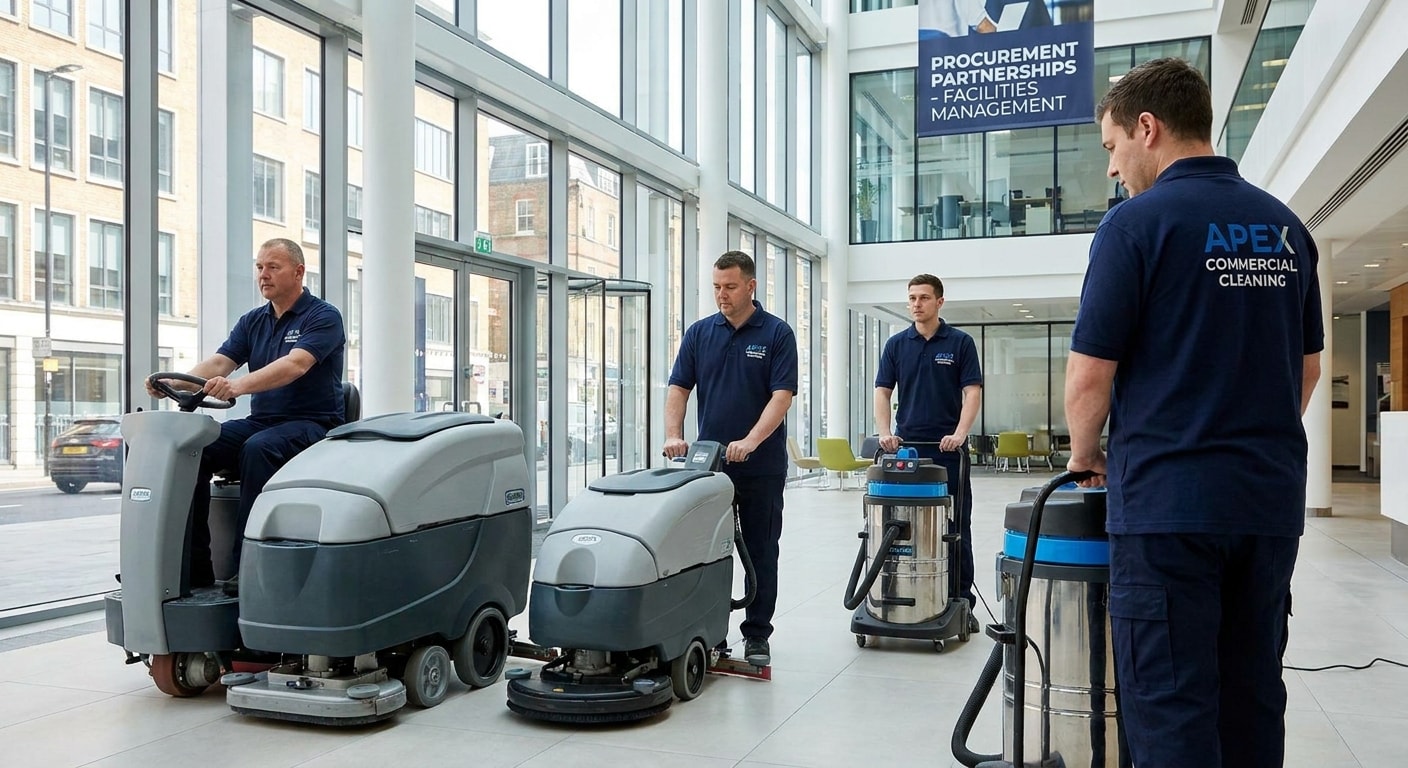
Professional commercial cleaning team using industrial equipment in a modern UK office building
---
Why Cleaning Tenders Are Different
Cleaning is often treated as a commodity purchase by buyers — "it's just cleaning, surely price wins." In practice, that's rarely true. Public sector evaluations routinely weight quality at 40–60% of the total score, sometimes higher. The reasons are straightforward:
Service continuity risk. A cleaning contractor that fails mid-contract causes immediate operational disruption. Hospitals can't function with unclean wards. Schools face regulatory issues with dirty facilities. Buyers want confidence you'll deliver reliably for three to five years. Staff management complexity. TUPE regulations mean incoming contractors often inherit the incumbent's workforce. Buyers want to see you understand your obligations and have a robust people management plan. Regulatory obligations. NHS cleaning must comply with the National Standards of Cleanliness. Schools follow DfE guidance. Care homes are subject to CQC inspection. Buyers expect contractors to demonstrate sector-specific knowledge. Social value requirements. Under the Social Value Act 2012 and the Procurement Act 2023, public sector buyers must consider social, economic, and environmental benefits. Cleaning contracts — labour-intensive, often employing disadvantaged workers — are expected to deliver meaningful outcomes.Understanding this landscape is the first step to writing bids that win.
---
The Cleaning Contract Market: Who's Buying
Before writing a word, know your buyer. The public sector cleaning market divides into several distinct segments, each with different priorities, timescales, and evaluation approaches.
NHS and Healthcare
NHS cleaning contracts are among the highest-value and most complex in the sector. Trusts procure cleaning under frameworks including NHS Shared Business Services (NHS SBS) and Crown Commercial Service (CCS) RM6232 (Facilities Management). Standalone contracts also appear on Find a Tender Service (FTS) and Contracts Finder.
Key priorities: infection prevention and control (IPC), compliance with the National Standards of Cleanliness 2021, audit-ready quality management, and TUPE compliance.
Contract values: Typically £200k–£5m+ per year depending on trust size and scope.Local Authorities
Councils procure cleaning for offices, leisure centres, libraries, depots, and sometimes schools. Many use dynamic purchasing systems (DPS) or multi-lot frameworks to manage contracts across different building types.
Key priorities: value for money, living wage compliance, environmental sustainability, and local workforce commitments.
Contract values: Highly variable — from £30k for a single building to multi-million-pound borough-wide contracts.Education (Schools and Universities)
Academy trusts, maintained schools, further education colleges, and universities all procure cleaning independently. Academy trusts and multi-academy trusts (MATs) often consolidate contracts across several sites.
Key priorities: safeguarding (DBS checks, child protection policies), school-hours discretion, curriculum disruption minimisation, and cost efficiency.
Contract values: £20k–£500k+ depending on institution size.Housing Associations
Registered providers procure cleaning for communal areas, void properties, and office space. Procurement approaches vary — some use frameworks, others run open or restricted procedures.
Key priorities: resident experience, value for money, social value (resident employment), and environmental credentials.
Contract values: £50k–£2m+ depending on stock size and scope.Commercial and Private Sector
While this guide focuses primarily on public sector tenders, many of the principles apply equally to large commercial procurements — office parks, retail centres, and corporate headquarters increasingly run formal tender processes.
---
How Public Sector Cleaning Tenders Are Structured
Most public sector cleaning tenders follow a two-stage process for higher-value contracts, or a single-stage open procedure for lower-value opportunities.
Stage 1: Selection Questionnaire (SQ)
The SQ (formerly Pre-Qualification Questionnaire or PQQ) filters out suppliers who don't meet minimum standards. You'll typically need to demonstrate:
- Minimum annual turnover (often 1–2x the contract value)
- Professional indemnity and public liability insurance
- Relevant experience (usually 2–3 similar contracts in the past 3–5 years)
- Health and safety credentials (CHAS, SafeContractor, or equivalent)
- Environmental management certification (ISO 14001 or equivalent)
- Quality management certification (ISO 9001 or equivalent)
- Absence of mandatory or discretionary exclusion grounds
Pass the SQ and you're invited to tender (ITT).
Stage 2: Invitation to Tender (ITT)
The ITT is where the real competition happens. You'll be evaluated on:
Price (typically 40–60%): Your submitted pricing schedule, assessed against a benchmark or relative to other bidders. Quality (typically 40–60%): Written responses to method statement questions covering service delivery, staffing, mobilisation, quality management, and more. Social Value (sometimes scored separately, sometimes embedded in quality, typically 10–20%): Your commitments to local employment, apprenticeships, environmental sustainability, and community benefit.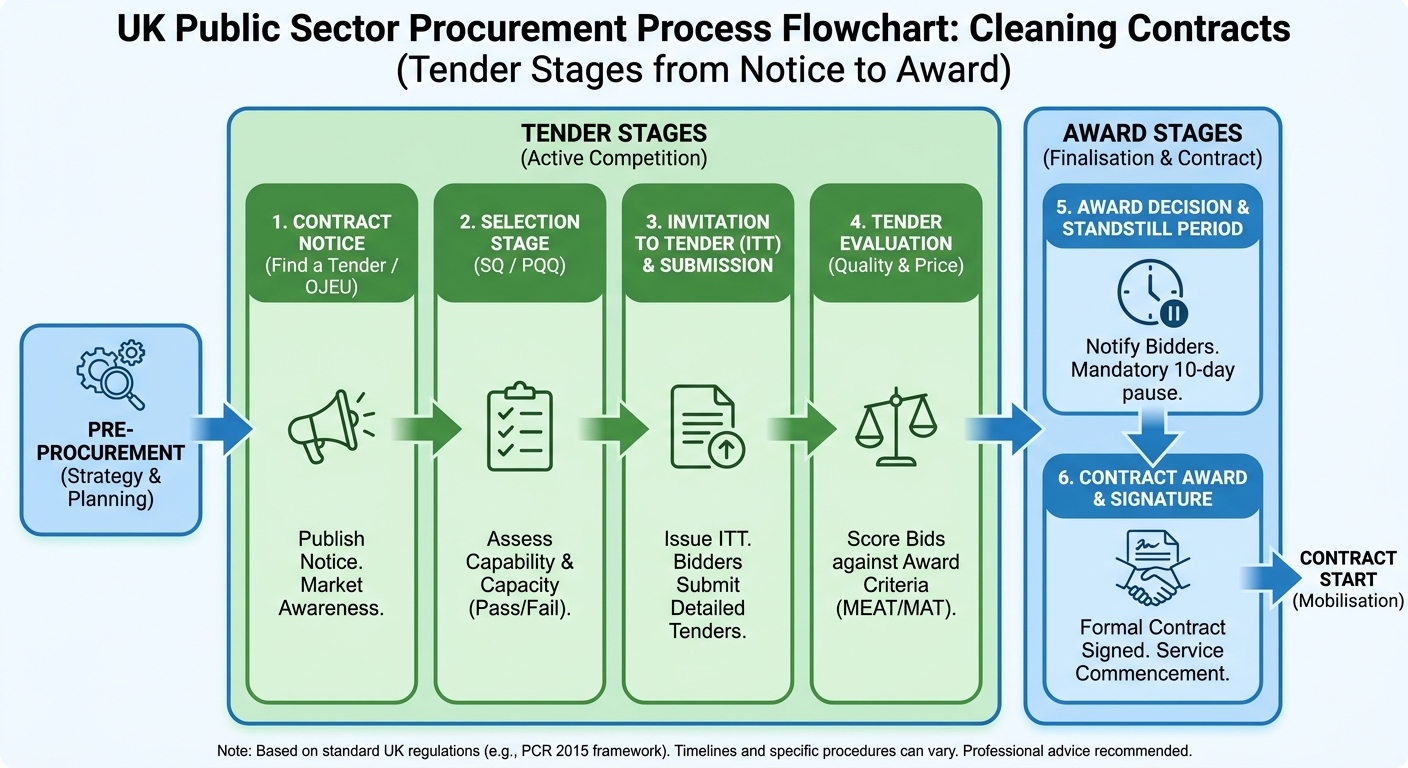
UK public sector procurement process for cleaning contracts showing tender stages
---
Pricing Your Cleaning Tender: Getting It Right
Pricing is where many cleaning companies lose tenders — not because they're too expensive, but because their pricing is unclear, insufficiently justified, or doesn't align with the buyer's specification.
Build Your Costs From the Ground Up
Buyers can spot inflated or deflated rates. The most credible pricing submissions are built transparently from:
Labour costs: Calculate hours per week per site, multiplied by your fully loaded labour rate (including National Living Wage, employer NI, holiday pay, pension contributions, and any TUPE uplifts). In 2026, the National Living Wage is £12.21/hour for workers 21+. Many public sector buyers specify the Real Living Wage (currently £12.60/hour in the UK, £13.85 in London) — check the specification carefully. Supervision and management: Include site supervisor time (often 10–15% of operative hours on larger contracts), contract manager time, and any overhead allocation for your head office support function. Materials and consumables: Estimate annual spend on cleaning chemicals, paper products, bin liners, and other consumables. Many specifications include COSHH schedules — price to these. Equipment and machinery: Depreciation, maintenance, and replacement costs for floor care equipment, scrubber-dryers, pressure washers, and specialist machinery. Overhead and profit: Typically 10–20% combined, though this varies by company size and contract type. Be realistic — undercutting to win and then struggling to deliver is a well-worn path to contract failure.Pricing Transparency Pays Off
Many modern cleaning tenders ask you to submit a detailed pricing breakdown, not just a total. This is an opportunity, not a burden. A transparent, well-structured cost model:
- Demonstrates commercial competence
- Allows buyers to identify savings opportunities without cutting corners
- Builds trust in your ability to manage the contract
Include a one-page pricing narrative alongside your schedule, explaining key assumptions (hours, rates, materials volumes) and noting any risks or dependencies (e.g., "pricing assumes TUPE will apply to X staff at current terms").
Watch the TUPE Trap
If the incumbent has a workforce that will transfer under TUPE, your labour costs are largely predetermined. Request the TUPE information early, scrutinise it carefully, and build accurate TUPE uplifts into your model. Underpricing TUPE is a common and expensive mistake.
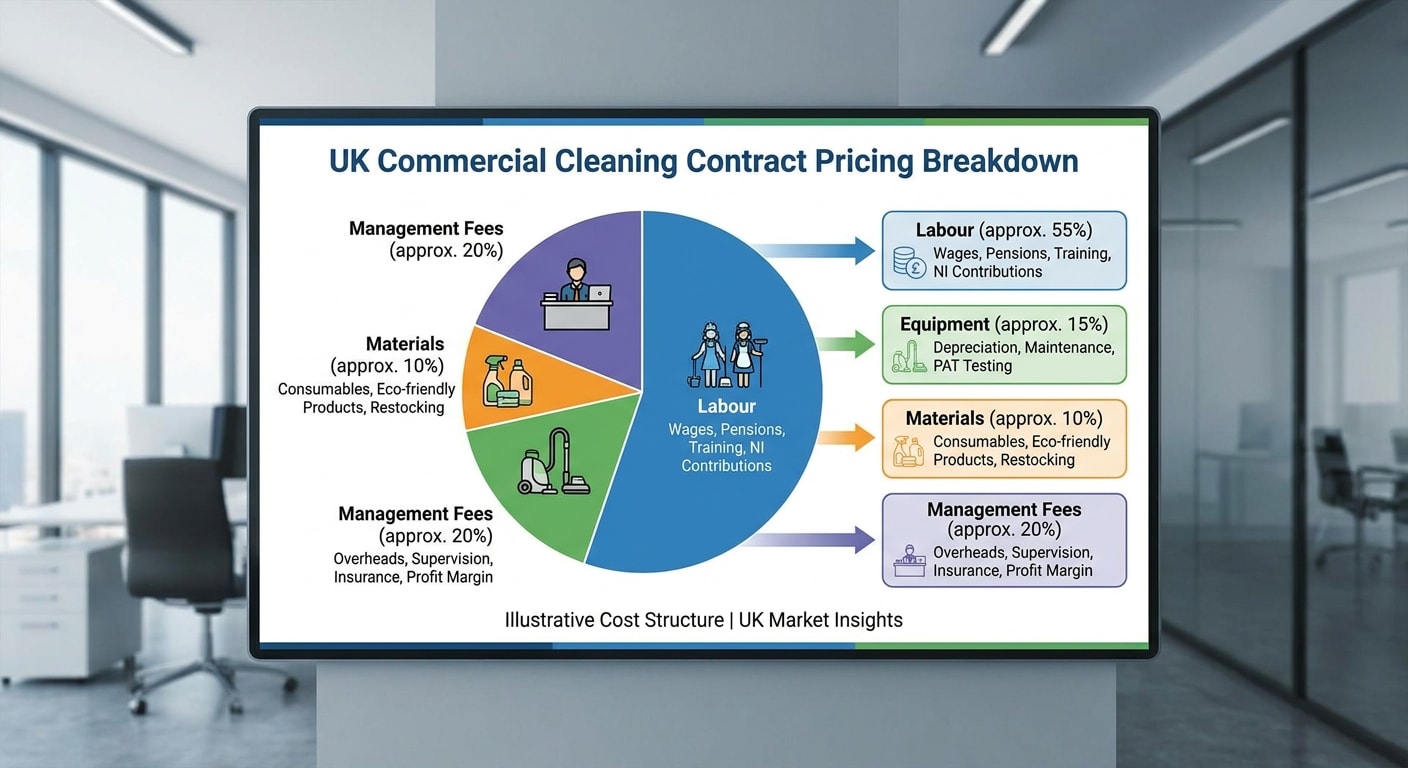
Cleaning contract pricing breakdown showing labour, equipment, materials and management costs
---
Writing Winning Method Statements
Method statements are the heart of a quality cleaning bid. Each question tests a specific aspect of your capability and approach. Here's how to tackle the most common ones.
Service Delivery Methodology
What buyers are testing: Do you understand how to clean this type of building? Do you have a logical, safe, and effective approach? What to include:- Your cleaning sequences and frequencies aligned to the specification
- How you'll manage high-risk areas (kitchens, toilets, healthcare isolation rooms, etc.)
- Your approach to daytime cleaning vs. out-of-hours work
- Colour-coding systems to prevent cross-contamination
- Chemical selection rationale (environmentally friendly where specified, COSHH-compliant throughout)
- How you adapt your methodology for seasonal variations or high-footfall periods
Staffing and TUPE Management
What buyers are testing: Can you manage a cleaning workforce professionally? Do you understand TUPE? What to include:- Your TUPE consultation process and timeline
- How you'll communicate with transferring staff
- Your approach to retaining existing staff where possible
- Pay and terms harmonisation (if applicable)
- Ongoing HR support — absence management, performance management, disciplinary procedures
- Training and induction programme for new or transferred staff
- Your approach to Living Wage compliance and pay review
Quality Management and Auditing
What buyers are testing: How will you maintain standards over the contract term? What happens when things go wrong? What to include:- Your quality management system (ISO 9001 or equivalent)
- Internal audit frequency and methodology (spot checks, periodic full audits)
- How you use audit data to drive continuous improvement
- Your KPI framework — what you'll measure and report
- Rectification processes for non-conformances (how quickly, by whom, how tracked)
- Client reporting pack — content, frequency, format
- Escalation paths for serious issues
Mobilisation Plan
What buyers are testing: Can you take over this contract smoothly with minimal disruption? What to include:- Week-by-week mobilisation timeline from contract award to go-live
- TUPE consultation milestones
- Equipment delivery and installation schedule
- Staff induction and training dates
- System set-up (cleaning management software, access credentials, etc.)
- Risk register for mobilisation — and mitigation actions
- Key personnel responsible for each mobilisation workstream
- Communication plan for the buyer and end users
Most buyers want mobilisation completed within 4–8 weeks. Be realistic — over-promising on timelines and then failing to deliver is a serious credibility problem.
Health, Safety, and Environmental Management
What buyers are testing: Are you a safe, responsible contractor? What to include:- Your H&S management system (ISO 45001 or equivalent, CHAS, SafeContractor)
- COSHH management — chemical assessments, SDS sheets, training
- PPE provision and enforcement
- Lone worker policy (relevant for early morning/late evening cleaning)
- Accident reporting and near-miss investigation
- Environmental management system (ISO 14001 or equivalent)
- Chemical reduction programme — are you moving toward greener products?
- Waste management — how you dispose of cleaning waste
- Carbon footprint — any targets or reduction initiatives?
---
Social Value: Turn It Into a Scoring Advantage
Social value used to be a box-ticking exercise. Under the Procurement Act 2023, it's a genuine scoring criterion — and for cleaning companies, it's an area where you can genuinely differentiate.
Why Cleaning Companies Have a Natural Advantage
Cleaning is a labour-intensive, community-based service. Your workforce often comes from the same communities you're serving. That creates real opportunities to deliver meaningful social value:
Local employment. Committing to recruit a proportion of your workforce locally (within X miles of the contract site) is credible and deliverable. Quantify the commitment — "at least 60% of our site team will be recruited from within 10 miles" — and explain your recruitment channels. Employment for disadvantaged groups. Cleaning has historically been an entry-level sector. Partnering with local job centres, ex-offender rehabilitation programmes, or refugee employment organisations to create pathways into work is powerful social value evidence. Buyers in health and local authority often score this highly. Apprenticeships. The cleaning industry has its own apprenticeship standard (Cleaning and Environmental Services Operative, Level 2). Committing to one or more apprenticeships on the contract — with a specific number and timeline — demonstrates investment in the workforce. Living Wage. If the specification doesn't mandate it, voluntarily committing to pay the Real Living Wage is a strong social value commitment. Frame it clearly: "All operatives employed on this contract will be paid the Real Living Wage as a minimum, reviewed annually in line with the Living Wage Foundation's rate increase." Environmental commitments. Transition to concentrated chemicals (fewer deliveries, less plastic), electric floor care equipment, reduced single-use products. Quantify where possible — "our concentrated dosing system reduces plastic packaging by 70% compared to standard RTU products."How to Present Social Value
Don't just list commitments — link them to the buyer's Social Value priorities. Most public sector buyers publish their Social Value priorities alongside the tender. Read them, identify the top 2–3 priorities, and structure your response to address those specifically.
Use the SMART framework: Specific, Measurable, Achievable, Relevant, Time-bound. "We will support local employment" scores poorly. "We will recruit a minimum of 4 local residents within 5 miles of the contract site within the first 3 months of mobilisation, working in partnership with [specific local job centre or community organisation]" scores well.
---
Compliance Credentials: What You Need to Win
Most public sector cleaning tenders require specific accreditations. If you don't have them, you'll either fail the selection stage or score poorly on quality questions. Here's what you need:
Essential Accreditations
CHAS (Contractors Health and Safety Assessment Scheme) or equivalent (SafeContractor, Avetta, Constructionline Gold): Required by the vast majority of public sector buyers. CHAS certification demonstrates you have a compliant H&S management system. Annual renewal. ISO 9001 (Quality Management Systems): Increasingly required rather than merely desirable, particularly for NHS and local authority contracts. If you're not certified, a credible plan to achieve certification within 12 months may be accepted by some buyers. ISO 14001 (Environmental Management Systems): Required for many NHS and larger local authority contracts. Demonstrates systematic management of your environmental impact. ISO 45001 (Occupational Health and Safety): Supersedes OHSAS 18001. Not universally required but scores highly where present. Disclosure and Barring Service (DBS) checks: Mandatory for any contract involving schools, care settings, or anywhere children or vulnerable adults are present. Be clear about your DBS checking process — Enhanced DBS for all operatives, annual refresh, how you manage new starters. COSHH assessment library: Not a formal accreditation but expected evidence. A well-maintained library of COSHH assessments for every chemical you use demonstrates professional H&S management.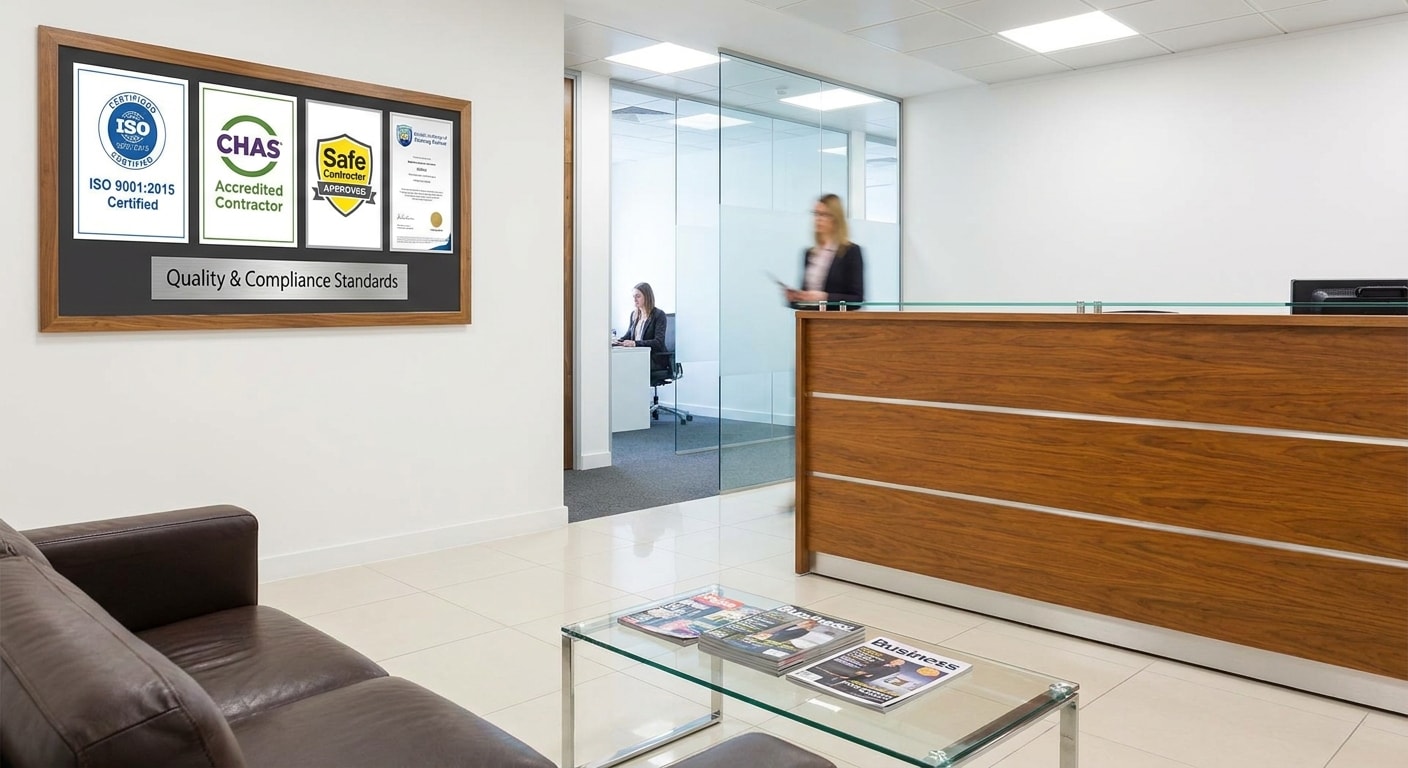
Cleaning services compliance certifications including ISO, CHAS and Safe Contractor accreditations
Sector-Specific Requirements
NHS contracts: Familiarity with the National Standards of Cleanliness 2021, Patient Environment Action Group (PEAG) scoring methodology, and Infection Prevention Society guidance. Evidence of IPC training for operatives. Food environments (canteens, kitchens): Food Safety Level 2 certificate minimum; Level 3 for supervisors. British Retail Consortium (BRC) audit experience a significant plus. Schools: Safeguarding policy aligned to Keeping Children Safe in Education (KCSIE). All staff to have read Part 1 (or Annex A) as appropriate. Designated safeguarding lead awareness training.---
Common Mistakes That Lose Cleaning Tenders
After reviewing hundreds of cleaning tender responses, the same errors appear repeatedly. Avoid them.
1. Generic "We are a leading cleaning company" Opening
Evaluators read dozens of bids. An opening paragraph that could belong to any company immediately signals a low-effort submission. Start with something specific to this buyer, this contract, or this challenge.
2. Failing to Address the Specification
The tender specification is your scoring guide. Every element in it should be addressed in your response. If the specification mentions "colour-coding system," address colour-coding specifically — don't just say you "comply with industry best practice."
3. Underselling Your Social Value
Many cleaning companies have genuinely impressive social value stories — a workforce that's 80% from the local area, 20% previously long-term unemployed, active partnerships with community organisations — and they summarise it in three lines. Tell the story. Use names (with permission), numbers, and outcomes.
4. Vague KPIs Without Targets
"We will conduct regular audits" is not a KPI. "Monthly full audits scoring to BICS standard, with a target score of ≥95% in all categories, and a 2-hour rectification SLA for any Category A failure" is a KPI.
5. Ignoring TUPE
If there's a TUPE element and your response doesn't address it substantively, evaluators will either score it zero or raise it as a clarification. Acknowledge TUPE, show you understand it, and explain your approach.
6. Submitting Without Proofreading
Spelling errors, inconsistent staff numbers between sections, and pricing that doesn't add up. All of these undermine confidence in your professionalism. Have someone who didn't write the bid read it before submission.
---
Using AI to Write Cleaning Tenders Faster and Better
Bid writing is time-consuming. A well-written cleaning tender response can take 20–40 hours. For a small to medium-sized cleaning company, that's a significant investment — especially when you're bidding on multiple contracts simultaneously.
AI-powered bid writing tools like mytender.io are changing the economics of tendering for cleaning companies.

Professional bid writer using AI software to write cleaning service tender responses
How mytender.io Helps Cleaning Companies
Content library: Upload your past bids, case studies, policies, accreditation certificates, and staff CVs. mytender.io builds a searchable library that the AI draws on when generating responses — so your bid always sounds like you, not a generic template. Specification analysis: Paste in the tender specification and mytender.io identifies every requirement, flags any conflicts or ambiguities, and creates a compliance checklist. Nothing gets missed. Draft generation: For each method statement question, the AI generates a structured draft drawing on your content library. You review, refine, and personalise — but you're editing a solid draft rather than starting from a blank page. Word count management: Cleaning tenders often have strict word limits per question. mytender.io tracks word counts in real time and helps you cut responses without losing key scoring points. Consistency check: Ensures that the staff numbers, KPIs, and commitments in your method statement responses match those in your pricing schedule and mobilisation plan. Inconsistencies are flagged before submission. Social value support: Suggests social value commitments based on the buyer's published priorities and your company's track record, helping you frame commitments in a way that maximises scores.The result: a bid that typically takes 20–40 hours of manual work can be completed in 6–10 hours with AI assistance. That means you can bid on more contracts — and bid more thoughtfully on each one.
---
Tender Strategy: Which Opportunities to Pursue
Not every cleaning tender is worth bidding. A systematic approach to opportunity selection saves time and improves win rates.
The Bid/No-Bid Decision
Before investing time in any tender, ask:
Can we deliver it? Geographic coverage, workforce capacity, equipment, and specialist expertise (healthcare, food environments) all matter. Bidding for contracts you can't deliver — and then either withdrawing or failing — damages your reputation with procurement teams. Can we price to win? If the incumbent is a national contractor with enormous economies of scale and the contract is being re-tendered purely on price, a smaller regional operator may not be able to compete on cost. Be realistic. Do we meet the selection criteria? If the SQ requires ISO 9001 and you don't have it, you'll be filtered out. Check the selection criteria before spending time on a bid. What's our realistic win probability? Use your knowledge of the market, the buyer's history, and your own strengths and weaknesses to make an honest assessment. A 20% win probability bid deserves proportionally less resource than a 60% win probability bid. What's the strategic value? Sometimes a lower win probability bid is worth pursuing because the reference site would open doors to a specific sector (e.g., winning your first NHS contract to build credibility for future NHS bids).Building Pipeline
The most successful cleaning companies don't just respond to tenders — they build pipeline by:
Monitoring Find a Tender Service (FTS) and Contracts Finder daily. Set up alerts for relevant CPV codes (most cleaning services fall under 90910000 – Cleaning services, 90911200 – Building-cleaning services, 90911300 – Window-cleaning services, 90919000 – Office, school and office equipment cleaning services). Tracking framework renewals. Most public sector frameworks last 4 years. If you missed a framework, note when it expires and monitor for the re-procurement. Submit expressions of interest to framework owners months in advance. Relationship development. Procurement officers change, but facilities managers often stay longer. Building relationships with FM leads at target organisations — attending sector events, responding to market engagement exercises, requesting site visits — positions you as a known quantity when the tender is issued. Sub-contracting networks. Partnering with larger contractors who prime large frameworks but need regional delivery capacity gets you onto contracts you couldn't win independently. Deliver well, and you build the reference sites to prime similar work yourself.---
Sector Deep Dive: NHS Cleaning Tenders
NHS cleaning is the gold standard for complexity and compliance in this sector. Get it right here and every other market becomes easier.
National Standards of Cleanliness 2021
All NHS premises must comply with the National Standards of Cleanliness (NSC) 2021, published by NHS England. The NSC sets out:
- 49 functional risk groups, each with defined cleaning frequencies and audit methodologies
- A risk-based approach to audit scoring with clear pass/fail thresholds
- Patient Environment Action Team (PEAT) replacement by Patient-Led Assessment of the Care Environment (PLACE) assessments
Your bid must demonstrate familiarity with the NSC. Reference it specifically. Explain how your service specification maps to NSC functional areas. Show that your supervisors are trained to audit to NSC standards.
Infection Prevention and Control
IPC is non-negotiable in healthcare. Your response should cover:
- Your IPC training programme (initial and refresher)
- How you respond to IPC outbreaks (norovirus, C.diff, COVID variants, MRSA)
- Enhanced cleaning protocols for isolation areas
- Coordination with the Trust's Infection Control team
- Ante- and post-discharge cleaning procedures
Patient Experience
Cleanliness consistently ranks in the top three factors for patient experience scores. Many NHS trusts now link cleaning KPIs to Friends and Family Test (FFT) scores and patient survey data. Reference this linkage in your bid — it demonstrates that you understand why cleanliness matters, not just how to deliver it.
---
Sector Deep Dive: School Cleaning Tenders
Schools present unique challenges — safeguarding, curriculum disruption, and budget constraints among them.
Safeguarding is Non-Negotiable
Every operative working in a school must have an Enhanced DBS check. But safeguarding goes beyond checks:
- All operatives must receive safeguarding training (at minimum, an awareness of the signs of abuse and the reporting process)
- Your company must have a Designated Safeguarding Lead or a named safeguarding contact
- Your safeguarding policy must be aligned with Keeping Children Safe in Education (KCSIE)
- Procedures for an operative who witnesses a safeguarding concern must be clear
Many school cleaning tenders include a specific safeguarding question. Answer it thoroughly. Schools that have experienced safeguarding failures with cleaning contractors are acutely sensitive to this.
Working Around the Curriculum
Most school cleaning is carried out outside of school hours, but deep cleans, specialist cleaning (science labs, art rooms, sports halls), and reactive cleaning often happen during the school day. Your bid should explain:
- How you communicate with site managers about scheduling
- How your operatives behave around pupils (uniform, signage, restricted access areas)
- Your process for urgent reactive cleaning (a child is sick in a classroom — what happens next?)
Understanding Academy Trust Procurement
Multi-academy trusts (MATs) are increasingly professionalising their procurement. Larger MATs (10+ schools) often run formal tender processes with written evaluation criteria. Smaller MATs may procure more informally. Either way, the decision-maker is often the Chief Operating Officer or Finance Director — not a professional procurement officer. Write your bid accordingly: clear, jargon-free, focused on outcomes and value.
---
The Future of Cleaning Services Procurement
Several trends are reshaping how cleaning services are procured in 2026 and beyond.
The Living Wage Mandate
The Real Living Wage is increasingly being mandated rather than encouraged. London's Cleaning and Support Services Sector Deal (signed by TfL, GLA, and several large private sector employers) sets a precedent. Expect more public sector contracts to specify the Real Living Wage as a contractual minimum in 2026–27.
What this means for your bid: If you already pay the Real Living Wage, say so prominently. If you don't, develop a credible transition plan and include it in your social value response.Technology Integration
Smart building technology is creating demand for data-driven cleaning. Occupancy sensors that tell you which areas have been used (and therefore need cleaning), automated dispensing systems that track chemical consumption, and digital audit platforms are all becoming expected on larger contracts.
Buyers are increasingly asking about technology integration in tender questions. Even if you're not deploying full sensor-based systems, demonstrating that you're using digital work scheduling, mobile audit apps, and electronic reporting positions you as forward-looking.
Net Zero Commitments
Many public sector buyers now have carbon reduction commitments that extend to their supply chain. Expect cleaning tenders to increasingly ask about your carbon footprint, your Science Based Targets (SBTs), and your plan to reduce emissions from your operations.
Key areas: electric vehicles for supervisory staff, electric floor care equipment, concentrated chemistry (reducing transport emissions), and renewable energy for any depot or office premises.
The Procurement Act 2023
The Procurement Act 2023, now fully in force, changes the framework for public sector procurement in England, Wales, and Northern Ireland. Key implications for cleaning contractors:
Central Digital Platform (CDP): You'll register your company once and your details are shared across all public sector buyers. Keep your CDP profile current — it's your first impression before any tender. Transparency requirements: More information about contracts and awards must be published. Use this to research competitors' pricing and social value commitments on awarded contracts. Debarment register: Suppliers who have seriously failed on public contracts can be debarred. This is a warning to contractors who might consider walking away from difficult contracts — the reputational and commercial consequences are now more severe.---
Checklist: Your Cleaning Tender Submission
Use this checklist before every submission:
Pricing:- [ ] Labour costs built from NLW/RLW base, fully loaded
- [ ] TUPE information reviewed and incorporated
- [ ] Management and overhead allocation included
- [ ] Materials and equipment costs itemised
- [ ] Pricing narrative submitted alongside schedule
- [ ] Service delivery methodology references this specific building/site type
- [ ] Staffing plan includes TUPE detail (if applicable)
- [ ] Quality management section includes specific KPIs with targets
- [ ] Mobilisation plan has week-by-week timeline
- [ ] H&S section references relevant accreditations with certificate numbers
- [ ] Commitments are SMART (Specific, Measurable, Achievable, Relevant, Time-bound)
- [ ] Commitments aligned to buyer's published Social Value priorities
- [ ] Local employment and apprenticeship commitments quantified
- [ ] Environmental commitments quantified where possible
- [ ] All required accreditations listed with certificate numbers and expiry dates
- [ ] DBS policy described clearly (Enhanced, how managed, new starter process)
- [ ] Insurance certificates current and at required levels
- [ ] Word counts within limits for all questions
- [ ] Staff numbers consistent across all sections
- [ ] Pricing totals cross-checked
- [ ] Proofread by someone who didn't write the bid
- [ ] Submitted before deadline (aim for 24 hours before)
---
How mytender.io Can Transform Your Cleaning Business
Winning cleaning tenders is about more than writing skills — it's about having the right infrastructure to bid consistently, at volume, without sacrificing quality.
mytender.io gives cleaning companies of all sizes access to enterprise-grade bid writing capability:
For sole traders and small firms: The content library means you never start from a blank page. Upload your past bids and policies once, and the AI draws on them for every future submission. Spend your time on client relationships, not admin. For growing regional contractors: Multi-user collaboration means your management team, H&S coordinator, and operations manager can all contribute to bids simultaneously. No more emailing Word documents back and forth. For national operators: Framework lots, contract management, and bid pipeline tracking give you visibility across dozens of concurrent opportunities. Consistent quality across every submission, regardless of which team member is leading.The cleaning sector is competitive. The companies that win consistently are the ones that treat tendering as a core business discipline — investing in the skills, processes, and tools to do it well. mytender.io is built for exactly that.
---
Getting Started
If you're new to public sector cleaning tenders, start here:
- Register on the Central Digital Platform (CDP) at find-tender.service.gov.uk — free, mandatory for UKGA contracts.
- Get CHAS certified — the single most impactful accreditation investment for entry-level public sector cleaning work.
- Build your content library — pull together 2–3 case studies from existing contracts, your key policies (H&S, Environmental, Safeguarding, Equal Opportunities), and staff CVs for key personnel.
- Set up tender alerts — configure CPV code alerts on Contracts Finder and FTS so you see relevant opportunities as they're published.
- Start with lower-value lots — many frameworks have lots starting at £30k–£50k where competition is lower and evaluation less intensive. Win two or three of these and you have the references to bid for larger contracts.
- Use mytender.io to compress your learning curve — the AI's familiarity with public sector evaluation frameworks means your first few bids benefit from hundreds of prior bid patterns, without you having to learn by losing.
The market is there. The contracts are published, the evaluation criteria are transparent, and the buyers genuinely want good suppliers. The question is whether your bid is good enough to win. With the right approach — and the right tools — it can be.
---
mytender.io is the AI-powered bid writing platform built for UK businesses. Upload your content, connect your past bids, and let AI help you write better tenders, faster. Start your free trial today.Tags
Ready to Transform Your Tender Writing?
See how MyTender's AI can help you write winning tenders in a fraction of the time.