
Central Digital Platform Payment Data: How Suppliers Can Turn Transparency into Tender Advantage
Payment reporting on the Central Digital Platform changes how public sector buyers assess supplier confidence. Here is how bid teams can turn transparency into stronger tender evidence.
mytender.io Research Team
Tender Writing & Bid Management Specialists
Central Digital Platform Payment Data: How Suppliers Can Turn Transparency into Tender Advantage
Payment data used to live quietly in finance.
A buyer might ask about payment terms. A contract manager might chase an invoice. A subcontractor might complain if the process dragged.
But most bid teams did not treat payment performance as tender evidence.
That is changing.
The Procurement Act 2023 is pushing UK public procurement into a more transparent operating model. The Central Digital Platform is becoming the place where supplier data, notices and contract information are pulled into one public record. From 2026, details of significant payments under public contracts are part of that shift.
For suppliers, this is not just a compliance story. It is a bid strategy story.

Bid team analysing Central Digital Platform payment data for a public sector tender strategy
The teams that win under the new regime will not be the ones who say, "we have strong governance". Everyone says that.
They will be the ones who can prove it.
Payment data gives you proof. Used badly, it exposes weak controls. Used well, it supports your answers on contract management, supply chain resilience, social value, mobilisation and risk.
This guide explains what suppliers should do now, how payment transparency affects tender scoring, and how to turn finance data into sharper bid evidence.
Why this topic matters now
The procurement conversation in 2026 is being shaped by three linked trends.
First, the Procurement Act has made transparency a design principle, not a side note. Buyers are publishing more information across the procurement lifecycle, from pipeline notices to contract performance information.
Second, the Central Digital Platform is becoming more important to supplier identity and public contract records. Suppliers need to think about the information attached to them before an evaluator or stakeholder goes looking for it.
Third, public sector buyers are under pressure to choose suppliers who can actually deliver. The move to Most Advantageous Tender means price still matters, but confidence matters more than it used to.
Payment behaviour sits right in the middle of that confidence question.If your invoices are clean, your subcontractors are paid properly, and your contract managers can explain the commercial controls, you look lower risk.
If your process is vague, slow or disconnected from delivery, your bid starts to feel fragile.
What payment transparency really means for suppliers
Payment transparency does not mean every invoice becomes a public drama.
It means payment information is moving closer to the official record of how public contracts are managed. Details of significant payments under public contracts are being pulled into the broader transparency framework. Buyers, auditors, competitors and internal stakeholders will have more visibility than they had before.
That changes the tone of bidding.
A tender response cannot pretend contract delivery is just a neat mobilisation plan and a few review meetings. Delivery includes money moving through the system: purchase orders, invoice checks, approvals, disputed items, subcontractor payment and reporting.
If those bits are messy, the contract feels messy.
The point for suppliers is not to write a finance essay in every bid. Please don't. Evaluators have suffered enough.
The point is to show that your payment process supports delivery instead of distracting from it.
The hidden link between payment data and win rate
Most tender scoring models will not say "payment transparency" in a heading.
That is why suppliers miss it.
The theme usually appears inside other scored answers.
Contract management
Contract management answers often fall into a familiar pattern: mobilisation meeting, monthly review, KPI pack, escalation route, continuous improvement log.
That is fine. It is also forgettable.
Payment data lets you make the answer more credible.
You can explain that your monthly contract review pack includes invoice status, purchase order alignment, disputed items, aged queries, subcontractor payment checks and corrective actions. That gives the buyer a picture of the contract being managed in the round.
It says: we do not wait for finance problems to become relationship problems.
Mobilisation
Mobilisation is where payment processes often go wrong.
People are TUPE'd. Systems are switched on. Equipment is ordered. New suppliers are onboarded. The first invoices arrive while everyone is still learning the contract.
If the purchase order route is unclear, pain follows quickly.
A strong mobilisation answer should include commercial setup as a workstream. That means invoice routes, approval levels, subcontractor onboarding, first-month reconciliation, rate-card checks and issue escalation.
This is not glamorous. It wins marks because it feels real.
Supply chain resilience
Supply chain resilience is not only about alternative suppliers and stock availability.
It is also about whether partners can afford to keep serving the contract.
Small local suppliers are often central to public sector bids, especially where social value is weighted. They are also the suppliers most affected by slow payment and unclear query handling.
If your bid promises local SME participation, your payment process has to support that promise.
A useful response explains payment terms, onboarding support, dispute handling, escalation routes and how subcontractor feedback is reviewed.
Social value
Payment performance is rarely framed as social value. It should be.
Prompt payment to local SMEs helps cashflow. It protects jobs. It reduces stress on community partners. It keeps public money moving into the local economy rather than stuck in admin.
That is operational social value, not brochure social value.
If you are promising apprenticeships, local jobs, VCSE partnerships or community investment, your commercial process needs to make those commitments survivable.
Risk management
Payment issues create risk.
They damage relationships. They distract contract managers. They trigger escalation meetings. They make subcontractors deprioritise the work. They create noise at exactly the wrong moment.
A risk answer that includes payment controls is stronger than one that only talks about staffing, health and safety and business continuity.
It shows you understand how contracts actually fail.
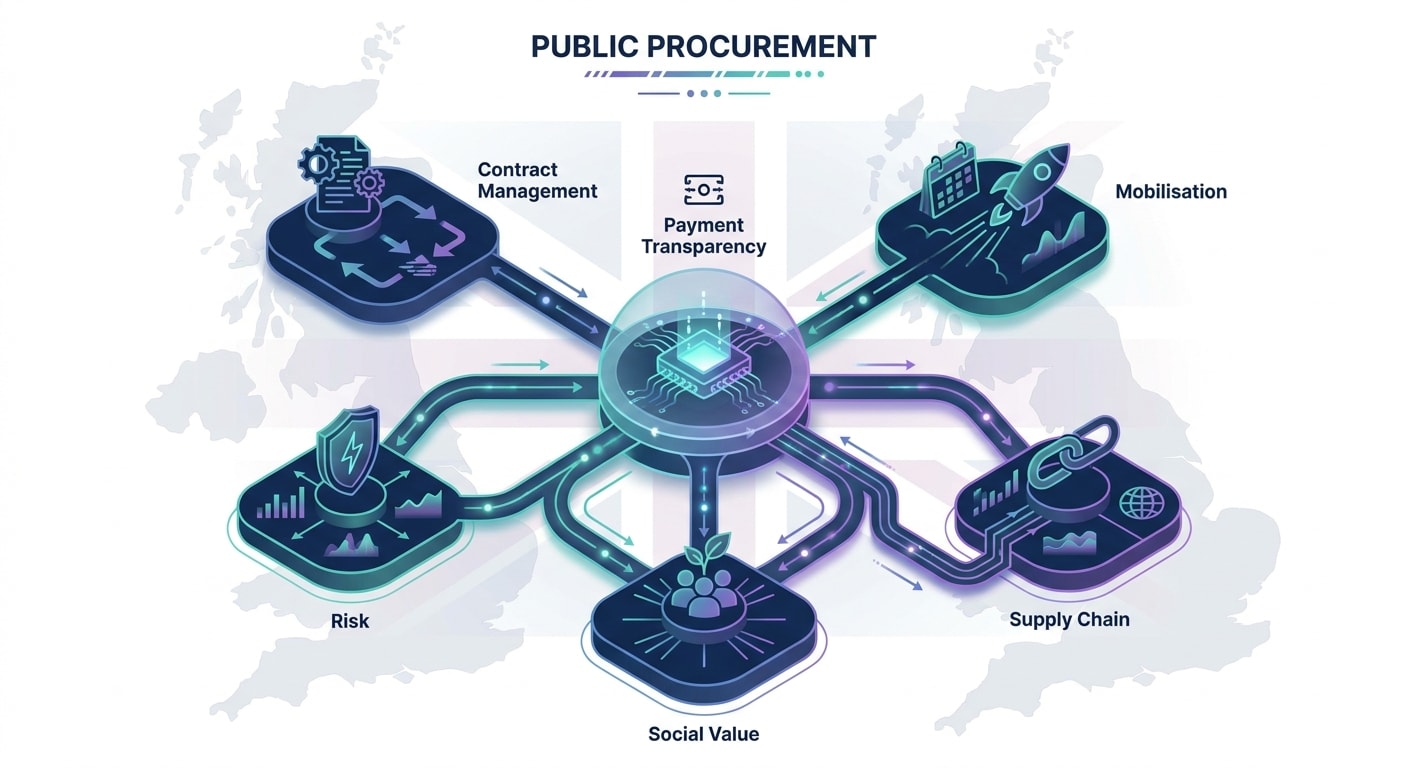
Payment transparency mapped to tender scoring areas including mobilisation, risk, social value and contract management
What good payment evidence looks like
Good evidence is not a pile of spreadsheets.
It is a short, clear story backed by data.
A bid writer should be able to understand it in ten minutes. An evaluator should be able to see why it reduces risk in ten seconds.
The best evidence usually has five parts.
1. The process
Explain how payment works from invoice receipt to approval and resolution.
Keep it plain. Who receives the invoice? Who checks it? Who approves it? What happens if the value is wrong? What happens if the service was not delivered? When does escalation begin?
Avoid internal jargon. The buyer does not care what your workflow is called. They care whether it works.
2. The ownership model
A payment process without ownership is just a diagram.
Name the roles involved: contract manager, finance lead, operational manager, procurement lead, subcontractor manager. Explain who owns what and when they meet.
This matters because payment issues often sit between teams. Finance says operations need to approve. Operations says finance has the invoice. The subcontractor says nobody is replying.
Your bid should show that this does not happen on your contracts.
3. The dashboard
A simple dashboard can do a lot of work.
It might include:
- invoices received
- invoices approved
- invoices queried
- average approval time
- aged disputed items
- subcontractor payment status
- first-month mobilisation invoices
- corrective actions
Do not overcomplicate it. The goal is visibility, not theatre.

Example-style payment governance dashboard for supplier bid evidence and contract management reviews
4. The improvement loop
Data is useful only if someone acts on it.
Show how payment issues are reviewed, what thresholds trigger action, and how lessons are fed back into the contract plan.
For example:
- repeated invoice coding errors lead to updated site guidance
- recurring subcontractor queries lead to revised onboarding notes
- delayed approvals lead to named deputies for holiday cover
- disputed rates lead to a refreshed rate-card sign-off process
This is the section that separates real governance from policy wallpaper.
5. The proof point
Use a short example.
Not a case study that eats half the page. Just a concrete proof point.
For example: "On a multi-site FM contract, we reduced invoice queries in the first quarter by introducing a weekly mobilisation reconciliation meeting covering purchase order alignment, subcontractor onboarding and disputed items."
That sort of line feels much more believable than "we operate excellent commercial controls".
How to prepare before the next tender lands
Do this now, not during a live deadline.
When a tender is due Friday, finance will not thank you for asking them to explain three years of payment behaviour by Wednesday lunchtime.
Build a payment evidence pack
Create one reusable pack for bid teams.
It should include:
- standard payment workflow
- roles and responsibilities
- approval thresholds
- disputed invoice process
- subcontractor payment approach
- escalation route
- reporting cadence
- dashboard example
- two or three proof points
- language approved for tender use
Keep the pack short. Ten pages is probably too much. Three to five pages is plenty.
The aim is to help bid writers answer quickly and accurately.
Audit your claims against reality
This is where I would be strict.
If your bid library says you pay subcontractors promptly, check whether the data supports it.
If your social value answer says you work brilliantly with local SMEs, ask a few local SMEs whether they agree.
If your mobilisation template promises purchase orders before contract start, check whether that happens.
Tender content should not describe an imaginary version of the business.
It should describe the best true version.
Connect finance, operations and bids
Payment transparency exposes silos.
A bid team cannot write good evidence if finance owns the data, operations owns the reality, and nobody has translated either into buyer language.
Set up a simple quarterly review between bids, finance and operations.
The agenda can be basic:
- what payment issues appeared this quarter?
- what changed because of them?
- what evidence can be reused in future bids?
- what claims should we stop making?
- what examples are safe and useful to include?
That meeting will do more for tender quality than another generic bid-library refresh.

Finance, operations and bid teams collaborating on payment evidence before a tender deadline
How to write about payment data without sounding dull
Payment governance can become painfully dry.
The trick is to write it as a buyer benefit.
Do not say:
> Our finance department operates a comprehensive invoice management process with structured approval workflows.
Say:
> We prevent invoice issues becoming delivery issues by reviewing payment status, purchase order alignment and disputed items in the monthly contract meeting.
The second version tells the evaluator why they should care.
Here are a few more translations.
From process to reassurance
Weak: "Invoices are processed in accordance with internal policy."
Stronger: "Each invoice is checked against agreed rates, purchase orders and service completion before approval, reducing disputed items after mobilisation."
From compliance to continuity
Weak: "Subcontractors are paid within agreed terms."
Stronger: "We track subcontractor payment status in contract reviews so local partners are not left chasing invoices while delivering the service."
From reporting to action
Weak: "Payment reports are available monthly."
Stronger: "Monthly reports identify aged queries, approval delays and recurring coding issues, with named owners assigned to clear each item."
This is the difference between information and evidence.
The Central Digital Platform angle
Suppliers should treat the Central Digital Platform as more than a place to register.
It is part of the buyer's transparency environment. The more structured procurement data becomes, the easier it is for buyers to compare suppliers, spot patterns and challenge vague claims.
That does not mean every tender evaluator will spend hours investigating your public record. They won't.
But it does mean your bid content needs to be consistent with the data environment around it.
If your organisation has public contract experience, make sure your supplier information is accurate, your identifiers are tidy, and your internal evidence matches what a buyer could reasonably find.
Bid confidence is built through consistency.
Your tender says one thing. Your public record says the same thing. Your case studies say the same thing. Your contract management evidence says the same thing.
That is how a supplier starts to feel safe.
A practical payment evidence checklist
Before your next major public sector tender, check these twelve items.
- Do we know who owns payment governance for public contracts?
- Can we explain the invoice journey in plain English?
- Can we show how disputed invoices are handled?
- Do contract managers review payment status, or is it finance-only?
- Do we track subcontractor payment status?
- Can we evidence prompt payment to SMEs or local suppliers?
- Does mobilisation include purchase order and invoice setup?
- Do our social value promises depend on suppliers we pay slowly?
- Do we have a dashboard or sample report suitable for tender evidence?
- Can we name one improvement made because payment data revealed an issue?
- Is our bid-library language true, current and approved?
- Does our Central Digital Platform supplier information match our tender claims?
If you cannot answer half of those, you do not have a writing problem.
You have an evidence problem.
What bid teams should stop doing
Stop treating payment as a finance-only topic.
Stop using phrases like "prompt payment is embedded across our organisation" unless you can prove what that means.
Stop promising local SME impact without checking whether those SMEs get paid cleanly.
Stop leaving commercial setup out of mobilisation plans.
Stop writing risk answers that ignore one of the most common sources of contract tension.
Most of all, stop waiting for the tender question to name the issue.
Good bid teams read the scoring model beneath the wording.
Where mytender.io fits
A strong bid library is not just a folder of polished paragraphs.
It is a living evidence system. It should connect policies, proof points, dashboards, case studies and lessons learned so your team can write quickly without making things up under pressure.
That is the useful role of specialist bid technology.
A general AI tool can help summarise a policy. It cannot know whether your payment evidence is current, approved, mapped to the right tender section and consistent with your past submissions.
A bid intelligence layer can.
That is the gap mytender.io is built around: helping bid teams turn real organisational knowledge into better tender responses, faster, without losing control of quality.
If you want to find live public sector opportunities where stronger payment evidence could make a difference, the mytender.io Tender Finder is free to use.
Final thought
Payment transparency sounds like an admin change.
It is bigger than that.
It is part of a wider move towards evidence-led procurement, where suppliers are judged not only by what they promise but by how convincingly they can prove they will deliver.
That is good news for well-run bidders.
If your payment process protects the buyer, supports subcontractors and keeps delivery calm, do not hide it in finance.
Use it.
Because in 2026, the safest-looking supplier has a serious advantage.
Tags
Ready to Transform Your Tender Writing?
See how MyTender's AI can help you write winning tenders in a fraction of the time.