
CDM Compliance in Tender Responses: What Evaluators Actually Look For
A practical, peer-to-peer guide to writing CDM 2015 sections that actually score. Covers duty holders, pre-construction information, construction phase plans, evaluator scoring patterns, and the common mistakes that cost bidders marks.
mytender.io Research Team
Tender Writing & Bid Management Specialists
CDM Compliance in Tender Responses: What Evaluators Actually Look For
It is 7pm the night before submission. The commercial section is signed off, the method statements have been peer reviewed, and the social value response is in good shape. Then the bid manager opens the health and safety section one last time and feels the familiar lurch. The CDM 2015 question is answered, technically, but the response reads like a paragraph lifted from a corporate policy document. There is no project context. There is no mapping to duty holder roles. There is no evidence of how pre-construction information will flow into the construction phase plan. It is, in evaluator language, a Level 1 answer, when the question demanded a Level 4.
If that scene feels uncomfortably familiar, you are not alone. CDM sections are one of the most consistently underperforming areas in UK construction tenders. Bidders treat them as compliance theatre, evaluators treat them as a serious test of competence, and the gap between those two perspectives costs construction firms more contracts than almost any other quality question.

Construction site safety briefing
This guide is written for bid managers and proposal writers who already know what CDM 2015 is, but want to understand what evaluators actually score, where the marks are won and lost, and how to write a CDM response that performs at Level 3 or 4 on standard public sector scoring rubrics.
What CDM 2015 Actually Requires in a Tender Context
Most bid teams understand that the Construction (Design and Management) Regulations 2015 set out duties for managing health and safety on construction projects. Fewer teams understand what tender evaluators are actually looking for when they read a CDM section. The gap between the regulation and the assessment criteria is where bidders lose marks.
The regulations themselves are clear. CDM 2015 applies to all construction projects in Great Britain, regardless of size or duration. It defines five duty holder roles, sets out the documents that must exist (pre-construction information, construction phase plan, health and safety file), and establishes notification thresholds for HSE (the F10 trigger of more than 30 working days with more than 20 workers, or more than 500 person-days of construction work).
In a tender response, none of that is in dispute. Evaluators do not need a recap of the regulations. What they need is evidence that your organisation has internalised those duties, has systems that operationalise them on real projects, and can map them specifically to the contract you are bidding for. The strongest CDM responses read like operational plans, not legal commentaries.
A useful test: if you stripped the contract reference and the project name out of your CDM response, would it read identically for any other tender? If yes, you are writing a generic compliance answer and you will score in the bottom half of the rubric. The Level 3 and Level 4 answers are project specific from the first sentence.
The Three Documents Evaluators Care About
Three documents underpin almost every CDM evaluation question:
Pre-construction information (PCI). The package of information about the site, the existing structures, the proposed works, and known hazards that the client (and Principal Designer) provides to designers and contractors before the construction phase. Evaluators want to see that you understand PCI is an input to your work, not something you generate after winning. They also want to see how you respond to gaps in PCI, which are common. Construction phase plan (CPP). The contractor-led document that sets out how health and safety risks will be managed during construction. This is the operational heart of CDM compliance and is where most tenders concentrate their scoring. A weak CPP description in a tender almost always correlates with a low overall CDM score. Health and safety file. The retained record of information about the completed works that future occupiers, maintainers, and demolition contractors will need. Often overlooked in tender responses because it relates to project handover, but increasingly scored under whole-life and lifecycle criteria.If your response does not address all three explicitly, you are leaving marks on the table.
The Five CDM Duty Holder Roles and How to Evidence Them
CDM 2015 defines five duty holder roles. Tender evaluators expect bidders to identify which roles their organisation will hold on the proposed contract, name the individuals (or describe the selection process), and evidence the competence of those individuals. Vague references to "our team" or "qualified personnel" score badly. Named, evidenced, contract-specific commitments score well.
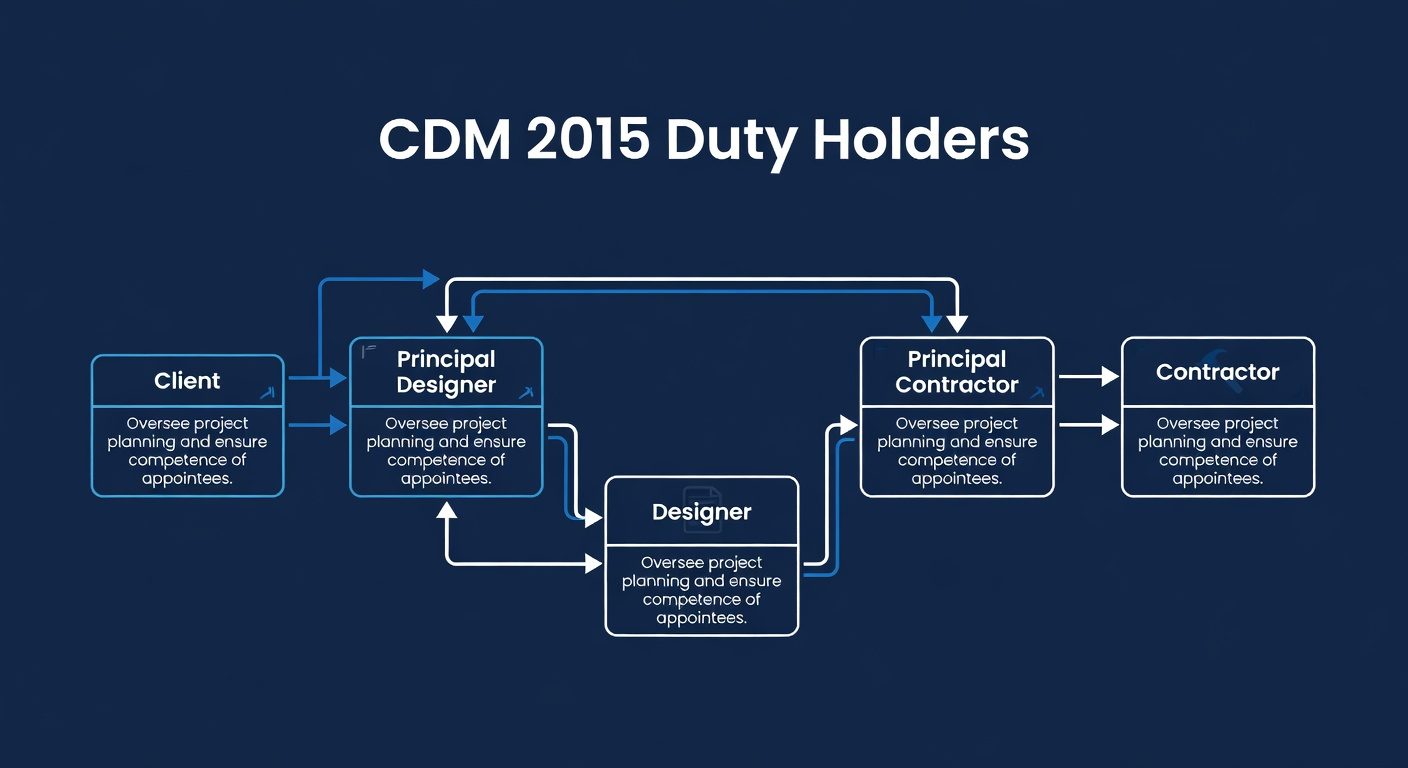
CDM 2015 duty holders and tender responsibilities
Client
Even when the contracting authority is the client, your tender often needs to describe how you support the client in discharging their duties. This is particularly true on framework call-offs and design-and-build contracts where the client may delegate significant responsibility. Evaluators look for evidence that you understand client duties (appointing competent duty holders, providing PCI, ensuring sufficient time and resource), and that you have a track record of supporting clients who lack in-house construction expertise. Local authorities, NHS trusts, and housing associations frequently score this dimension because they are themselves clients and want reassurance.
Principal Designer
The Principal Designer plans, manages, monitors, and coordinates health and safety in the pre-construction phase. On any project with more than one contractor, a Principal Designer must be appointed in writing before construction begins. If your bid covers design responsibility (full design-and-build, two-stage tenders, or contractor-led design), evaluators expect you to identify the proposed Principal Designer, evidence their competence (CDM training, ICE/RIBA/CIOB membership where relevant, project history), and explain how they will discharge their duties on this contract.
The most common Principal Designer scoring failure is treating the role as a job title rather than a function. Evaluators want to see how the Principal Designer will engage with other designers, manage design risk registers, contribute to PCI, and hand over to the Principal Contractor. A response that simply states "[Name] will act as Principal Designer" with no description of their workflow scores at Level 1 or 2.
Principal Contractor
The Principal Contractor plans, manages, monitors, and coordinates health and safety in the construction phase. This is the role most main contractors will hold on most tenders, and it is where the deepest scoring scrutiny falls. Evaluators expect a detailed description of how the Principal Contractor function will operate: the named individual or team, their competence, their reporting lines, their interaction with the project manager, and the systems and processes they will use to discharge their duties.
Strong Principal Contractor responses describe specific activities: site induction processes, daily briefings, weekly safety walks, monthly safety committees, behavioural safety programmes, near-miss reporting, contractor competence verification, and engagement with workers. Weak responses describe none of these and rely on phrases such as "we will fulfil our duties as Principal Contractor in accordance with CDM 2015." The latter scores at Level 1.
Designer
Anyone who prepares or modifies a design for a construction project is a Designer under CDM 2015. This includes architects, engineers, surveyors, and increasingly digital and BIM specialists. Designers must eliminate, reduce, or control foreseeable risks through design choices, and must provide information about residual risks. In a tender response, evaluators want to see your Designer competence framework, your design risk management process, and evidence of design risk registers from comparable projects.
A particularly strong evidencing technique is to include a sanitised extract from a previous design risk register, showing how a specific hazard was identified, the design options considered, the chosen solution, and the residual risk communicated to the contractor. This kind of evidence pushes responses from Level 3 to Level 4.
Contractor
Any individual or business that carries out, manages, or controls construction work is a Contractor under CDM 2015. Contractor duties include planning, managing, and monitoring their own work; complying with directions from the Principal Contractor; cooperating with other duty holders; and providing site induction and information to their own workers. In a tender response, the Contractor section is often where supply chain management and subcontractor competence intersect with CDM. Evaluators look for evidence of how you assess subcontractor CDM competence at PQQ and call-off stages, and how that flows into your construction phase plan.
Pre-Construction Information: The Section Most Bidders Underwrite
Pre-construction information is the most underweighted topic in CDM tender responses. Bid teams often dispatch it in a single paragraph, treating it as a tickbox. Evaluators, particularly those with HSE or local authority backgrounds, treat it as a serious indicator of contractor competence.
A strong PCI response in a tender describes three things. First, your understanding of what PCI the client is providing, what is missing, and what assumptions you are making. Second, your process for interrogating PCI to identify hazards relevant to the work (asbestos surveys, ground investigations, services drawings, neighbour considerations, traffic management, environmental constraints). Third, your process for raising gaps with the client and the Principal Designer, including timescales and escalation routes.
The reason PCI scores so heavily is that it is the moment when contractors demonstrate whether they will be active partners in risk management or passive recipients of information. Evaluators have seen too many post-incident reports where a contractor proceeded with works despite incomplete PCI. They want reassurance that your organisation does not.
A practical drafting technique: include a short PCI gap analysis specific to the contract you are bidding for. Even on a tender where you do not have full PCI yet, you can describe the categories of information you would expect (recent condition surveys, asbestos register, ground conditions, existing services, neighbouring occupier risks) and explain how you would respond if any were missing. This contract-specific reasoning typically lifts a CDM response by a full scoring band.
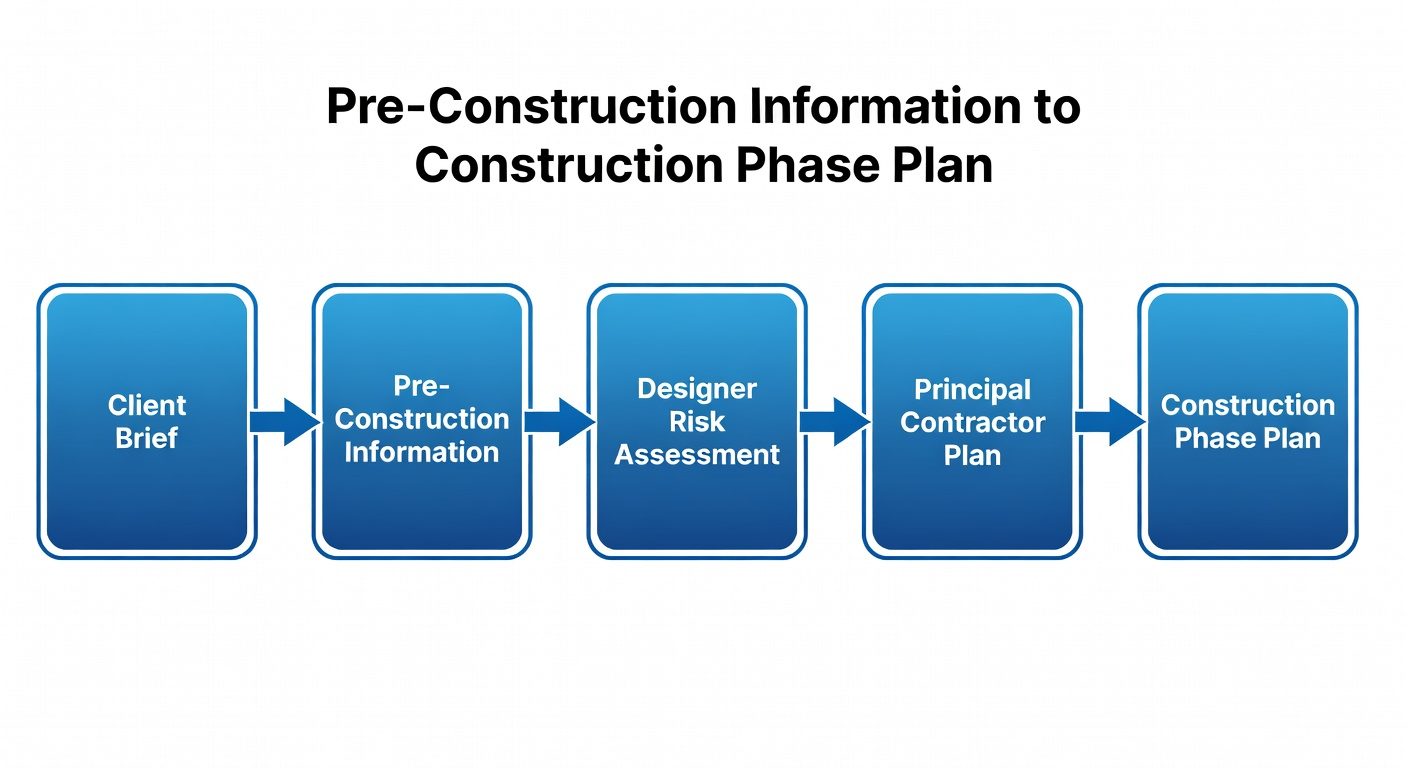
Pre-construction information to construction phase plan flow
Construction Phase Plan: Where Most Marks Are Won
The construction phase plan is the operational document that demonstrates how the Principal Contractor will manage health and safety risks on the project. It is also the document most heavily scored in CDM-focused tender questions, often carrying 30 to 50 percent of the total CDM marks.
A high-scoring CPP response covers the following structural elements, each linked back to the specific contract:
Site description and arrangements. Vehicle and pedestrian segregation, welfare provision, security, perimeter management, and emergency arrangements. Tied to the actual site, not generic. Project-specific risk assessments. The principal hazards for this project (working at height, confined spaces, hot works, asbestos, heritage constraints, occupied premises, traffic management, public interface), with the controls hierarchy applied (eliminate, substitute, engineer, administrate, PPE). Subcontractor and trade coordination. How different trades will be sequenced, how interfaces will be managed, and how the Principal Contractor will verify the competence and method statements of each contractor. Communication and consultation. Site induction content, daily briefings, toolbox talks, suggestion schemes, near-miss reporting, and worker engagement initiatives. References to the Health and Safety (Consultation with Employees) Regulations 1996 strengthen this section. Monitoring and review. Inspection schedules, safety walks, audit programmes, performance metrics, and the trigger points that would prompt a CPP revision during construction. Occupational health. Often overlooked, but increasingly scored under social value and worker wellbeing criteria. Dust, noise, vibration, manual handling, mental health, and welfare arrangements. Emergency planning. Fire, first aid, spillage, structural collapse, and the interface with adjacent occupiers (particularly important on schools, hospitals, and live operational sites).The technique that separates Level 4 responses from Level 3 is specificity. A Level 3 response describes what you will do in general terms. A Level 4 response describes what you will do on this site, with these neighbours, in this sequence, with these named individuals responsible for each element. The CPP is a project document; your tender response should read like the executive summary of a project document, not an extract from a corporate policy.
What Evaluators Actually Score Versus What Bidders Think They Score
A persistent misalignment between bidder assumptions and evaluator priorities costs construction firms significant marks every year. The table below summarises the gap.
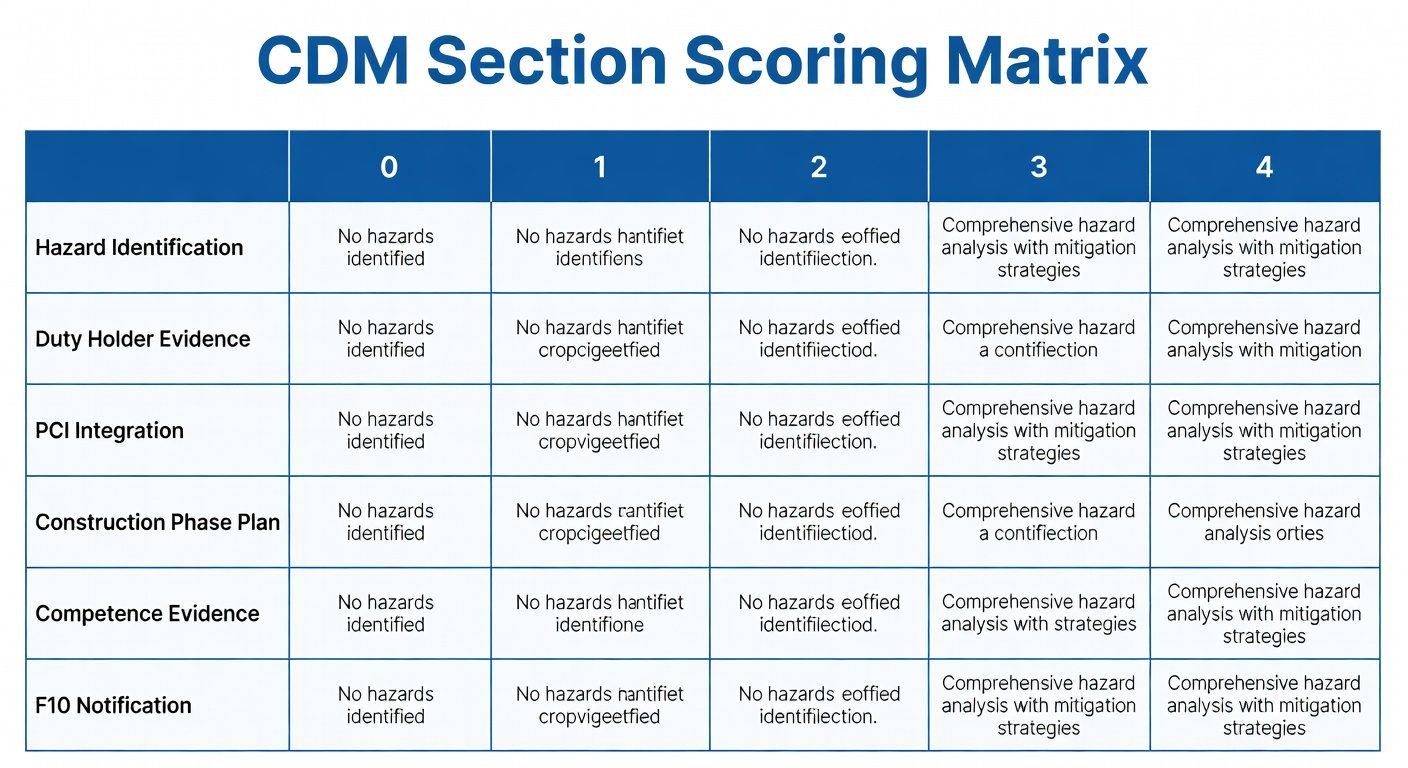
CDM section scoring matrix
Most bidders assume evaluators are scoring policy strength, certifications held, and accident statistics. Those elements matter, but they typically account for less than a third of CDM scoring weight. Evaluators are actually scoring four things, in roughly this order:
Project specificity (35 to 45 percent of weight). Have you tailored your response to this contract, this site, these stakeholders? Generic responses cap at Level 2, regardless of how detailed they are. Duty holder evidencing (20 to 25 percent). Have you named the individuals or described the selection process, evidenced their competence, and explained how they will discharge their duties? Vague references to "our experienced team" lose marks. Operational systems (20 to 25 percent). Do you describe the systems and processes that will deliver the duties you have committed to? Policies are necessary but insufficient. Evaluators want process descriptions. Lessons learned and continuous improvement (10 to 15 percent). Can you reference specific lessons from previous projects, near-misses, or incidents, and demonstrate how those lessons have improved your CDM systems? This is increasingly weighted under the Procurement Act 2023, where past performance is now a permitted evaluation factor.What bidders often over-invest in: ISO 45001 certification narrative, RIDDOR statistics, accident frequency rates, and corporate health and safety awards. These belong in the response, but as supporting evidence, not headline content. Evaluators have seen them all before. They tell you whether the bidder is broadly competent. They do not tell you whether the bidder will deliver this contract safely.
Common Mistakes That Cost Marks
Across hundreds of scored CDM responses, the same patterns of marks loss recur. The most damaging are listed below.
Generic policy quotation. Pasting paragraphs from a corporate H and S policy into a project-specific tender response. Evaluators recognise this instantly and score it down. Confusing CDM 2015 with CDM 2007. The 2015 regulations replaced the CDM Coordinator with the Principal Designer and abolished the requirement for a separate Health and Safety Plan. Responses that still reference CDM Coordinators or pre-2015 documentation reveal that the bid library has not been updated, and evaluators draw broader inferences about systems maturity. Misunderstanding F10 notification. The notification threshold is more than 30 working days with more than 20 workers simultaneously, or more than 500 person-days of construction work. Many bidders apply the wrong test or assume any project triggers F10. Evaluators with HSE backgrounds notice immediately. Failing to address PCI gaps. Treating PCI as something you receive passively, rather than something you interrogate actively. The strongest responses describe how you would handle missing or inadequate PCI, with named escalation routes. Generic risk lists. Listing "working at height, manual handling, slips trips and falls" without tying any of those hazards to the specific project or describing the controls hierarchy applied. Evaluators read this as boilerplate. Ignoring subcontractors. Describing the Principal Contractor's duties without explaining how subcontractor competence is verified, how their method statements feed into the CPP, or how non-compliance is addressed. Most construction work is delivered by subcontractors. Your tender must reflect that. Forgetting occupational health. Treating CDM as accident prevention while ignoring chronic health hazards (silica, isocyanates, noise, vibration, mental health). Evaluators with public sector backgrounds increasingly score this dimension because it aligns with social value and worker wellbeing. Mismatched competence claims. Claiming a Principal Designer with extensive heritage experience when the named individual's CV shows a portfolio of distribution centres. Evaluators check. The mismatch loses both CDM marks and broader credibility.How HSE Enforcement Trends Affect Tender Scoring
Evaluators do not score tenders in a vacuum. They are aware of HSE enforcement trends, sentencing guideline updates, and high-profile prosecutions. Recent themes that increasingly shape CDM evaluation include the following.
Continued focus on falls from height. Still the leading cause of construction fatalities, and a recurring theme in HSE enforcement. Tender responses that demonstrate genuine engagement with hierarchy of controls (designing out the need to work at height, providing engineered solutions before relying on PPE) score well. Occupational lung disease. HSE has emphasised dust as a hidden killer, with sustained campaigns on silica, asbestos, and wood dust. Tender responses that include occupational health surveillance, exposure monitoring, and workplace controls score better than those that focus only on acute risks. Mental health and worker wellbeing. Increasingly explicit in tender questions, particularly in public sector procurement aligned with social value goals. Construction has had elevated suicide rates for years, and buyers want to see active employer engagement with mental health, not just an EAP brochure. Subcontractor and supply chain duties. HSE has prosecuted Principal Contractors for failures by their subcontractors where competence verification was inadequate. Tender responses that describe rigorous subcontractor competence assessment, ongoing monitoring, and corrective action processes score better. Sentencing guideline impact. The Definitive Guideline for Health and Safety Offences has driven significantly higher fines for construction breaches. Buyers increasingly want evidence that contractors are taking CDM seriously not just as a regulatory burden but as a commercial and reputational priority.A response that references current enforcement themes, links them to project-specific risks, and demonstrates a coherent approach to managing them outperforms a response that treats CDM as static compliance.
Practical Drafting Checklist
Before submitting any CDM section, run it through this checklist. If you cannot answer yes to most of these, the response will score below its potential.
- Have you identified which CDM duty holder roles your organisation will hold on this contract?
- Have you named the individuals proposed for each duty holder role, or described the selection process?
- Have you evidenced their competence with project examples relevant to this contract?
- Have you described how PCI will flow into your CPP, with specific reference to the project?
- Have you described the contents and structure of the CPP you will produce?
- Have you addressed subcontractor competence assessment and management?
- Have you addressed occupational health alongside acute safety risks?
- Have you referenced specific lessons learned from previous projects?
- Have you avoided phrases such as "we will comply with CDM 2015" without further detail?
- Have you stripped any references to CDM Coordinator, CDM 2007, or the pre-2015 H and S Plan?
- Have you confirmed F10 notification logic for this project specifically?
- Have you included an occupational health and worker wellbeing element?
Run the response through a colleague with site experience, not just a bid writer. Site-experienced reviewers catch the hand-waving phrases that evaluators score down.
How mytender.io Helps with CDM Sections
mytender.io is built for bid teams who need to produce project-specific, evidenced tender responses at speed without sacrificing quality. For CDM sections specifically, the platform supports three workflows that consistently lift scoring outcomes.
The content library holds your CDM building blocks (duty holder competence statements, CPP structures, PCI workflows, lessons learned summaries) in a single, version-controlled location. Bid teams can pull tested content and tailor it to the specific contract, rather than starting from a blank page or hunting through old bids.
The AI bid writer supports project-specific drafting by ingesting the tender documents, understanding the contract context, and helping bid writers produce CDM responses that reflect the actual site, scope, and stakeholders. The platform is particularly strong at flagging when content is generic and prompting for specificity, which is the single most powerful improvement most CDM responses need.
The evaluator perspective tools allow bid managers to see their CDM response through the lens of common scoring rubrics, with feedback that maps to Level 1 through Level 4 criteria. This pre-submission review consistently catches the boilerplate language and missing evidence that costs marks at evaluation.
If you want to see how the platform handles a real CDM question end-to-end, the Tender Finder gives you live UK construction opportunities with CDM-relevant questions you can practice against. Browse current construction tenders on mytender.io and try drafting a CDM response with the platform. The improvement against a manual draft is usually visible within a single iteration.
Closing Thought
CDM 2015 sections are not where bid teams want to spend their final hours before submission. They feel like compliance theatre, and the temptation to recycle last bid's wording is strong. But evaluators score CDM as a serious test of contractor competence, and the marks are significant. A CDM response that earns Level 4 instead of Level 2 can move a bid from below the threshold to shortlisted, particularly on quality-led tenders where health and safety carries 10 to 15 percent of total weight.
The fix is rarely about writing more. It is about writing more specifically. Name the duty holders. Tie PCI to this site. Describe the CPP for this project. Reference lessons from comparable contracts. Address occupational health. Strip the boilerplate. The response that results will be shorter, sharper, and significantly more valuable.
Construction tendering is competitive enough on price and programme. Do not let CDM be the section that loses the contract.
Tags
Ready to Transform Your Tender Writing?
See how MyTender's AI can help you write winning tenders in a fraction of the time.