
Catering Tenders 2026: School, NHS and Council Bid Guide
Master catering and food services tender writing with proven strategies for school catering, NHS patient meals, and public sector food contracts. Expert guidance on GBSF compliance, Natasha's Law, TUPE, sustainable sourcing, and AI-powered bidding.
mytender.io Research Team
Catering & Hospitality Specialists
Catering & Food Services Tender Writing Guide 2026: Win More Public Sector Contracts
UK public sector catering is a £3.5 billion annual procurement market, spanning schools, hospitals, prisons, military messes, universities and local authority services. Yet catering bids have one of the lowest average win rates in public procurement—around 12%—largely because operators underestimate how technically demanding modern catering tenders have become. Food safety frameworks, allergen law, School Food Standards, TUPE obligations and net zero commitments now sit alongside traditional menu and price considerations.
For the fundamentals that apply in every sector, see our bid writing guide, how to respond to an invitation to tender and how to write a method statement.
This guide distils what actually wins public sector catering contracts in 2026. Whether you're bidding for a 25-school local authority contract, an NHS trust patient meals service, a university residential catering contract, or a £50 million MoD messing framework, the fundamentals are the same: prove compliance rigour, demonstrate nutritional credibility, show sustainable sourcing evidence, and price the contract realistically against a volatile cost base.
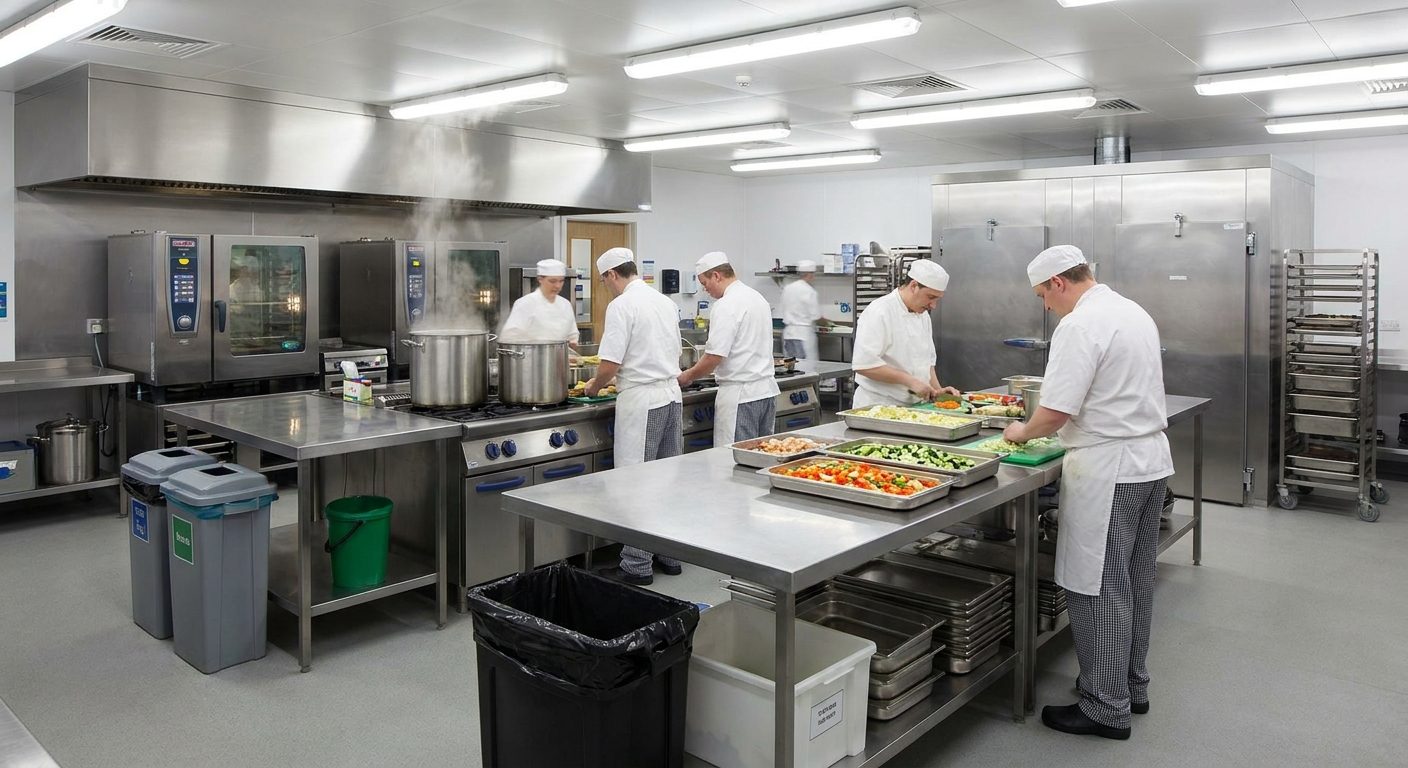
Catering & Food Services Tender Guide 2026
Understanding the UK Public Sector Catering Market
Public sector catering fragments into distinct sub-markets, each with its own buyer behaviour, compliance framework and evaluation weighting. Treating them as a single opportunity is the fastest way to lose bids.
Schools catering is the largest single segment at roughly £1.8 billion annually, split between Universal Infant Free School Meals (reception to Year 2), Free School Meals (income-assessed for older pupils), and paid meal services. Local authority contracts typically cover 20 to 150 schools on a single framework, while multi-academy trusts (MATs) procure separately—often for 5 to 30 schools at a time. Contract values range from £500,000 annually for a small MAT to £35 million+ for a major county council. NHS catering accounts for around £600 million annually across in-patient meals, staff restaurants and retail outlets. Patient feeding is dominated by a small number of specialist operators (Apetito, Bidfood, Compass Medirest, ISS Healthcare, Sodexo Healthcare), while staff dining and retail concessions offer more opportunities for mid-size operators. NHS Supply Chain operates several national frameworks, but individual trusts still run their own competitions for site-specific contracts. Higher and further education catering sits at roughly £400 million, covering residential dining, retail outlets, conferences and events, and sports venue catering. Universities increasingly bundle catering with vending, retail and hospitality into single multi-service contracts running 5 to 10 years with extension options. Ministry of Defence catering represents around £350 million annually, dominated by the Pay As You Dine (PAYD) framework and Defence Food Services. ESS (Compass), Sodexo and Aramark hold the bulk of messing contracts, but sub-contracts and specialist contracts (officers' messes, training establishments) appear regularly. HM Prisons and Probation Service (HMPPS) catering is worth approximately £200 million, split between in-house kitchens supported by supplier frameworks and fully outsourced catering services in private-sector prisons. The national prisons food framework is a significant contract for dry goods, frozen food and fresh produce. Local authority adult social care catering (meals on wheels, day centres, supported living) totals around £150 million. These contracts often blend production, delivery and nutritional care planning, and they typically weight quality at 70% given the vulnerability of service users.The remaining market—children's residential homes, local authority staff restaurants, fire and police service catering, event and stadium catering for public venues—adds roughly £200 million more.
Contract Types and How They Differ
Public sector catering contracts fall into four operational models. Each has distinct bid requirements and evaluation priorities.
Fully outsourced on-site catering gives the operator complete responsibility for menu development, procurement, production, service, staff management and compliance. The incumbent typically has TUPE-protected staff, an established supply chain and embedded processes. Bid evaluation weights operational mobilisation, quality assurance and social value heavily, alongside price. Cook-chill or cook-freeze delivered meals require the operator to produce meals in a central production unit (CPU) and deliver them regenerated-ready to the client site. NHS patient feeding and many meals-on-wheels services use this model. Evaluation focuses on food safety systems, nutritional analysis, allergen management and delivery reliability. Managed service / client-retained staff contracts see the operator provide management, menu planning, procurement and compliance while the client employs the catering staff. These hybrid contracts are common in NHS staff dining and local authority school catering where staff are LGPS pension scheme members. Dry goods and fresh produce supply contracts (no catering operation) focus purely on wholesale food supply. Evaluation centres on range, price, delivery frequency, allergen data quality and sustainability of supply chain. These frameworks are often national (e.g., NHS Supply Chain, Crown Commercial Service).Understanding which model applies determines your bid narrative, cost structure and the compliance evidence that will carry weight.
The Compliance Framework: What You Must Get Right
Catering tenders disqualify non-compliant bids at evaluation. Before a quality scorer reads a single menu, you must clear a compliance gate covering five frameworks.
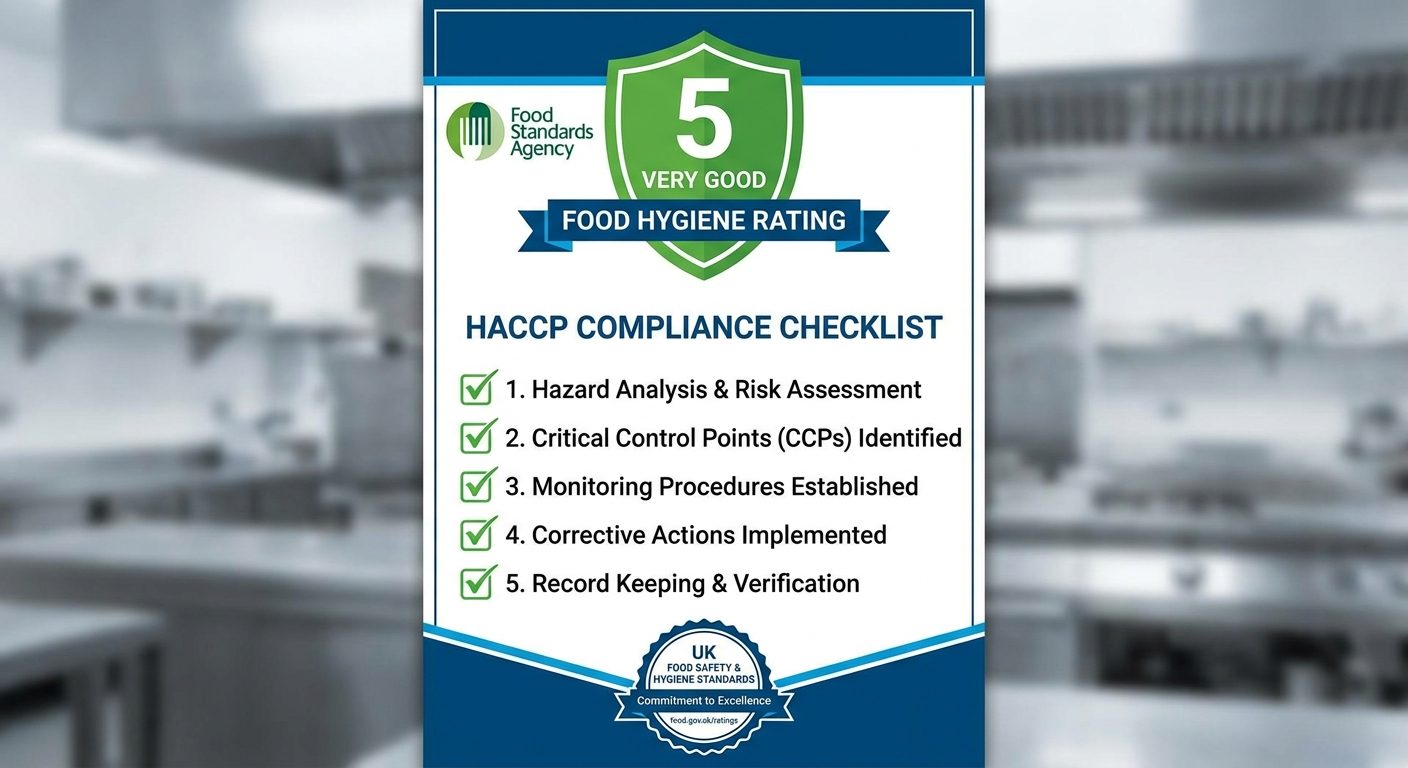
Food Standards Agency Hygiene Ratings
Almost every public sector catering tender now requires a Food Hygiene Rating Scheme (FHRS) score of 5 ("Very Good") across all food premises operated by the bidder, or requires a clear remediation plan if any premises scores below 5. Some buyers accept 4 ("Good") with conditions. Zero tolerance for scores of 3 or below is standard.
Evidence required: FHRS certificates for every premises, dated within six months. A register of all premises with their current scores, inspection dates and local authority issuers. Where scores are below 5, a FSA-aligned remediation plan showing corrective actions, target re-inspection date and accountable manager. Common failure point: bidders provide certificates for their head office or CPU only, omitting satellite kitchens. Buyers increasingly cross-check against the FSA public database, so incomplete disclosure is a credibility-killer.HACCP and Safer Food Better Business
Your Hazard Analysis and Critical Control Points (HACCP) system is the operational backbone of food safety. For large operators, this is typically a fully documented, audited HACCP plan aligned to Codex Alimentarius principles. For smaller operators running lower-risk activities, the FSA's Safer Food Better Business (SFBB) pack remains acceptable for many tenders.
Buyers look for:
- Current HACCP plan with documented CCPs, critical limits, monitoring procedures and corrective actions
- Evidence of annual HACCP review and whenever menu or process changes occur
- Named HACCP team and HACCP-qualified senior manager (Level 3 Food Safety and HACCP as minimum, Level 4 for larger operations)
- Temperature monitoring records (probe calibration, fridge and freezer logs, cook/chill/regeneration records)
- Pest control contract and records
- Cleaning schedules aligned to HACCP prerequisites
Your bid should extract the headline evidence—not the 200-page plan itself—and demonstrate that the system is lived, not a shelf document.
Natasha's Law and Allergen Management
Since October 2021, all food prepacked for direct sale (PPDS) must carry a full ingredients list with the 14 FSA allergens emphasised. Natasha's Law enforcement has intensified, with significant fines and prosecutions changing the tendering landscape. Public sector buyers now expect allergen management to be demonstrated at forensic detail.
Your bid should cover:
- How allergen data is captured at point of procurement (supplier allergen declarations, challenge testing for high-risk products)
- Your allergen database system (products like Kafoodle, Nutritics, Saffron, Erudus—or an equivalent in-house system)
- How allergen information reaches the point of service (menu labels, digital screens, QR codes, team knowledge)
- PPDS compliance procedures (labelling workflows, label verification, audit trail)
- Free-from meal provision and segregation procedures in production
- Allergen awareness training (Level 2 minimum for all food handlers, documented refresh cycle)
- Incident response procedures if an allergen reaction occurs
Allergen management is now commonly a pass/fail sub-criterion. A strong bid shows an integrated system—supplier to plate—rather than a collection of disconnected controls.
Food Safety and Hygiene Compliance
Government Buying Standards for Food and Catering (GBSF)
The GBSF is mandatory across central government departments, their agencies and executive NDPBs, and is increasingly adopted by the wider public sector. Compliant bids must demonstrate procurement of food produced to standards equivalent to UK legal minimums (Red Tractor, Lion Quality, RSPCA Assured, LEAF Marque, MSC, Marine Stewardship, Fairtrade for applicable categories).
The GBSF was refreshed in 2024 with stronger requirements on plant-based options, reduced salt and sugar, sustainable fish, and British-produced seasonal produce where possible. Your bid should map key product categories against GBSF standards with supplier evidence, and quantify British-sourced spend as a percentage of total food spend.
School Food Standards and Nutritional Frameworks
For school catering bids, the Department for Education's mandatory School Food Standards sit alongside buyer-specific nutritional requirements. The standards set out minimum and maximum portions for food groups across a typical week (meat, fish, vegetables, fruit, starchy foods), and restrict fried foods, confectionery, and salt added to cooking.
Leading bids now go beyond minimum compliance:
- Nutritionist-reviewed menus with full nutritional analysis per dish (calories, protein, carbohydrate, fat, saturated fat, salt, sugar, fibre)
- Whole-grain and wholemeal starch integration
- Salt reduction strategies aligned to PHE/OHID targets
- Fruit and vegetable variety tracking (demonstrating seasonal rotation)
- Plant-based and meat-free day provision
- Healthy Start compliance where applicable
For NHS patient feeding, the equivalent frameworks are the Hospital Food Standards (refreshed 2022 post-Hospital Food Review), with nutrition standards for patients, staff and visitors, plus specific standards for patients with dysphagia, renal disease, diabetes and other dietary requirements. The IDDSI framework (International Dysphagia Diet Standardisation Initiative) is now the default standard for texture-modified meals.
How Public Sector Buyers Actually Evaluate Catering Bids
Most UK public sector catering tenders use a Most Economically Advantageous Tender (MEAT) or, under the Procurement Act 2023, Most Advantageous Tender (MAT) model. Typical quality-to-price weightings are:
- Schools catering: 60/40 quality/price (sometimes 70/30 for primary-only contracts)
- NHS patient feeding: 70/30 quality/price, with quality sub-weightings heavily on nutrition and safety
- Higher education: 50/50 to 60/40, depending on retail and hospitality complexity
- MoD messing: 60/40, with operational resilience weighted heavily
- Meals on wheels / adult social care: 70/30, with social value commonly 10-15% of total
Quality scoring commonly breaks down into:
- Food offer and menu development (20-30%): menu design, nutritional credibility, culinary innovation, seasonal rotation, special dietary provision.
- Food safety and compliance (15-20%): HACCP, allergen management, audit and assurance.
- Mobilisation and operational delivery (15-20%): transition plan, TUPE handling, staffing model, contingency planning.
- Quality management and continuous improvement (10-15%): customer feedback, KPIs, benchmarking, innovation roadmap.
- Sustainability and social value (10-20%): sourcing, net zero, local employment, apprenticeships, waste reduction.
- Account management and governance (5-10%): named team, meeting rhythm, reporting, escalation.
Price is typically assessed on a full-life basis with volume-weighted unit pricing, open-book cost models for larger contracts, and (increasingly) risk-share mechanisms for food inflation and energy.
The bids that win are not the ones that answer each question—they're the ones that tell a coherent story in which menus, people, supply chain, compliance and social value reinforce each other.
School Catering Contracts: The Biggest Segment, the Trickiest Buyer
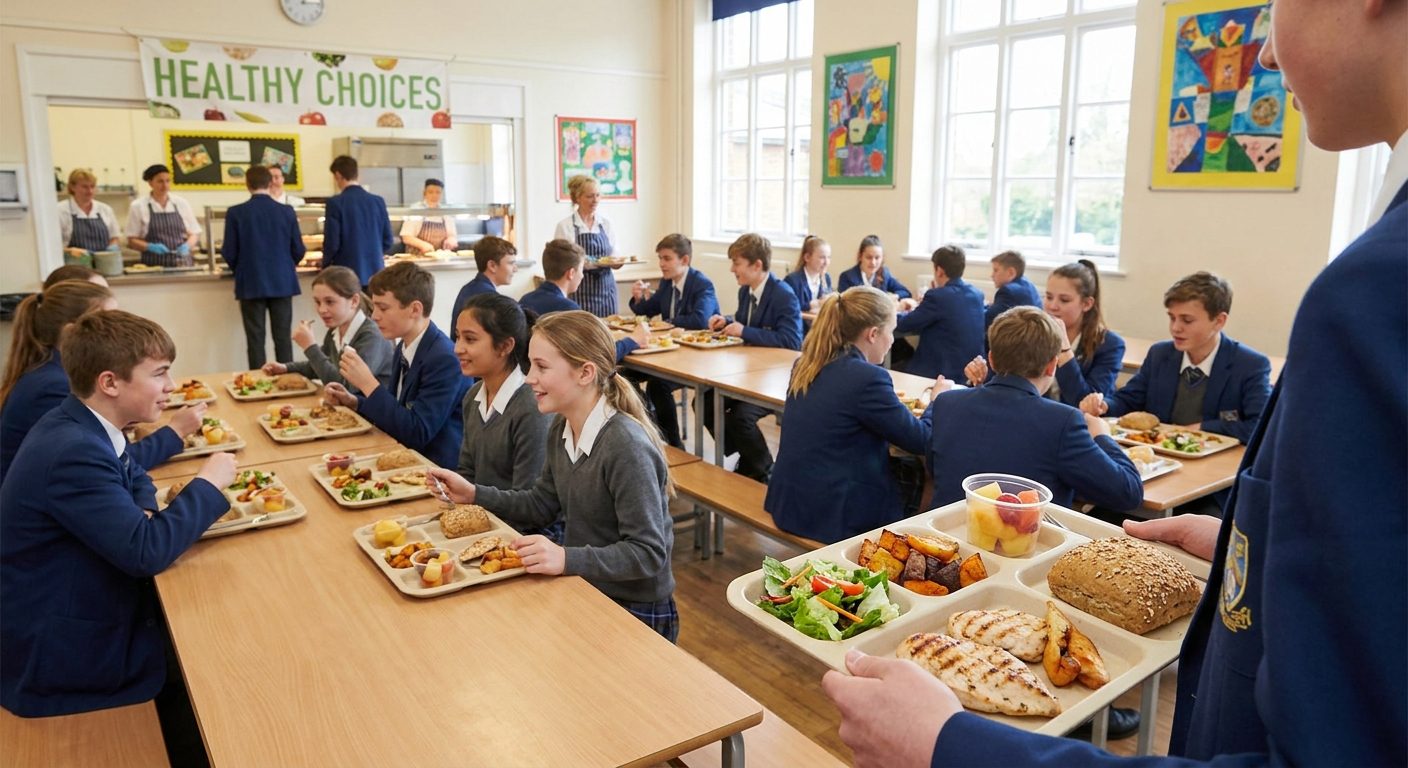
School Catering Contracts
School catering has distinctive characteristics that trip up generalist operators.
Low average transaction value and volatile take-up. Primary free school meal take-up ranges from 65% to 90% depending on socio-economic factors, school engagement and food quality. Paid meal take-up in secondary schools is often below 40%. Your pricing model must flex realistically with take-up, and your bid should show how you drive take-up through offer, marketing and in-school engagement. The UIFSM funding rate squeeze. Universal Infant Free School Meal funding from central government has not kept pace with food inflation. The gap between UIFSM rate and true cost of a compliant, nutritious meal has widened significantly. Winning bids show how operators can deliver within the rate through menu engineering, volume procurement and operational efficiency—without resorting to cheap ingredients that fail School Food Standards. Multi-site logistics. A 30-school contract spread across a county is an operational engineering challenge. Your bid must evidence production model (cook-fresh on site, cook-chill from CPU, or hybrid), vehicle routing, staff scheduling, produce delivery frequency and kitchen equipment provision. The buyer wants to see you have thought through heat lamps at Holy Trinity Primary as well as menu theory. Kitchen capital investment. Many schools have ageing kitchens. Progressive bidders offer kitchen capital investment, with amortisation built into the unit price or a separate capital plan. This is a common tie-breaker on quality-equivalent bids. Parental expectation and engagement. Parents are a powerful stakeholder. Your bid should show parent communication—menus, nutrition information, allergen self-service, parent taster sessions, pupil councils, SEND family engagement. Education in food. Curriculum support (farm visits, cooking lessons, harvest festivals, healthy eating weeks) increasingly features in evaluation criteria. Demonstrate how your catering enhances the educational mission, not just feeds pupils.NHS Catering: The Most Technical Segment
NHS patient feeding is arguably the most technical sub-segment in UK catering. A single trust may serve 3,000 meals per day across multiple wards, each with specific nutritional, cultural, religious and medical requirements.
Bid critical success factors:
- IDDSI compliance for texture modification (levels 0-7) with clinical engagement and dietitian sign-off
- Therapeutic diet ranges (renal, diabetic, low residue, high energy/protein, gluten-free, allergen-free)
- Cultural and religious provision (Halal-certified, Kosher, vegetarian, vegan, Afro-Caribbean ranges)
- Nutrition screening integration (MUST score response, food fortification strategy, between-meal snacks)
- Protected Mealtimes Policy support
- Red tray / red jug systems for patients needing feeding assistance
- Nutrition and Hydration Week and similar campaign participation
- Electronic meal ordering integration (with systems like Saffron, Trakcare, Cerner)
The 2020 Hospital Food Review set clear expectations that have become standard in NHS tender evaluation. Your bid must demonstrate the technical capability to deliver—not just intent.
Staff and visitor catering in NHS sites has evolved toward 24/7 healthier options, grab-and-go, and sugar-levy alignment. Retail contribution to trust finances matters increasingly, so bid financial models must show realistic retail performance with sensitivity analysis.
TUPE: The Catering-Specific Minefield
TUPE (Transfer of Undertakings Protection of Employment) applies to most public sector catering re-tenders. Incoming operators inherit the existing catering workforce under their current terms and conditions. Getting TUPE wrong is the single biggest cause of catering contract mobilisation failure.
Key bid considerations:
- Due diligence on TUPE data: demand and analyse the full employee list including roles, hours, pay, enhancements, shift patterns, pension arrangements, length of service, sickness history and any ongoing grievances.
- Pension liabilities: many long-serving public sector catering staff are members of LGPS or NHS pension schemes. Admitted body status, fair deal pensions and potential contribution rate changes materially affect bid pricing.
- Enhanced terms: long-serving staff often have pay enhancements, higher holiday entitlements, or pension rights that far exceed your standard workforce cost. Model these precisely.
- Cost of change: if you plan to harmonise terms over time, the process must respect ETO (Economic, Technical, Organisational) reasons and TUPE case law. Most harmonisation plans cost more and take longer than bidders initially assume.
- Staff engagement plan: mobilisation success depends on visible, empathetic engagement with transferring staff before day one—management meet-and-greets, FAQs, supervisor training, retention offers.
Buyers consistently rate TUPE handling highly in quality evaluation because botched transitions cause immediate service failures and reputational damage.
Pricing Strategy: Managing a Volatile Cost Base
Catering cost structures have been hit harder than most sectors by recent inflation cycles. Between 2022 and 2025, UK food inflation exceeded 25% cumulatively, while National Living Wage rose from £9.50 to £11.44 and energy costs doubled and fell back. Your pricing strategy must handle this volatility credibly.
Core elements of a robust catering bid price:- Unit cost build-up: direct food cost, direct labour, production overhead, site overhead, management overhead, contract overhead, profit
- Food cost engineering: basket analysis against menu, supplier framework leverage, seasonal rotation, menu-based purchasing
- Labour productivity: meals per labour hour benchmarks by service type, realistic allowance for shift handovers, breaks, sickness and training
- Food inflation protection: where contracts allow, use DEFRA food CPI or a relevant sub-index. Price adjustment clauses should be symmetric (benefit both parties) and indexed fairly.
- National Living Wage pass-through: most public sector buyers now require and expect full NLW pass-through, often via a specific uplift mechanism rather than general indexation.
- Energy and utility allowances: where operator-supplied, model realistically; where client-supplied, confirm cost treatment.
- Capex recovery: kitchen investment, service equipment, vehicles—amortised in unit price or separate capital recovery.
Aggressive loss-leading on catering price almost always ends in mid-contract renegotiation or withdrawal. Buyers know this and penalise unrealistic pricing in evaluation.
Sustainability, Net Zero and Sourcing
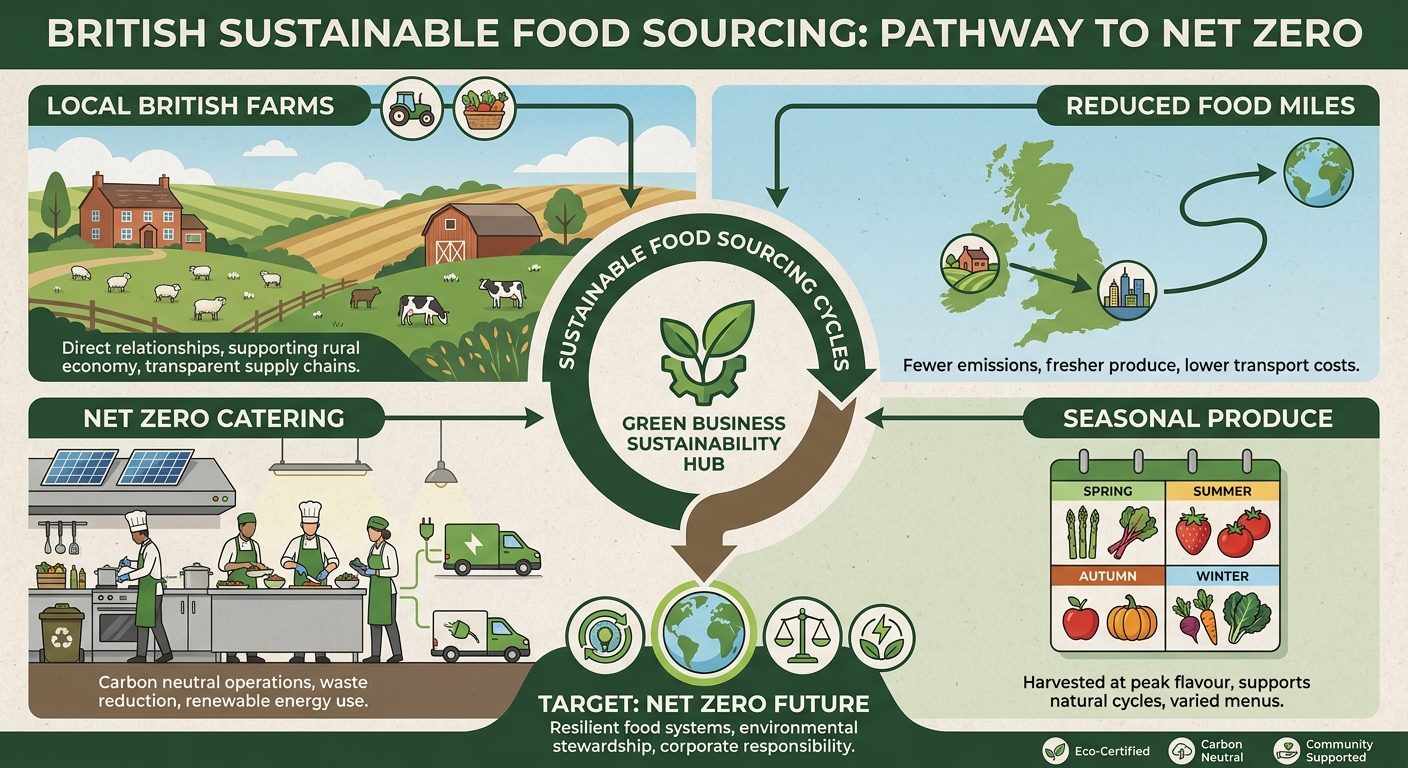
Sustainable Catering Sourcing
Defra's Plan for Public Procurement of Food and Catering Services (updated 2024) sits alongside the GBSF as the framework for sustainable food procurement. It emphasises British-produced, seasonally available food, reduced food miles, and measurable carbon reporting.
Credible bids quantify sustainability, not just describe it:
- % British/local food spend: define the radius (local often means within 50 miles, regional within 150 miles), and commit to baseline and targets.
- Seasonal menu rotation: demonstrate how menus change 4-12 times annually to reflect British growing seasons.
- Sustainable fish: MSC/ASC certified, or species from Marine Conservation Society Green/Amber list.
- Ethical meat and dairy: Red Tractor, RSPCA Assured, LEAF, organic; egg is Lion Quality free-range/barn minimum.
- Plant-based menu share: percentage of menu that is plant-based or vegetarian, trending up over contract life.
- Scope 3 food emissions: kgCO2e per meal served, baseline and reduction trajectory. Carbon labelling on menus is emerging as a differentiator.
- Food waste reduction: production waste, plate waste, unavoidable waste—measured weekly, with waste hierarchy response (redistribution to charity via Neighbourly/FareShare, anaerobic digestion, composting, as last resort landfill).
- Packaging: elimination of single-use plastics, compostable alternatives, reusable cup and container schemes for staff/student dining.
Public sector buyers increasingly require Science Based Targets initiative (SBTi) alignment, Task Force on Climate-related Financial Disclosures (TCFD) reporting for larger contracts, and specific net zero commitments aligned to NHS Net Zero (2045 direct, 2040 where possible) or sector equivalents.
Cite real certifications, named suppliers, and quantitative commitments. Vague sustainability prose scores badly.
Food for Life and Soil Association Accreditation
The Soil Association's Food for Life Served Here accreditation (Bronze, Silver, Gold) is a recognised quality mark in school, hospital and care catering. Many local authorities require Bronze as a minimum contract condition, with Silver or Gold preferred. The scheme audits against standards including:
- No undesirable food additives or hydrogenated fats
- 75%+ freshly prepared dishes
- Free-range eggs, Red Tractor or equivalent meat
- Seasonal menu planning
- Information on food provenance
- Chef training and menu engagement
If Food for Life accreditation is required or scored in the tender, attach current certificates and any improvement plan to progress tiers during the contract life.
Social Value in Catering Tenders
Social value is a mandatory evaluation component under the Social Value Act and Procurement Act 2023, typically weighted 10-20% of quality. Catering contracts offer distinctive social value opportunities:
- Apprenticeships: professional cookery, hospitality supervision, food safety—tied to a specific number of apprentice starts over contract life
- Local SME food supply: % of food spend with SMEs and local producers, measurable annually
- Food redistribution: surplus food donated to community fridges, FareShare, Neighbourly (track meals diverted from waste)
- Youth employment: NEET pathways, Kickstart-type schemes, sector-based work academies
- Community engagement: free school holiday meal provision, community cookery classes, food bank support
- Healthy eating education: curriculum support in schools, cookery workshops in hospitals and day centres
- Supply chain equity: payment terms below 30 days for SME suppliers, Modern Slavery Act section 54 compliance beyond minimums
Under TOMs (Themes, Outcomes and Measures) or National Social Value Model metrics, each commitment translates to a quantifiable £ value. Your bid should express social value as specific, measurable, contract-bounded commitments—not generic aspirations.
Digital and Technology Enablement
Leading catering operators now compete on technology as much as food. Public sector buyers increasingly expect:
- Digital pre-ordering: parent-led pre-ordering for school meals (ParentPay, WisePay integrations), ward-based electronic menu selection in NHS
- Cashless payment: contactless everywhere, refund and balance management, free school meal anonymisation
- Allergen transparency: QR-code to full recipe and allergen data, digital menu boards, kiosk displays
- Production management: integrated systems covering menu planning, costing, nutritional analysis, allergen data, stock control, purchase order workflow, HACCP records
- Feedback loops: in-service feedback (tablets at service points, QR-survey post-meal), supervisor app reporting, customer satisfaction dashboards
- Data and reporting: KPI dashboards for client stakeholders, consumption analytics, waste reporting, nutritional compliance reporting
Your bid should name the specific systems, integrations and data outputs the client will receive—not abstract "digital transformation" language.
Mobilisation: Winning the First 90 Days
Catering contracts often fail in mobilisation, not in steady state. A bulletproof mobilisation plan is critical evaluation content.
Typical milestones for a 3-month mobilisation:
- Weeks 1-2: contract award, kick-off, TUPE data exchange, incumbent cooperation protocol
- Weeks 3-6: staff consultation and formal TUPE letters, supplier engagement, equipment surveys, menu launch preparation
- Weeks 7-10: staff onboarding, uniform and ID issue, training on new systems, allergen systems migration, mock service
- Weeks 11-12: client walk-through, soft launch, go-live, hypercare
- Weeks 13-16: post-go-live review, performance baselining, first formal governance meeting
Name the accountable mobilisation director. Name the interim operations structure. Commit to hypercare resources (extra management presence for 4-8 weeks post go-live). Provide a risk register with mitigation.
How AI Is Changing Catering Bid Writing
Catering tenders are document-heavy. A typical £5m annual schools contract tender runs to 150-400 pages of questions, specifications, pricing schedules, data returns and policy attachments. Skilled bid teams have always won more than under-resourced ones; AI-powered bid writing is compounding that advantage.
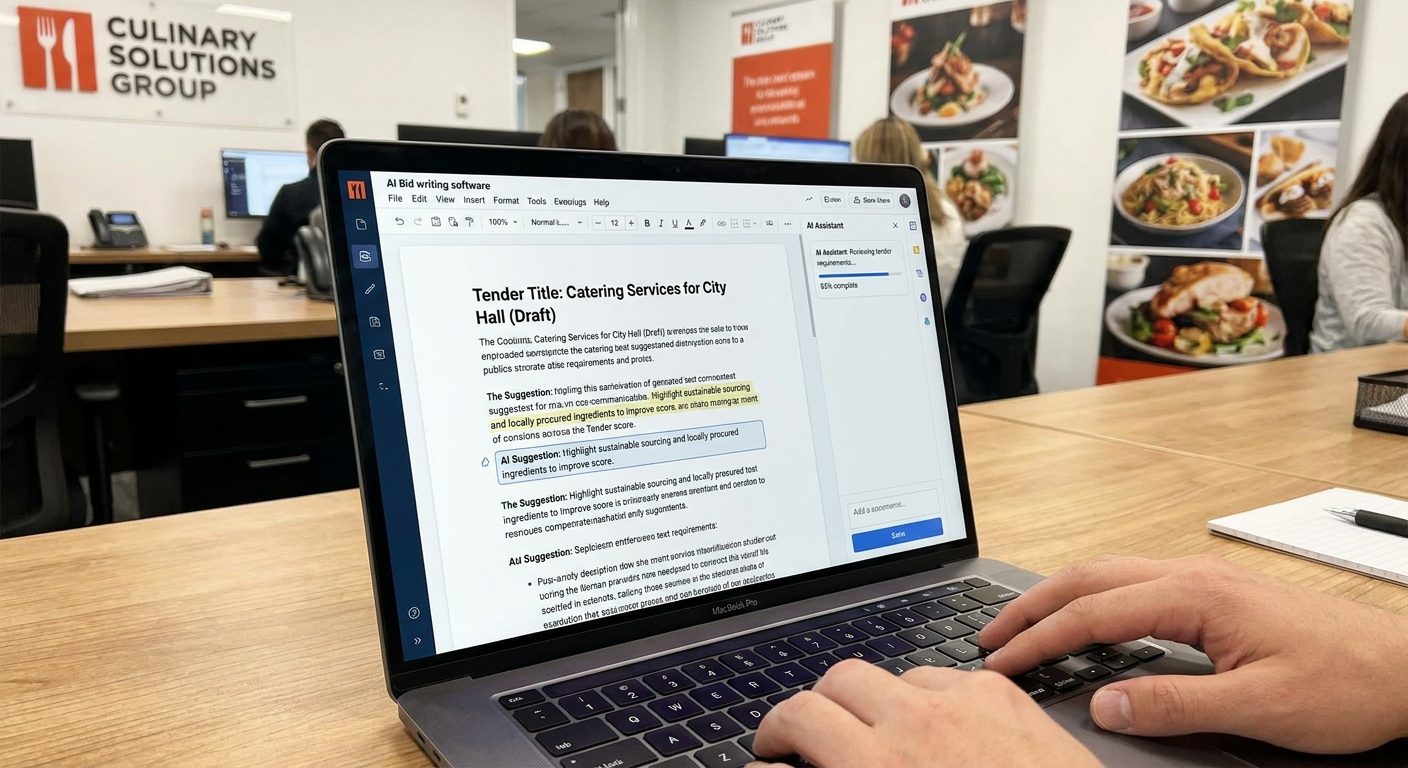
AI-Powered Catering Tender Writing
Where AI tools like mytender.io add the most value in catering bids:
- Question bank intelligence: instantly surfacing your best previously-written answers on HACCP, allergen management, Food for Life, TUPE, social value and mobilisation. Bid teams stop reinventing wheels on every submission.
- Specification-to-response mapping: identifying which evaluation criteria each question tests, and drafting responses that explicitly address the scoring model.
- Menu, nutrition and sustainability narrative drafting: generating first-draft content from your real menu database, certifications and sourcing data—ready for chef, nutritionist and sustainability lead to refine.
- Compliance checklist automation: cross-referencing bid content against buyer requirements (GBSF, School Food Standards, Hospital Food Standards, allergen regulation) so nothing is missed.
- Consistency across volumes: ensuring the menu narrative in Volume A matches the procurement detail in Volume B and the pricing rationale in Volume C.
- Social value quantification: generating TOMs-aligned commitments and proxy value calculations from specific contract parameters.
- Clarification response acceleration: turning around buyer clarifications in hours, not days, with factual consistency against the main submission.
The goal is not AI-written bids. The goal is human experts (chefs, nutritionists, operations directors, bid managers) spending their limited time on judgement, strategy and client insight—while AI handles the drafting and consistency work that previously consumed 60% of bid production time.
mytender.io is built specifically for complex tender responses, with UK public procurement frameworks, tender evaluation models and sector-specific content libraries embedded. Catering is a natural fit because the bids are large, evidence-heavy, and repeated across many buyers.
Common Catering Tender Failure Modes
Ten recurring mistakes that lose otherwise strong bids:
- Generic menu content that could apply to any contract, rather than a menu tailored to the specific site, demographic and seasonal context.
- Unsubstantiated sustainability claims without named certifications, measurable commitments or supply chain evidence.
- TUPE due diligence gaps leading to underpriced labour costs and mobilisation chaos.
- FHRS evidence covering the head office only when satellite kitchens exist.
- Allergen management as a bolt-on rather than a system integrated from procurement to plate.
- Pricing that assumes 100% take-up or otherwise ignores volume risk.
- Social value as aspiration rather than contract-bounded, measurable commitments.
- Mobilisation plans without named accountable individuals and without hypercare commitment.
- Non-compliance with School Food Standards or Hospital Food Standards detectable in the submitted menu analysis.
- Ignoring the specification's scoring model—writing what you want to say rather than what the question and evaluation criteria actually ask for.
Any of these alone can cost you the contract. Several together guarantee it.
Pre-Submission Checklist
Before you press submit on a catering tender, verify:
- All FHRS certificates current, all premises covered, 5-star or remediation plan in place
- HACCP plan evidenced and HACCP-qualified manager named
- Natasha's Law compliance evidenced end-to-end
- Allergen database system named and demonstrated
- Menu matrix compliant with School Food Standards / Hospital Food Standards / GBSF as applicable
- Nutritional analysis attached for all menu cycles
- TUPE position acknowledged, data quality-assured, costed accurately
- Pricing model shows unit cost build-up and inflation protection mechanism
- Social value commitments are SMART and quantified to £ value
- Sustainability commitments have named certifications and measurable targets
- Mobilisation plan has named accountable director and week-by-week milestones
- All attachments referenced in the narrative are included and match the reference
- Evaluation criteria weighting mirrored in your response structure
- UK English, consistent terminology, compliant word counts
- Clarifications reviewed and reflected
- Final proofread by someone who hasn't written any of it
Conclusion: Catering Is Now a Compliance-Led Sport
Winning UK public sector catering tenders in 2026 requires more than good food and a competitive price. The evaluation lens has shifted: compliance rigour, nutritional credibility, sustainable sourcing evidence, social value quantification and mobilisation realism now determine outcomes as much as menu design.
The operators winning market share are those who treat catering bids as the technical, evidence-led submissions they have become—supported by chefs, nutritionists, sustainability leads, HR experts and bid professionals working together, with AI tools like mytender.io handling the heavy document lifting so human experts focus on judgement and client insight.
If your catering win rate is stuck below 15%, the opportunity is clear: raise the technical rigour of your submissions, quantify what you promise, tell a coherent story across menu, people, supply chain and compliance—and use modern bid technology to make it sustainable for your team.
The £3.5 billion UK public sector catering market rewards operators who show up ready. Make your next bid the one that does.
---
mytender.io is the UK's leading AI-powered bid writing platform for public sector tenders, with sector-specific content libraries including catering, food services and hospitality. Book a demo to see how mytender.io can help your catering team win more public sector contracts.Tags
Ready to Transform Your Tender Writing?
See how MyTender's AI can help you write winning tenders in a fraction of the time.