

Bid Review Quality Assurance: How to Run Pink, Red and Gold Team Reviews for AI-Assisted Tender Responses
A practical guide to tender response quality assurance in 2026: pink team, red team and gold team reviews, AI verification, evidence checking, scoring alignment and final submission control.
mytender.io Research Team
Tender Writing & Bid Management Specialists
Bid Review Quality Assurance: How to Run Pink, Red and Gold Team Reviews for AI-Assisted Tender Responses
A tender response can look finished long before it is actually safe to submit.
The formatting is clean. The word count fits. Every question has an answer. The compliance matrix is mostly green. Someone has written a confident executive summary. The deadline is tomorrow afternoon and everyone wants to stop touching the document.
That is exactly when bad bids get submitted.
The problem is not usually laziness. It is review confusion. Different reviewers look for different things at the same time. One person rewrites style. Another checks the price schedule. A director asks for a new win theme at the last minute. The bid manager is trying to reconcile tracked changes, chase missing evidence, confirm mandatory attachments and keep the portal upload from becoming a theatre of pain.
AI has made this both better and worse.
It can produce a first draft quickly, summarise a 300-page ITT, turn messy notes into usable prose and compare an answer against the question. But speed creates a new risk: teams mistake a complete-looking answer for a verified answer. They review for grammar when they should be reviewing for scoring. They approve text that sounds plausible but has not been tied back to evidence. They reuse good content in the wrong context. They leave AI-generated claims in the bid that no operational lead has signed off.

Bid team in a modern office reviewing a tender response quality assurance board with AI verification, evidence checks and scoring criteria
This is why bid review quality assurance matters more in 2026. The Procurement Act 2023 environment has increased visibility around supplier performance, transparency and contract delivery. Buyers are asking sharper questions about evidence, delivery confidence and AI use. Evaluators are not rewarding polished generic answers. They are rewarding responses that answer the question, prove the claim, match the scoring model and can survive contract delivery.
This guide explains how to run a proper review process for AI-assisted tender responses. It covers pink team, red team and gold team reviews, evidence verification, AI governance, scoring alignment, final submission control and the practical checks that prevent embarrassing mistakes.
Why bid reviews fail
Most tender reviews fail because they happen too late and try to do too much.
The classic pattern is familiar. The bid team drafts the response. Subject matter experts contribute late. Commercial review happens in parallel with quality review. Directors are invited to comment once the document is almost finished. Everyone notices something different. The review becomes a mixture of proofreading, strategy debate, compliance checking, evidence hunting and executive preference.
That is not quality assurance. That is panic with tracked changes.
A good review process separates decisions by stage. It asks the right question at the right time.
Early in the process, the question is whether the response strategy is right. Have we understood the buyer? Are the win themes credible? Do we have the evidence? Are there obvious compliance risks?
In the middle, the question is whether the draft is answering the scoring criteria. Is the structure clear? Are the claims evidenced? Are we differentiating or just describing the service? Are the answers specific to this contract?
Near the end, the question is whether the submission is controlled. Are all attachments present? Are declarations consistent? Are portal fields complete? Are pricing and quality answers aligned? Has every AI-assisted section been checked by someone accountable?
When those questions are asked in the wrong order, quality drops. A red team reviewer starts correcting commas because nobody has defined the review role. A director rewrites the solution because the strategy was never locked. A commercial lead discovers a delivery promise that the price does not support. A bid writer fixes grammar while a mandatory requirement remains unanswered.
The answer is not more review. It is better staged review.
The three-review model: pink, red and gold
Bid teams use different labels, but the structure is simple.
A pink team review checks the solution before the full draft is written. It tests the plan, win themes, answer structure and evidence strategy.
A red team review checks the draft through the evaluator's eyes. It tests scoring alignment, clarity, differentiation, evidence and compliance against the question.
A gold team review checks the final submission. It tests whether the bid is approved, consistent, complete and ready to upload.
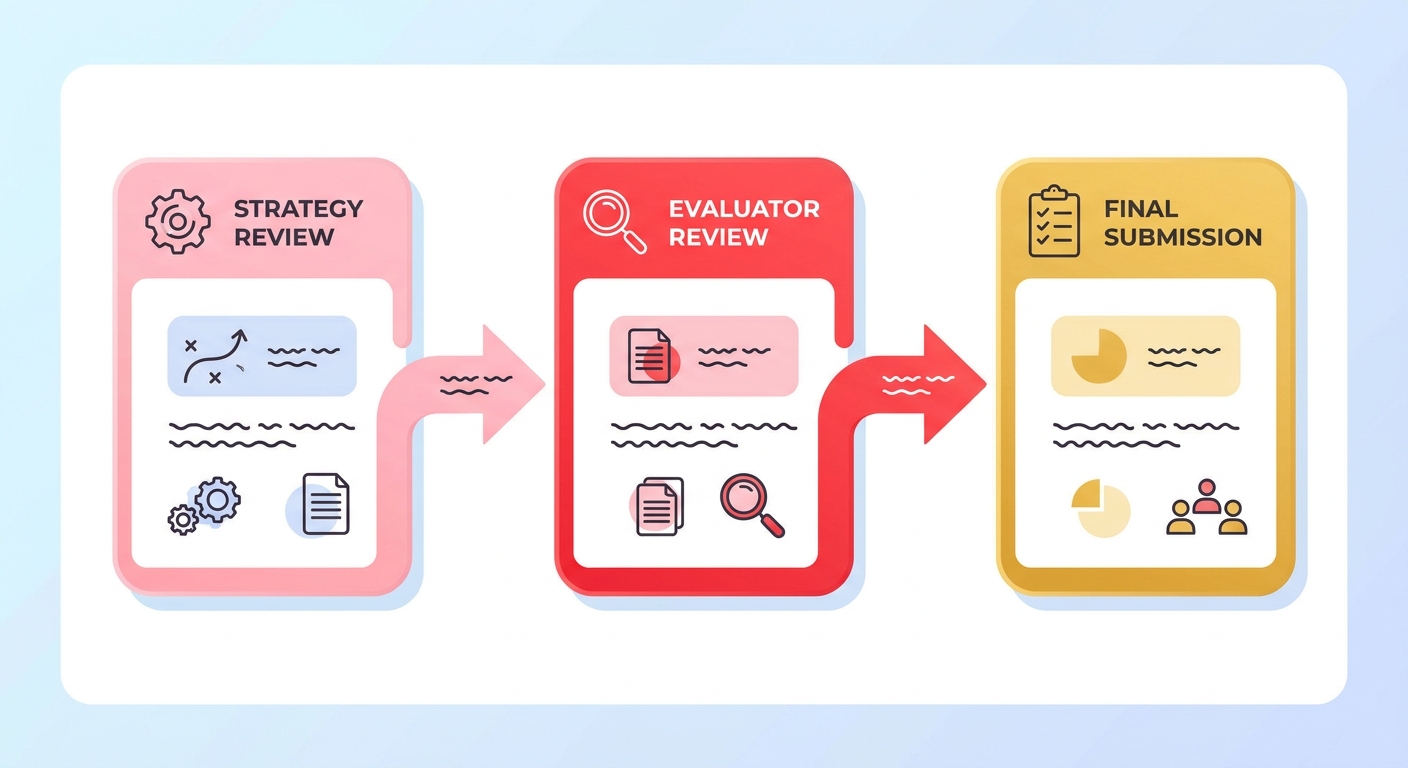
Three-stage bid review workflow showing pink team strategy review, red team evaluator review and gold team final submission control
Those stages should not blur. If your red team is still deciding the win strategy, your pink team was too weak or skipped. If your gold team is rewriting technical content, your red team did not finish its job. If your portal upload reveals missing evidence, the whole review process was too document-focused and not compliance-focused enough.
For AI-assisted bids, the model needs one additional thread running through all three stages: verification. Any AI-generated or AI-shaped answer should be checked for accuracy, evidence, source material, confidentiality and human ownership. This does not mean treating AI as suspicious by default. It means treating the final bid as a contractual document. If you submit it, the organisation owns it.
Pink team review: test the strategy before the writing sprint
The pink team review should happen before the main drafting effort begins. Its job is to prevent the team from writing the wrong bid efficiently.
This matters because AI can accelerate a bad strategy. If the prompt is weak, the source material is generic or the win themes are vague, you can produce thirty pages of fluent but low-scoring content very quickly. The pink team is the moment to slow down before the machine speeds up.
A strong pink team review answers seven questions.
1. What is the buyer really scoring?
Do not start with the section title. Start with the marking scheme.
A question labelled mobilisation might really be scoring continuity of service, risk control, stakeholder confidence and speed to readiness. A social value question might be scoring local specificity, measurable commitments and governance rather than broad corporate purpose. A technology question might be scoring user adoption and data security more than feature depth.
The pink team should translate each question into scoring intent. For every response, write one plain-English sentence: to score highly here, we need to prove that...
That sentence becomes the anchor for the answer.
2. What is our answer strategy?
A response strategy is not a list of services. It is the reason the buyer should believe your method will work better than a competitor's.
For example, a weak strategy for mobilisation is: we have a proven mobilisation process.
A stronger strategy is: we reduce mobilisation risk by validating inherited data before go-live, assigning named workstream owners, separating statutory compliance from routine transition tasks, and giving the client weekly risk-based readiness reports.
That gives the writer something to build around. It also gives reviewers something to test.
3. What evidence do we actually have?
The pink team should identify evidence before the writing begins. This avoids the common failure where a bid makes strong claims and then scrambles for proof.
Evidence can include case studies, KPIs, mobilisation plans, implementation logs, customer testimonials, audit results, accreditations, training records, risk registers, governance templates, screenshots, service reports, lessons learned, contract performance data and named team experience.
The review should separate available evidence from hoped-for evidence. If the team says we can get that later, record who owns it and when it will be available. If nobody owns it, it is not evidence. It is optimism.
4. What can AI draft safely?
AI should not be used in the same way for every section.
It is well suited to first-draft structure, summarising source documents, extracting requirements, comparing a draft to an evaluation criterion, turning SME notes into clearer prose and finding inconsistent statements across a response.
It should be tightly controlled around pricing, legal commitments, delivery promises, named credentials, certifications, performance statistics, TUPE assumptions, contract-specific KPIs and anything that creates operational liability.
At pink team stage, decide the role of AI for each response. The answer might be full first draft from approved source library, structure only, comparison check only, or no AI drafting.
5. What are the red flags?
A pink team should be honest about weaknesses. Missing evidence, weak incumbent knowledge, tight mobilisation, marginal commercial terms, limited local presence, thin social value commitments or risky delivery assumptions should be visible early.
The point is not to make the bid sound worse. It is to decide how to deal with reality.
Some red flags can be mitigated with a stronger method, partner evidence, phased mobilisation or a clear governance approach. Others should trigger a bid/no-bid escalation. If the gap is material and cannot be fixed, writing around it will not help.
6. What must reviewers not reopen later?
Good bid governance locks decisions. Once the pink team agrees the win themes, solution approach, evidence plan and response owners, later reviewers should not casually reopen them unless new information appears.
This protects the bid from last-minute executive rewrites. It also protects the team from style-based review masquerading as strategy.
7. What does good look like for each answer?
Before drafting, define success. A simple target works:
- the answer opens by directly addressing the buyer's scoring intent
- the method follows a clear sequence
- every major claim has proof
- risks are acknowledged and controlled
- the response is specific to the contract
- the final paragraph reinforces the buyer benefit
That is enough to guide writers and reviewers.
Red team review: read like an evaluator, not a colleague
The red team review is where many bids either improve sharply or descend into subjective editing.
A red team should not ask whether the draft is nicely written. It should ask whether the evaluator can award marks.
This requires discipline. Reviewers need the ITT, scoring criteria, draft response, compliance matrix, evidence plan and any buyer clarifications. They should not review from memory. They should not treat house style as more important than scoring. They should not rewrite the bid in their own voice unless the answer is genuinely unclear.

Evaluator-style red team review table comparing tender questions, scoring criteria, evidence strength and response gaps
A practical red team scorecard should cover six areas.
Compliance
Does the answer respond to every part of the question? Does it respect word limits, formatting rules and attachment instructions? Are mandatory requirements clearly met? Are there any statements that conflict with the commercial submission, contract terms or declarations?
Compliance is not glamorous, but it is unforgiving. A strong answer can still lose if it misses a sub-question or relies on an attachment the instructions did not permit.
For complex questions, break the buyer's wording into individual requirements. Then check whether each requirement is answered explicitly. If the tender asks for approach, timescales, roles, risks and reporting, the response needs all five. Do not assume evaluators will infer missing pieces.
Scoring alignment
Does the response target the marks available? If the scoring guidance rewards evidence of previous delivery, the answer cannot rely on future intention. If the question rewards innovation, the response must explain what is different and why it benefits the buyer. If social value is scored on measurable local outcomes, national policy statements will not carry the answer.
This is where AI comparison can help. A governed tool can compare the draft against the question and highlight unanswered elements. But the human reviewer still decides whether the answer is persuasive. AI can spot gaps. It cannot fully understand buyer politics, incumbent context or operational credibility.
Evidence strength
Every important claim should be backed by evidence.
The red team should look for unsupported phrases such as proven, robust, experienced, market-leading, best practice, seamless, comprehensive and innovative. These words are not banned, but they create a proof debt. If the response says proven, where is the proof? If it says seamless, what controls make it seamless? If it says experienced, who has done it before and where?
Useful evidence is specific. It names the contract type, service environment, scale, result and relevance to this buyer. It does not need to expose confidential customer details, but it must be concrete enough to be credible.
Differentiation
A compliant answer is not automatically competitive. The red team should ask: could a strong competitor say the same thing?
If the answer describes normal practice, it may still be necessary, but it will not differentiate. To improve it, add detail around how the method is governed, how risks are escalated, how data is used, how users experience the service, what evidence proves performance, or what lesson from previous delivery has changed the approach.
Differentiation is not hype. It is specificity.
Readability
Evaluators are busy. They reward answers that make scoring easy.
A strong tender response uses clear headings, direct topic sentences, short paragraphs, purposeful bullets and signposting that mirrors the question. It does not hide the answer in a long narrative. It does not start with corporate history. It does not force the evaluator to hunt for the point.
AI-generated text often has a particular weakness here. It can sound smooth while saying little. Red team reviewers should cut generic openings, repeated benefits and abstract language. Replace them with operational detail.
Delivery credibility
The final test is whether the organisation can deliver what it has promised.
This is where red team review should involve operational leads, not just bid writers. If the response commits to response times, reporting cycles, staffing levels, implementation milestones, social value outcomes or technology integrations, someone accountable must confirm the promise is realistic.
A bid is not a marketing document. It becomes the basis of a contract.
AI verification: the missing review layer
AI-assisted tender responses need a verification layer that sits across the whole review process.
This is not bureaucracy for its own sake. It protects the bid team from four common risks.
First, hallucinated claims. AI can produce plausible statements about certifications, case studies, statistics, contract experience or methodologies that sound right but are not sourced.
Second, context drift. AI can reuse strong content from a previous bid but fail to adapt it to the current buyer, service model or geography.
Third, confidentiality risk. If teams use unapproved tools, they may expose buyer documents, pricing, staff data or commercially sensitive information.
Fourth, accountability gaps. People may assume that because AI drafted something, nobody owns the detail. That is wrong. The submitting organisation owns every sentence.
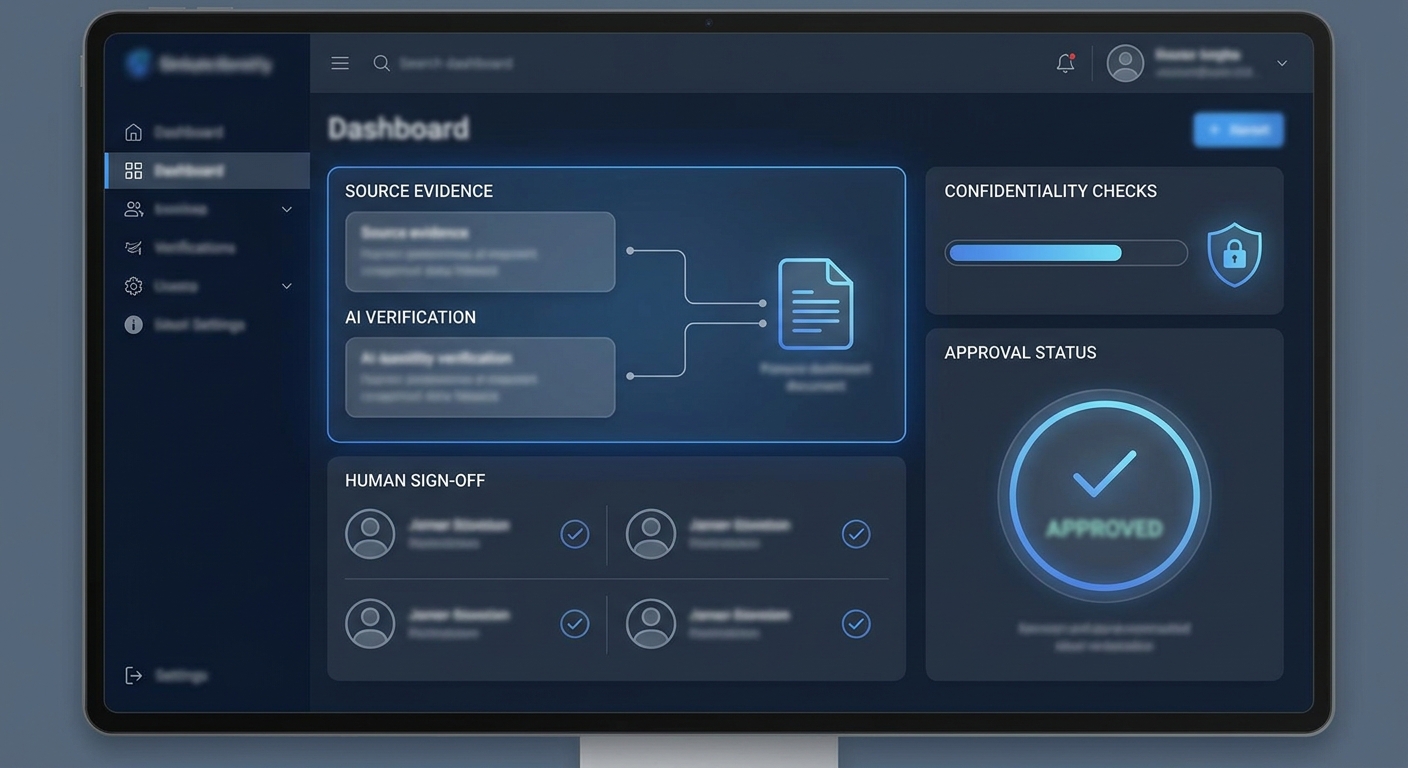
AI-assisted tender response verification dashboard showing source evidence, human sign-off, confidentiality checks and final approval status
A practical AI verification check should include the following.
Source traceability
For every AI-assisted section, identify the source material used. Was it the tender document, approved content library, previous winning response, SME notes, policy document, case study database or external research?
If the source cannot be identified, the section should not be trusted until checked manually.
Claim checking
Highlight factual claims: numbers, dates, certifications, contract examples, team experience, system capabilities, accreditations, response times, KPIs and named methods. Check each one against an approved source.
This is where a platform like mytender.io is valuable because bid teams can work from a controlled content library rather than copying from scattered folders, old submissions and unverified chat outputs.
Human ownership
Assign an owner to each section. The owner is not merely the person who typed it. It is the person accountable for accuracy and delivery credibility.
For a health and safety method, that may be the HSEQ lead. For mobilisation, it may be the operations director. For data security, it may be the CTO or information security owner. For social value, it may be the social value lead or contract sponsor.
Disclosure readiness
Many public sector buyers now ask whether AI was used in preparing the response and how outputs were checked. The answer should be calm, transparent and specific.
A good disclosure says that AI-supported tools were used to assist with document analysis, drafting from approved source material and consistency checking; that all outputs were reviewed by named human owners; that no confidential buyer information was entered into unapproved public tools; and that the final response was verified against source evidence before submission.
Do not invent a disclosure at 4pm on submission day. Build it from the review record.
Contractual promise control
AI should not create new commitments without approval. If a draft says weekly reporting, named account director, same-day escalation, 24-hour response, quarterly innovation workshop or guaranteed cost saving, each commitment needs confirmation.
This is especially important where the quality response and pricing model must align. A beautiful promise that is not priced is a margin problem waiting to happen.
Gold team review: make the final submission boring
The gold team review should be boring. That is the point.
By this stage, strategy is locked. The red team comments are resolved. Evidence is attached. Commercial and technical commitments are aligned. The gold team is not there to improve the prose. It is there to prevent avoidable submission failure.
A good gold team review covers five areas.
1. Document completeness
Check that every required response, form, schedule, declaration, certificate, policy, pricing document and attachment is present. Use the buyer's portal checklist, not your internal file list.
Pay attention to file names, formats, version numbers, signatures, page limits, word counts and upload fields. Many tender failures are not strategic. They are administrative.
2. Consistency
Compare the executive summary, technical response, pricing submission, implementation plan, CVs, case studies and declarations. Look for contradictions.
Does the mobilisation plan say six weeks while the pricing assumes eight? Does the technical answer name a system that the security schedule does not mention? Does the social value plan promise local apprenticeships while the staffing model has no local delivery team? Does the AI disclosure align with the actual drafting process?
Consistency is a scoring issue because inconsistency creates doubt.
3. Approval trail
Confirm that the right people have approved the submission. This includes commercial sign-off, operational sign-off, legal or contract review where required, information security approval for data commitments, and executive approval for high-value or high-risk bids.
The review record should show who approved what and when. If a late change is made after approval, the relevant owner should re-approve it.
4. Portal readiness
Tender portals create their own risks. Some fields have character limits. Some uploads fail silently. Some portals require every page to be saved before final submission. Some questions are answered directly in the portal rather than in documents.
The gold team should confirm portal access, deadline time zone, upload permissions, file size limits, naming conventions and final submission receipt. Do not leave first portal login to the final hour.
5. Final reader test
One person should read the submission as a buyer would. Not to rewrite. Not to perfect. Just to check whether the story still holds together.
The buyer should understand why you are the right supplier, how you will deliver, what evidence proves it, what risks you have controlled and what value they will receive.
If that story is clear, stop editing.

Final gold team tender submission checklist with portal upload, approvals, attachments, consistency checks and submission receipt
A practical review timetable
The best review process depends on bid size, but the principle is always the same: review early enough to change the answer.
For a two-week tender, a sensible timetable might look like this.
Day one is qualification, document analysis and response planning. The bid manager breaks down the requirements, confirms the timetable and assigns owners.
Day two is the pink team review. The team confirms win themes, evidence, AI use, compliance risks and answer structures.
Days three to seven are drafting and evidence gathering. AI can support first drafts, requirement extraction and consistency checks, but section owners remain accountable.
Day eight is internal section review. Writers and SMEs resolve obvious gaps before the formal red team.
Day nine is red team review. Reviewers score the draft against the question, evidence and evaluator expectations.
Days ten and eleven are recovery. The team resolves red team findings, strengthens weak evidence and updates the compliance matrix.
Day twelve is commercial, legal and operational sign-off.
Day thirteen is gold team review and portal preparation.
Day fourteen is submission, ideally several hours before the deadline.
For a larger bid, stretch the same model. For a short turnaround, compress it, but do not skip the logic. Even a 48-hour bid can have a miniature pink review, evaluator check and final submission control.
The review roles that actually matter
A review process works only if roles are clear.
The bid manager owns the timetable, compliance matrix, version control and resolution of review actions. They are the person who turns comments into a controlled recovery plan.
The solution owner owns the delivery method. They confirm that the response is operationally realistic and aligned with how the contract will be delivered.
The commercial owner confirms pricing alignment, margin, assumptions, exclusions, contract terms and commercial risks.
The evidence owner ensures case studies, KPIs, policies, certificates and supporting documents are current, accurate and approved.
The AI governance owner, if separate, confirms approved tools, source traceability, disclosure readiness and human verification.
The executive sponsor approves the final strategic position and any material risk.
Avoid inviting reviewers who have no defined role. More comments do not mean more quality. They often mean more noise.
How mytender.io supports better bid QA
A good process still needs the right working environment. If your bid evidence is scattered across SharePoint folders, old submissions, emails, spreadsheets and people's heads, review becomes harder than it should be.
mytender.io is built for this problem. It helps bid teams analyse tender documents, generate first drafts from approved knowledge, organise reusable content, check compliance and collaborate around the response. The point is not to replace the bid team. It is to remove the repetitive searching, copying and formatting that stops them spending time on strategy and quality.
For review, that matters in four ways.
First, reviewers can see whether the answer is built from relevant source material rather than mystery text.
Second, bid teams can move faster from first draft to evaluator-focused improvement, because the blank page problem is gone.
Third, compliance checking becomes more systematic. Requirements are visible, not buried in a PDF.
Fourth, AI governance becomes easier because teams are working inside a controlled bid environment rather than pasting sensitive tender content into unapproved tools.
That is the real value of AI in bid QA. Not replacing judgement. Giving good reviewers better material, earlier.
Common review mistakes to avoid
The first mistake is reviewing too late. If the first serious review happens after the full draft is complete, the team will resist major changes because the deadline is too close. Early strategy review prevents expensive rewrites.
The second mistake is treating proofreading as quality assurance. Clean writing matters, but grammar is not the same as scoring. A beautifully written answer can still fail if it does not answer the question.
The third mistake is letting seniority override evidence. A director may have strong instincts, but evaluators score what is written and evidenced. Challenge late strategic changes unless they are backed by the tender criteria.
The fourth mistake is ignoring the commercial connection. Quality answers often make commitments that pricing must support. Review delivery promises and commercial assumptions together.
The fifth mistake is trusting AI output because it sounds confident. Confidence is not evidence. Every material claim needs a source.
The sixth mistake is failing to close comments. A review that produces 200 comments but no action log creates confusion. Categorise findings by owner, priority and deadline. Close them visibly.
The seventh mistake is editing until the deadline. At some point, marginal wording improvements create more risk than value. Lock the document, run the gold team checks and submit calmly.
Bid review quality assurance checklist
Use this checklist as a starting point.
Pink team checks:
- buyer scoring intent translated for each question
- win themes agreed and linked to evidence
- response structure drafted before writing
- red flags identified and owned
- AI role agreed by section
- evidence plan confirmed
- bid/no-bid concerns escalated
Red team checks:
- every question and sub-question answered
- response aligned to marking criteria
- major claims evidenced
- generic language reduced
- differentiation made specific
- operational owner confirms deliverability
- AI-assisted content verified against sources
- red team actions logged and resolved
Gold team checks:
- all required documents complete
- pricing, quality and declarations consistent
- approvals recorded
- AI disclosure ready if required
- file names and formats match instructions
- portal access and upload limits checked
- final submission receipt saved
The bottom line
AI has changed tender writing, but it has not changed what evaluators need. They still need clear answers, credible evidence, compliant submissions and confidence that the supplier can deliver.
The winning bid teams in 2026 will not be the ones that generate the most words fastest. They will be the ones that combine speed with control. They will use AI to remove friction, then use disciplined review to sharpen the strategy, verify the evidence and protect the submission.
Pink team keeps the bid from going in the wrong direction. Red team makes the response score. Gold team makes the final submission safe.
Get those three reviews right and AI becomes an advantage rather than a risk.
If you want to give your bid team faster first drafts, clearer compliance checks and a controlled way to reuse evidence, book a mytender.io demo. We will show you how to move from rushed review cycles to a cleaner, faster tender response process.
Tags
Ready to Transform Your Tender Writing?
See how MyTender's AI can help you write winning tenders in a fraction of the time.