
Breaking Down the Bottlenecks in a Bid Process: A Guide for 2026
Most bid teams lose not because they write badly, but because they run out of time. Here's where the real bottlenecks are, and what actually fixes them.
mytender.io Research Team
Tender Writing & Bid Management Specialists
Breaking Down the Bottlenecks in a Bid Process
You don't lose most tenders because of bad writing.
You lose them because you spent the first two weeks chasing documents and the last 48 hours doing five people's jobs at once. The quality of what you actually submitted? That was always limited by the time you had left.
Bid bottlenecks are structural. They happen in the same places, in almost every organisation, with almost every ITT. Understanding where they are, and why they keep appearing, is the first step to actually fixing them.
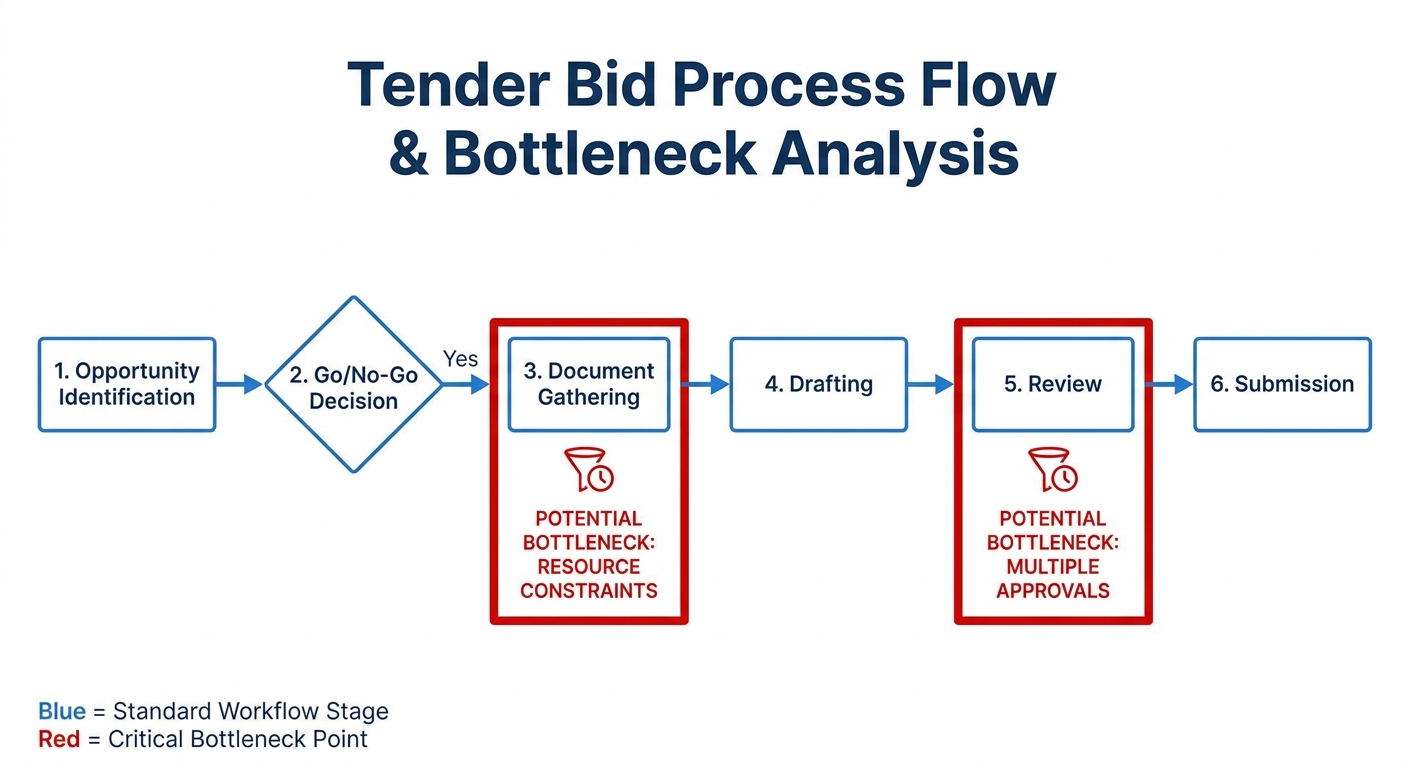
Bid process workflow showing key bottleneck stages
The Problem Is Usually Upstream
Most bid managers will tell you the pressure point is the final 72 hours before submission. That's true. But the reason those 72 hours are so brutal is almost always something that went wrong in week one or two.
The upstream bottlenecks that create the late-stage crunch:
Go/no-go indecision. The ITT lands. It sits in someone's inbox while the right people argue about whether to bid. Three days later, you're on the hook for a full response with a week less runway than you needed. Late document requests. The ITT needs a financial statement, a modern slavery policy, an ISO certificate. You know where these should live. They don't. Cue a round of internal emails that takes four days to resolve. Unclear ownership. No one has agreed who writes what. The bid manager ends up drafting sections that belong to technical or commercial leads, then rewriting them again when those leads eventually get involved.If you can cut two or three days from these upstream delays, the final submission is better, less stressful, and more likely to score well.
Bottleneck 1: The Go/No-Go Decision
This is where time gets wasted most reliably.
The decision to bid should take hours, not days. In practice, it takes days because the criteria for making it aren't agreed in advance. Every new tender becomes a fresh negotiation: is this worth our time? Can we win? Do we have the resource?
A structured go/no-go framework solves this. It doesn't need to be complex. Something like:
- Strategic fit: Does this align with our target sectors and clients?
- Win probability: Do we have relevant experience, relationships, and a credible track record?
- Resource availability: Do we have the capacity to respond well within the timeline?
- Commercial case: Does the contract value and margin justify the bid cost?
Score each factor 1 to 5. Set a threshold (say, 15 out of 20) below which you don't bid unless there's a compelling strategic reason. Document the decision.
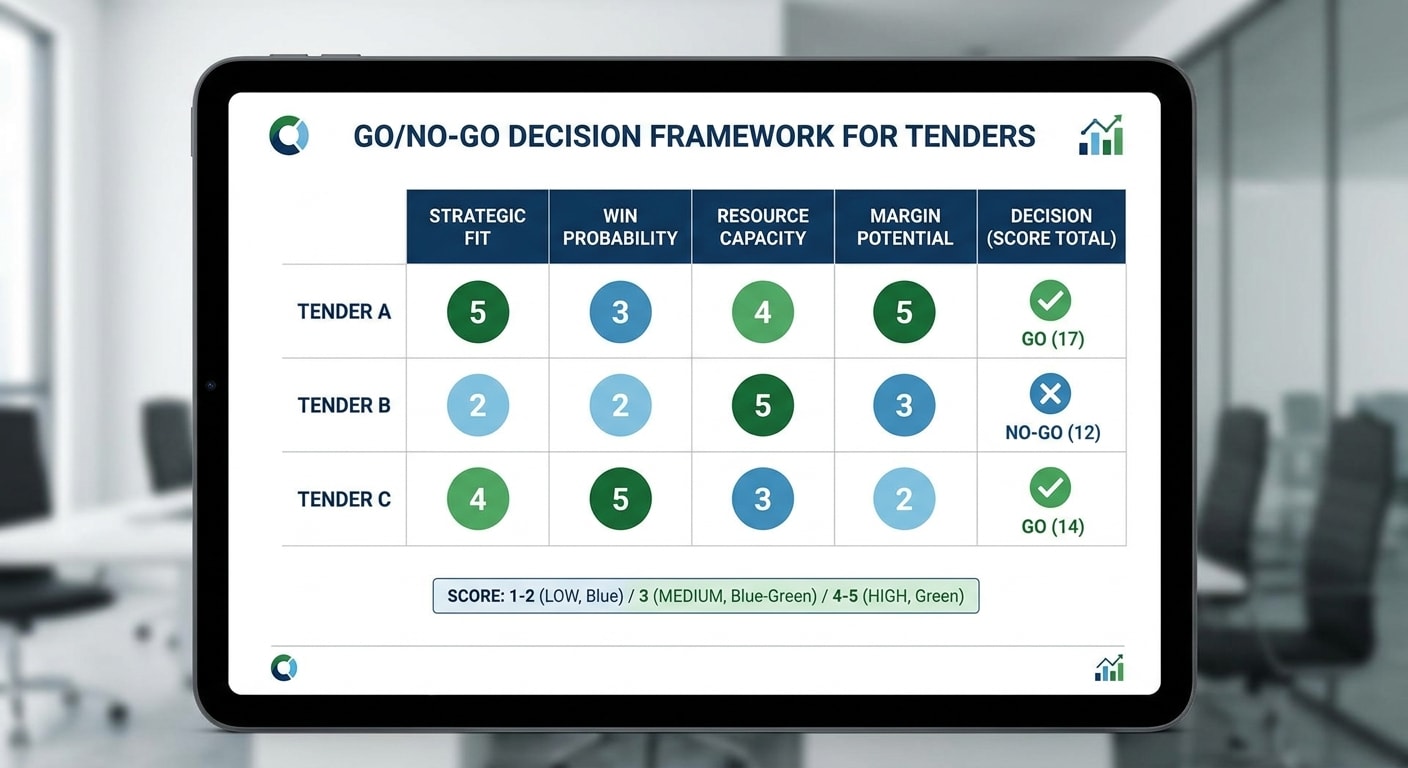
Go/No-Go decision framework scoring matrix
The discipline isn't in the framework; it's in using it every time without exceptions. The tenders you decline are not failures. They're capacity you protected for the bids worth winning.
Bottleneck 2: Document Gathering
You'd think this one would be solved by now. It isn't.
Most bid teams spend between 5 and 15 hours per tender tracking down supporting documents: certificates, policies, financials, organograms, CVs, case studies. These are often scattered across email threads, SharePoint folders with names that made sense to someone in 2021, and people's personal drives.
The fix is a properly maintained bid library. Not a folder labelled "Bid Library" that hasn't been touched since last year. A living, organised store of:
- Company overview text at 100, 250, and 500 words
- Accreditation certificates with expiry dates flagged
- Key policies (quality, GDPR, modern slavery, environment) with version numbers
- A bank of case studies, tagged by sector, contract value, and service type
- CVs for key personnel, kept current
- Insurance certificates and financial summaries

Bid content library system showing organised templates and reusable sections
The build-up to an ITT shouldn't involve any of this. It should be: open the library, confirm the documents are current, pull what you need.
If your library doesn't exist yet, or it's out of date, the short-term answer is to create a "bid pack" immediately after each submission: gather every document used, note where it came from, update anything that changed, and file it. Over three or four bids, you'll have a usable library with almost no extra effort.
Bottleneck 3: SME Availability
This is the one bid managers talk about least, but feel most.
You need the Head of Operations to sign off the mobilisation plan. The Technical Director to review the methodology section. The Finance team to confirm the commercial model. None of them have bid writing in their job description. All of them are already busy.
The result: draft sections sit in inboxes for days. You receive comments 48 hours before submission. The feedback contradicts earlier versions. You're in a review loop that was never properly designed.
The fix has two parts.
First, agree time commitments before the bid starts. When you confirm the decision to bid, you also confirm which SMEs are needed and what's expected of them: a 2-hour input session in week one, review feedback by a specific date, sign-off 48 hours before submission. These are non-negotiable deadlines, not requests.
Second, structure what you send them. Don't send SMEs a 40-question ITT and ask them to "have a look." Send them a scoped document: the three sections relevant to their expertise, with prompts and word counts, and a clear deadline. Their job is to answer questions, not manage a tender.
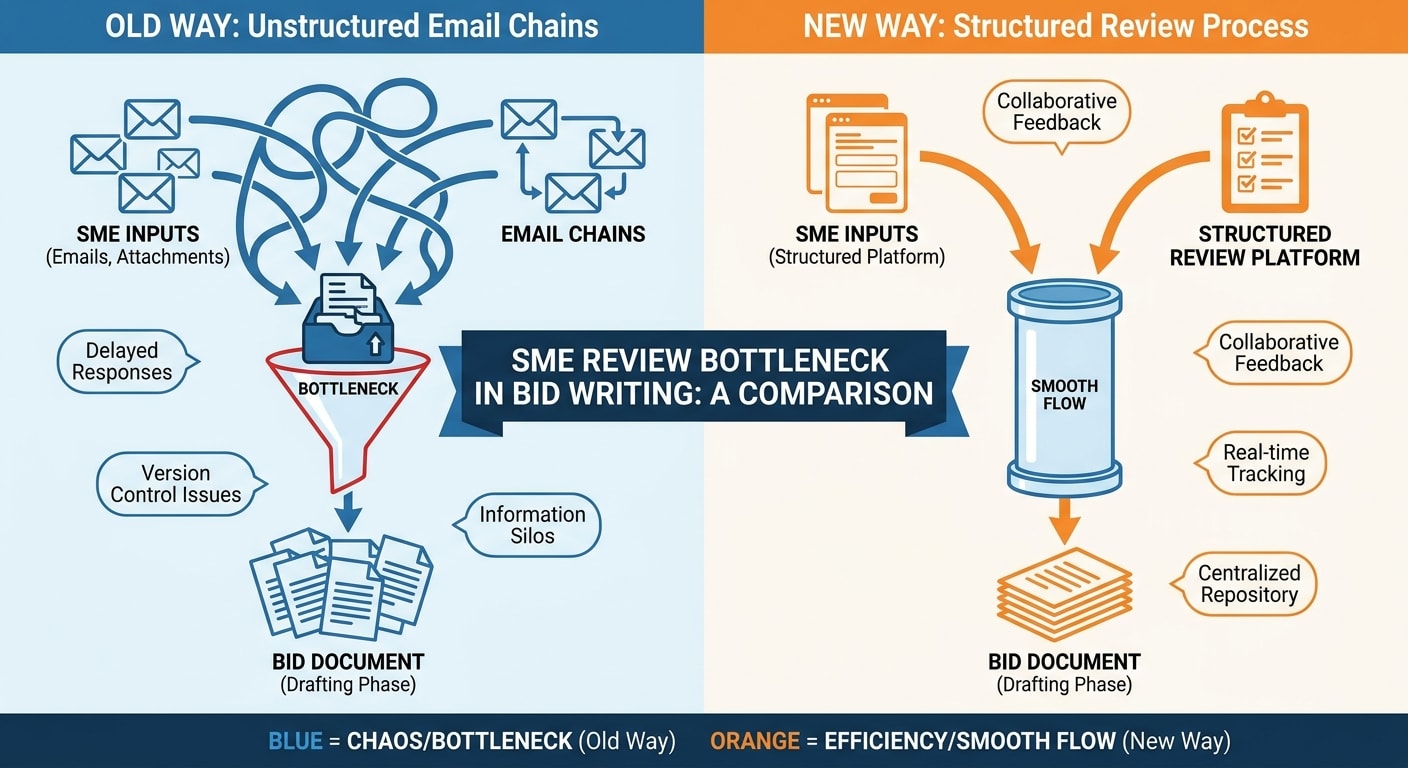
SME review bottleneck diagram showing structured vs unstructured review process
This sounds like administration. It is administration. It's also what separates bid functions that consistently hit quality from those that consistently scramble.
Bottleneck 4: The Review Loop
Review is where time disappears in the middle of a bid.
The common pattern: first draft goes out, comes back with tracked changes from four people, some of which contradict each other. You reconcile, send a second draft, get more comments. By draft three, the comments are about formatting. You've lost a week.
A cleaner review process:
- One review stage, not continuous feedback. Set a deadline for all comments on a draft. After that deadline, no new comments until the next formal review gate.
- Clear reviewer roles. Content accuracy (SMEs), quality and tone (bid manager), commercial sign-off (director). Not everyone reviews everything.
- A review template. Tell reviewers what to look for: factual accuracy, claims that need evidencing, anything missing. Not grammar. The bid manager handles grammar.
- Version control. Track drafts by date, not by filename suffixes like "v3_FINAL_edited_REVIEW2".
The goal is one solid review pass per section, not an open-ended feedback loop.
Bottleneck 5: The Submission Crunch
Even with good upstream management, the final 24 hours before submission are intense. This is normal. What shouldn't happen is that final day being the first time anyone has assembled the full response.
The submission crunch comes from:
- Completing sections in isolation without checking word counts until the end
- Discovering formatting requirements (font, file format, section ordering) late
- Waiting on executive sign-off that should have been arranged days earlier
- Finding at 10pm that the portal has specific upload requirements your document doesn't meet
Mitigating this:
Run a pre-submission check 48 hours out. Is every section drafted and reviewed? Do all documents meet the formatting spec? Is the portal accessible and are you confident uploading works? Book executive sign-off in the calendar. Don't assume someone will be available on submission day. Get the slot at the start of the bid. Build a submission checklist. Every ITT-specific requirement, checked off before anything is uploaded. Portals have rejected submissions for file size limits, incorrect naming conventions, and missing declarations. These are avoidable.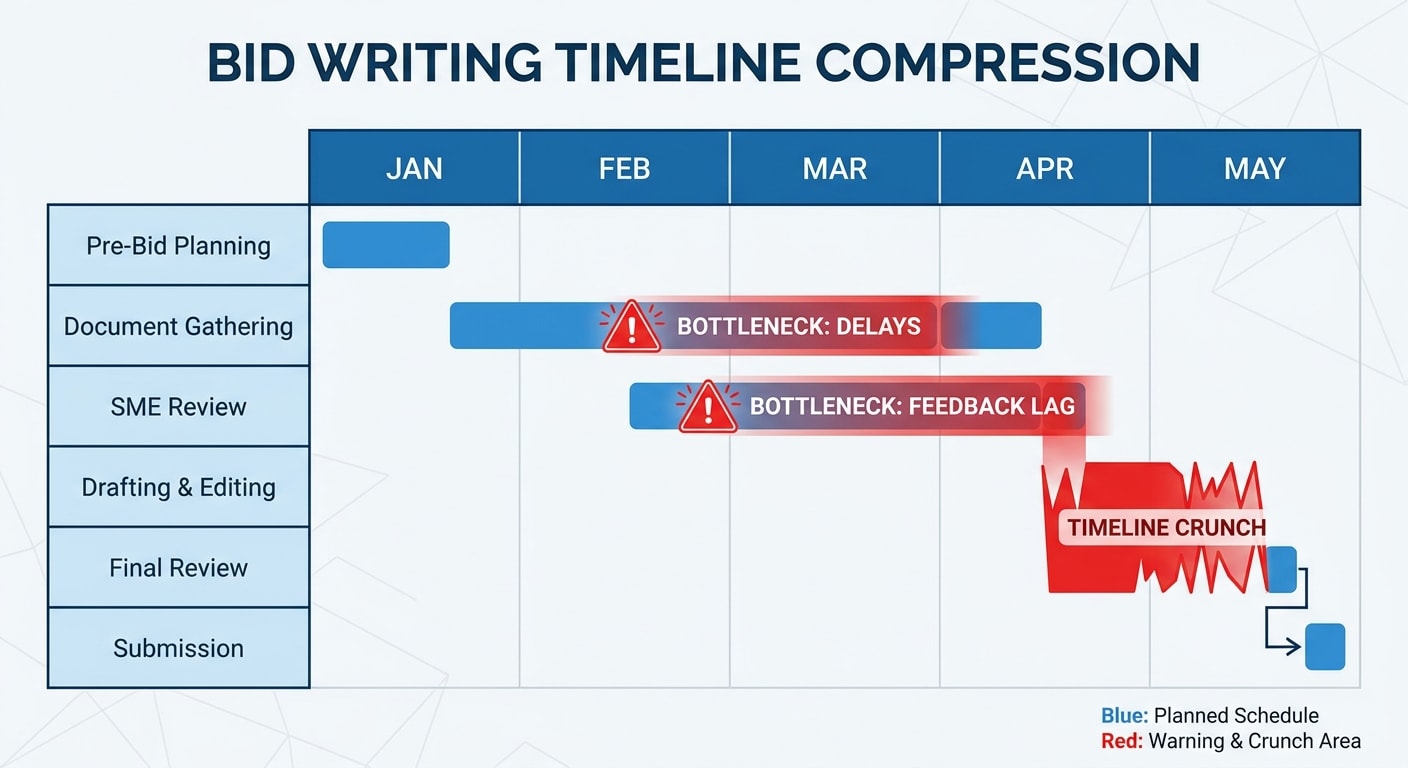
Bid timeline showing common bottleneck compression in the final 48 hours
The Capacity Question
There's a ceiling to how much process improvement can fix.
If your bid team is bidding for more work than they can handle well, the bottlenecks will persist regardless of frameworks and libraries. The realistic fix is either more resource, or fewer bids. Not fewer bids submitted, but fewer opportunities pursued.
This is a harder conversation than it sounds. Sales pressure tends to push toward bidding on everything. The commercial instinct is that more bids equals more chances. In practice, spreading a bid team thin produces lower-quality responses across the board and a win rate that reflects it.
The better model is selective: fewer, better bids, based on a genuine go/no-go discipline. A 30% win rate on well-chosen opportunities beats a 12% win rate on everything that comes through the door.
Tracking your bid cost (hours spent per tender, including SME time) against win rate by tender type is the starting point. Most bid teams have never done this calculation. When they do, the right answer about where to focus usually becomes obvious.
Where AI Actually Helps
The honest answer is that AI doesn't fix the SME availability problem or the go/no-go indecision. Those are human and organisational bottlenecks.
Where it genuinely helps:
First-draft speed. Getting a coherent first draft in place in hours rather than days gives reviewers something to react to. It's faster to edit than to write from scratch, and it moves the timeline forward. Content library interrogation. If your past bids and case studies are in a structured system, AI can surface relevant evidence quickly. Instead of manually searching for case studies that match an evaluation criterion, you query the library and get targeted suggestions. Compliance checking. Running a response against the ITT to confirm every question has been answered, every word count has been respected, and no mandatory requirements have been missed. This takes time to do manually and is reliably done poorly under pressure. Review support. Checking for inconsistencies, unsupported claims, or sections that don't follow the question's structure. Faster than a full human review pass. mytender.io is built specifically for bid teams: past content, AI drafting, and compliance checks in one place. The friction points it removes are the document-gathering and first-draft stages where most capacity gets burned.The Point of All This
Better bid process doesn't mean more bureaucracy. It means fewer surprises, less scrambling, and more hours spent on the sections that actually score marks.
Most teams could free up 30 to 50 percent of their bid writing time by fixing the upstream bottlenecks. That's not time recovered to submit more bids. It's time recovered to write better ones.
Start with go/no-go. Then the library. Then SME commitments. Each fix builds on the last.
If you want to see live tender opportunities matched to your sector while you're working on process, the Tender Finder is free to use and updated daily.
Tags
Ready to Transform Your Tender Writing?
See how MyTender's AI can help you write winning tenders in a fraction of the time.