
Bid Commitment Register: How to Control Tender Promises in Flexible Procurement
Flexible procurement creates more presentations, negotiation rounds and final-offer refinements. Here is how bid teams can use a commitment register to control promises, protect margin and submit cleaner final tenders.
mytender.io Research Team
Tender Writing & Bid Management Specialists
Bid Commitment Register: How to Control Tender Promises in Flexible Procurement
The most expensive tender promise is often the one nobody remembers making.
It happens quietly. A delivery lead answers a question in a presentation. A commercial manager softens a contract position in a negotiation meeting. A bid writer adds a stronger social value commitment to improve a weak section. A senior sponsor tells the buyer that mobilisation can be brought forward by two weeks because it sounds confident in the room.
None of those moments feels reckless at the time. They are part of trying to win.
The problem comes later, when the final tender submission has to reconcile everything that has been said, written, clarified, refined and priced. If the bid team cannot see every commitment in one place, the final offer becomes a risk exercise. The contract may include obligations that operations never approved. The price may exclude promises made in a presentation. The final written response may contradict a clarification answer. The mobilisation plan may promise a date that the implementation team cannot deliver.
A bid commitment register fixes that. It is a simple control document, but in 2026 it is becoming one of the most valuable tools in modern bid management.

Bid commitment register dashboard for a public sector tender team
Why bid commitments matter more in 2026
Public procurement is becoming more flexible, more transparent and more evidence-led.
Under the Procurement Act regime, buyers can use the competitive flexible procedure to design staged competitions around the contract they are buying. That means more supplier presentations, practical demonstrations, dialogue-style meetings, negotiation windows, site visits, commercial refreshes and best-and-final-offer stages.
That flexibility is useful. It gives buyers a better way to test deliverability before award. It also gives suppliers more chances to explain the detail behind their solution, correct misunderstandings and show the people who will actually run the contract.
But it creates a new bid-management problem: promises are no longer made only in the written response.
A traditional open tender is easier to control. There is one deadline, one set of answers, one pricing submission and one clarification process. The bid team can review the response before submission and know exactly what the business is committing to.
A flexible tender is different. The offer evolves. The buyer may ask for an initial response, then a presentation, then a technical workshop, then a revised commercial model, then a final submission. Each stage can create commitments that affect cost, risk, service levels or contract delivery.
Those commitments are not harmless just because they were made in conversation. If they form part of the evaluated offer, appear in the record of negotiations, answer a clarification question, or are repeated in the final submission, they can shape the contract and the buyer's expectations.
That is why bid teams need a formal way to track them.
What is a bid commitment register?
A bid commitment register is a live record of every material promise made during a tender.
It captures what was promised, where it came from, who owns it, whether it is costed, whether it is deliverable, whether it changes an earlier position, and whether it must appear in the final submission.
It is not just a notes file. A good register is a decision tool. It helps the team decide which commitments to keep, which to price, which to clarify, which to soften, which to remove and which to escalate before they become contract obligations.
Think of it as the bridge between bid writing and contract delivery.
The bid response says what the supplier will do. The commitment register checks whether the supplier can actually do it, has priced it properly and has a named owner after award.
That matters because most tender failures are not caused by a complete lack of promises. They are caused by promises that are too vague, too numerous, under-costed, inconsistent or owned by nobody.
A commitment register turns promise-making into controlled promise-management.
What counts as a commitment?
A commitment is any statement that a buyer could reasonably treat as part of your offer.
Some commitments are obvious. If the response says you will provide a 24-hour helpdesk, run monthly contract review meetings, deliver 12 apprenticeships, reduce carbon emissions by 20%, mobilise within six weeks or maintain a 98% service level, those are commitments.
Others are easier to miss.
A commitment can be created by a presentation answer. It can sit inside a clarification response. It can appear in a pricing assumption. It can be implied by a method statement. It can be created by a revised programme. It can appear in a social value schedule, mobilisation plan, innovation proposal, risk register, escalation model, implementation roadmap or contract mark-up.
The test is simple: if the buyer might score you on it, rely on it, compare it with another bidder's offer, include it in the contract, or expect the delivery team to honour it, put it in the register.
That does not mean every sentence needs to be logged. The register should focus on material commitments that affect cost, quality, delivery, risk, compliance, timing, customer experience or contract management.
The goal is not bureaucracy. The goal is control.
The commitments that cause the most damage
Not all tender promises carry the same risk. Some are harmless because they restate existing capability. Others can quietly destroy margin or create operational pain for years.
The first high-risk group is service-level commitments. These include response times, fix times, reporting deadlines, staffing cover, escalation windows, availability targets and performance thresholds. They often look small in the bid, but they shape the operating model.
The second group is mobilisation commitments. Compressed mobilisation dates are attractive to buyers and dangerous for suppliers. If mobilisation depends on recruitment, vetting, TUPE consultation, asset transfer, systems configuration, site access, data migration or incumbent cooperation, the register should show every dependency.
The third group is social value commitments. Social value can now carry significant evaluation weight, especially where buyers want measurable jobs, skills, local impact or community outcomes. The danger is making commitments that are easy to write and hard to evidence after award.
The fourth group is commercial commitments. Price holds, discounts, open-book assumptions, risk sharing, gainshare models, indexation positions, free-of-charge services and included extras all need clear ownership. If the finance team has not seen them, they are not controlled.
The fifth group is innovation commitments. Bids often promise dashboards, AI tools, process automation, carbon reporting, predictive maintenance, resident portals or smarter workflow. These are valuable if they are real. They are risky if the product, data, integration or adoption plan is vague.
The sixth group is contract-change commitments. During negotiation, suppliers may accept wording that shifts risk, tightens liability, expands reporting, removes exclusions or changes termination consequences. These changes may never appear in the narrative bid response, but they can have the biggest commercial impact.
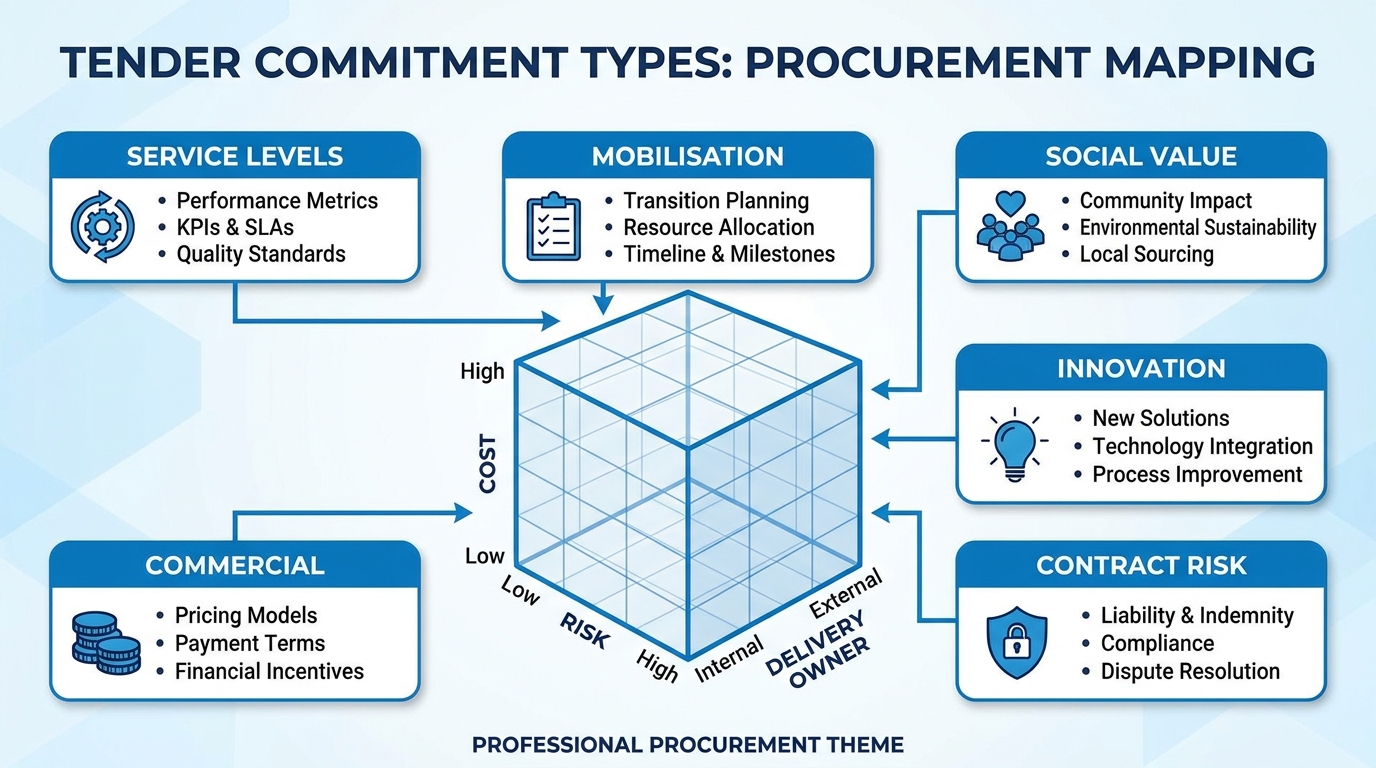
Different tender commitment types mapped by cost, risk and delivery owner
Why flexible procurement makes registers essential
The competitive flexible procedure rewards suppliers that can adapt. It also exposes suppliers that cannot govern change.
In a staged process, the buyer may test the offer repeatedly. They may ask the delivery team how the service will be mobilised. They may ask commercial leads what happens if volumes change. They may ask product teams to demonstrate reporting. They may ask social value leads how outcomes will be measured. They may ask legal teams to explain contract positions.
Every one of those moments can improve the score. Every one can also create a commitment that must be reconciled with the final tender.
The risk is not that people deliberately overpromise. Most people are trying to be helpful. The risk is that each specialist sees only their own part of the bid.
Operations may promise a stronger service model without knowing the margin. Sales may promise a faster start date without knowing the mobilisation dependency. Legal may accept a contract position without knowing the delivery consequence. The bid writer may strengthen the narrative without knowing whether the evidence exists.
A commitment register gives the bid manager a single version of truth. It makes the evolving offer visible.
That is especially important before a BAFO stage. A final offer should not be a creative rewrite from scratch. It should be a controlled consolidation of everything the team has learned and agreed. The commitment register shows what has changed, what is still live and what needs final approval.
The minimum fields every register should include
A commitment register can be built in a spreadsheet, a bid-management platform or a structured database. The format matters less than the discipline.
At minimum, include these fields.
Commitment ID. Give every commitment a unique reference. This helps the team discuss commitments without losing context. Source. Record where it came from: written response, clarification answer, presentation Q&A, negotiation meeting, demo, contract mark-up, BAFO instruction, pricing schedule or internal decision. Exact commitment. Capture the promise in plain language. Avoid vague shorthand. If the buyer has wording, quote it accurately. Category. Tag the commitment as commercial, technical, mobilisation, service level, social value, compliance, reporting, innovation, contract, staffing, sustainability or risk. Tender section. Link it to the relevant question, schedule, lot, scoring criterion or contract clause. Owner. Name the person or function responsible for delivery if the bid is won. Approver. Name the person who has authority to approve the commitment before submission. Cost impact. Record whether it is priced, unpriced, included, excluded, provisional or still under review. Delivery impact. Note whether it affects mobilisation, staffing, systems, suppliers, training, governance or reporting. Risk rating. Use a simple red, amber, green rating. Red means do not submit without senior approval. Amber means confirm before final submission. Green means controlled. Evidence. Link the case study, policy, report, KPI, certificate, method statement or data source that proves the commitment is credible. Status. Mark it as proposed, approved, rejected, superseded, needs pricing, needs clarification, included in final offer or contract handover required. Final submission action. State whether it must be included, revised, removed, cross-checked, priced or handed over.That structure is enough for most teams. Large bids can add fields for margin impact, contract clause, dependency, expiry date, buyer question, version history and handover owner.
How to start the register before the bid is written
The best time to create the register is before the first solution workshop.
That may feel early. It is not. Commitments start forming as soon as the team interprets the tender. People begin making assumptions about staffing, timelines, technology, pricing, social value and risk before a word is submitted to the buyer.
Start by reviewing the tender documents and pulling out obvious mandatory commitments. These include minimum service levels, required reporting, mobilisation deadlines, contract KPIs, statutory obligations, accreditations, resourcing requirements, social value measures, security standards and pricing rules.
Then log the commitments the supplier is likely to propose voluntarily. These are the commitments that may differentiate the bid: enhanced governance, faster mobilisation, better reporting, local recruitment, lower carbon delivery, innovation workshops, continuous improvement targets or named expert support.
This early pass creates two benefits.
First, it stops the team discovering late that the response includes promises nobody priced. Second, it helps writers turn strong commitments into better narrative. A commitment that has an owner, evidence and measurement method is easier to write convincingly.
This is where mytender.io's workflow helps. Bid teams can break down the ITT, identify requirements, retrieve relevant past evidence and draft responses from a controlled knowledge base rather than relying on memory and scattered documents. The commitment register then becomes the governance layer that checks the output before it becomes binding.
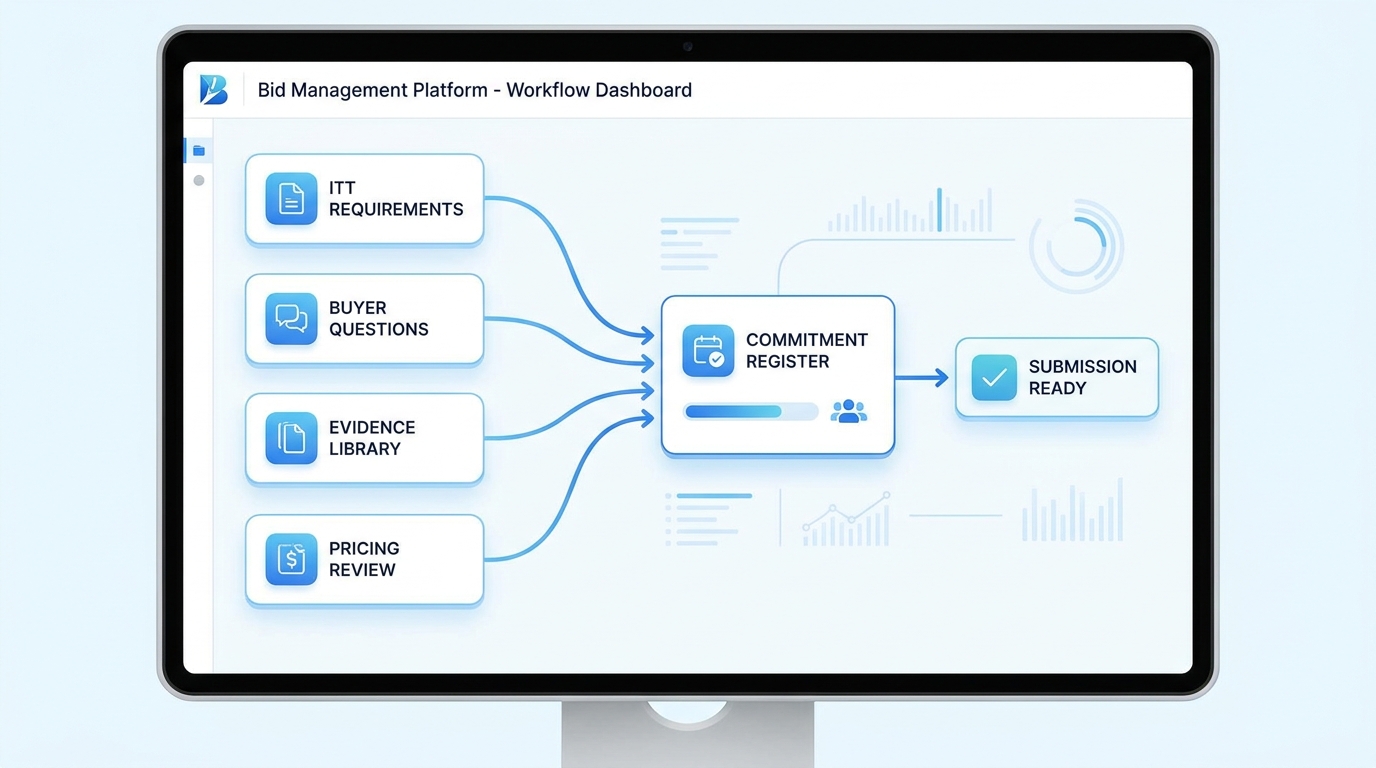
Tender team building a commitment register from ITT requirements and buyer questions
Managing presentation and interview commitments
Tender presentations are where commitment control often breaks down.
Written responses usually go through review. Presentations sometimes do not. The team rehearses slides, but not the boundaries of what can be promised in Q&A. The buyer asks a reasonable question, someone gives a confident answer, and the bid has changed.
That is not a reason to make presentations robotic. Buyers want to see credible delivery people, not a group reading legal disclaimers. But the team needs guardrails.
Before the presentation, identify topics where the panel is likely to probe: mobilisation, staffing, reporting, systems, risk, social value, pricing assumptions, contract management and performance recovery. For each topic, agree what the team can say confidently, what needs qualification and what must not be promised without approval.
After the presentation, hold a short commitment capture session. Do it the same day while memories are fresh. Ask four questions.
What did we promise explicitly?
What did we imply?
What did the buyer seem to care about most?
What needs to be reflected in the final submission or clarified in writing?
Do not rely on the slide deck alone. The highest-risk commitments usually happen in Q&A, not on the slides.
If the buyer provides a written record of the presentation or clarification answers, compare it with your register. If their understanding is wider than yours, deal with it quickly. Silence can become acceptance.
Managing negotiation commitments
Negotiation stages need even tighter control because commitments often involve trade-offs.
A buyer may ask for a lower price, stronger service level, faster mobilisation, different risk allocation, longer price hold, more detailed reporting or reduced exclusions. The supplier may be willing to move, but only if the wider commercial picture still works.
A commitment register should separate three things: what the buyer requested, what the supplier offered, and what was actually agreed.
That distinction matters. Internal notes can become messy during negotiation. Someone may describe an option as if it has been accepted. Someone else may price a scenario that was only floated. The final submission can then include an unapproved concession.
For every negotiation point, log the commercial impact and the corresponding exchange. If the team reduces price, what changed in scope, risk, payment profile, term, volume, implementation or service design? If the team accepts a tougher KPI, what resource or technology supports it? If the team offers an innovation, what dependency must the buyer meet?
The register should also track superseded positions. Final offers often fail because old and new commitments sit side by side. If a revised mobilisation date replaces the initial date, mark the earlier commitment as superseded. If a BAFO price replaces the original model, show what assumptions changed.
This is not just tidy administration. It protects the buyer relationship. A clear final offer is easier to evaluate and easier to contract.
Social value commitments need special discipline
Social value commitments deserve their own section in the register because they are visible, measurable and increasingly important in scoring.
The temptation is to make social value sound bigger in the bid. More apprenticeships, more volunteering, more local spend, more community events, more carbon savings, more school engagement, more supplier-diversity commitments.
That can win marks if it is real. It can backfire if the buyer expects delivery and the contract team cannot evidence it.
For each social value commitment, record the beneficiary, location, number, timing, delivery partner, cost, internal owner, measurement method and reporting cadence. If the commitment depends on buyer access, local labour availability, recruitment timescales or third-party involvement, record that dependency too.
A strong social value commitment is not just a promise. It is a mini delivery plan.
For example, “we will support local employment” is not controlled. “We will create four paid work placements for local unemployed residents during year one, delivered with a named employability partner, reported quarterly through attendance, completion and progression data” is controlled, if the operational team has approved it and the cost is in the model.
The commitment register forces that level of detail before submission.
How to use the register before final submission
Before the final tender goes out, run a commitment audit.
This should be a formal review, not a quick scan. The bid manager, commercial lead, delivery owner and senior sponsor should work through the register and ask whether each commitment is still accurate, priced, evidenced and aligned with the final response.
Check for contradictions. Does the method statement promise a weekly report while the pricing model includes monthly contract management? Does the presentation promise a named implementation lead while the CV section uses a different person? Does the social value plan promise local recruitment while the mobilisation plan relies on existing staff? Does the contract mark-up accept a response-time obligation that the operational model cannot meet?
Check for unpriced extras. These often hide in words like enhanced, dedicated, additional, bespoke, unlimited, proactive, no extra cost, included, guaranteed and immediate.
Check for vague commitments. If a promise cannot be measured, owned or evidenced, either sharpen it or remove it.
Check for missing handover actions. Any commitment that survives into the final offer must be handed to the delivery team after award. If not, the bid may win, but mobilisation starts with a surprise.
Finally, check that the final submission says what the register says. The register is not the contract, but it should mirror the offer.

Final tender submission audit showing approved, costed and evidenced commitments
A practical commitment register workflow
For most bid teams, the workflow should be simple.
At kickoff, create the register and pre-load mandatory requirements from the ITT.
During solution design, add proposed differentiators and assign owners.
During writing, check that each strong claim links to evidence and an approver.
Before submission, review cost, risk and deliverability.
After clarification questions, add any new promises and update the affected sections.
After presentations, capture Q&A commitments and decide which must appear in writing.
After negotiation meetings, log requests, offers, agreed changes and superseded positions.
Before BAFO or final tender, run the commitment audit and remove contradictions.
After award, hand the register to mobilisation and contract management.
That last step is often forgotten. It is also where the register creates lasting value. The delivery team should not have to reverse-engineer the bid to find out what was promised. They should receive a clean list of obligations, measures, owners and evidence.
This improves mobilisation, reduces buyer frustration and helps the supplier deliver the contract they sold.
Common mistakes to avoid
The first mistake is starting too late. If the register is created only at final review, it becomes a clean-up exercise. It may still catch issues, but it will not shape the bid properly.
The second mistake is logging only big commitments. Small promises can be expensive if repeated often. Additional reports, extra meetings, faster response times and bespoke dashboards all take resource.
The third mistake is confusing evidence with approval. A case study may prove you have done something before. It does not prove you can afford or resource it on this contract.
The fourth mistake is leaving the register with the bid writer alone. Bid writers are central, but they cannot approve operational, legal or commercial risk on behalf of the business.
The fifth mistake is failing to update the register after live buyer interactions. Presentations and negotiations are exactly where the register earns its keep.
The sixth mistake is treating the register as internal admin rather than win strategy. In reality, it helps the bid team write stronger answers because it forces claims to become specific, evidenced and credible.
How mytender.io supports commitment control
A commitment register works best when the underlying bid process is structured.
If the team is writing in disconnected documents, searching old folders for evidence, copying content from previous bids and tracking clarifications by email, commitment control becomes fragile. The register will help, but the team is still fighting scattered information.
mytender.io gives bid teams a better foundation. The platform helps break down tender requirements, generate first drafts from approved knowledge, retrieve relevant evidence, manage collaboration and keep the response aligned to the buyer's scoring criteria.
That matters because commitment control is not only about avoiding risk. It is about making better promises.
The strongest tender responses are specific. They show what will happen, when, who will do it, how it will be measured and why the buyer should believe it. That is exactly the discipline a commitment register creates.
With mytender.io, teams can move faster without losing governance. Writers can draft from proven material. Reviewers can focus on risk and quality rather than chasing missing content. Bid managers can see where the offer is strong, where evidence is thin and where final approval is needed.
The result is a cleaner final tender and a smoother handover after award.

AI-assisted bid management workspace linking commitments, evidence and final tender content
The SEO-friendly answer: what should a bid commitment register include?
A bid commitment register should include the commitment source, exact promise, tender section, category, delivery owner, approver, cost impact, delivery impact, risk rating, evidence, status and final submission action.
For flexible procurement, it should also record presentation Q&A promises, negotiation offers, superseded positions, buyer dependencies and BAFO changes.
For social value, it should capture measurable outcomes, beneficiaries, timing, reporting method and delivery partner.
For mobilisation, it should capture dependencies such as recruitment, TUPE, vetting, assets, data, systems, training, site access and incumbent cooperation.
For commercial commitments, it should show whether the commitment is priced, conditional, included, excluded or still awaiting approval.
That is the practical minimum.
A simple example
Imagine a facilities management supplier bidding for a local authority contract.
In the written response, the team promises monthly performance reporting, a six-week mobilisation, quarterly innovation reviews and two local apprenticeships.
During the presentation, the operations director says the team can provide weekly mobilisation updates, bring in a named mobilisation manager and attend resident forums during the first three months.
During negotiation, the buyer asks for a faster helpdesk response time and a stronger social value reporting schedule.
Without a commitment register, those promises sit in different places. The pricing model may include only monthly reporting. The mobilisation manager may not be available. The apprenticeship commitment may not have a delivery partner. The helpdesk response time may require extra resource.
With a register, the bid manager can see the whole picture. Weekly mobilisation updates are approved because they are low cost and high value. The named mobilisation manager is confirmed for the start date. The social value reporting schedule is costed and linked to existing quarterly governance. The helpdesk response time is accepted only for priority-one incidents because a blanket change would require a different staffing model.
The final tender is clearer, more credible and more commercially safe.
How to keep the register light enough to use
The danger with any governance tool is that it becomes so heavy nobody updates it. A commitment register should feel like a live bid control, not a compliance chore.
Keep the first version deliberately simple. Use a short list of fields, a clear risk rating and named owners. Do not ask the team to fill twenty columns for every minor wording choice. If the register is painful, people will work around it, and the important promises will move back into meeting notes and inboxes.
The strongest habit is a five-minute update rhythm. At the end of every major bid meeting, ask whether anything has changed the offer. At the end of every buyer interaction, ask what the buyer could reasonably believe you have promised. Before every review gate, filter the register for red and amber items. That is enough to keep control without slowing the team down.
It also helps to separate commitments from actions. “Check whether we can offer weekly reporting” is an action. “We will provide weekly reporting during mobilisation” is a commitment. Mixing the two makes the register noisy. Keep actions in the bid plan and commitments in the register. Link them where useful, but do not let one tool become everything.
For larger tenders, appoint a commitment owner. This is usually the bid manager, commercial lead or proposal manager. Their job is not to approve every promise personally. Their job is to make sure every promise has the right approver before it reaches the buyer.
Finally, make the register visible during reviews. Do not bury it as an attachment. Put the red and amber commitments on the review agenda. Ask finance about unpriced promises. Ask operations about delivery risk. Ask legal about contract wording. Ask the executive sponsor whether any high-risk commitment is worth making because it improves the chance of winning.
That is how the register earns its place. It gives senior reviewers a practical view of the offer, not another document to admire and ignore.
Final thought
A bid commitment register will not make a weak offer strong on its own.
It will do something just as important: stop a strong offer becoming chaotic.
Flexible procurement gives suppliers more chances to influence the buyer. That is good news for teams with strong solutions, good evidence and credible delivery people. But more interaction means more moving parts. More moving parts mean more promises. More promises mean more risk unless somebody is keeping score.
The best bid teams in 2026 will not be the teams that promise the most. They will be the teams that make the right promises, prove them properly, price them honestly and hand them over cleanly after award.
That is what a commitment register is for.
If your tender process now includes presentations, negotiation rounds, demonstrations or final-offer stages, do not wait until the end to work out what you have promised. Start the register at kickoff, keep it live, and use it to turn every commitment into something the business is proud to stand behind.
Tags
Ready to Transform Your Tender Writing?
See how MyTender's AI can help you write winning tenders in a fraction of the time.