
AI Procurement Data Readiness: The Bid Team Guide for 2026
AI can speed up tender writing, but only if your bid data is clean enough to trust. Here is how bid teams can get their evidence, library and governance ready for 2026.
mytender.io Research Team
Tender Writing & Bid Management Specialists
AI Procurement Data Readiness: The Bid Team Guide for 2026
AI is not the hard part any more.
The hard part is whether your bid data is good enough for AI to use.
That is the uncomfortable bit most teams discover after the demo. The tool can draft. It can summarise. It can compare requirements. It can pull a first answer together in seconds.
Then someone reads the output and spots the problem: the case study is three years out of date, the carbon figure has no source, the mobilisation plan belongs to a different contract, and the answer sounds confident about something nobody has checked.
That is not an AI problem. It is a data readiness problem.

Bid team reviewing AI procurement data readiness on a large office screen
In 2026, this matters more than it did a year ago. Procurement teams are using more AI. Public buyers are asking sharper questions about evidence, transparency and contract performance. The Procurement Act 2023 has pushed the market towards more visible supplier records, more flexible procedures and a stronger focus on Most Advantageous Tender.
So the bid teams that win will not be the ones who simply "use AI".
They will be the ones whose evidence is clean, current and governed well enough for AI to make them faster without making them reckless.
This guide explains what AI procurement data readiness means for bid teams, how to assess your current position, and what to fix first.
What AI procurement data readiness actually means
AI procurement data readiness is the state where your bid content, tender evidence, case studies, policies, pricing assumptions, lessons learned and compliance records are organised well enough for AI tools to use safely.
That sounds dry. It is not.
It is the difference between asking AI for a mobilisation response and getting a credible first draft, or getting a polished hallucination with the wrong contract name in paragraph three.
For a bid team, readiness usually has five parts:
- Findability: the right content can be found quickly.
- Accuracy: the information is true, current and source-backed.
- Relevance: evidence is tagged by sector, buyer type, service line and contract size.
- Governance: people know what can be reused, what needs approval and what is obsolete.
- Traceability: claims can be traced back to a source document, contract record or named owner.
If one of those is missing, AI becomes risky.
Not useless. Risky.
A human bid writer can often smell when a legacy answer feels wrong. AI cannot. It will treat an outdated boilerplate paragraph with the same confidence as a verified contract KPI unless your system tells it the difference.
Why this topic matters now
The search trend around AI in procurement is noisy, but the underlying movement is real.
Procurement teams are moving from experimentation to operational use. AI is being used for tender discovery, requirement extraction, compliance checking, RFx analysis, first-draft writing and supplier risk review. At the same time, suppliers are dealing with more public procurement transparency, more scrutiny of contract performance and more pressure to prove value beyond price.
That combination creates a new bid management problem.
Speed without trusted evidence is not an advantage. It is just faster risk.The common mistakes showing up across tender writing in 2026 are still familiar: generic responses, weak tailoring, missed instructions, poor evidence, vague social value and late submissions. AI can help with all of those.
But only if the underlying content is worth reusing.
If your bid library is a dumping ground, AI will scale the mess.
If your evidence is structured, reviewed and linked to live delivery data, AI can help your team produce stronger work in less time.
That is the opportunity.
The old bid library problem has become an AI problem
Bid libraries were already difficult before AI arrived.
Most teams have some version of the same setup: a folder of old submissions, a few "gold standard" answers, policy PDFs, CVs, case studies, pricing notes, social value examples and a spreadsheet nobody quite trusts.
It works until the pressure rises.
Then a bid manager needs a 750-word answer on quality assurance by Friday. Someone searches for the closest old response. They paste it into the draft. They tweak the buyer name, adjust a few bullets and hope the examples still hold.
That was never ideal. With AI, it becomes more dangerous because the reuse happens faster and at larger scale.

Messy bid library documents being organised into clean AI-ready tender data
AI can surface content you forgot existed. That is useful.
It can also surface content you should have retired. That is the trap.
A modern bid library needs to tell the system more than "this document exists". It needs to tell the system:
- when the content was last reviewed;
- who owns it;
- which sectors it applies to;
- which claims are approved;
- which figures need refreshing;
- which answers should never be reused without legal, finance or operations input;
- which examples are strong enough to lead with.
Without that layer, AI will still be quick. It just will not be reliably useful.
A simple test: would you let a new starter use your library alone?
Here is the easiest way to assess your current readiness.
Imagine a capable new bid writer joins tomorrow. They understand tendering, but they do not know your business yet. You give them access to your bid library and ask them to draft a response for a live opportunity.
Could they tell which content is current?
Could they identify the best case study for the sector?
Could they see which social value commitments were actually delivered?
Could they avoid using old pricing assumptions, retired accreditations or obsolete policy wording?
If the answer is no, your AI tool will struggle too.
A new starter at least knows when to ask, "is this still true?" AI often does not. It needs metadata, rules and review points.
That does not mean you need a six-month data transformation programme before using AI.
It means you need to fix the content that carries the most scoring risk first.
The five content types to clean first
Not all bid data is equally important.
Do not start by organising every folder. That is how internal improvement projects die quietly in week three.
Start with the content that appears often, carries scoring weight and creates risk if wrong.
1. Case studies
Case studies are the backbone of good tender evidence.
They show delivery credibility. They prove you have done similar work. They help evaluators trust your method statements, mobilisation plans and risk controls.
They are also often badly maintained.
A case study should have:
- client name and sector;
- contract dates;
- contract value or scale, where appropriate;
- services delivered;
- measurable outcomes;
- named internal owner;
- permission status;
- last reviewed date;
- relevance tags;
- proof sources, such as KPI reports, testimonials or contract review notes.
The last reviewed date matters more than people think.
A strong 2022 case study might still be useful. But if it references a delivery model you no longer use, a system you have replaced or a team structure that has changed, it needs updating before AI puts it into a live response.
2. Policies and compliance documents
Policies are dangerous because they look official.
Health and safety. Modern slavery. Information security. Equality. Environmental management. Quality assurance. Business continuity. Safeguarding. Data protection.
Tender teams tend to assume these documents are fine because they sit in a folder with a formal title.
That assumption is expensive.
AI can summarise a policy brilliantly and still reproduce old wording. It can turn a stale document into a convincing answer. That is worse than an obviously bad draft because people are less likely to challenge it.
Every policy used in tender responses should have an owner, review date and approval status.
If the policy is expired, mark it clearly. If it is under review, mark it clearly. If only part of it should be used in bids, write that down.
3. Social value commitments
Social value answers are where generic content goes to die.
Buyers increasingly expect specific, measurable commitments tied to the contract. They do not want vague promises about supporting communities, apprenticeships, volunteering or sustainability.
AI can help generate structure, but it cannot invent commitments you can actually deliver.
For AI-ready social value content, store:
- commitments made in previous bids;
- commitments delivered;
- evidence of delivery;
- geographic relevance;
- cost and operational assumptions;
- approved wording;
- red lines on what not to promise.
That final point is crucial.
A tender response can overpromise in seconds. Delivery teams live with it for years.
4. Performance data and KPIs
Under the new procurement regime, performance evidence matters more.
Contract Performance Notices, payment transparency and public procurement data all point in the same direction: buyers want more confidence that suppliers can deliver what they claim.
Bid teams need a cleaner bridge between delivery data and tender writing.
For each core service line, know which KPIs you can evidence. Response times, completion rates, first-time fix, customer satisfaction, audit scores, waste diversion, carbon reduction, training completion, payment performance, mobilisation milestones.
Do not just store the number.
Store the context.
A 98% KPI means little unless the evaluator knows the contract type, period measured, sample size and service conditions.
5. Standard answers
Standard answers are not bad.
Bad standard answers are bad.
A good standard answer gives the bid team a structure, approved language and reusable proof points. A bad one gives them a wall of generic prose that sounds like every competitor.
For AI readiness, standard answers should be broken into smaller approved blocks:
- approach;
- evidence;
- differentiator;
- risk control;
- mobilisation detail;
- reporting method;
- buyer benefit.
That makes AI much more useful. It can assemble relevant material rather than recycling one giant answer.
How to tag your bid content properly
Most bid libraries fail because the tagging is either too thin or too ambitious.
Too thin means everything is called "quality", "social value" or "case study". That barely helps.
Too ambitious means someone creates 200 tags and nobody uses them consistently.
Use a practical middle ground.
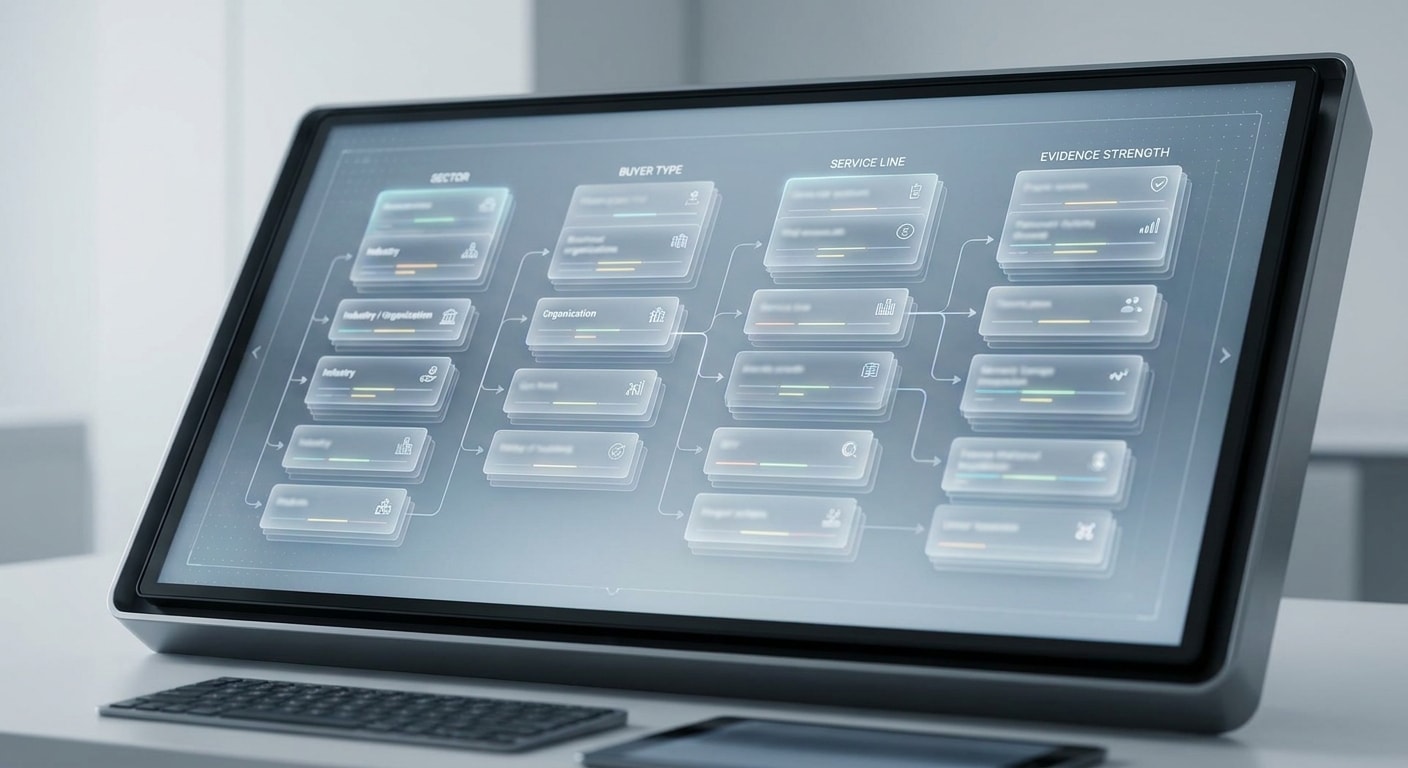
Structured tagging system for AI-ready tender evidence and bid content
A good bid content tagging system includes:
- Sector: FM, construction, waste, healthcare, education, local government, housing.
- Service line: cleaning, security, hard FM, planned maintenance, reactive repairs, waste collection, design and build.
- Buyer type: local authority, NHS, central government, housing association, university, private sector.
- Question theme: mobilisation, quality, risk, social value, sustainability, innovation, contract management, TUPE, safeguarding.
- Contract scale: small, medium, large, framework, single site, multi-site.
- Evidence strength: approved, needs refresh, strong example, weak example, do not use.
- Date sensitivity: evergreen, review annually, review before every use.
That is enough for most teams.
The key is consistency. A small taxonomy used properly beats a beautiful taxonomy nobody follows.
The governance layer: who is allowed to approve what?
AI readiness is not just a filing exercise.
It is a governance exercise.
When AI produces a tender draft, someone still needs to decide whether the answer is safe, accurate and competitive. The question is not "did AI write this?" The question is "who owns the claim?"
Every high-value content area should have an owner.
For example:
- health and safety claims: SHEQ lead;
- financial standing: finance director;
- pricing assumptions: commercial lead;
- mobilisation plans: operations lead;
- cyber security: IT/security owner;
- social value commitments: ESG or delivery owner;
- case studies: account owner or contract manager;
- final answer quality: bid manager.
This does not mean every tender needs a committee.
It means the bid team should know where approval sits before the deadline panic starts.
A simple RAG status works well:
- Green: approved content, safe to reuse with tailoring.
- Amber: usable structure, but facts or figures need review.
- Red: do not use without owner approval.
Put that status where people can see it. If it lives in someone's head, it does not count.
How AI changes the role of the bid manager
AI does not remove the bid manager from the process.
It makes judgement more important.
The old version of the job involved a lot of searching, stitching, formatting and chasing. Those tasks do not disappear, but the balance changes. The bid manager becomes more like an editor-in-chief, evidence controller and evaluator translator.
They need to ask:
- does this answer respond to the actual question?
- is the evidence specific enough?
- does the claim match what delivery can prove?
- is the win theme clear in the first third of the answer?
- have we answered the scoring criteria, not just the heading?
- is the tone credible for this buyer?
AI can accelerate the draft. It cannot decide whether the answer deserves marks.
That is still human work.
Where teams go wrong with AI bid writing
The most common mistake is treating AI as a writer before treating it as a researcher.
A blank prompt like "write a tender response about mobilisation" will produce something. It might even sound fine.
But a strong tender response needs context:
- the buyer's problem;
- the scoring criteria;
- the contract risks;
- your proposed delivery model;
- proof from similar contracts;
- constraints from operations and finance;
- the exact question wording;
- the word count;
- the evaluation weight.
Without that context, AI fills the gaps with generic language.
Generic language rarely wins.
Another mistake is letting AI polish weak thinking. A beautifully phrased answer with thin evidence is still thin. In some ways, it is worse, because the polish hides the weakness until an evaluator scores it.
A practical AI-ready bid data audit
You do not need to audit everything at once.
Start with a two-week sprint.
Choose the content used in your last five submitted tenders and your next five likely opportunities. That will show you the material that actually matters.
For each item, record:
- what it is;
- where it lives;
- who owns it;
- when it was last used;
- when it was last reviewed;
- whether the facts are source-backed;
- whether it can be reused;
- which sectors and question types it fits;
- what needs fixing.

Bid team running a two-week AI-ready data audit sprint with tender evidence cards
Then sort the issues into three buckets.
Fix now
These are items that could damage a live bid if reused.
Expired accreditations. Old insurance figures. Incorrect contract values. Case studies without permission. Social value commitments that delivery cannot support. Outdated policy statements. Unsupported carbon claims.
Fix these first.
Fix next
These are useful items that need structure.
Good case studies without outcomes. Strong method statements buried in old submissions. Useful lessons learned that are not tagged. KPI data without narrative. Buyer feedback sitting in inboxes.
These improve quality and speed once cleaned.
Park for later
These are low-use or low-value documents.
Archive them. Do not let them clutter search results.
AI tools are only as useful as the content they can see. Removing rubbish is as important as adding material.
What good looks like in practice
A ready bid content record does not need to be fancy.
For a case study, it might look like this:
Title: Multi-site hard FM mobilisation for local authority estate Sector: Facilities management Buyer type: Local authority Services: PPM, reactive maintenance, statutory compliance, helpdesk Contract scale: 42 sites, 5-year contract Used for: mobilisation, risk, contract management, social value Evidence: mobilisation completed 11 days early; 97.8% PPM completion in first year; zero high-risk compliance gaps at first audit Owner: Operations Director Last reviewed: July 2026 Status: Green Do not use for: healthcare estates, security services, cleaning-only bidsThat gives AI enough structure to retrieve the right example and enough guardrails to avoid misuse.
It also gives the bid manager enough context to tailor properly.
The same principle applies to method statements, CVs, policies and pricing assumptions. The goal is not to create a perfect database. The goal is to make the right content easy to find, trust and adapt.
The compliance risk nobody likes talking about
AI makes it easier to produce content that looks complete.
That is useful when the content is accurate. It is dangerous when the answer includes claims you cannot evidence.
Tender compliance is not just about submitting the right attachments before the portal closes. It includes whether your response is truthful, current and aligned with the buyer's instructions.
The risk areas are obvious once you list them:
- invented or inflated performance figures;
- outdated accreditations;
- misleading case study relevance;
- unsupported environmental claims;
- unapproved subcontractor references;
- incorrect staffing assumptions;
- overcommitted social value promises;
- accidental reuse of another buyer's confidential detail.
A responsible AI process reduces these risks. A careless one multiplies them.
This is why bid teams need review gates, source links and content ownership.
Not because governance is fun. It is not.
Because losing trust with a buyer is far more expensive than spending an hour cleaning your evidence.
How to brief AI properly for tender work
A good AI prompt is not magic. It is a clear brief.
For tender work, include:
- the exact question;
- word count;
- evaluation criteria;
- buyer priorities;
- contract context;
- approved evidence to use;
- evidence not to use;
- required tone;
- structure;
- compliance constraints;
- desired output format.
For example:
> Draft a 900-word response to the mobilisation question below. Use the approved FM case study tagged Green. Lead with the evaluator benefit. Include three mobilisation risks and controls. Do not mention the old CAFM platform. Keep the tone practical and evidence-led. Use British English. Stay within the question scope.
That is very different from:
> Write a mobilisation answer.
The first prompt gives AI boundaries. The second invites waffle.
Building a better feedback loop
Win/loss feedback is one of the most underused data sources in bidding.
Most teams read it, grumble about the scores, save the PDF somewhere and move on.
That is a waste.
If you want AI to improve future bids, feed it better learning material.
For each tender outcome, capture:
- scores by question;
- evaluator comments;
- themes in strengths and weaknesses;
- competitor insight, where available;
- whether your evidence was specific enough;
- whether your win themes landed;
- which content was reused;
- what should change in the library.
Then tag the lesson against the relevant content.
If your mobilisation answer scored poorly because the programme lacked detail, that should attach to your mobilisation template.
If your social value answer scored well because it named local delivery partners, that should attach to your social value evidence.
This is where AI becomes genuinely useful over time. Not because it has a magic understanding of your market, but because you stop throwing away learning.
What procurement leaders should ask before buying AI tools
If you are choosing AI tender software, do not start with the shiny features.
Start with the data questions.
Ask:
- Can the system connect answers to source documents?
- Can we tag content by sector, service line and question type?
- Can we mark content as approved, needs review or retired?
- Can users see when evidence was last reviewed?
- Can we control who can use sensitive material?
- Can it separate buyer confidential content from reusable company content?
- Can it learn from win/loss feedback?
- Can it support human review before submission?
The answer to those questions matters more than whether the demo produced a pretty paragraph in eight seconds.
Fast drafting is easy to show.
Reliable tender intelligence is harder.
That is the bit worth paying for.
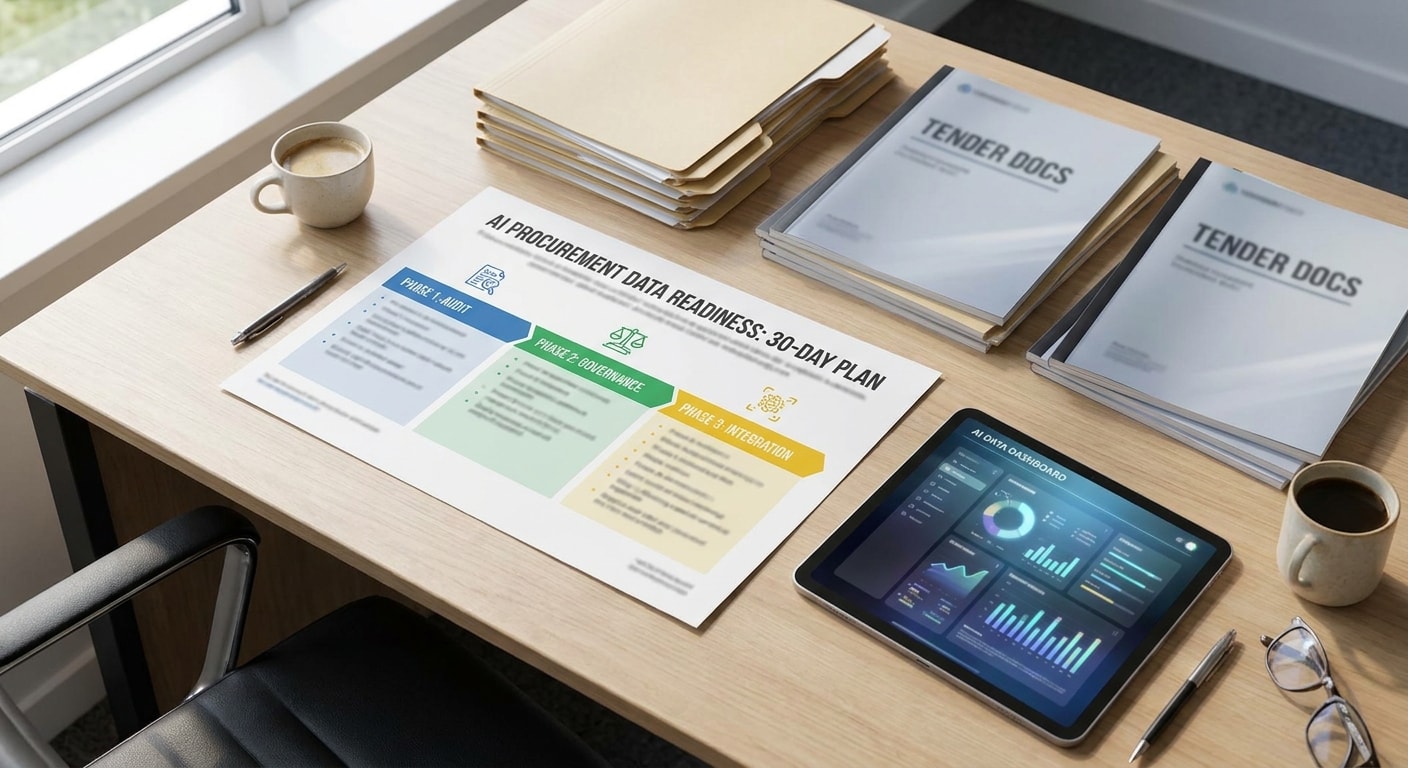
The 30-day readiness plan
If your bid library is messy, do not panic.
Most are.
Here is a practical 30-day plan.
Week 1: map the mess
List your active content sources: old bids, shared drives, CRM, contract review packs, policy folders, CV folders, ESG reports, pricing models, lessons learned, buyer feedback and delivery dashboards.
Do not fix everything. Just map what exists and who owns it.
Week 2: clean the highest-risk evidence
Review the content most likely to appear in live bids: case studies, policies, accreditations, KPI figures and social value commitments.
Mark each as Green, Amber or Red.
Archive anything clearly obsolete.
Week 3: create a usable tagging system
Agree a small taxonomy. Sector, service line, buyer type, question theme, evidence strength and review date are enough for most teams.
Apply it to your top 50 content items.
Week 4: test it on a live-style question
Take a real tender question and run a controlled draft process.
Can the right evidence be found? Is the output specific? Are the claims traceable? Does the bid manager spend less time searching and more time improving the answer?
If yes, scale from there.
If no, fix the content before blaming the AI.
Thirty day roadmap for AI procurement data readiness and tender writing improvement
How mytender.io thinks about this
At mytender.io, we do not think the future of bidding is "AI writes everything and humans press submit".
That is fantasy. Worse, it is dangerous fantasy.
The useful version is more grounded: AI helps bid teams find the right evidence, understand tender requirements, draft faster, check compliance and reuse learning. Humans still own judgement, strategy, pricing, relationship context and final accountability.
That only works when the evidence layer is strong.
A specialist bid platform should help you build that layer. It should not just generate text. It should help you manage the content, evidence and review process that makes the text worth submitting.
The real competitive advantage
AI will become normal in tendering.
That means "we use AI" will not be a differentiator for long. It may already be too vague to mean anything.
The real advantage will sit underneath:
- better bid intelligence;
- cleaner evidence;
- stronger content governance;
- faster learning from feedback;
- sharper qualification decisions;
- more consistent review;
- less time wasted hunting through old folders.
That is not as flashy as a demo.
It is more valuable.
Because tenders are not won by the team that writes the most words. They are won by the team that gives evaluators the most confidence.
AI can help you do that.
But only if your data is ready.
A useful next step
If you are reviewing your AI bid writing process, start with your next live opportunity. Pick the top five answers that will decide the score and trace every claim back to its source.
If that feels painful, that is the work.
And if you want to see live opportunities matched to your sector while you improve the evidence behind your responses, the mytender.io Tender Finder is free to use.
Tags
Ready to Transform Your Tender Writing?
See how MyTender's AI can help you write winning tenders in a fraction of the time.