
AI in bids timeline
From first drafts to bid agents: what has changed, what still needs work, and where we go next.
Jamie Horsnell
mytender.io
I wanted to draw a line in the sand on AI in bids. Nearly four years after ChatGPT arrived, a lot has changed, both in what the technology can do and in what bid teams expect from it. It’s worth looking back at how we got here before thinking about what comes next.
First, we could get words on a page
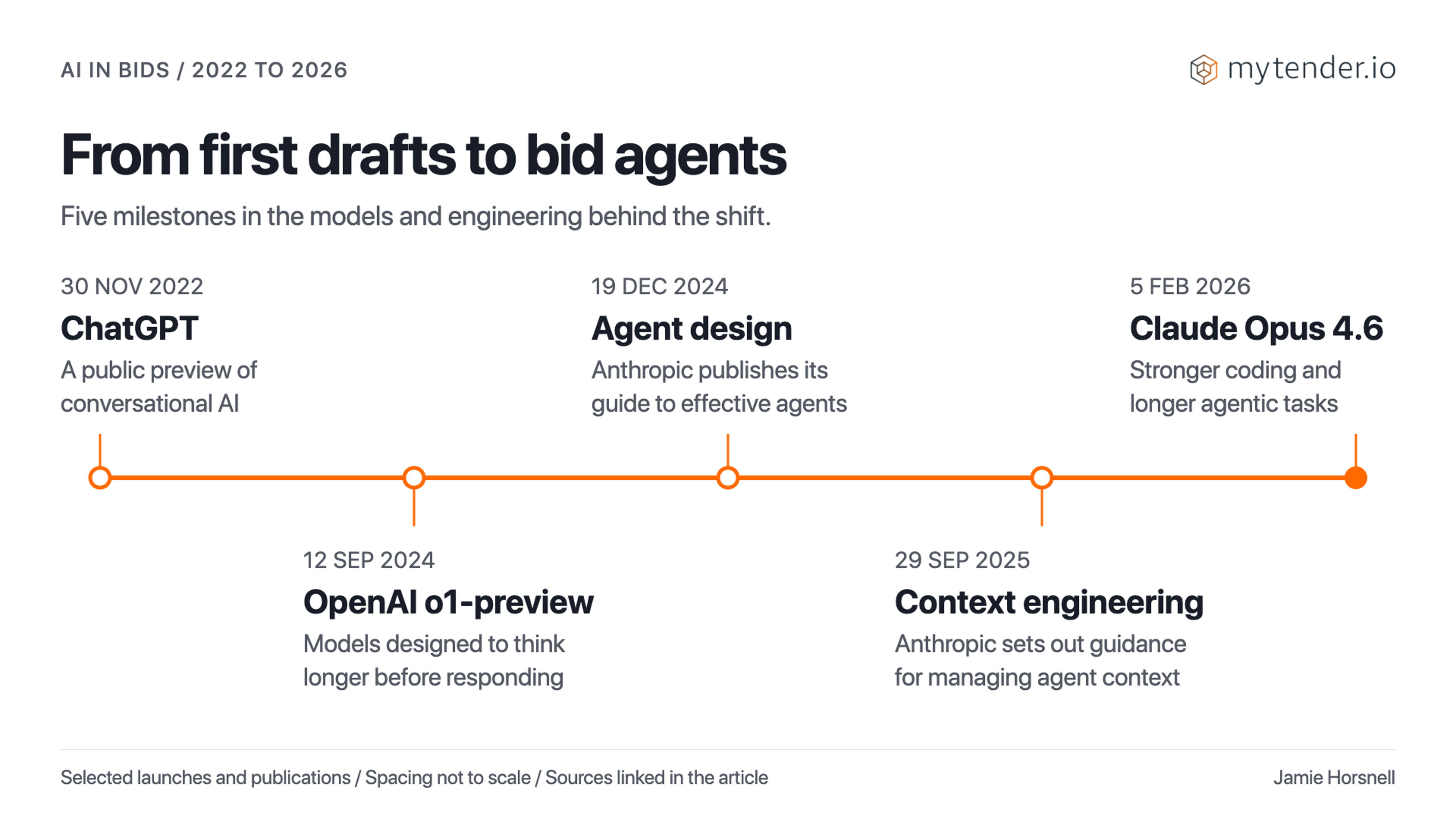
When ChatGPT launched on 30 November 2022, people quickly linked its ability to generate text with the work of writing bids.
The initial excitement made it feel as though huge efficiencies were around the corner. In practice, much of that early value came from opening up a new way of working. You could start with a page of text rather than a blank canvas.
That helped. But once teams brought in larger volumes of content, more complicated questions and the requirements of a live bid, the limitations became clearer. People also got used to the “AI-ness” of responses. The excitement / fear, gave way to a more useful question about what actually drove the quality of the output.
A lot of the answer came back to content and instructions.
Better prompts, better models, the same need for evidence
Prompt engineering became a big part of the work. Teams wrote long, detailed instructions. Specialist vendors took on that work for customers, organised their content and tried to handle larger bodies of information more effectively.
This made first drafts more useful, but quality still fell short on complex bids. The time saved across the whole process could be much narrower than the speed of generating the first response suggested.
As models improved, the scope widened to reading and analysing tender documents, research and feedback on drafts. A distinct step came with reasoning models such as OpenAI’s o1-preview, released on 12 September 2024, which was designed to spend more time thinking before responding.
Better reasoning and larger context windows helped. They didn’t remove the need to select the right evidence, show where it came from and check that a response was supported, and giving a model more documents still didn’t guarantee that it would use the right parts of them.
From prompting to building agents
By late 2024, model providers were already describing systems that could choose their own steps and use tools. Through 2025, the focus increasingly shifted towards making those agents useful in practice.
There was a gap between an agent being able to take an action and being reliable enough to trust with a any piece of work, and the infrastructure around them lagged to what was needed to make them effective.
Coding became a particularly visible example of that progress. Claude Opus 4.6, released on 5 February 2026, was another step forward: Anthropic reported improvements in planning, debugging and sustaining longer agentic tasks. It didn’t make coding a solved problem, but it showed how much more useful an agent could become when the model and the working environment improved together.
For bidding, teams were getting a clearer view of the use cases that worked: initial drafts, research, tender analysis and reviewing responses. The challenge was joining those pieces together without losing quality along the way.
That brought more attention to context engineering. Alongside deciding what to instruct the AI to do, teams had to decide what to give it, what it should retrieve and what it needed to remember as the work progressed.
Specialist tools focused on agents for particular jobs, while general-purpose platforms made it easier to build and customise your own. Both needed the infrastructure around the model to work.
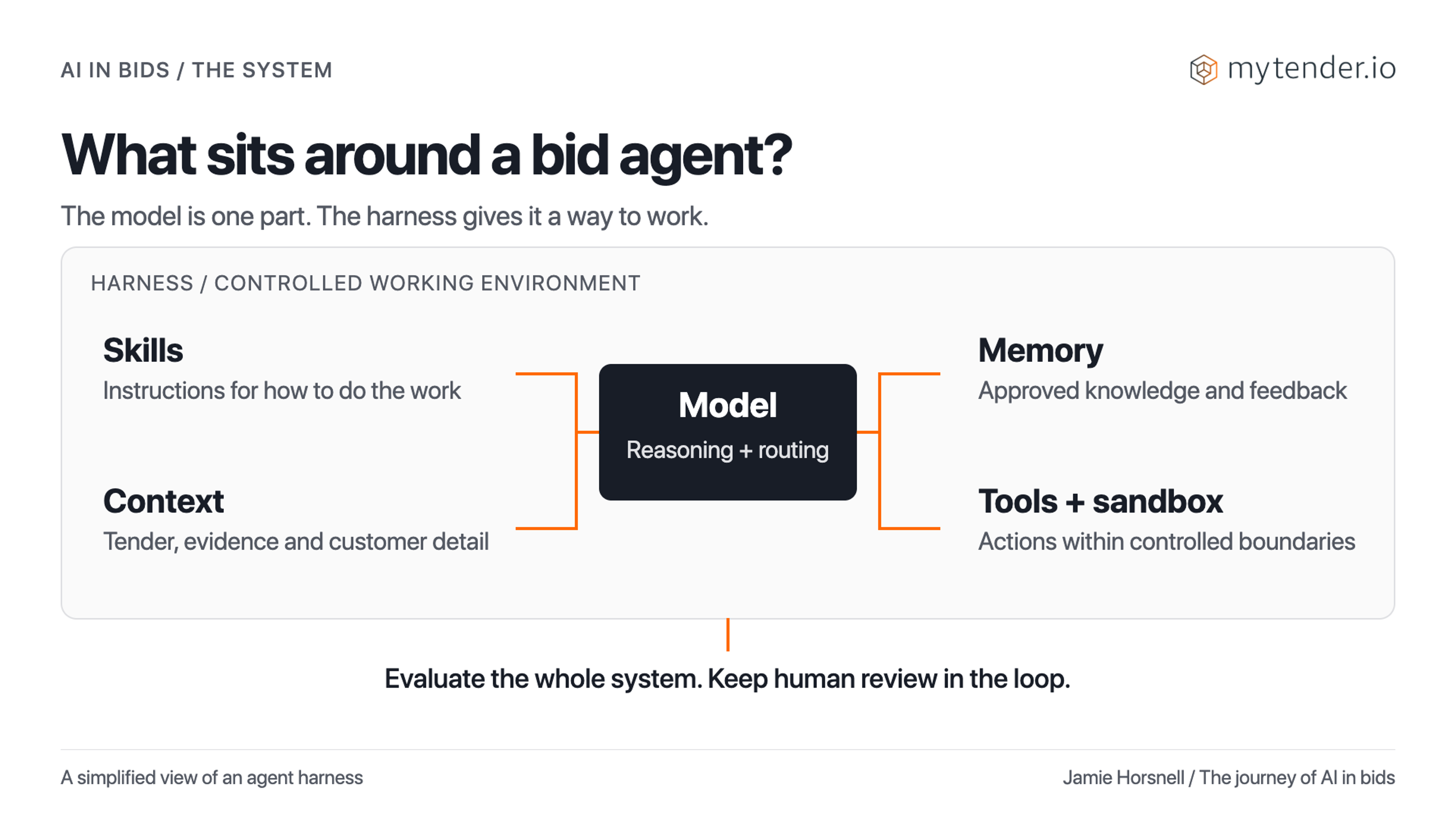
You’ll often hear that infrastructure referred to as a harness. It includes the skills and instructions the agent follows, its memory, the context it can access, the models it uses and the tools and sandbox in which it can act.
Where the work sits now
That brings us to late 2026. General-purpose tools can do far more than they could even a year ago. There is still a lot of work in getting them to behave consistently across the specific demands of a bid.
Model selection is one example. In a simpler workflow, a developer could choose a model in advance and use it for every request. As the range of tasks grows, it becomes more useful to route work to different models at runtime, with clear rules about the trade-off between speed, cost and quality.
Evaluation has expanded too. At mytender.io, our evaluations now cover more than 500 test cases. The work has grown beyond judging the core written response to checking how the system behaves across a much wider set of situations. Developing and maintaining those evaluations takes a lot of our time.
What this means for building versus buying
My co-founder Sam explores the wider business decision in his article on building versus buying AI. His point about the value of an ongoing specialist partnership is closely connected to the technical work above.
At each stage, the limitations of a general-purpose solution have changed. Earlier, a lot of the work went into prompts, large documents and hallucinations. Those problems haven’t disappeared, but there are now more things to get right:
- Getting the agent to perform the task consistently, including knowing when to check its work or ask a person.
- Routing work to the right model at the right time, rather than applying the same speed-quality trade-off to everything.
- Making memory useful, so the agent can retain approved feedback and relevant knowledge without carrying old mistakes forward.
- Giving the agent access to the best available bid content, with enough context to use it properly.
It’s quicker than ever to build a first version. Getting an agent to work exactly how you want it to, and keeping it working as the technology changes, is still hard. A build-versus-buy decision needs to account for that ongoing work as well as the initial build.
And bid teams still have to bring judgement, nuance, empathy, creativity and care. Better output doesn’t remove the responsibility to decide what you can credibly promise a customer or what will matter to the people evaluating the bid.
The next phase of AI in bids
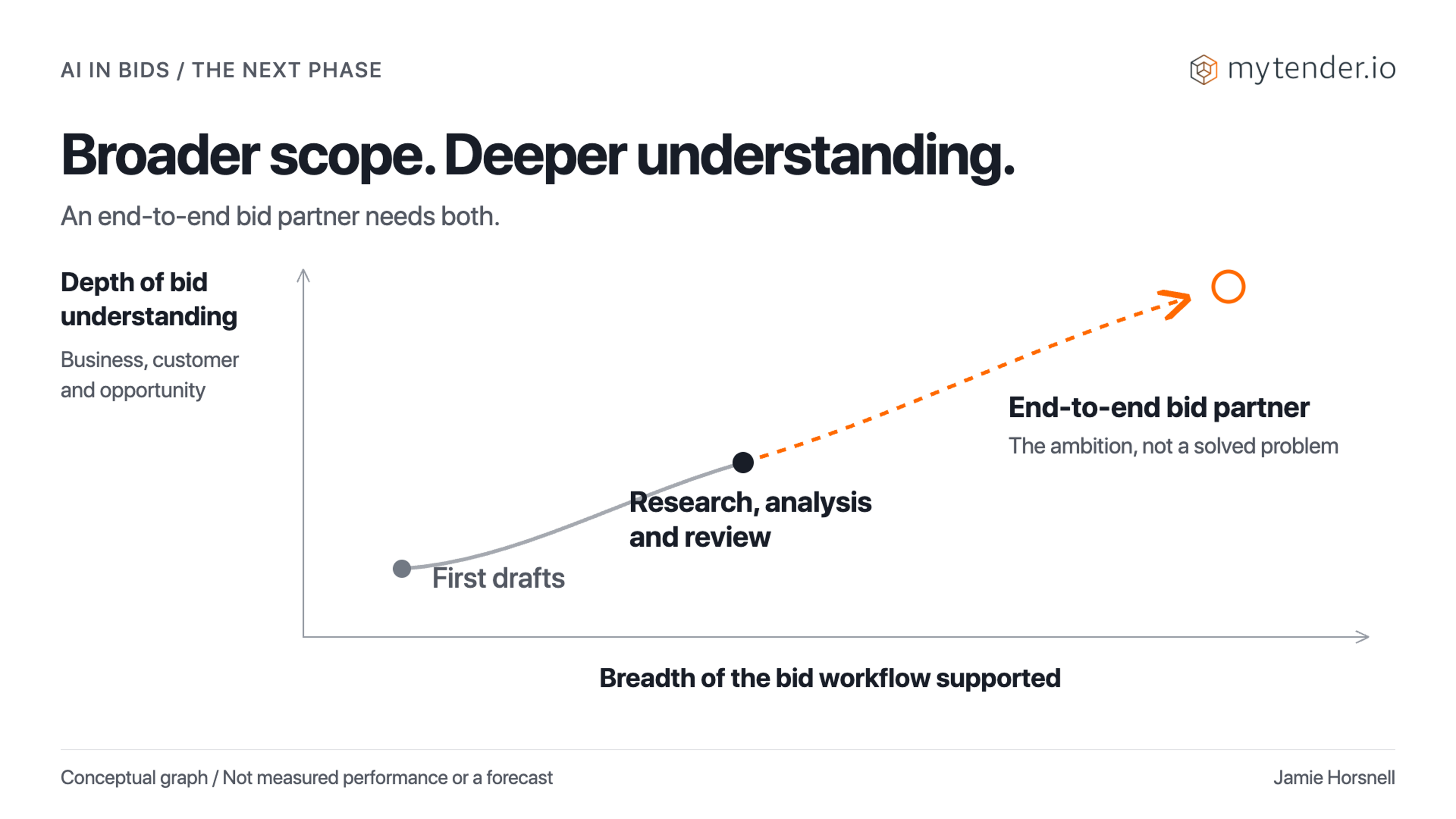
I think AI still has much further to expand horizontally across bidding. A useful end-to-end bid partner would need to support more of the process, while developing a much deeper understanding of the business, the customer and the opportunity.
Those two things have to develop together. Covering more tasks is of limited value if the agent doesn’t understand them well enough to do them properly.
We’re also seeing more work on teams of agents, with different agents taking responsibility for different parts of a task. Opus 4.6’s launch, for example, included agent teams in Claude Code as a research preview. In bidding, that could mean separating research, drafting and review, but having more agents doesn’t automatically produce a better bid. Their handovers and shared understanding need to work too.
The capabilities are there more than ever. Building a bid agent, or a team of agents, with the skill and depth of understanding to perform exceptionally remains the biggest challenge in delivering the next phase of value.
Whether progress plateaus or keeps accelerating is still to be seen. For bid teams, the useful test is how much of the work AI can help with reliably, and how much checking and rewriting it leaves behind.
Tags
Ready to Transform Your Tender Writing?
See how MyTender's AI can help you write winning tenders in a fraction of the time.