
AI Disclosure Statement for Tender Responses: What to Write When Buyers Ask About AI Use
A practical guide for bid teams on writing credible AI disclosure statements in tender responses, covering PPN 017, human review, evidence control, confidentiality and governance.
mytender.io Research Team
Tender Writing & Bid Management Specialists
AI Disclosure Statement for Tender Responses: What to Write When Buyers Ask About AI Use
AI disclosure has moved from a niche compliance question to a normal part of public sector tendering.
A buyer may ask whether you used generative AI to prepare your response. They may ask how AI output was checked. They may ask whether any confidential buyer information was entered into a public AI tool. They may ask how you prevent hallucinated claims, recycled boilerplate, copyright risk, biased content or unapproved commitments.
Some suppliers panic and write too much. Others say almost nothing. Both approaches can hurt the bid.
The right answer is not a confession, a sales pitch for your software, or a vague promise that humans were involved. It is a controlled disclosure. It tells the evaluator where AI supported the process, where it did not replace judgement, how the final response was verified, and why the buyer can trust the submission.
That matters because AI is no longer just a productivity tool for bid teams. It is part of the procurement risk conversation. Cabinet Office guidance on AI use in procurement, the wider Procurement Act transparency regime, Most Advantageous Tender evaluation and growing buyer awareness of generic AI content all point in the same direction: suppliers can use AI, but they need governance.

Bid team reviewing an AI disclosure statement for a public sector tender response
This guide explains how to write an AI disclosure statement that is honest, concise and score-safe. It is written for bid managers, sales directors, compliance leads and subject matter experts who use AI in their response process but do not want the disclosure question to become a weakness.
Why buyers now ask about AI in tender responses
Buyers are not usually asking because they want to ban AI.
Most public bodies understand that suppliers use digital tools to draft, organise, check and improve content. They use technology themselves. The concern is not whether a bid team used software. The concern is whether the final submission is accurate, confidential, original, compliant and deliverable.
Generative AI creates specific risks for a procurement team.
It can produce confident but incorrect statements. It can turn a weak evidence base into polished prose that looks more certain than it is. It can invent accreditations, case study details, implementation dates, technical specifications, policy commitments or social value numbers. It can make every supplier sound the same. It can also create confidentiality concerns if tender documents, pricing data, client information or commercially sensitive drafts are entered into tools without proper controls.
For evaluators, the issue is trust. A tender response is not marketing copy. It becomes part of the contract story. The buyer may rely on it when scoring quality, assessing risk, appointing a supplier and managing delivery. If AI has helped create the response, the buyer wants reassurance that the supplier still owns every word.
That is why AI disclosure questions are becoming more common. They help buyers test whether the supplier has a mature bid process or whether AI is being used as a shortcut.
The best suppliers treat the question as an opportunity. A strong AI disclosure can show discipline, transparency and quality control. It can reassure the buyer that you use modern tools without weakening professional judgement.
The mistake most bid teams make
The common mistake is to answer the AI disclosure question as if it is only about the tool.
Teams write something like: we used ChatGPT to help draft parts of the response, but all content was reviewed by humans.
That may be true, but it is too thin. It does not tell the evaluator what was reviewed, who reviewed it, how factual claims were checked, how confidential information was protected, or how AI-supported drafting was kept aligned to the tender requirements.
The opposite mistake is just as risky. Some teams write a long policy essay about artificial intelligence, model types, ethical principles, automation, innovation and the future of bid writing. The evaluator did not ask for a white paper. They asked whether the submitted response can be trusted.
A good answer sits between those extremes.
It should be direct enough to satisfy disclosure. It should be specific enough to reassure. It should be short enough not to distract from the scored answer. And it should be connected to the bid process, not just the technology.
The buyer wants to know five things:
- Did you use AI to prepare the response?
- If yes, what did AI do and what did it not do?
- What information was protected from AI tools?
- How did qualified people review and approve the final content?
- How can the buyer be confident that the response is accurate and deliverable?
If your disclosure answers those points, you are in safe territory.
Start by separating acceptable support from risky substitution
The first step is to describe AI as a support tool, not as the author of unverified promises.
There is a real difference between using AI to organise information and using AI to invent a response. Evaluators understand that difference. Your disclosure should make it clear.
Acceptable AI support might include summarising non-confidential tender instructions, turning internal notes into a clearer first draft, checking readability, identifying gaps against the question, creating a compliance checklist, suggesting headings, comparing a response against the word count, or helping the team find relevant previous answers in an approved bid library.
Riskier use includes generating technical claims without source evidence, creating social value commitments without operational sign-off, drafting pricing assumptions, writing legal exceptions, summarising confidential buyer documents in public tools, producing case study metrics without checking delivery records, or submitting AI output without expert review.
Your statement should draw that boundary.
For example:
AI tools were used to support document organisation, drafting efficiency, readability review and compliance checking. AI was not used to make final technical, commercial, legal or delivery commitments. All factual claims, case study evidence, performance data and proposed commitments were reviewed and approved by named subject matter experts before submission.
That wording works because it does not apologise for using AI. It shows control.
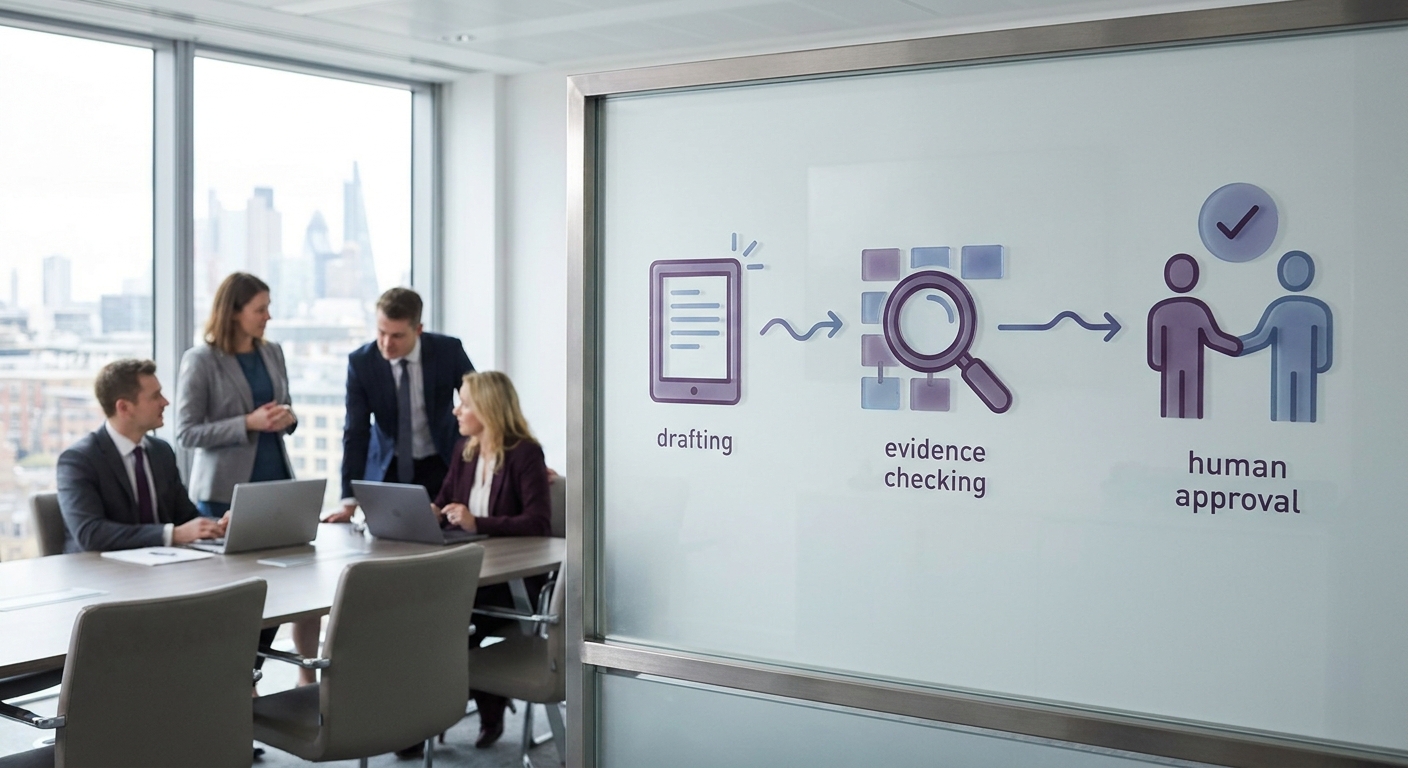
AI tender response governance workflow showing drafting, evidence checks and human approval
What to include in an AI disclosure statement
A strong disclosure statement has six practical components.
1. Scope of AI use
State where AI was used in the bid process. Keep it plain.
You might say AI supported initial structure, summarisation of internal notes, grammar review, gap checking, compliance matrix review or retrieval from an approved knowledge base. If the buyer asks for named tools, provide them. If they do not, you can still describe tool categories.
Avoid overclaiming. If AI drafted sections of the response, do not hide behind the phrase proofreading. If AI only checked readability, do not imply it built the solution.
Honesty matters. Procurement teams are increasingly alert to generic AI writing. If your answer feels evasive, it creates more concern than a straightforward disclosure.
2. Information control
Explain what information was not entered into AI tools, or how it was protected.
This is especially important for public sector tenders where documents may include sensitive service details, incumbent performance issues, user data, estate information, security requirements, pricing schedules or commercially confidential material.
A good statement might say that confidential buyer documents were handled only in approved systems, that public AI tools were not used for restricted information, that access was limited to authorised bid team members, or that any AI-enabled platform used for the response operated within the supplier's controlled environment.
If your company uses mytender.io, this is where the platform story matters. The value is not AI for the sake of AI. It is controlled AI grounded in your approved bid content, previous answers and tender documents, with review workflows that keep the team accountable.
3. Human accountability
Name the review discipline, not just the existence of humans.
Every weak disclosure says humans reviewed the content. A stronger one says which functions reviewed which types of content.
Technical responses should be reviewed by technical leads. Service delivery commitments should be reviewed by operations. Commercial assumptions should be reviewed by finance or commercial owners. Legal positions should be reviewed through the correct route. Social value commitments should be checked by the people who will deliver them. Data, KPIs and case study metrics should be verified against source records.
You do not always need to name individuals in the tender response, but you should show the roles involved.
4. Evidence verification
AI can make unsupported statements sound convincing. Your disclosure should explain how evidence was checked.
This can be simple. Say that all claims were traced to source evidence, such as contract records, performance dashboards, client feedback, management reports, policies, certificates, project files or approved case studies.
If the tender is high value, add that evidence was reviewed against the requirement before final approval. That reassures the evaluator that your response is not generic.
5. Commitment control
This is one of the most important parts.
A tender response often contains commitments: response times, staffing levels, mobilisation milestones, training hours, social value outcomes, carbon reduction measures, reporting frequencies, governance meetings, escalation routes and continuous improvement actions. If AI helped draft the response, the buyer needs confidence that these commitments are real.
Your disclosure should say that commitments were approved by accountable business owners before submission. That tells the evaluator you have not let a writing tool create contractual risk.
6. Final ownership
End by saying the supplier accepts responsibility for the submitted response.
This does not need to be dramatic. It simply closes the loop.
For example:
We accept full responsibility for the final tender submission. AI-assisted content was treated as draft material only and was subject to our standard bid review, evidence verification and approval process before submission.
That is a strong final sentence because it removes ambiguity.
A practical AI disclosure statement template
Use this as a starting point. Adapt it to the buyer's exact question, your actual process and your own tools.
AI tools were used to support the preparation of this response in limited and controlled ways, including response structuring, drafting efficiency, readability review and compliance checking against the tender questions.
AI was not used as a substitute for professional judgement, solution design, pricing, legal review or final approval. Confidential buyer information and commercially sensitive material were handled only through approved systems and were not entered into uncontrolled public AI tools.
All AI-assisted draft content was reviewed by the relevant subject matter experts before submission. Technical claims, service commitments, case study evidence, performance data and social value commitments were checked against source records and approved by accountable business owners.
We accept full responsibility for the final tender submission. The response reflects our proposed delivery model, verified evidence and confirmed commitments.
That template is deliberately balanced. It does not over-explain. It does not sound defensive. It gives the evaluator the reassurance they need.
For a heavily regulated tender, you may need more detail. For a short supplier questionnaire, you may need less. The principle stays the same: disclose, control, verify, own.

Example AI disclosure statement being checked against tender requirements and source evidence
How to answer if the buyer asks, Did you use AI?
Sometimes the question is binary. Did you use AI in preparing this response? Yes or no.
Do not try to be clever. If AI was used, say yes and explain the boundary.
A good short answer is:
Yes. AI-enabled tools were used to support drafting efficiency, structure, readability and compliance review. AI output was not submitted without human review. All factual claims, commitments, commercial assumptions and delivery proposals were verified and approved by the relevant subject matter experts. We accept full responsibility for the final response.
That is enough for many questionnaires.
If the honest answer is no, avoid sounding old-fashioned or evasive. You can still show governance:
No generative AI tools were used to draft or edit this response. The submission was prepared by our bid team and subject matter experts using our standard review and approval process.
Do not say no if you used AI for drafting and then argue later that it was only a minor use. Procurement teams are less concerned by controlled AI use than by inaccurate disclosure.
How to answer if the buyer asks for a policy
Some tenders ask for your AI policy or a description of your governance approach. In that case, the response needs more substance.
Structure it around controls:
- Permitted use cases: what AI may be used for in bid preparation.
- Prohibited use cases: what AI must not be used for without approval.
- Data protection: how confidential and personal data is protected.
- Evidence standards: how factual claims are verified.
- Human review: who approves technical, commercial and operational content.
- Audit trail: how drafts, sources and approvals are retained.
- Training: how bid team members are trained to use AI responsibly.
- Continuous improvement: how lessons are captured after submission.
The strongest policy answers are operational. They show how the rules affect day-to-day bid work.
For example, do not just write that your company maintains human oversight. Write that no AI-assisted answer can be submitted until the response owner has checked the source evidence, the operational lead has approved delivery commitments, and the bid manager has completed the compliance review.
That is the difference between a principle and a control.
What not to write
There are several phrases that weaken AI disclosure statements.
Do not write that AI was used to ensure the response was fully compliant. AI can help check for gaps, but compliance is the supplier's responsibility. Say the response was reviewed against the tender requirements by the bid team.
Do not write that AI generated accurate answers. Accuracy comes from source evidence and expert review, not the model.
Do not write that AI was used to create innovative commitments unless those commitments have been checked by delivery owners. Innovation in a tender response still needs budget, resource, risk assessment and implementation planning.
Do not write that confidential data was anonymised if you cannot explain how. Anonymisation is not a magic word. If the buyer presses, you need a real process.
Do not write that your use of AI gives you a competitive advantage by producing better answers faster. The disclosure question is not the place for a product pitch. Save the efficiency story for sections where it is relevant, such as mobilisation, knowledge management or continuous improvement.
Do not make the buyer feel that a tool is accountable for the answer. The supplier is accountable.
How AI disclosure affects scoring
In many tenders, the AI disclosure question may be pass or fail, informational, or part of a broader quality or governance score. Even when it is not directly scored, it can influence evaluator confidence.
A vague disclosure can create doubt. If the buyer sees generic content elsewhere in the response, the AI statement may confirm their concern. They may wonder whether the proposal has been tailored, whether claims are real, or whether the supplier has control over commitments.
A strong disclosure does the opposite. It supports the whole submission. It tells the evaluator that the bid team has a quality system, not just a writing tool.
This is especially important under Most Advantageous Tender evaluation. Buyers are looking for value, deliverability, resilience, transparency and long-term performance. AI governance sits naturally within that picture. A supplier that can manage AI responsibly is more likely to manage contract information, evidence, reporting and improvement responsibly too.
The disclosure will not win the tender by itself. But a poor disclosure can undermine an otherwise good response.
Building an AI audit trail for bid teams
The best way to write a good disclosure is to have the evidence before the tender asks for it.
Create a simple AI audit trail for each bid. It does not need to be complicated. It should record:
- Which AI-enabled tools were used.
- What they were used for.
- Whether confidential information was entered.
- Which source documents supported the final answer.
- Who reviewed technical and operational claims.
- Who approved commercial, legal and contractual commitments.
- What changed after review.
- Where the final approved version is stored.
This protects the bid team. It also makes future responses faster. Instead of rebuilding the AI disclosure from memory, you can pull from a controlled record.
mytender.io helps because the bid process is already built around structured responses, source knowledge, team workflows and review stages. That means AI is not floating around separately from the bid. It sits inside the work your team is already doing: breaking down the ITT, finding relevant past content, drafting from approved knowledge, checking compliance and managing review.
That is the model buyers are more likely to trust: AI as part of a governed bid process, not a shortcut around it.
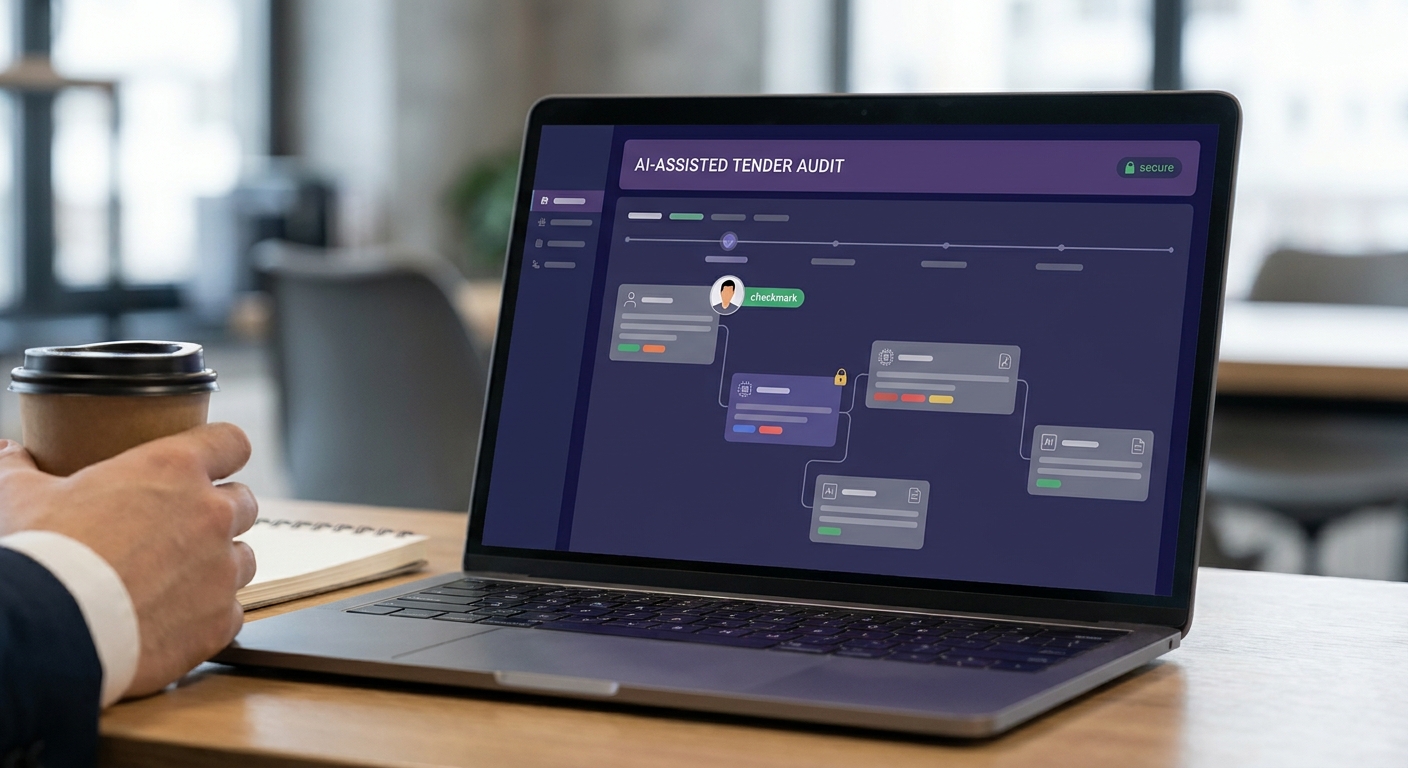
Digital audit trail for AI-assisted tender writing with source evidence and approvals
How to adapt the statement by sector
The core disclosure can stay consistent, but the emphasis should change by sector.
Facilities management
FM tenders often involve operational commitments, service levels, TUPE, statutory compliance, asset data, health and safety and resident or user experience. Your AI disclosure should stress that service commitments and KPI assumptions were reviewed by operational leads. If you used AI to draft method statements, say that final content was checked against your actual CAFM processes, staffing model, escalation routes and contract management approach.
Construction
Construction bids carry risk around programme, safety, design responsibility, building safety, competence, supply chain, carbon and method statements. Your disclosure should make clear that AI did not replace technical design, programme validation, health and safety review or commercial pricing. If AI helped with drafting, the final answer should still be tied to project experience, named roles, risk controls and evidence.
Healthcare and NHS tenders
Healthcare buyers are particularly sensitive to patient safety, continuity, confidentiality, safeguarding, infection control and regulatory compliance. Your disclosure should emphasise data protection, clinical or operational review, and verification against approved policies or standards. Avoid any wording that suggests AI made clinical or safety judgements.
Professional services
Professional services tenders often rely on expertise, methodology, team credentials and case studies. Your disclosure should show that CVs, experience claims, client examples and proposed methodologies were verified by the consultants or delivery team who will actually provide the service.
Technology and cyber
Technology buyers may ask more detailed questions about model governance, data handling and security. Be ready to explain tool access, data retention, information classification and review controls. Do not use generic cyber language. Tie the answer to your actual security and bid governance process.
How to train your bid team
AI disclosure is not just a line in the response. It is a behaviour change for bid teams.
Everyone involved in tenders should understand what can and cannot go into AI tools. They should know how to label draft AI-assisted content. They should know when a response needs evidence. They should know that AI can improve clarity but cannot approve a commitment.
A simple internal rule works well:
If the sentence makes a claim, find the source. If the sentence makes a promise, find the owner. If the sentence uses buyer information, check the data rules. If the sentence sounds impressive but nobody can prove it, delete it.
That rule keeps AI useful without letting it create risk.
Training should also cover prompt hygiene. Bid writers should avoid pasting uncontrolled confidential material into public tools. They should avoid asking AI to invent examples. They should ask AI to identify gaps, simplify language, compare against requirements or structure existing evidence.
Used well, AI reduces busywork. Used badly, it creates polished risk.
How mytender.io supports controlled AI use in tenders
Bid teams do not need less AI. They need better governed AI.
The problem with generic tools is that they sit outside the tender workflow. A bid writer copies information from the ITT, pastes draft content into a chat window, copies the output back into a document, and hopes the review process catches everything. That approach can work for light drafting, but it creates gaps: weak source control, unclear ownership, inconsistent review, lost context and avoidable compliance risk.
mytender.io is built for tender writing rather than generic content generation. It helps bid teams break down requirements, retrieve approved content, create first drafts from relevant knowledge, collaborate with subject matter experts and check the response against the tender. The value is not simply speed. It is speed with control.
That matters for AI disclosure. When a buyer asks how AI was used, you can point to a structured process: approved knowledge sources, human review, tracked ownership, compliance checking and accountable final approval. That is far stronger than saying someone used an AI chatbot and then read the output.
The strongest bid teams will not be the ones that avoid AI. They will be the ones that use it responsibly enough to explain it clearly.
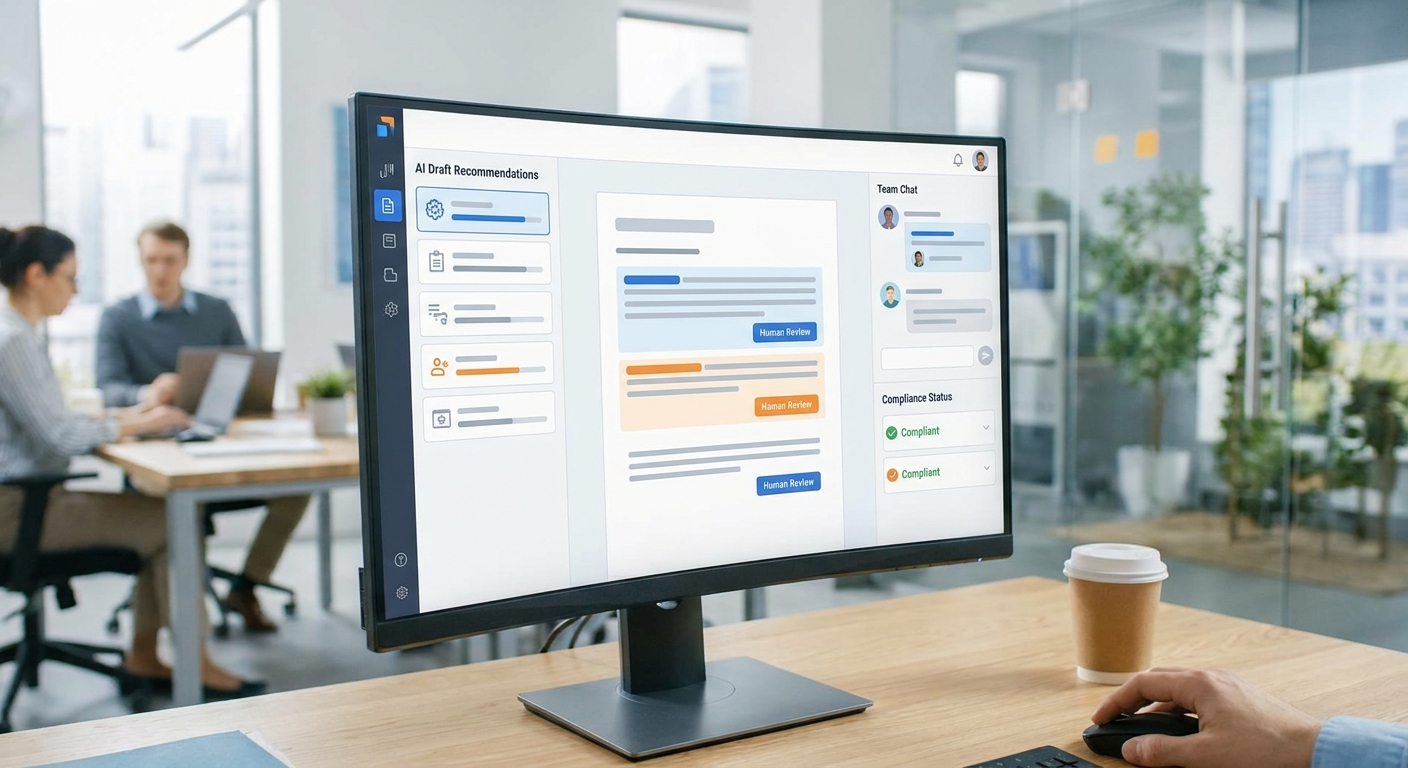
mytender.io style bid workspace showing AI-assisted tender drafting with human review controls
A final checklist before submission
Before you submit a tender that involved AI, run this checklist:
- Have we answered the buyer's AI question directly?
- Have we said where AI was used and where it was not used?
- Have we protected confidential buyer information?
- Have factual claims been checked against source evidence?
- Have technical answers been reviewed by the right subject matter experts?
- Have commercial and legal positions been approved through the right route?
- Have delivery commitments been approved by operational owners?
- Have social value numbers been checked for feasibility?
- Have we removed generic AI wording that does not answer the buyer's requirement?
- Are we comfortable accepting responsibility for every final statement?
If the answer to any of these is no, the disclosure is not the problem. The bid process is the problem.
Fix the process before you submit.
How to keep the disclosure aligned with the rest of the response
The AI disclosure should not sit in isolation. It should match the evidence, tone and process described elsewhere in the submission.
If your quality answers say you have named operational leads, the disclosure should explain that those leads approved operational commitments. If your mobilisation answer includes a detailed implementation plan, the disclosure should not imply that the plan was generated without project review. If your social value answer includes apprenticeship numbers, local spend targets or volunteering hours, the disclosure should make clear those figures were checked against capacity and delivery ownership.
Evaluators notice contradictions. A response can sound confident in the main answer and cautious in the disclosure, or transparent in the disclosure and generic everywhere else. Both create friction. The best approach is to make the whole bid feel governed.
That means using the same evidence discipline throughout the submission. Do not let AI disclosure become a small compliance paragraph that only appears at the end. Build the controls into the writing process from the beginning. When a section owner approves an answer, ask them to approve the facts, the commitments and the source evidence at the same time. When the bid manager completes the final compliance check, include AI-supported content in the review rather than treating it as a separate issue.
This also helps with future contract management. If the contract is awarded, your delivery team should be able to recognise the commitments in the bid. They should not discover after award that AI-assisted drafting introduced a reporting frequency, innovation promise or improvement target that nobody discussed. The disclosure process is therefore not just about procurement compliance. It is about protecting delivery.
A useful test is simple: could your contract manager explain every material commitment in the response without blaming the bid team or the tool? If yes, your AI disclosure is probably supported by a real process. If no, slow down and tighten the evidence before submission.
The bottom line
AI disclosure should not scare bid teams.
Used responsibly, AI can help teams work faster, organise evidence, improve clarity and reduce compliance misses. But public sector buyers are right to ask how the content was controlled. A tender response is too important to be treated as unverified generated text.
The best AI disclosure statement is calm, specific and accountable. It says what AI helped with. It says what humans owned. It explains how confidential information, evidence and commitments were protected. It makes clear that the supplier stands behind the final answer.
That is the balance evaluators want.
If your bid process can support that statement, AI becomes a strength rather than a risk.
Tags
Ready to Transform Your Tender Writing?
See how MyTender's AI can help you write winning tenders in a fraction of the time.