
Agentic AI Bid Workflows: How Tender Teams Should Use AI Agents in 2026
AI bid writing has moved beyond draft generation. Here is how bid teams can use agentic AI workflows to qualify tenders, build compliance matrices, route evidence, review responses and protect quality in 2026.
mytender.io Research Team
Tender Writing & Bid Management Specialists
Agentic AI Bid Workflows: How Tender Teams Should Use AI Agents in 2026
AI bid writing has entered a new phase.
For the last few years, most tender teams have judged AI by one question: can it write a decent first draft? That question still matters, but it is no longer the most interesting one. The better question in 2026 is this: can AI help the whole bid process move with more control, more evidence and less wasted effort?
That is where agentic AI workflows come in.
An AI agent is not magic. It is not a replacement bid manager hiding inside a laptop. It is a focused workflow that can read, compare, extract, route, check and suggest actions across a tender process. Used well, agents take on the repetitive coordination work that slows bid teams down. Used badly, they produce more noise, more false confidence and more review risk.
The difference is workflow design.
Tender teams do not need an army of autonomous agents making commercial decisions on their own. That would be reckless. They need controlled AI workflows that break a tender into clear tasks: qualify the opportunity, analyse the documents, map requirements, find evidence, draft from approved sources, check compliance, support review and preserve an audit trail.
This guide explains what that looks like in practice.

Bid team using agentic AI workflow dashboard to analyse tender documents and route evidence
Why agentic AI matters now
The timing is not accidental.
Public procurement has become more transparent, more data-heavy and more compliance-focused. Under the Procurement Act, suppliers see more notices across the commercial lifecycle. Buyers are asking sharper questions about social value, delivery risk, cyber security, net zero, economic standing and the use of AI itself. At the same time, bid teams are under pressure to respond faster without lowering quality.
That combination exposes the limits of simple AI drafting.
A first draft is useful, but it does not solve the whole problem. The real bottleneck in most bid teams is not typing. It is knowing what matters, finding the right evidence, getting the right people involved, tailoring the answer to the buyer and proving that nothing mandatory has been missed.
Agentic workflows are designed for that wider problem.
Instead of asking one model to write a full response from a blank prompt, a bid platform can run a sequence of smaller, governed tasks. One workflow extracts mandatory requirements. Another identifies pass or fail criteria. Another builds a compliance matrix. Another searches the content library for relevant case studies. Another flags claims that need proof. Another checks the final draft against the scoring criteria.
That is a very different use of AI.
It moves the technology from copywriter to process assistant. More importantly, it makes AI useful to bid managers, subject matter experts, reviewers and sales leaders, not only to the person writing the response.
What an agentic bid workflow actually is
The phrase can sound grander than it needs to.
In a tender context, an agentic workflow is a structured chain of AI-assisted tasks with rules, permissions and human checkpoints. The workflow takes an input, such as a tender pack, and produces useful outputs, such as a qualification summary, a compliance matrix, a responsibility plan, a draft response or a review report.
The key is that the system does not only generate text. It acts on defined steps.
A simple workflow might look like this:
- Read the ITT, specification, pricing schedule and evaluation criteria.
- Extract all mandatory requirements and submission instructions.
- Identify the buyer's stated outcomes, pain points and scoring weights.
- Compare the opportunity against your ideal customer profile and past wins.
- Recommend a bid, no-bid or qualify further decision.
- Create a response plan with owners, evidence gaps and deadlines.
- Draft first responses using only approved content library sources.
- Check each answer against the requirement, word count and scoring criteria.
- Flag unsupported claims for human review.
None of those steps removes the bid team. The point is to reduce the manual drag between steps so people can spend more time on judgement.
That distinction matters because tendering is full of judgement calls. You cannot safely automate whether a buyer is strategically important, whether a low-margin contract is still worth pursuing, or whether a social value commitment is commercially realistic. Those decisions need people.
But you can automate the painful work around them.
You can automate the extraction of deadlines. You can automate the first compliance matrix. You can automate the search for previous answers. You can automate checks for missing appendices. You can automate the comparison between a draft response and the buyer's exact question.
That is the sensible promise of agentic AI in bid writing.
The old AI tender workflow is too shallow
Many teams still use AI in a fragile way.
A bid writer copies a question into a generic AI tool, adds a rough instruction and gets a polished answer back. It looks helpful. It may even sound impressive. But unless it is grounded in the organisation's real evidence, it creates work later.
Someone has to check whether the claims are true. Someone has to add the right case study. Someone has to remove generic phrasing. Someone has to align the answer with the scoring criteria. Someone has to make sure confidential data has not been pasted into a public tool. Someone has to explain whether AI was used if the buyer asks.
That is not automation. It is displacement.
The effort moves from drafting to checking, and the risk often increases. The answer may be smoother, but it is not necessarily more compliant, more persuasive or more specific.
Agentic workflows solve a different problem because they start with the tender pack and the company's knowledge base, not a blank prompt. The workflow knows the question, the criteria, the library, the evidence and the review steps. It can show why it suggested an answer and where the supporting material came from.
That is why grounded workflow design beats generic prompt engineering.
Bid teams do not win because a paragraph sounds fluent. They win because the answer is relevant, evidenced, compliant and easy for evaluators to score.
Workflow one: opportunity qualification
The first place to use AI agents is before the team starts writing.
Most bid teams waste too much time on weak opportunities. The usual pattern is familiar: a tender lands, everyone feels the pressure, a quick meeting happens, and the team starts working before the commercial case has been properly tested. By the time doubts appear, hours have already gone.
A qualification workflow can make that earlier decision sharper.
The agent reads the tender notice, specification and evaluation criteria. It compares the opportunity against your target sectors, buyer history, geography, contract size, margin assumptions, accreditations, case studies and delivery capacity. It then produces a structured summary for the bid manager or sales lead.
The output should not be a robotic yes or no. It should be a decision brief.
A good qualification brief might include:
- Why the opportunity looks attractive.
- Where the organisation has strong matching evidence.
- Which mandatory criteria may be difficult.
- Whether the buyer is known, unknown or strategically valuable.
- Which competitors or incumbents may have an advantage.
- What the likely bid effort will be.
- Which evidence gaps must be closed before committing.
That is enough to run a proper bid, no-bid discussion.
The value is not only speed. It is consistency. Every opportunity gets assessed against the same commercial logic instead of whoever happens to be loudest in the meeting. Over time, the team can compare the AI-assisted qualification view against real outcomes and improve the model.
For mytender.io customers, this is one of the most powerful uses of past bid data. Previous wins, losses, scores and feedback should shape future decisions. If the system knows which types of tenders you win, which questions you struggle with and which evidence gaps keep appearing, it can help the team stop chasing every shiny opportunity.
That alone can improve win rate.
A team that bids less but bids better is usually more dangerous than a team that says yes to everything.
Workflow two: tender pack analysis
Once the team decides to bid, the next problem is document overload.
A serious tender pack can include an ITT, specification, pricing schedule, contract terms, appendices, policies, data sheets, clarification logs and portal instructions. The important details are rarely in one neat place. Submission rules may sit in one document, scoring guidance in another and mandatory technical requirements in a buried appendix.
This is exactly where agentic AI should help.
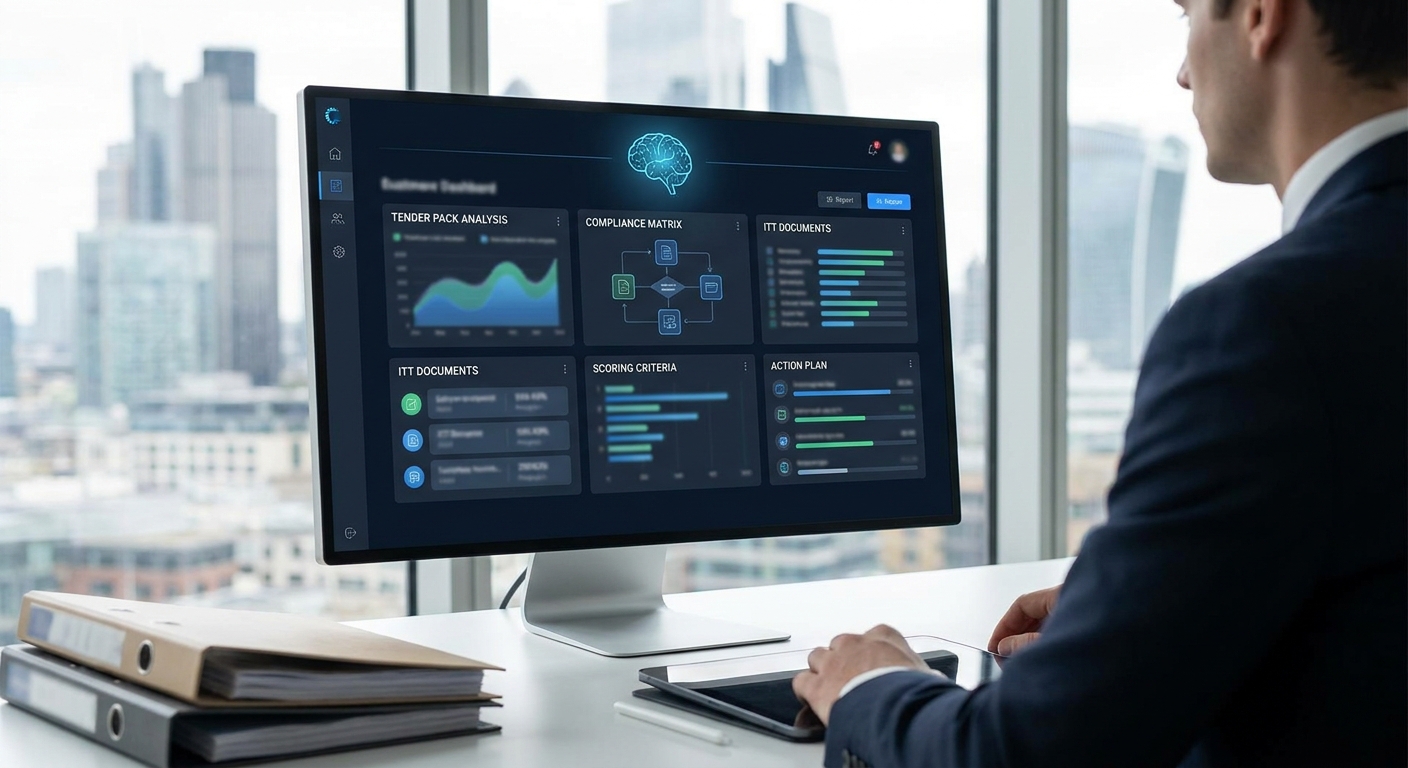
A tender pack analysis workflow should read all available documents and turn them into a practical bid map. It should extract the deadlines, portal requirements, response formats, evaluation criteria, mandatory documents, pass or fail conditions, word limits, pricing instructions, contract risks and clarification deadlines.
The result is not a summary for its own sake. It is an operating plan.
AI tender pack analysis turning ITT documents into compliance matrix and action plan
The best outputs are structured enough for the bid manager to use immediately:
- A compliance matrix covering every requirement.
- A list of mandatory attachments and declarations.
- A breakdown of scored questions by weighting.
- A summary of buyer outcomes and likely win themes.
- A list of unusual terms, risks or commercial issues.
- A responsibility matrix for internal owners.
- A clarification question log.
This saves time, but it also reduces error.
Manual tender reviews are vulnerable because humans skim under pressure. An instruction about file naming, maximum page count or contract acceptance can be missed. A required certificate can be assumed but not checked. A social value question can be answered as a narrative when the buyer asked for measurable commitments.
AI does not remove the need for human checking. It gives the checker a stronger first pass.
The bid manager can challenge the output, add judgement and spot nuance. But they are starting from a structured map instead of a pile of PDFs.
Workflow three: compliance matrix creation
Compliance matrices are not glamorous. They are also where many bids are won or lost.
A strong compliance matrix does three things. It records every requirement, assigns ownership and tracks evidence. A weak matrix becomes a half-finished spreadsheet that no one trusts by the final week.
An AI agent can create the first version quickly.
It can identify mandatory requirements, scored questions, contractual obligations, accreditations, insurance levels, policies, method statements, pricing documents and supporting certificates. It can then group them by response section, owner, deadline and risk level.
The important part is that the matrix remains alive.
Too many teams create a compliance matrix once and then ignore it while the real bid evolves elsewhere. An agentic workflow should update the matrix as documents change, clarifications arrive and drafts are completed. If the buyer issues an addendum, the system should identify what changed and which response sections are affected.
That matters because 2026 tendering is more iterative.
Competitive flexible procedures, preliminary market engagement, clarification rounds and multi-stage processes mean the tender can change shape. If your compliance view is static, it can drift away from reality.
A good AI compliance workflow should answer practical questions:
- Which mandatory items are still missing?
- Which responses do not yet answer all parts of the question?
- Which claims need documentary proof?
- Which owners are blocking progress?
- Which sections changed after the latest clarification?
- Which answers are too generic for the scoring criteria?
This is where mytender.io's compliance checking matters. The point is not simply to make drafting quicker. It is to stop the team discovering avoidable gaps at the end.
The earlier a gap is visible, the cheaper it is to fix.
Workflow four: evidence retrieval and content grounding
The phrase grounded AI can sound technical, but the tendering principle is simple: the answer must come from approved evidence.
A buyer does not award marks because a response is beautifully worded. They award marks because the supplier proves capability, experience, control and value. That proof lives in previous bids, policies, case studies, accreditations, CVs, method statements, mobilisation plans, risk registers, social value reports and performance data.
The problem is that this material is often scattered across SharePoint folders, old submissions, personal drives and inboxes.
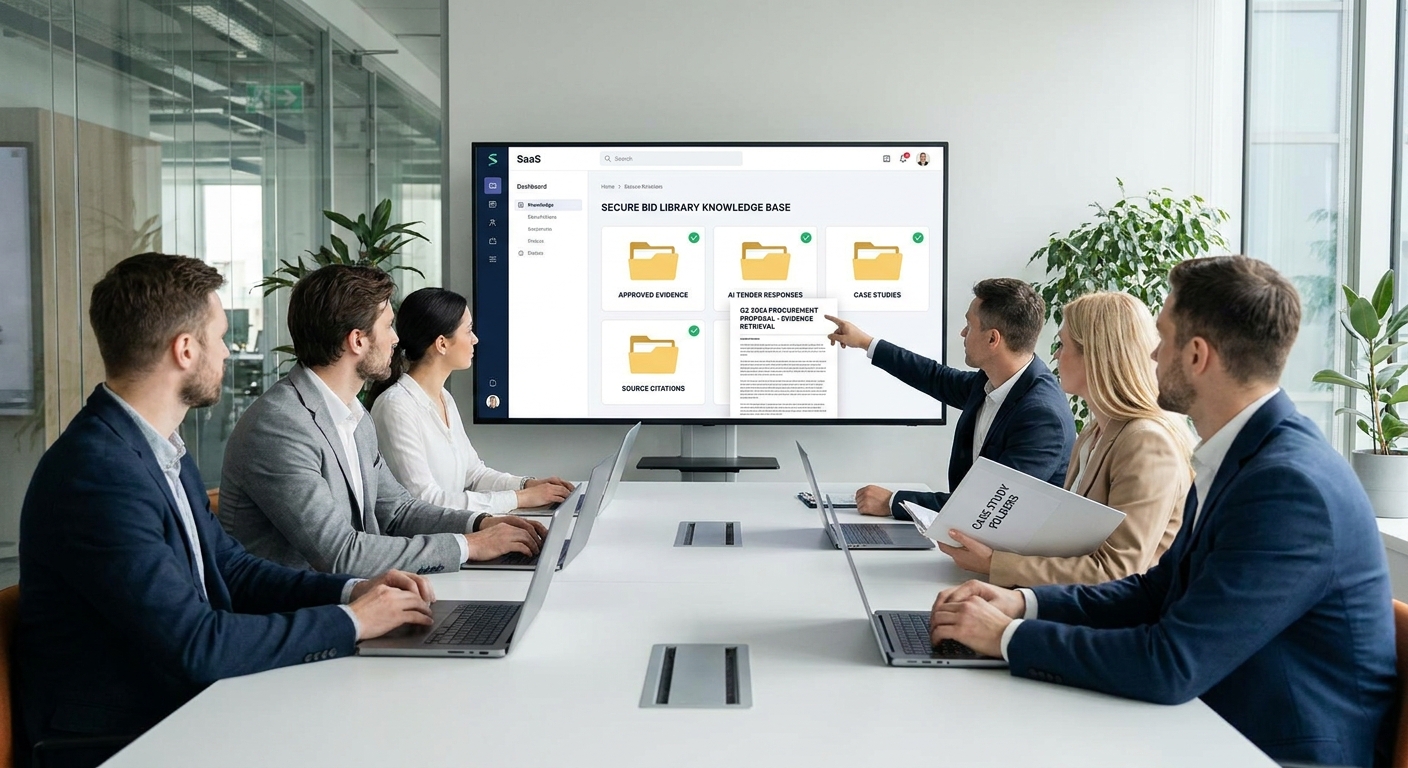
An evidence retrieval workflow connects the tender question to the right internal knowledge. The agent reads the question, identifies what evidence is needed and searches the approved library for relevant material. It should return sources, not just prose.
For example, if a buyer asks for experience delivering hard FM services in live healthcare environments, the workflow should not produce a generic hard FM answer. It should look for healthcare FM case studies, PPM performance data, HTM or HBN compliance references, mobilisation evidence, relevant staff experience and risk controls for occupied sites.
That evidence then becomes the foundation for the draft.
Approved bid library evidence being retrieved and linked to AI-generated tender responses
This is where generic AI tools struggle. They can describe what good evidence might look like, but they do not know which evidence your organisation actually has. Worse, they may invent specificity. In tender writing, invented specificity is poison.
A governed agentic workflow should make the evidence trail visible:
- Which source was used.
- When it was last updated.
- Who owns it.
- Whether it has been approved for reuse.
- Which tender answer it supports.
- Whether the claim needs a human check.
This gives reviewers confidence. It also helps the bid library improve over time. If a section repeatedly has weak evidence, the team can fix the library rather than rewriting around the same gap every month.
That is the real productivity gain. Not faster fluff. Better reusable knowledge.
Workflow five: SME routing and answer ownership
Bid delays often come from people, not documents.
The bid writer needs a technical answer from operations. Operations are busy. Finance needs to confirm a pricing assumption. HR needs to validate training data. Sustainability needs to check a carbon reduction claim. Legal needs to review a contract term. Everyone has a part of the answer, but no one owns the whole thing except the bid manager.
Agentic workflows can reduce that coordination burden.
When the tender pack is analysed, the system can identify which sections need which internal owners. It can route questions to subject matter experts with the relevant context attached. Instead of sending a vague message asking for input, the workflow can provide the exact buyer question, the scoring criteria, suggested source material, the required format and the deadline.
That changes the quality of SME input.
People give better answers when the ask is specific. They give worse answers when they are forwarded a giant tender pack and told to comment by Friday.
A good SME routing workflow should also distinguish between input, approval and accountability. A subject matter expert may provide technical detail. A bid manager may shape the answer. A director may approve the commitment. Those are not the same role.
This matters for AI governance too.
If an AI-assisted response includes a claim about service levels, staffing, carbon reduction, cyber controls or social value commitments, the right human has to confirm it. The workflow should make that review visible. It should not allow a high-risk claim to slide into the final submission just because the paragraph sounds confident.
In 2026, the best bid teams will treat human sign-off as part of the workflow, not an informal scramble at the end.
Workflow six: first draft generation
Drafting still matters.
The point of agentic AI is not to pretend writing is irrelevant. It is to make drafting better by feeding it the right inputs. A first draft produced after qualification, document analysis, compliance mapping and evidence retrieval is far more useful than a first draft produced from a loose prompt.
The draft should be built from:
- The buyer's exact question.
- The scoring criteria and weighting.
- The relevant specification points.
- Approved library content.
- Selected case studies and proof points.
- Tone and style guidance.
- Word count or page limit.
- Known win themes.
That gives the writer a strong starting point.
The draft may still need editing. It should. Good tender writing is not only assembled content. It is argument, prioritisation and judgement. The writer must decide what to lead with, what to cut, what to evidence and how to make the answer easy to score.
But the blank page is gone.
More importantly, the first draft is less likely to drift away from the requirement. If the workflow has already mapped the question to the criteria and evidence, the answer starts in the right lane.
This is how mytender.io frames AI first drafts: minutes, not days, but still grounded in the customer's own winning content. The aim is not to replace bid expertise. It is to give bid experts a better first version so they can spend time on the parts that actually improve score.
That is a healthier model than asking AI to be creative from nothing.
Workflow seven: review, challenge and scoring simulation
Review is where agentic AI becomes especially valuable.
Most bid teams have some version of pink team, red team and gold team review. In theory, each stage improves the response. In practice, reviews are often rushed, inconsistent and too focused on grammar. Reviewers comment on what they notice, not always on what the buyer will score.
An AI review workflow can provide a more systematic first pass.
It can compare each answer against the buyer's question, evaluation criteria, word count, mandatory requirements and evidence sources. It can flag where the answer is vague, unsupported, incomplete, repetitive or misaligned. It can identify claims that do not have a source. It can show where the response spends too many words on company background and too few on the buyer's outcome.
This is not the same as pretending to know the evaluator's score.
Scoring simulation should be treated carefully. AI cannot guarantee what a buyer will think. But it can apply the published criteria consistently and highlight weaknesses the team can fix before submission.
Useful review prompts include:
- Does this answer respond to every part of the question?
- Is the strongest evidence visible in the first half of the answer?
- Are benefits linked to the buyer's stated outcomes?
- Are commitments measurable and deliverable?
- Are unsupported claims clearly flagged?
- Is there a stronger case study available?
- Does the answer sound like everyone else?
That last question matters more than people admit.
As AI-generated content becomes common, evaluators will see more fluent but generic responses. Tender teams that rely on polish alone will blend into the pile. The winners will use AI to strengthen evidence, structure and relevance, then use human judgement to sharpen the story.
Workflow eight: AI disclosure and audit trail
AI use in tenders is no longer something to hide or hand-wave.
Public sector buyers are increasingly aware that suppliers use AI to prepare bids. Some ask direct questions about it. Others focus on data security, accuracy and accountability. Either way, bid teams need a clear internal record of how AI was used.
An agentic workflow should create that record automatically.
The audit trail does not need to be theatrical. It should show which documents were processed, which sources were used, which drafts were generated, which humans reviewed the output and which claims were approved by the relevant owner.
That helps in three ways.
First, it supports quality control. If a reviewer asks where a claim came from, the team can answer quickly.
Second, it supports compliance. If a buyer asks whether AI was used, the supplier can explain the workflow honestly: AI assisted with document analysis, evidence retrieval, drafting and compliance checks, with human review and approval before submission.
Third, it supports trust. Internally, people are more likely to adopt AI if they can see the guardrails.

Human reviewer approving AI-assisted tender response with audit trail and source citations
The wrong approach is to let everyone use different tools in different ways and hope no one asks. That creates risk. Sensitive buyer information may be pasted into unapproved systems. Claims may be generated without evidence. Different teams may give different explanations of how AI is used.
The right approach is boring and effective: approved platform, approved knowledge sources, clear permissions, human sign-off and a record of decisions.
That is what serious AI adoption looks like in bid management.
What should stay human
Agentic AI should take work away from people, not accountability.
That means drawing clear boundaries. Some tasks are appropriate for automation. Others should remain human-led even when AI provides support.
AI can extract requirements. Humans decide strategy.
AI can surface evidence. Humans decide what matters.
AI can draft options. Humans choose the argument.
AI can flag risks. Humans make commercial decisions.
AI can check for compliance. Humans approve submission.
The highest value human work in bidding is not typing sentences. It is understanding the buyer, choosing the win themes, making trade-offs, building relationships, testing commitments and deciding where the organisation can genuinely outperform competitors.
Agentic workflows should protect that work.
If your AI system floods the team with outputs no one trusts, it has failed. If it saves time but creates hidden risk, it has failed. If it encourages junior writers to submit unverified claims, it has failed. If it helps the team focus on evidence, strategy and quality, it has done its job.
This is why governance is not a blocker to AI adoption. Governance is what makes adoption possible.
Common mistakes when introducing AI agents
The first mistake is automating too much too soon.
A team sees a demo, gets excited and tries to build an end-to-end automated bid machine. That usually collapses under real tender complexity. The safer approach is to start with one painful workflow, prove value and expand from there.
Tender pack analysis is a strong starting point because the problem is clear and the output is easy to verify. Compliance matrix creation is another. Evidence retrieval is often the next step because it attacks one of the biggest sources of delay.
The second mistake is using poor source content.
AI does not fix a messy bid library. It exposes it. If your policies are outdated, case studies are weak and past answers contradict each other, an AI workflow will retrieve messy evidence faster. That is not transformation. That is chaos at speed.
Before scaling agentic AI, clean the knowledge base. Decide which documents are approved, who owns them and when they expire.
The third mistake is treating AI review as final approval.
AI can flag issues, but it cannot own the commercial promise. If a response commits to staffing levels, mobilisation dates, carbon targets or service credits, a human with authority must approve it.
The fourth mistake is ignoring change management.
Bid teams are practical. They will adopt tools that make their day easier and resist tools that create extra admin. The workflow has to fit how bids are actually run. If the system requires perfect behaviour from busy people, it will fail.
The fifth mistake is measuring only time saved.
Time saved matters, but it is not the whole story. The better metrics are win rate, bid quality score, compliance errors avoided, SME response time, evidence reuse, review findings and the percentage of bids started from a complete qualification brief.
That is how you prove AI is improving the bid function, not merely speeding up production.
A sensible implementation roadmap
The best roadmap is boringly practical.
Start with the bid process you already have. Map the stages from opportunity identification to submission. Identify where delays, errors and rework occur. Then add AI workflows to those points.
A sensible sequence looks like this.
First, centralise the knowledge base. Bring together approved policies, case studies, accreditations, CVs, method statements, social value examples, mobilisation plans and past high-scoring answers. Assign owners and review dates. Remove duplicate or obsolete material.
Second, introduce tender pack analysis. Use AI to extract deadlines, requirements, scoring criteria, submission instructions and risks. Make the output visible to the bid manager at the start of every opportunity.
Third, automate the first compliance matrix. Let the system create the structure, then let the bid manager validate it. This builds confidence because the team can see where the AI is right and where human nuance is needed.
Fourth, connect evidence retrieval. For each response, the system should suggest relevant approved sources and show where they came from.
Fifth, add first draft generation. Only do this once the inputs are strong enough. Drafting before evidence retrieval simply recreates the generic AI problem.
Sixth, add AI-assisted review. Use it to check answer completeness, compliance, source support, repetition and alignment with the scoring criteria.
Seventh, measure outcomes. Track how long each stage takes, which sections create review issues, which evidence gaps recur and how scores change over time.

Roadmap for implementing agentic AI bid workflows from knowledge base to review and submission
This sequence avoids the trap of starting with the flashiest feature. Draft generation feels exciting, but it is only as good as the workflow around it. The foundation is knowledge, structure and control.
How mytender.io fits this shift
mytender.io is built for the reality that tenders are not ordinary documents.
They are deadline-driven, evidence-heavy, compliance-sensitive and team-based. A generic AI assistant can help with words, but it does not understand the full bid workflow unless the organisation builds a lot around it.
mytender.io focuses on the workflow that bid teams actually need: analysing tender requirements, generating first drafts from past successful content, managing the content library, supporting collaboration, checking compliance and helping teams move faster without losing control.
That matters because the future of AI bid writing is not one enormous prompt. It is an organised system that connects the tender pack, the knowledge base, the people and the review process.
The strongest tender teams in 2026 will not be the ones that let AI write the most. They will be the ones that use AI to make every decision, answer and review step better grounded.
They will qualify more intelligently. They will plan earlier. They will reuse evidence without sounding recycled. They will give subject matter experts clearer tasks. They will review against the buyer's criteria instead of personal preference. They will keep an audit trail of AI-assisted work.
That is how agentic AI becomes useful.
Not by replacing the bid team.
By removing the drag that stops the bid team doing its best work.
Final thought
Agentic AI is not a shortcut around tender discipline. It is a way to enforce it.
The teams that get the most from AI will still need strong bid managers, credible evidence, engaged subject matter experts and honest commercial judgement. The technology does not remove those needs. It makes them more visible.
That is good news.
Tendering has always rewarded the suppliers who understand the buyer, prove their claims and submit clean, compliant responses. Agentic AI simply gives modern bid teams a better operating system for doing that at speed.
If your current AI use begins and ends with drafting paragraphs, you are leaving most of the value on the table.
The next step is to build the workflow around the writing.
That is where the real advantage sits.
Tags
Ready to Transform Your Tender Writing?
See how MyTender's AI can help you write winning tenders in a fraction of the time.